Base Metals Intelligence Is Not a Commodities Data Subset
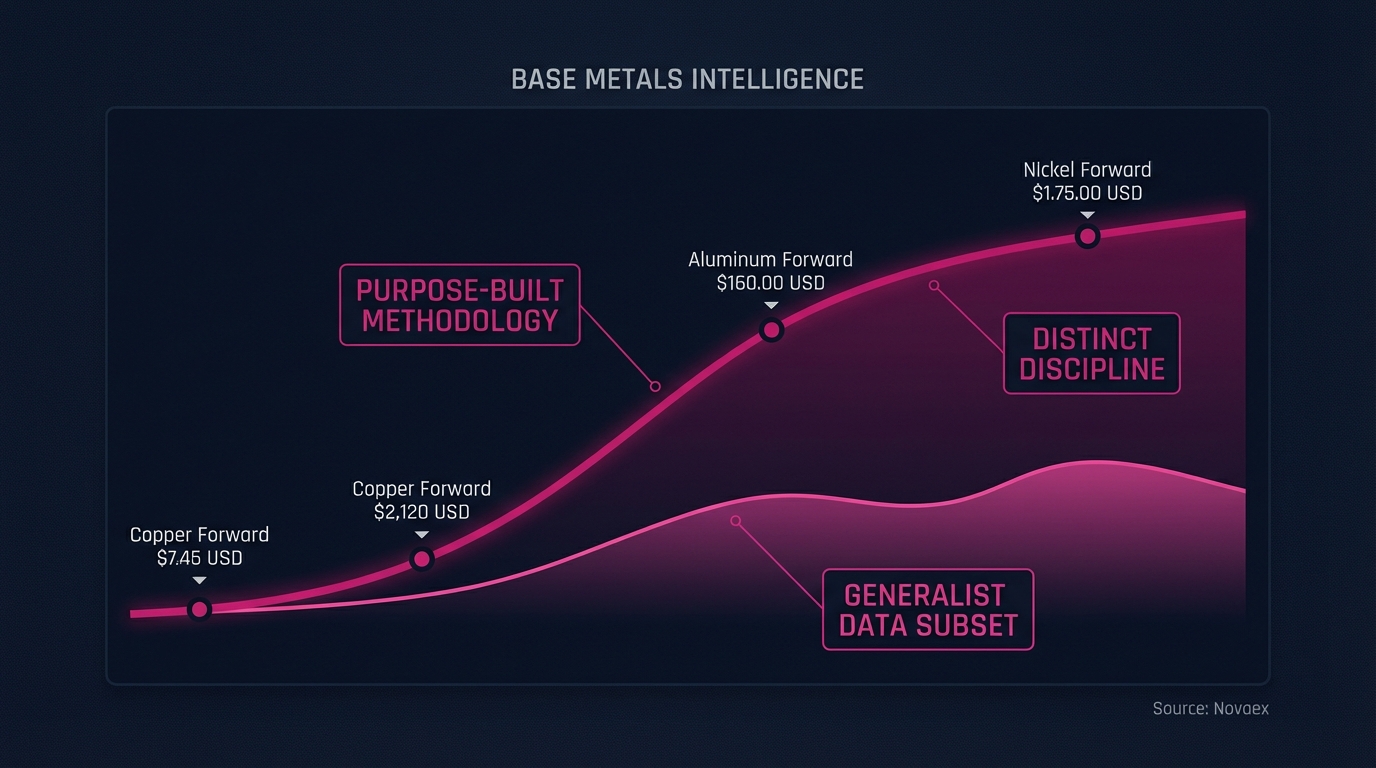
Base metals intelligence is a distinct analytical discipline, not a feature set any multi-asset platform can replicate by adding LME price feeds. The methodology required to serve a copper trader making a hedging decision is structurally different from the methodology behind a generalist commodities dashboard. That difference is not about data volume. It is about how the architecture was built, and for whom.
Most commodity platforms approach coverage as a mapping problem: identify markets, ingest feeds, display outputs. The result is predictable: diluted intelligence distributed across every market while none is fully mastered. For a front-office metals trader managing LME positions under time pressure, that analytical dilution is not an inconvenience. It is a structural liability.
This post examines the methodological distinction between purpose-built base metals intelligence and generalist commodities data and makes that distinction observable through the specific analytical architecture that genuine metals coverage requires.
What "Depth-First" Means in Base Metals Analytics
The term depth-first describes a deliberate sequencing principle: complete understanding of one commodity before moving to the next. depth-first methodology explainer
It is the opposite of the breadth-first approach that defines most multi-commodity platforms, where coverage width is the headline metric and analytical depth is a secondary consideration.
In practice, depth-first methodology means that copper analytics cannot share infrastructure with crude oil analytics and expect to deliver equivalent insight. Copper trades across LME, COMEX, MCX, and SHFE: four exchanges with distinct contract specifications, margin structures, and liquidity profiles. According to the London Metal Exchange, copper is one of the most liquid industrial metals markets globally, with annual notional turnover regularly exceeding $10 trillion. That level of market complexity requires more than a feed and a chart.
A depth-first architecture answers questions that breadth-first platforms are not designed to ask: Which settlement price applies to this physical contract? What is the cash-to-3M spread implying about nearby supply? How does SHFE warrant data affect the LME prompt date curve? These are the operational questions metals traders carry into every session. A platform that cannot answer them without manual workarounds has not built base metals intelligence. It has built a multi-commodity display.
The Operational Need for a Copper Analytical Layer
Copper requires a dedicated analytical layer because its pricing structure, delivery mechanics, and cross-exchange arbitrage dynamics are commodity-specific, not commodity-generic. A single copper contract can reference LME cash, LME 3M, COMEX nearby, or a fixed-price physical deal, each requiring different hedging logic. According to the CME Group, COMEX copper futures average over 150,000 contracts traded daily, representing distinct exposure that is not directly substitutable with LME positions. Treating these as equivalent data points rather than distinct instruments is the first failure mode of platforms built without metals-specific architecture.
The analytical layer copper needs models these relationships as operational objects, not as parallel price feeds requiring manual synthesis by the trader.
Why Generalist Platforms Fall Short on Base Metals Intelligence
Generalist commodity platforms fall short on base metals not because they lack data, but because their architecture was not designed around the operational workflows of metals traders.
The evidence is structural. Multi-asset platforms prioritize breadth: energy, agriculture, metals, softs, freight, all served by a common data model. That model cannot simultaneously satisfy the specific requirements of a zinc spread trader on LME and a crude oil options desk. According to a 2023 study by Greenwich Associates, over 67% of commodities professionals reported that their primary data platform required significant manual augmentation to support specialized trading decisions. The platform did not fail to deliver data. It failed to deliver intelligence.
For base metals specifically, the operational requirements are unusually dense. A single trading session may require a front-office trader to simultaneously monitor:
- LME cash-to-3M spreads across six base metals
- SHFE warrant inventory changes and their prompt implication
- MCX near-month contracts for INR-denominated exposure
- COMEX settlement versus LME equivalent for cross-market arbitrage
- Physical premium indices for regional delivery differentials
Core Data Requirements for Base Metals Trading
A base metals trader needs prompt-date visibility, cross-exchange arbitrage data, warrant and inventory analytics, physical premium benchmarks, and settlement curve structure, all integrated into a single analytical workspace. According to the LME, over 80% of base metals futures volume is used for hedging purposes, meaning most traders are managing physical exposure, not speculating. That hedging context requires precision that price feeds alone cannot provide.
The operational requirement is integration. Individual data fields matter less than how those fields connect to each other within a single analytical environment.
Architectural Limitations of Generalist Platforms
Generalist commodity platforms fall short for metals traders because their data models were designed for price surveillance, not for the operational workflows of metals hedging and position management. The limitation is architectural: a platform built to show whether copper is up or down cannot, without fundamental redesign, show whether a specific prompt date's cash-to-3M spread implies backwardation risk for a forward purchase contract. Those two functions require different structural assumptions about what data is and what it should do.
The Methodological Gap: Structure Before Scale
The methodological gap between base metals intelligence and generalist commodities data becomes most apparent at the level of analytical structure: the decisions made before any data is displayed.
Purpose-built base metals methodology begins with the market microstructure of each metal: how contracts are specified, how settlement is calculated, how spreads function across prompt dates, and how cross-exchange relationships are modeled. This is structural work. It happens before a single dashboard element is designed.
Generalist platforms invert this sequence. They design flexible, multi-asset interfaces first and then populate them with available feeds. The result is a display architecture that can show copper price alongside natural gas price alongside corn price, but cannot model the relationship between LME copper cash and 3M as an operational analytical object.
According to a report by Accenture on commodity trading operations, firms using purpose-built analytics tools for specific commodity classes reported a 34% reduction in manual data reconciliation time compared to firms using generalist multi-asset platforms. That reduction is not explained by data volume. It is explained by the elimination of structural gaps that require traders to use spreadsheet workarounds.
Purpose-Built Methodology in Trading Decisions
Purpose-built methodology improves trading decisions by eliminating the gap between raw market data and operational insight. When a platform models LME prompt date structure as an analytical object, not just a data field, a trader can immediately assess whether nearby backwardation represents a delivery squeeze or a temporary spread anomaly. That distinction carries material value in a hedging program. It cannot be reliably made using a generalist display populated with price feeds.
The improvement is not incremental. It is the difference between a system built for the problem and a system adapted toward it.
How Base Metals Intelligence Connects to Operational Decisions
Analytical methodology must connect specific data fields to specific trading decisions. Market data only becomes valuable when it directly supports an operational workflow.
base metals hedging workflow overview
Consider the prompt date. On the LME, every trading day has a unique prompt, a specific value date for cash settlement. Managing a physical contract book across multiple forward delivery dates requires prompt-specific visibility, not just a generic 3-month futures price. A generalist platform that surfaces only the 3M benchmark requires the trader to manually back-calculate prompt adjustments. This friction scales with position complexity and compounds when markets move fastest.
Purpose-built base metals architecture models prompt date curves as primary analytical objects. Each prompt date carries its own cash price, spread to 3M, open interest context, and historical comparison. That structure serves a specific operational need: a trader with a fixed-price physical sale needs to identify the exact prompt at which to hedge, not the nearest futures contract.
The same logic applies to SHFE warrant data. LME-listed aluminum inventory is a global benchmark, but SHFE aluminum warrant changes affect the Asian supply picture and feed into LME prompt date expectations for delivery. A platform that does not surface warrant movement in a format connected to prompt structure is not serving the aluminum trader's operational reality. It is showing them a number without context.
According to the World Bureau of Metal Statistics, aluminum inventory changes on SHFE have shown correlation coefficients exceeding 0.6 with LME cash-to-3M spread movements in high-volatility quarters. Tracking these relationships as integrated analytical outputs, not as separate data lookups, is the difference between intelligence and data.
Reading the Multi-Metal Architecture as Evidence
The most direct way to observe the methodological distinction is to examine what genuinely purpose-built base metals output actually contains, not as a product claim, but as structural evidence.
Novaex platform architecture overview
Novaex covers copper, aluminum, zinc, nickel, lead, and tin across LME, MCX, COMEX, and SHFE. While broad coverage statements are common, the underlying structure of this coverage sets it apart.
Each metal in the Novaex analytical environment carries:
- Full prompt date curve visibility: not 3M only, but specific cash prices across near-dated and forward prompts
- Cash-to-3M spread analytics: modeled as a spread instrument, not two separate price fields requiring manual subtraction
- Cross-exchange price differentials: COMEX versus LME, MCX versus LME, SHFE versus LME, modeled as arbitrage-relevant relationships
- Warrant and inventory context: exchange-reported inventory changes surfaced in analytical proximity to prompt curve data
- Physical premium indices: regional delivery premiums that connect exchange pricing to physical contract economics
- Integrated position management: hedge positions mapped against physical exposure in the same analytical environment
Defining Depth-First Analytics in Commodities
Depth-first analytics in commodities is a methodology that prioritizes complete market mastery of each individual commodity, including its exchange structure, contract specifications, and operational trading workflows, before expanding coverage to additional markets. According to research published in the Journal of Commodity Markets, analytical platforms designed around specific commodity classes consistently outperform generalist tools on decision-relevant metrics including latency, precision, and workflow integration. Depth-first analytics inverts the conventional platform-building sequence: structure before scale, mastery before expansion.
The practical result is an architecture where every data field traces back to a specific operational question a metals trader actually asks.
The Standard Base Metals Intelligence Should Be Held To
Defining a standard is a different act than making a competitive claim. A standard specifies the conditions that must be met for a category of work to be done adequately.
For base metals intelligence, those conditions are:
- Exchange-complete coverage: LME, COMEX, MCX, and SHFE modeled as distinct analytical environments, not unified under a generic futures template
- Prompt-date granularity: specific cash prices and spreads for individual delivery dates, not just benchmark contract prices
- Cross-exchange relationship modeling: arbitrage differentials surfaced as analytical objects, not derivable only through manual cross-referencing
- Physical-to-financial integration: the ability to map exchange-traded hedge positions against physical contract exposure in a single workflow
- Inventory and warrant context: exchange-reported supply data integrated with price analytics, not siloed in a separate data lookup
According to a 2024 industry survey by Coalition Greenwich, 71% of metals trading desks reported that their biggest analytical gap was not data availability but data integration: the ability to see relevant variables in operational proximity to each other. That gap is methodological. Filling it requires purpose-built architecture, not additional data subscriptions.
LME base metals market structure reference
Novaex was built specifically because that gap existed and no available platform was closing it. The builder spent four years in front-office metals trading, documenting exactly which analytical objects were missing and which workflows were being replicated manually in spreadsheets. The resulting platform architecture reflects operational reality rather than product roadmap convenience.
Applying This Distinction When Evaluating Analytical Infrastructure
Understanding base metals intelligence as a distinct discipline changes the questions a trading operation should ask when assessing its analytical tools.
Firms must evaluate platforms based on analytical structure rather than data volume or coverage count:
- Can this platform show the cash-to-3M spread for nickel as a spread instrument, not as two subtractable numbers?
- Does it model COMEX copper settlement in relation to LME cash, or present them as parallel but disconnected feeds?
- Can an operator view LME aluminum warrant changes in the same analytical environment as the aluminum prompt curve?
- Can physical purchase contracts be mapped against exchange hedge positions without exporting to a spreadsheet?
The distinction matters operationally because errors compound. A trader using a generalist platform for base metals is not simply working with incomplete data. They are making decisions within an analytical framework that was not designed for their market. Workarounds accumulate. Spreadsheet bridges multiply. And the moments when analytical clarity matters most (high-volatility sessions, prompt date clustering, inventory announcement windows) are precisely when the manual burden is most costly.
According to the Bank for International Settlements, commodity derivatives markets saw average daily turnover of $1.9 trillion in 2022, with base metals representing a structurally significant and growing share of that volume. The capital deployed in these markets warrants analytical infrastructure built for the purpose.
Conclusion
Base metals intelligence is a discipline defined by its methodology: the structural decisions about how markets are modeled, how data fields connect, and how analytical outputs map to operational workflows. A generalist platform can surface base metals prices. Without purpose-built architecture, it cannot deliver the integrated analytical environment that metals hedging and position management require.
The standard is observable: prompt-date granularity, cross-exchange arbitrage modeling, physical-to-financial integration, and inventory context are not premium features. They are the minimum conditions for genuine base metals intelligence.
Three immediate steps for metals trading operations assessing their analytical infrastructure:
- Audit existing analytical gaps: identify which operational decisions still require manual data reconciliation or spreadsheet augmentation before execution analytical gap self-assessment
- Evaluate platforms against the five conditions: use exchange completeness, prompt granularity, cross-exchange modeling, physical integration, and inventory context as the assessment framework, not vendor-provided feature comparisons
- Request a structured demonstration on a specific metal: ask any platform to walk through prompt date curve analytics and cross-exchange differential modeling for copper or aluminum before advancing the evaluation