2027 aluminium landed cost: what the European premium adds, line by line
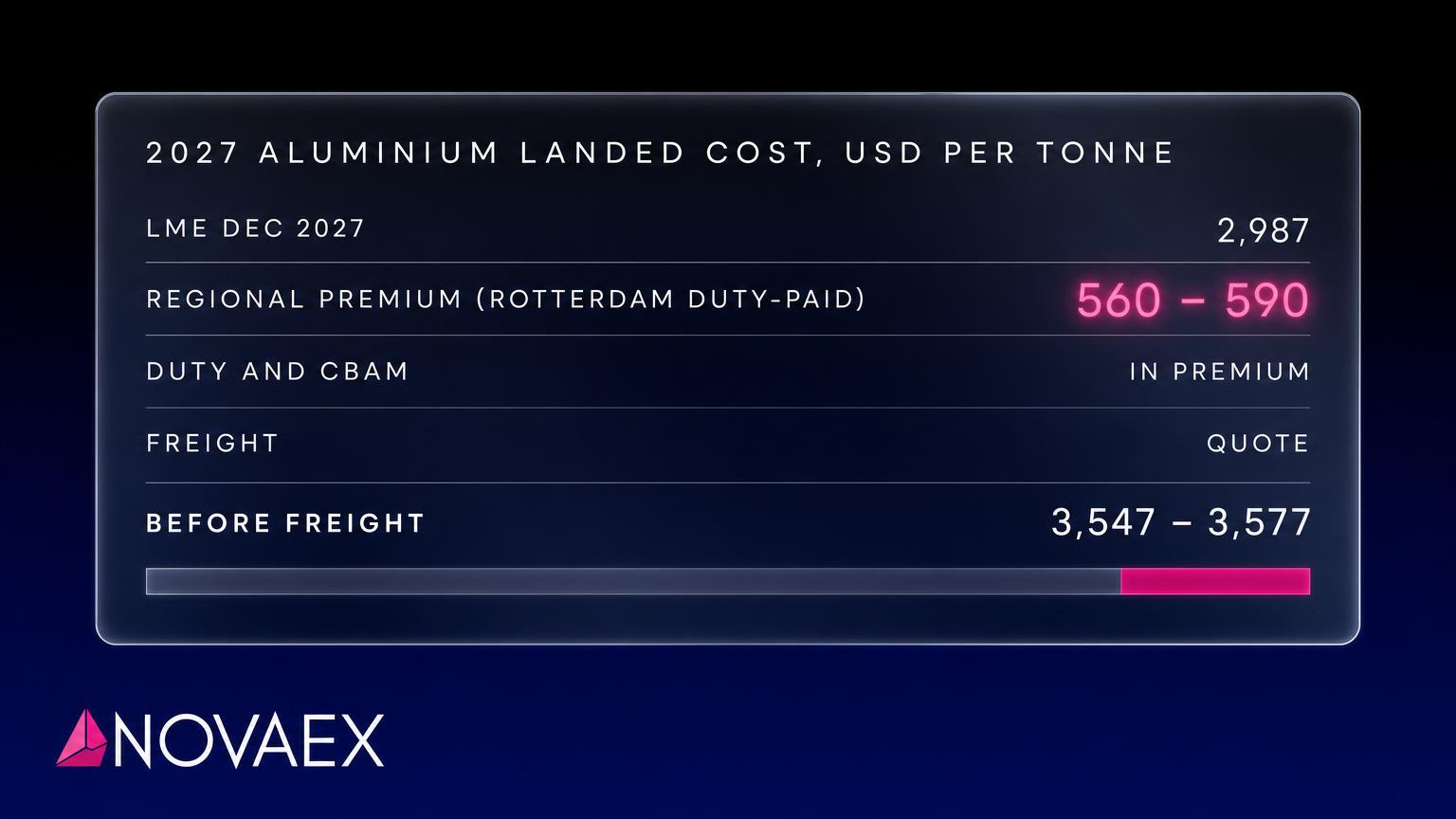
Rotterdam duty-paid is at $560-590/t while Asian premiums fall, and 2027 terms close at the end of November. Here is how to put a number on the landed cost, and what is still open.
A defensible 2027 aluminium landed cost has four lines: LME, the Rotterdam premium, freight and duty. Duty and CBAM already sit inside the duty-paid premium, so adding them again double counts. At $560-590/t (Fastmarkets, 27 October), the premium is about 16% of metal cost before freight, and on a fixed-price quote it stays open until someone fixes it.
How far has the European aluminium premium moved?
The Rotterdam duty-paid premium has risen from $533/t on 23 September to $560-590/t on 27 October, while Asian premiums have fallen. Europe is paying for tight prompt metal. Asia is paying for metal that is not short.
The dated moves:
Rotterdam duty-paid, $533/t, 23 September. CRU, up $10/t in a week.
COMEX European duty-paid, front month, $574/t, 1 October. The highest since 8 June, per Reuters via Mining.com.
Rotterdam duty-paid, $560-590/t, 27 October. Fastmarkets, as reported in Discovery Alert.
Japan Q4 premium, $255/t, 15 October. Platts, down 35.44% from Q3's $395/t, same Discovery Alert report.
These sit on different bases: an assessment, a futures contract and a quarterly Japanese settlement. Read them as direction, not as a spread anyone can trade.
CRU puts the European move down to supply: low physical stocks, restricted prompt availability, vessel delays and rising logistics costs. It expects vessel disruption to keep some inventory categories tight, potentially through November. The duty-paid and duty-unpaid premiums are also diverging, by $79/t on 23 September, which CRU says is not yet wide enough to cover import duty and CBAM.
What goes into the landed cost of 2027 aluminium?
Landed cost is the LME price plus the regional premium plus freight to your plant, with duty and CBAM counted once. If you buy on a duty-paid premium, duty and CBAM are inside it. If you buy duty-unpaid, they are separate lines you add yourself.
Line Figure, USD per tonne Source and date Where it sits
LME aluminium, December 2027 2,987 LME price, 30 October, via Discovery Alert Hedgeable on the forward curve
Regional premium, Rotterdam duty-paid 560-590 Fastmarkets, 27 October Fix in contract or hedge on a listed contract
Duty Inside the duty-paid premium CRU methodology: 3% on some products, 6% on alloy Negotiated: duty-paid or duty-unpaid
CBAM Inside the duty-paid premium About €2.8/t net in 2026, per Discovery Alert Negotiated: who carries it, shown as its own line
Freight to plant Your forwarder's quote Not in the example Negotiated or fixed with the carrier
Before freight, that is $3,547-3,577/t. The premium is $560-590 of it, which is 15.8% to 16.5%.
A worked example on 6,000 tonnes
Take a manufacturer that has sold 6,000 t of aluminium content for 2027 delivery at fixed prices. At the premium range above, metal cost before freight is $21.28m to $21.46m. The premium alone is $3.36m to $3.54m.
Every $10/t on the premium is $60,000 on that tonnage. The premium has already moved a long way inside one year: AlCircle reports $362.50/t in January and $595.50/t in May 2026. That $233/t swing is $1,398,000 on 6,000 t.
Two cautions on the example. The December 2027 LME price is one point on the curve, not a 2027 average. Freight is left out because it depends on your plant and carrier, so put your own quote in the line and date it.
The CBAM figure is small beside the premium. At about €2.8/t net for 2026, it is not the story. The Q4 certificate price is due on 4 January 2027, so check the 2027 factor with your customs broker before you write it into a contract.
What can you hedge, and what has to be negotiated before terms close?
The LME leg can be fixed on the forward curve today. The premium can be fixed in the supply contract or hedged on a listed contract, but only against the assessment your contract references. Duty, CBAM allocation, freight and pass-through are negotiated terms, and CRU's read is that premium and value-added-product terms are usually concluded by end-November.
Hedgeable
The LME leg. On 30 October cash stood at $3,113.50/t against $2,987/t for December 2027, a backwardation of $126.50/t, per the Discovery Alert report. A 2027 quote built off cash carries a $126.50 that the forward curve does not ask for.
The premium, with a basis check. A COMEX European duty-paid contract exists. Whether it tracks the Fastmarkets, CRU or Platts assessment named in your supply contract is the question to settle first, along with how much volume it trades.
Negotiated
Which assessment, duty-paid or duty-unpaid. This decides whether duty and CBAM are inside the number or on top of it.
Fix, float, or fix by date. Tranches by quarter, matched to tonnage you have already sold, stop one date setting the year.
CBAM allocation. Ask for it as its own line, so it is visible when the factor changes.
Pass-through on the sales side. Where a customer pays on an index, check the clause carries the premium and not only the LME price. If it carries only LME, that tonnage is fixed-price in effect.
Freight. Fix it with the carrier or name the reference it floats against.
What could move the 2027 premium?
Two readings are open, and neither is a forecast. On the tight reading, CRU describes lean trading books and limited prompt duty-paid metal. Reuters reported on 2 October that a US tariff cut on Canadian aluminium was under discussion, which could pull Canadian metal away from a Europe whose imports from Canada rose 80% year on year to 269,839 t in January to July. That decision was unconfirmed in the report.
On the easing reading, Morgan Stanley forecasts a 2027 surplus of 830 kt, as reported by Discovery Alert, and Fastmarkets expects a tight 2026 to give way to a more bearish 2027. CRU says new 2027 capacity would reach Asia first. We found no published 2027 Rotterdam premium offer when we searched on 10 November.
Where do you see this on your own book?
Ledger holds the landed-cost position and its coverage against the tonnage you have sold: the LME leg fixed or open, the premium fixed or open, and what is left between them. It gives you guidance on where you stand rather than a raw feed. Pulse is where the hedge call per metal gets made. The landed-cost layout above is here as a spreadsheet. To see the position on your own tonnage: Ledger Platform
Terms close at the end of the month, and the premium is the line still open. Seeing it run on your own book is a call away.