2027 copper concentrate terms: the QP, TC and premium lines to settle before Asia Copper Week
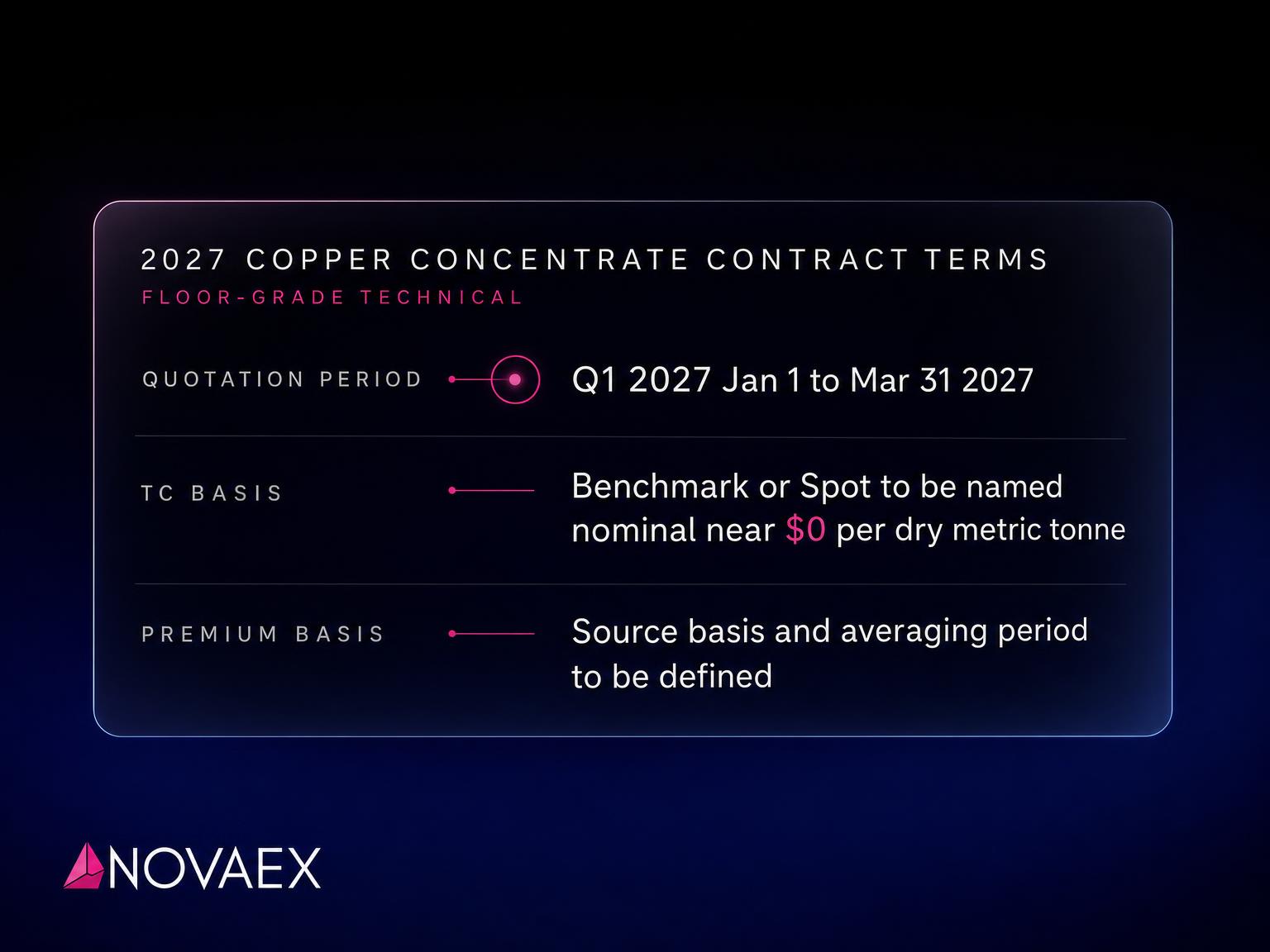
QP month, TC basis, premium basis — the three 2027 assumptions a producer's treasury team settles before Asia Copper Week.
Copper concentrate, 2027. Three lines in the contract decide how the year prices. Get them right before Asia Copper Week and the book takes care of itself.
The direct answer: settle the quotation period, the TC basis and the premium basis in writing before you sign. Name the QP month for each shipment, the declaration deadline and the default if nobody declares. Name whether TC/RC follows the annual benchmark or a spot reference, and which cathode premium applies to payable metal. Once those three sit in the term sheet, hedge coverage maps to board policy without argument.
What should your 2027 QP say, exactly?
Your 2027 QP should name the pricing month for each shipment, the party that declares it, the deadline to declare, and the default that applies if the deadline passes.
The market spectrum runs from the month before shipment through M+3 and M+4, where M is the loading month, and each QP option must carry a declaration deadline plus default terms. M+1, M+2 and M+3 are the standard menu most term sheets draw from. Fastmarkets uses M+3 as its base quotation period and normalises other QP terms against the forward curve, which tells you where the centre of gravity sits.
The sharp question for your desk: which month's price prices your metal? If the purchase QP and the sales QP sit in different months, the basis between those two months is an open position. It stays open whether anyone booked it or not. Name both months on one page before signing and that gap closes to a decision.
What does a $0 benchmark do to your TC clause?
A $0 benchmark TC/RC changes what the TC clause has to do. It no longer records income from processing. It records how a producer keeps value when the smelter keeps none.
The 2026 annual benchmark settled at US$0 per dry metric tonne TC and zero cents per pound RC, the first zero settlement on record, with spot charges trading below minus US$100 per dry metric tonne as smelters paid for concentrate access. The IEA records the same settlement at USD 0 per tonne, the lowest level ever agreed, with spot charges negative since 2024 on tight concentrate supply.
Two readings of that number sit side by side. One says the benchmark will recover with mine supply. The other says smelter capacity keeps the pressure on through 2027. Your term sheet does not need to pick the winner. It needs a clause that holds under either: benchmark or spot reference named in full, the price reporting source written into the line, and the fallback if that source stops publishing. A TC line that reads "as per benchmark" without naming which one fails the first audit question.
Which premium basis survives an audit?
The premium basis that survives an audit is the one written as a number with a source, a delivery basis and a period. Not a name. Not a convention.
For payable cathode value, name the premium, the basis CIF Shanghai, CIF Rotterdam, US Midwest, as applicable, the assessment source and the averaging period. Tie that averaging period to the same QP logic as the metal price so the two cannot drift apart. Where contracts carry price participation or escalators above an agreed copper price, write the threshold, the share and the QP it settles against. Treasury can then show the board that hedges match policy line by line, because the policy maps to named lines rather than to understandings.
What does treasury check before Asia Copper Week?
Asia Copper Week 2026 runs 17 to 19 November in Shanghai, and the 2027 benchmark conversation happens in its margins. Walk in with the three assumptions already drafted and the week becomes a pricing discussion. Walk in without them and it becomes a discovery exercise conducted at your expense.
The pre-signing check fits on one page. QP month per shipment pattern, declarant, deadline and default. TC/RC reference named with source and fallback, payables and penalties beside it. Premium with basis, source and averaging period. Each line carries one owner on your side. The trail behind every figure sits where audit can reach it without asking twice.
Settle the three lines now and the 2027 book prices itself. The metal still moves. The terms stop moving with it.