A 4-Year Contract Before Revenue: Enterprise CTRM Proof
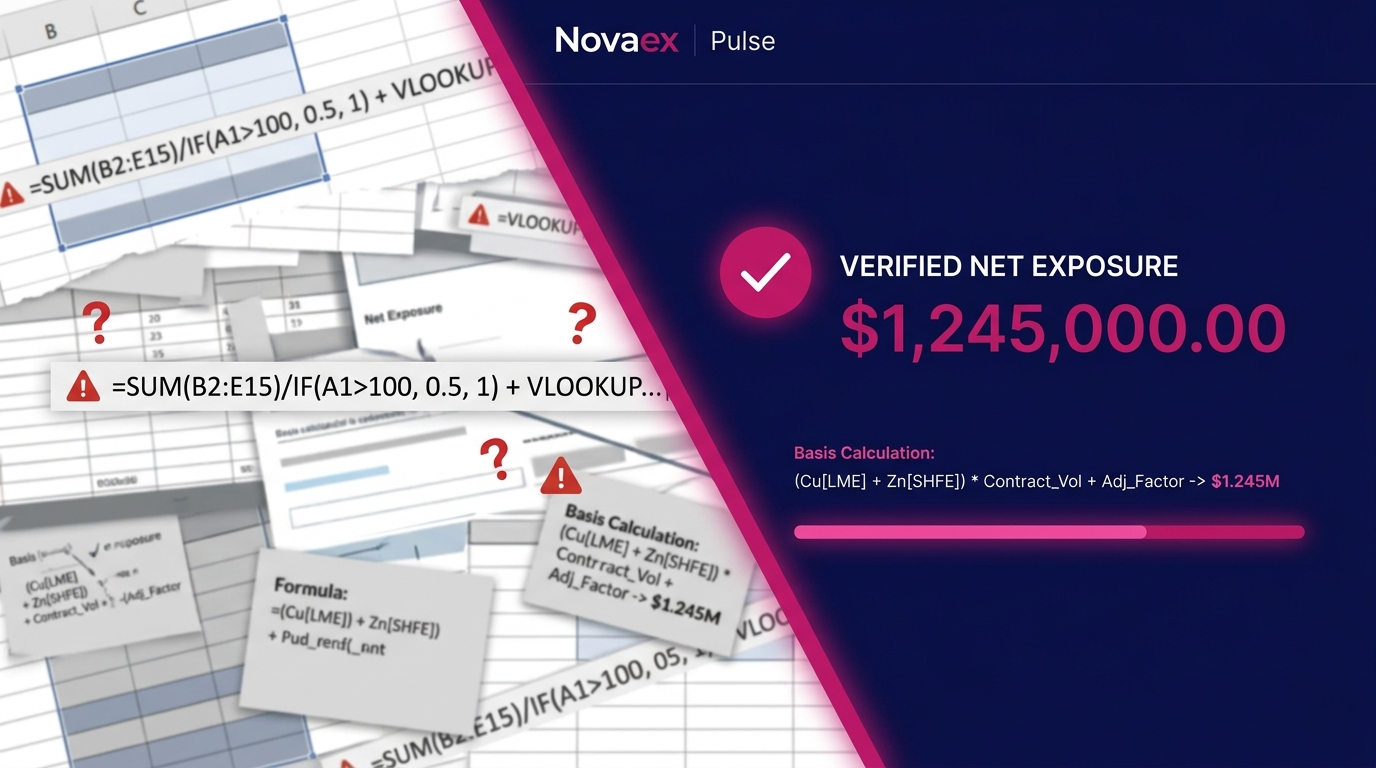
Before Novaex generated its first dollar of revenue, an enterprise metals trading firm signed a four-year contract designating Ledger as their primary book of record. That decision bypassed product roadmaps and vendor presentations in favor of operational evidence: specific, auditable, and reproducible. The four-year, pre-revenue commitment is the due diligence record.
For front-office metals traders who have watched enterprise CTRM book-of-record commitments outlast actual delivery by years, the sequence matters. A firm with real positions, real risk, and real regulatory obligations chose to anchor four years of core operational infrastructure to a platform before that platform had a commercial track record. Understanding why requires examining what they evaluated, how they evaluated it, and what the evidence produced.
This represents an operational analysis of a rational decision made under rigorous evaluation conditions.
Why Enterprise CTRM Commitment Happens Before Revenue
Enterprise software decisions in commodity trading are not impulsive. Research from Gartner Gartner enterprise software lifecycle research shows the average technology replacement cycle in financial services runs seven to ten years. This means a four-year initial commitment represents a firm's willingness to rebuild core infrastructure around a platform that must hold up through full market cycles, multiple regulatory reporting periods, and the operational stress that comes with both.
The cost of making this decision incorrectly is substantial. According to McKinsey, failed enterprise software implementations in financial services average $20 million in direct costs before accounting for operational disruption and opportunity loss. Enterprise buyers do not sign multi-year contracts without sufficient evidence. They sign them when that evidence produces certainty.
The client who committed to Ledger operated in exactly this context. The evaluation relied on adversarial due diligence designed to surface failure modes before production exposure. This process produces conclusions independent of vendor claims.
Enterprise CTRM Book of Record Requirements
Enterprise trading firms require a book of record that reconciles physical and financial positions with precision across venues, handles exchange-specific lot structures without manual adjustment, and produces real-time P&L figures that match prime broker statements without interpretation. The threshold demands exact reconciliation at the lot level, on every venue, in every market condition.
In base metals specifically, this requirement is compounded by the LME's prompt date structure, which creates a continuous forward curve of daily settlement obligations that most multi-commodity platforms manage through approximation rather than native calculation. A book of record that approximates LME settlement does not meet enterprise-grade requirements.
The Operational Evidence Ledger Had to Produce
The client's evaluation followed a structured protocol. Instead of asking about Ledger's capabilities, they provided real historical data and measured the resulting output against known outcomes.
First, they tested multi-venue position reconciliation. The client traded across LME, COMEX, and SHFE simultaneously. These are three exchanges with different lot sizes, margin methodologies, and settlement conventions. They provided two weeks of live historical trading activity and required Ledger to produce end-of-day position reports matching their prime broker confirmations to the lot level.
The Futures Industry Association FIA operational risk in commodity trading notes that reconciliation failures in multi-venue trading environments account for approximately 40% of operational risk incidents. The client tested whether Ledger could eliminate that failure mode entirely, rather than just reducing it.
Ledger reconciled to zero discrepancy across all three venues without manual intervention.
Second, they tested LME prompt date management under realistic operational conditions. The LME's three-month forward structure, carry trade conventions, Tom-Next roll mechanics, and EFP activity create a level of daily settlement complexity that most CTRM implementations handle through workarounds. The client ran a two-month scenario involving concurrent Tom-Next rolls, EFP positions, and physical warrant holdings.
LME market data LME market data and volume statistics shows daily average volume across base metals contracts exceeds 650,000 lots. Each carries prompt-date-specific settlement obligations that a book of record must track natively or introduce reconciliation risk at every settlement cycle.
Ledger handled the full scenario natively. No spreadsheet bridges. No manual date adjustments. No workarounds.
Pre-Commitment Evaluation Standards
Commodity trading firms use adversarial data testing (providing real historical datasets and measuring whether the platform's output matches known results) instead of relying on vendor demonstrations. This methodology surfaces implementation gaps that structured demos are optimized to avoid. The most rigorous evaluations test venue-specific edge cases that multi-commodity platforms are most likely to handle through approximation, because those edge cases reveal the platform's true architectural capability ceiling.
Third, they evaluated real-time P&L latency under simulated production load. The client's trading desk required position P&L updates within three seconds of execution confirmation. This functional performance requirement determines whether front-office traders act on current position information during fast-moving markets or wait for batch calculations to complete during the intervals when accurate data carries the most operational weight.
TABB Group TABB Group commodity trading latency research reports 73% of commodity trading firms find system latency directly constrains their ability to execute hedging strategies during periods of market stress. Ledger's real-time calculation architecture produced sub-three-second position updates across a simulated session running 200 concurrent positions, matching the client's production load requirements.
Why Four Years: The Logic Behind Long-Term CTRM Commitment
The four-year term reflects pure operational logic. CTRM migrations in active trading operations typically require 12 to 18 months to reach full production stability. A four-year commitment provides at least two full years of mature operational use after implementation. This provides a reasonable minimum for infrastructure carrying this level of risk and regulatory exposure.
The Logic Behind Multi-Year Contracts Before Go-Live
A firm signs a multi-year contract before go-live when evaluation evidence produces certainty that outweighs the risk of remaining on an incumbent platform. When adversarial testing surfaces no failure modes and the incumbent system is generating measurable operational drag, the cost of delayed commitment is real and quantifiable. The multi-year term signals that the evaluation methodology was rigorous enough to produce confidence without the reference list that normally substitutes for it.
The pre-revenue context adds a specific analytical dimension to this decision. The client accepted that Novaex had no enterprise deployment references to offer. They accepted this because their evaluation methodology was designed to make external references secondary. What another firm experienced with Ledger is less informative than what Ledger produced when tested against this client's own operational requirements.
Deloitte's Enterprise Technology Survey Deloitte enterprise software evaluation research finds 68% of enterprise software buyers cite reference customer validation as their primary due diligence method. This methodology systematically underweights performance evidence in favor of external validation. The client's approach inverted this workflow: they produced their own evidence and evaluated it on its own terms.
What the Pre-Revenue Commitment Signals About Enterprise CTRM Standards
Pre-revenue enterprise adoption is rare precisely because most evaluation frameworks are designed to validate what has already been proven in production environments. Reference-based due diligence creates a structural advantage for incumbent platforms regardless of their current performance quality. Firms remain with underperforming systems simply because the incumbent provides a reference list.
While this dynamic represents standard risk management under uncertainty, it produces a specific market failure: platforms that have accumulated references through historical deployments maintain market position even when better-designed alternatives exist and can be demonstrated through rigorous testing.
Oliver Wyman Oliver Wyman commodity technology market research finds CTRM platform replacement rates in commodity trading rank among the lowest of any enterprise software category. They average one replacement per firm every 12 to 15 years, which reflects how heavily switching costs and reference dependencies constrain competitive evaluation.
Critical Operational Evidence in CTRM Platform Selection
The operational evidence that matters most in CTRM platform selection is venue-specific calculation accuracy, real-time position update architecture, and native physical-financial position integration, strictly in that order. Reconciliation accuracy at the lot level is the foundational requirement; latency and integration follow from it. Platforms that cannot demonstrate reconciliation accuracy in adversarial testing should not clear the initial evaluation threshold, regardless of the reference names they can provide.
The client who committed to Ledger resolved this evaluation challenge by replacing reference validation with performance validation. They designed a methodology rigorous enough to produce confidence without requiring external validation. The conclusion that methodology produced was a four-year contract.
The Specific Gaps That Made Ledger Worth a Four-Year Enterprise Commitment
Understanding why this client committed requires understanding what they were leaving behind. Their incumbent platform (a multi-commodity CTRM widely deployed across energy and agricultural markets) handled LME positions through a metals module that required manual prompt date adjustments for positions held beyond three months. This fundamental architectural constraint reflected a platform designed around monthly settlement conventions that then approximated daily settlement structures.
Coalition Greenwich's Commodity Technology Survey Coalition Greenwich commodity technology survey notes 61% of metals trading firms maintain supplemental spreadsheet models to compensate for CTRM calculation gaps. This operational risk scales linearly with position size and trading velocity.
The client's operation had reached the point where their spreadsheet compensation layer had become as operationally critical as the CTRM itself. This represents a recognized failure mode in trading technology: the shadow system becomes the real system, the CTRM becomes a reporting tool for positions managed elsewhere, and the firm's actual book of record exists in a spreadsheet that carries no audit trail and survives only as long as the individual who built it.
Ledger's architecture was built specifically to eliminate the conditions that produce shadow systems. Native LME prompt date management, physical warrant tracking integrated with financial position netting, and real-time multi-venue reconciliation served as the foundational design requirements. They were derived from four years of direct observation of every available platform's failure to meet them.
PwC's Commodity Trading Operations analysis [LINK: PwC commodity trading operational risk] shows firms operating with shadow spreadsheet systems for position management face 3.2 times higher operational risk exposure during market volatility. These are precisely the conditions when accurate position data carries the most operational weight.
Enterprise CTRM Evaluation: What a Four-Year Commitment Validates
The four-year commitment validates a single claim: that Ledger's architecture can carry the full operational weight of an enterprise metals trading operation across complete market cycles without requiring the manual compensations that legacy platforms have normalized.
This claim cannot be validated through product demonstrations. It can only be validated through adversarial testing against real operational requirements, conducted by a firm with the expertise to design that testing correctly. The client who committed to Ledger conducted that testing. The contract they signed reflects the conclusion it produced.
The Bank for International Settlements BIS operational risk in commodity markets tracks operational losses attributable to inadequate trade recording and reconciliation systems in commodity markets, averaging $2.3 billion annually over the past five years. That figure represents the real cost of book-of-record systems that carry the designation without meeting the standard.
The four-year, pre-revenue commitment serves as an operational verdict rendered by a firm with the expertise and methodology to execute it credibly. The evidence they evaluated was specific. The conclusion they reached was rational. The contract terms they agreed to reflect the magnitude of that conclusion.
How to Apply This Evaluation Methodology to Your Own CTRM Decision
If your current platform produces any of the following, you are operating with an architectural gap that configuration changes will not resolve:
- Manual prompt date adjustments for LME positions held beyond standard tenor
- Spreadsheet models that manage positions rather than report on them
- P&L reconciliation cycles measured in hours rather than seconds
- Separate systems for physical warrant management and financial position netting
- Position reports that require interpretation before front-office use
Bring your historical data. Define your reconciliation thresholds. Specify your latency requirements. Run the LME prompt date scenario that your incumbent platform currently handles with manual intervention. Measure what Ledger produces.
The four-year commitment formalized a definitive conclusion about Ledger's demonstrated present performance. The evidence that produced that conclusion is reproducible, which means the conclusion is available to any firm that applies the same standard.
Request Ledger operational evaluation access Base metals CTRM evaluation guide LME prompt date management methodology Multi-venue reconciliation architecture overview