Aluminium premium 2027: what to fix in a contract and what to leave floating
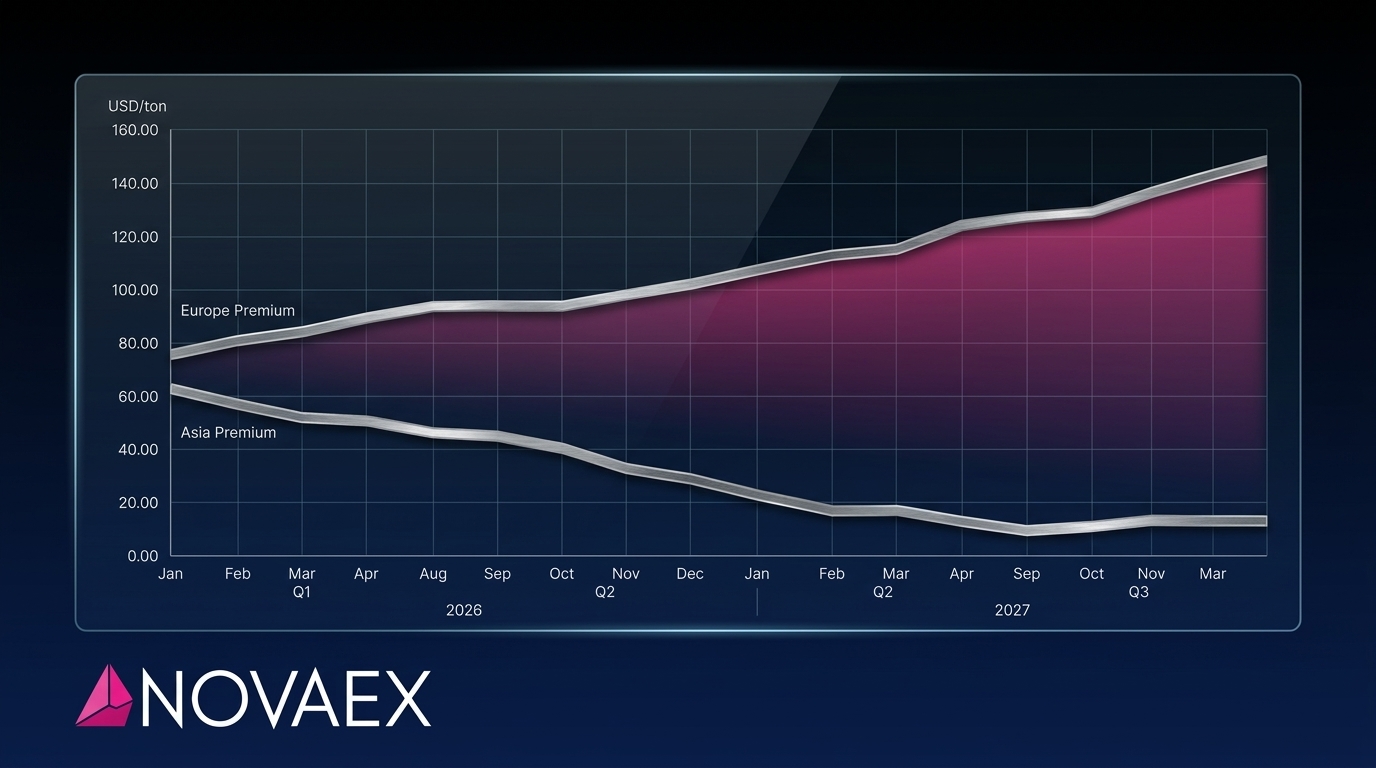
Rotterdam duty-paid stood at $533/t on 23 September. Some Japanese buyers have agreed $255/t for Q4. What a downstream cost owner can fix now, and what is worth leaving open.
Fix the premium on tonnage you have already sold at a fixed price, and fix it in tranches rather than on one date. Leave it floating on tonnage your customers pay for on an index. Europe's $533/t and Japan's $255/t are two different bets on 2027, and no verified 2027 offer settles either one yet.
Why do European and Asian aluminium premiums disagree?
Europe is pricing a shortage. Asia is pricing a surplus that new smelting is expected to widen. Rotterdam duty-paid reached $533/t on 23 September, while some Japanese buyers have agreed $255/t for Q4 shipments. A 2027 contract fixed in either region fixes a view on which story lasts longer.
The dated figures:
Measure Figure Source and date
Rotterdam duty-paid premium $533/t CRU, 23 September
Front-month COMEX European duty-paid premium $574/t LSEG via AlCircle, 1 October
Japan Q3 premium $395/t CRU, 30 September
Japan Q4 producer offers, opening $310-325/t Reuters via Kitco, 2 September
Japan Q4 producer offers, late September $245-260/t CRU, 30 September
Japan Q4, agreed by some buyers $255/t Reuters via TradingView
CRU Asia CIF premium $202/t CRU, 30 September
Those sit on different bases, a Rotterdam duty-paid assessment against a quarterly CIF Japan settlement, and on different dates. Read $533 less $255, or $278/t, as the size of the disagreement rather than a spread anyone can trade. On 1,000 t a year, that is $278,000.
What is holding Europe up
CRU puts the squeeze down to supply: low physical stocks, restricted prompt availability, vessel delays and rising logistics costs. It expects vessel disruptions to keep some inventory categories tight potentially through November.
CarbonChain's Nick Ogilvie, interviewed by AlCircle on 5 October, calls it a supply shock rather than a CBAM-driven deficit. His dates: duty-paid at $330/t in December, $575-600/t in early April. So $533/t is not a new high.
Canada is the live variable. EU imports from Canada rose 80% year on year to 269,839 t in January to July, and a cut in the US tariff on Canadian aluminium from 50% to 25% could pull some of that metal back toward the US. The tariff remains at 50% today.
What is pulling Asia down
CRU's Asia CIF premium was last assessed at $202/t. Japan Q4 offers slid from $325/t in early September to $245-260/t, and Reuters reports some buyers agreed $255/t, 35% below Q3. Inventories are building and demand is weak. CRU expects the capacity arriving in 2027 to reach Asia first.
Should you fix a 2027 European aluminium premium now?
Not all of it, and not on one date. A full-year fix at today's level pays shortage pricing for twelve months if the shortage clears. Leaving it all floating leaves a fixed-price book exposed if it does not. Tranches matched to tonnage already sold keep both readings alive.
Reading one: the tightness carries into 2027
CRU says Middle Eastern disruption, limited Gulf smelter restarts and Strait of Hormuz risk continue to constrain supply, and Chinese output is approaching its national cap.
CRU also says participants hold lean books and are unlikely to add significant length, even with new supply due in 2027.
CBAM's default-value mark-up rises from 10% in 2026 to 20% in 2027, which raises the charge on metal arriving without verified installation-level data.
Reading two: the premium is a shortage price on a clock
EGA targets the first quarter of 2027 for Al Taweelah, and had restored only a quarter of its cells by late August. San Ciprian completed its restart in April, and Slovalco began restarting 75,000 t in late August.
CRU notes lower Asian premiums could attract Asian metal into Europe. The duty-paid and duty-unpaid spread was $79/t on 23 September, not yet wide enough to cover import duty and CBAM. If it widens, clearing duty-unpaid metal could moderate the duty-paid market.
Should you fix a 2027 Asian aluminium premium now?
Not for the full year at today's level. The Japan premium is 35% below Q3, and CRU expects 2027 capacity to land in Asia first, so the evidence still points down. Japan's benchmark also resets quarterly, so a contract that references it floats four times a year unless you fix it.
The case for fixing a slice is the other reading. Vietnam and Thailand, which depend more on imported metal, have held comparatively firm, and the Middle East conflict has curtailed East-to-West flows. A fixed slice buys protection if the fall reverses. The rest rides lower if the capacity arrives as CRU expects.
What should a downstream cost owner lock, and what should stay open?
Lock the premium on tonnage sold at a fixed price, float it where your customer pays an index, and give the CBAM charge its own line in the contract. Those are three decisions about three exposures. Regional premiums in forward contracts can be fixed at signing or left floating, sometimes with an option to fix at intermediate dates, so the split is yours to write.
Tonnage sold at a fixed price. A premium move comes straight out of margin here. Fix in tranches, by quarter, so one date does not set the year. Where a listed premium contract exists, hedging it is the alternative to fixing it in the supply contract: the LSEG data above references COMEX European duty-paid and Japan premium contracts, and CME Group describes four regional aluminium premium futures.
Tonnage sold on an index. Float it, but check the sales clause passes the premium through and not only the LME price. If it passes only the LME price, that tonnage is fixed-price in effect.
The CBAM charge. Contracts increasingly allocate CBAM costs and show them separately, and some duty-paid assessments, Fastmarkets' among them, have included CBAM since January 2026. Check which one your contract references.
What is still unpublished?
As of 8 October 2026 we found no verified 2027 premium offers or forecasts. Every figure above is spot or Q4 2026.
Three dated items will move the reading: the Canadian tariff decision, EGA's first-quarter 2027 target for Al Taweelah, and the CBAM default mark-up stepping to 20%.
Two readings, one contract. Which unwinds first, the Gulf restarts or the Canadian diversion, sets how much of 2027 is worth fixing at $533/t.