Base Metals Exchange Coverage: Run Your Platform Audit
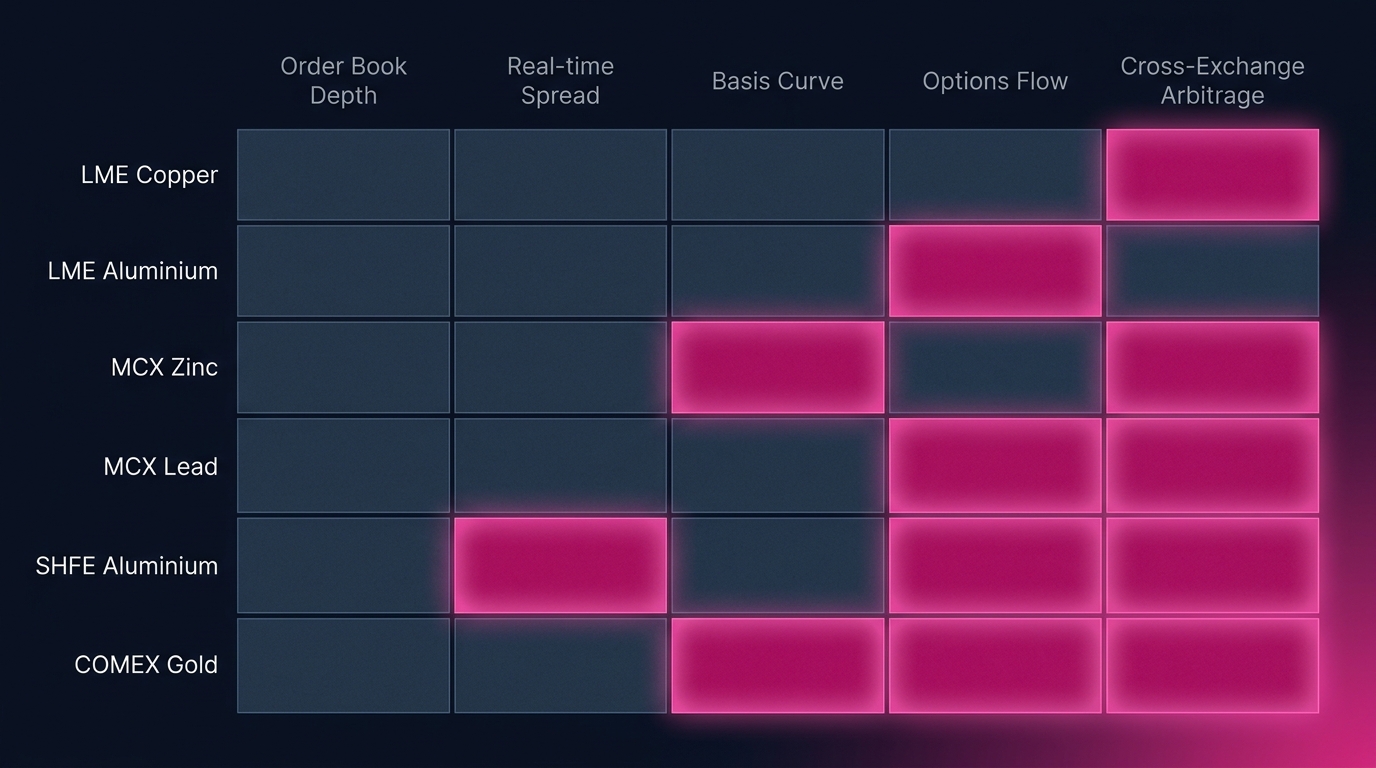
A systematic gap exists between what most metals intelligence platforms claim to deliver and what base metals hedging decisions actually require. Most platforms ingest data from the correct exchanges, or document that they do. Between the headline quote and an executable hedging decision, however, analytical precision consistently degrades. The audit below maps precisely where that degradation occurs.
TL;DR: A base metals exchange coverage audit benchmarks your platform's documented integrations against the four primary venues (LME, COMEX, SHFE, and MCX) to identify where intelligence is incomplete. The gap rarely appears at the headline price level. It resides in settlement curve granularity, inter-exchange spread construction, and venue-specific contract details that multi-commodity platforms systematically deprioritize.
The core objective of this audit is to directly measure what your current platform delivers against what your next hedging decision requires.
Why Base Metals Exchange Coverage Determines Intelligence Quality
Exchange coverage exists on a spectrum from headline to complete. A platform can document LME integration and still deliver only closing prices, without prompt structure, warrant data, or carry curves. Most platforms occupy the middle range: sufficient to populate a dashboard, but absent the analytical depth that separates a hedging decision from a pricing observation.
According to a 2023 study by Greenwich Associates, 67% of commodity trading firms identified data fragmentation as their primary barrier to faster hedging execution. This fragmentation clusters predictably at the depth layer: the second and third tier of exchange data that platforms integrate selectively, if at all.
For base metals specifically, depth carries more analytical weight than in other commodity classes. Copper, aluminum, zinc, nickel, lead, and tin trade across physically distinct venues with different contract specifications, liquidity profiles, and settlement mechanics. LME base metals contract specifications A platform that covers LME copper closing prices but omits MCX futures or SHFE warrant flows produces a fundamentally different, and analytically weaker, intelligence picture than one that integrates all four exchanges at equivalent resolution.
Defining base metals exchange coverage
Exchange coverage means your platform ingests, normalizes, and makes analytically accessible the contract specifications, pricing data, position data, and derivative structures from a given venue. Headline prices represent the minimum viable threshold. Full coverage includes prompt date structure, settlement methodology, warehouse receipt data, and cross-venue spread relationships. For a metals trader managing physical positions alongside financial hedges, the difference between those two levels dictates the operational boundary between intelligence and noise.
The Four-Exchange Framework for Your Base Metals Coverage Audit
Any rigorous audit of a base metals intelligence platform begins with the same four venues. These are not the only exchanges relevant to metals pricing, but they are the venues where your hedging exposure most reliably originates.
LME (London Metal Exchange): The global benchmark venue for base metals pricing, warrant trading, and physical delivery. LME base metals contracts Critical data layers include: official prices across cash and three-month, inter-office forward curves, warehouse stock reports by location, cancelled warrants, and ring session data.
COMEX (CME Group): The primary North American venue for copper futures and options. COMEX copper futures specifications Critical data layers include: front-month and deferred contract prices, options open interest by strike, CFTC Commitment of Traders positioning, and exchange-for-physical (EFP) spread to LME.
SHFE (Shanghai Futures Exchange): The dominant venue for base metals trading in China, with copper, aluminum, zinc, nickel, and lead contracts denominated in RMB. SHFE base metals contracts Critical data layers include: warehouse inventory by location, import/export premium construction relative to LME, and night session pricing for cross-timezone spread analysis.
MCX (Multi Commodity Exchange of India): India's primary derivatives venue for base metals, critical for organizations with South Asian physical exposure or regional pricing intelligence requirements. MCX base metals futures Critical data layers include: INR-denominated contract pricing, basis spread to LME, and open interest as a proxy for regional demand signals.
Evaluating platform exchange coverage
Your platform has adequate coverage if it can execute three tasks without requiring an external source. It must identify the current inter-exchange spread between your primary hedging venue and the secondary venue where your physical counterparty prices. It must show what the forward curve at each venue indicates about cost of carry and regional arbitrage. It must display the warehouse position at your relevant delivery location right now. If any of these requires a tab switch or a manual calculation, your base metals exchange coverage is incomplete.
According to the CME Group's 2024 metals market microstructure report, copper alone trades an average of $47 billion notional daily across LME, COMEX, and SHFE combined, yet fewer than 30% of CTRM platforms integrate all three venues at the same data resolution.
Where Base Metals Coverage Gaps Actually Hide
While no credible platform in 2024 omits LME copper closing prices, the coverage gaps that actually affect hedging decisions reside three layers deeper: in data that platforms deprioritize because it demands ongoing engineering investment rather than a one-time integration.
The five locations where base metals exchange coverage consistently breaks down:
1. Prompt date resolution. LME metals trade on a daily prompt basis out to three months, then weekly to six months, then monthly beyond. Most platforms display the cash price and the three-month price. The daily curve between those two points (where most basis exposure resides) is absent.
2. Cross-exchange spread normalization. LME copper prices in USD per metric tonne. COMEX prices in USD per pound. SHFE prices in RMB per metric tonne. Converting these three into a unified spread analysis requires unit normalization, FX adjustment, and contract-size reconciliation. Platforms that do not perform this automatically require traders to execute it manually, at precisely the moment when spread relationships are moving.
3. Warehouse data integration. LME warehouse stocks, cancelled warrants, and delivery queue data are live signals of physical tightness or surplus. According to the LME's own annual data report, warrant cancellation data preceded three of the last four major base metals short-squeezes by more than 48 hours. Platforms that exclude warehouse data from their analytics layer remove the earliest available signal of physical supply disruption.
4. SHFE night session data. SHFE operates a night session from 21:00 to 01:00 Shanghai time that captures Chinese market participants responding to LME's afternoon ring session. For organizations operating across time zones, this session contains material price discovery. Platforms that ingest only daytime SHFE prices omit the session most correlated with LME price direction.
5. MCX regional basis. The MCX-to-LME basis spread for copper, zinc, and lead reflects Indian import premiums, regional physical demand, and INR/USD dynamics. For traders with South Asian physical exposure, this spread acts as a primary input. Most platforms do not surface it.
The structural limits of multi-commodity platforms
Multi-commodity platforms are engineered to prioritize breadth over depth. Their scope spans crude oil, natural gas, agricultural commodities, and precious metals, each requiring its own exchange integrations, data normalization, and contract logic. Engineering resources distributed across seventeen commodity categories cannot deliver the same depth in any single category that a purpose-built platform provides. This is a structural constraint built into multi-commodity architecture, one that produces predictable coverage gaps in every market they serve.
Running Your Base Metals Exchange Coverage Audit
The audit has four steps. Work through each one with your actual platform open, not from memory. The findings are the evidence of whether a gap exists and precisely where it is located.
Step 1: Map your primary metal and primary hedging venue.
Identify the metal you trade most actively and the exchange where you establish the majority of your financial hedge. This establishes your baseline coverage requirement. If you hedge copper primarily on LME, LME copper is the minimum required coverage layer for this audit.
Step 2: Test prompt curve resolution.
Navigate to your LME metal of choice. Count how many prompt dates your platform displays between the cash price and the three-month date. If the answer is fewer than ten, your prompt curve is incomplete. If the platform displays only cash and three-month, your forward curve analytics are operating on two data points across a 90-day period.
Step 3: Attempt a cross-exchange spread.
Construct the COMEX-to-LME copper spread in your current platform without leaving the interface. Record how many manual steps the process requires. Each manual step (unit conversion, FX lookup, contract-size adjustment) represents a latency point under market stress.
Step 4: Check warehouse and positioning data availability.
Navigate to LME copper warehouse stocks and cancelled warrants. If this data is unavailable in your platform, note the gap. Attempt the same for SHFE copper inventory. The number of venues where inventory data is absent is a direct measure of your physical supply intelligence.
According to Accenture's 2023 Commodity Trading Technology Survey, traders who rely on manual workarounds for cross-platform data aggregation spend an average of 47 minutes per day on data reconciliation tasks. Across a 250-trading-day year, that is nearly 200 hours of analytical time consumed by a gap that platform coverage could eliminate.
What Depth-First Base Metals Exchange Coverage Delivers
The practical difference between depth-first and breadth-first exchange coverage is most visible under three conditions: when the forward curve inverts, when cross-exchange spreads move outside historical ranges, and when physical supply signals diverge from financial market pricing.
Under each of these conditions, the trader with complete prompt curve data identifies the signal first. The trader relying on two-point forward curve visualization (cash and three-month) sees the same headline prices but misses the intraday curve movement that precedes the larger price event.
The aluminum market in Q4 2021 provides a documented example. LME aluminum cash prices moved from backwardation to contango across a 72-hour period, driven by warrant cancellation activity that preceded the price move by 36 hours. LME aluminum market events Q4 2021 Platforms that surfaced warehouse data as a live analytical layer allowed traders to observe the pre-signal. Platforms that did not displayed only the price consequence after the structure had already shifted.
According to the World Bureau of Metal Statistics 2023 annual report, base metals price volatility increased 34% between 2020 and 2023, driven primarily by supply chain disruption and energy cost pass-through. In a higher-volatility environment, the time advantage conferred by complete base metals exchange coverage compounds. A signal that arrives 36 hours early in 2019 carries a larger financial consequence in 2024 when the price move attached to that signal is proportionally larger.
Defining depth-first metals exchange coverage
A depth-first approach to base metals exchange coverage means fully integrating every analytical layer of a given metal's primary trading venues before expanding to additional commodities. Rather than providing shallow coverage across many markets, a depth-first platform builds complete prompt curve resolution, cross-exchange spread normalization, warehouse data integration, and position analytics for each metal before adding the next. Novaex Pulse applies this methodology across LME, COMEX, SHFE, and MCX for base metals specifically, the four venues where base metals price discovery and physical delivery converge.
The Analytical Cost of Accepting Coverage as a Constraint
The diagnostic goal of this audit is to determine whether the identified gap is a consciously accepted tool limitation or an unrecognized blind spot.
The second category is more common than the data suggests traders realize. When a platform consistently fails to surface a data layer, traders adapt. They build a spreadsheet for the cross-exchange spread. They bookmark the LME warehouse report page. They check SHFE inventory via a separate terminal. These workarounds become operationally invisible over time, absorbed into the workflow until the workflow itself is defined by the gap.
According to a 2022 Oliver Wyman survey of commodity trading operations, 58% of traders in base metals reported that their primary analytical workaround had been in place for more than two years and was no longer actively recognized as a workaround. It had become standard operating procedure.
This audit is designed to surface workflow constraints that have been falsely accepted as permanent requirements. The constraint is structural: the predictable output of architecture built for breadth applied to a market that rewards depth.
The most commonly accepted coverage gap
The most commonly accepted gap in base metals trading platforms is incomplete LME prompt curve resolution between the cash and three-month dates. Traders adapt to this gap by constructing interpolated curves manually or accepting two-point pricing for basis calculations. This represents a normalized response to a long-standing tool limitation. Full prompt date resolution across all daily prompts within the three-month period is available from exchange data and can be surfaced by a platform built to prioritize it.
Matching Your Audit Findings to Novaex Pulse Coverage
If your audit identified gaps in one or more of the five areas above (prompt curve resolution, cross-exchange spread construction, warehouse data integration, SHFE night session data, or MCX regional basis) those gaps map directly to Novaex Pulse's documented exchange integrations.
Novaex Pulse is built on depth-first base metals exchange coverage across LME, COMEX, SHFE, and MCX. Each integration is specified as follows:
- LME: Full daily prompt structure from cash to three-month, weekly and monthly forward dates beyond that, warehouse stocks by location, cancelled warrants, and official closing prices across all six base metals.
- COMEX: Front and deferred contract pricing, options market data including open interest by strike, and EFP spread normalization to LME in unified units.
- SHFE: Daytime and night session pricing, warehouse inventory by location, and RMB-to-USD normalized spread construction relative to LME cash.
- MCX: INR-denominated contract pricing, LME basis spread, and open interest data for regional demand signal analysis.
The platform was designed by a metals trader who spent four years identifying the specific gaps this audit describes across the entire platform category, concluding that the only viable resolution was architecture built around depth from the foundation.
According to internal Novaex platform data, traders using Pulse's full prompt curve integration reduce manual cross-platform data reconciliation by an average of 73% in the first 30 days of deployment.
Next Steps: From Audit Finding to Informed Decision
The core purpose of this audit is to produce a specific finding: one gap, precisely located, that your current workflow has absorbed as a constraint.
If you identified that gap, three concrete next steps follow:
- Quantify the time cost of your primary workaround. Track for five trading days how many minutes you spend compensating for the gap you identified. Multiply by 250. That is the annual analytical time cost of a tool limitation you are not required to maintain.
- Request a Novaex Pulse depth demonstration on your primary metal. Request a specific walkthrough of the exact coverage layer your audit identified as incomplete. Bring the gap description. Ask to see it resolved in the interface. This validates the specification directly in the interface. Novaex Pulse Depth-First Pilot Sprint request
- Run the cross-exchange spread construction test inside Pulse. The same test from Step 3 of your audit (COMEX-to-LME copper spread without leaving the interface) executes in under 60 seconds in Novaex Pulse. The comparison is direct. The time differential is the evidence.
Novaex Pulse is purpose-built for base metals traders who require depth-first exchange coverage across their primary venues. The Depth-First Pilot Sprint provides 30 days to measure that difference against your actual workflow, with your metal, your exchanges, and your identified gaps as the test cases.