Can you reconcile three books without replacing your CTRM?
What the overlay reads, what it leaves alone, and the one feed to connect first.
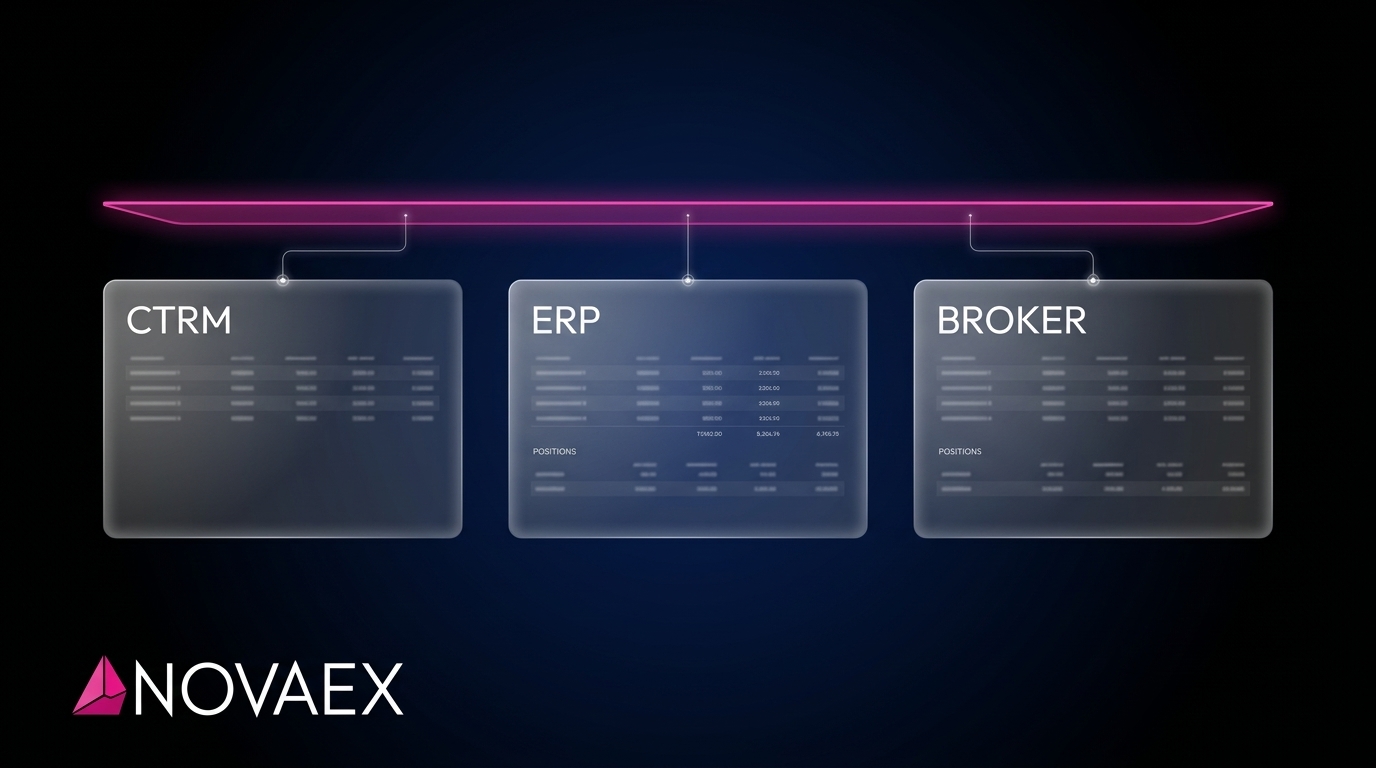
Yes. You can hold one reconciled position across physical, hedge and broker books without moving any of them. The overlay reads your CTRM, your ERP and your broker statements where they sit, matches them line by line, and leaves every system of record exactly where it is.
Why do physical, hedge and broker books drift apart?
They drift because they were never one book. The physical position lives in the CTRM or the ERP. The hedges live with the broker. The confirmations arrive on their own schedule.
Each system is right on its own terms. The CTRM knows what was bought and sold. The broker knows what cleared. The ERP knows what was invoiced. None of them knows what the other two did. The gap between them is filled by a person with a spreadsheet, once a month.
That timing is the cost. A quotation period on the purchase that does not match the sale. Tonnage invoiced against a price that was never the price. A hedge placed against a physical position that has since changed shape. Nothing announces itself. It surfaces at the close, weeks after the margin went.
Square it daily and this stays a correction.
What does the overlay touch, and what stays where it is?
This is the question the person who approves it will ask. So here is the precise answer.
What stays: your CTRM stays the physical book. Your ERP stays the financial record. Your broker accounts stay where they are. No migration. No rebooking. No retraining the desk on a new entry screen.
What the overlay does: it reads. It takes the physical lines from the CTRM or ERP, the hedge lines from broker statements and confirms, and the pricing context around them, then joins them into one reconciled position. LME and MCX live on screen. COMEX and SHFE computed into the arbitrage view. The per-metal call on which contract and when sits on top of that join.
What it never does: it never becomes the system of record. It never rewrites a trade in your CTRM. It never books to your ledger. The books you run today are the books you run after.
That distinction is what takes the migration objection off the table.
How does the reconciled position stay provable?
A reconciled total nobody can check is just another number. The position holds because the working is attached.
Every figure carries its trail, line by line. Physical line to hedge line to broker line, with the quotation period, basis and pricing source shown where each match was made. Where two lines do not match, the break is flagged as a break, with the tonnage, the date it opened and the side that needs to close it.
Audit trails, access controls and encryption sit behind every figure, with SOC 2 Type 2 readiness. The head of risk can put the number in front of the board or the auditor on the day it is asked and show how it was built. Trust in the numbers ranks above every other criterion for this buyer, so the proof travels with the number.
Check the working and the argument about where you stand ends.
What breaks most often in the first week?
The same three breaks, in almost every stack. Broker confirmations that arrive late and leave hedges unmatched for days. Quotation periods that match in the CTRM and mismatch at the broker. Invoices raised against a provisional price that the hedge was never struck against.
None of these needs a new system to fix. Each needs the three books side by side while there is still time to act. The overlay earns its place here, not in a quarterly review. It finds the tonnage sitting between the physical book and the broker confirmation, already invoiced short. Trail attached so you can check the working.
Find it on the day and it costs a phone call.
Which integration should you stand up first?
The broker feed.
The CTRM and ERP integrations give the overlay the physical and financial shape. The broker feed gives it the truth about what cleared. Without that third leg, reconciliation is still a monthly exercise. With it, the daily match can run.
Stand-up is read-only and narrow by design. The overlay connects to the broker statements and confirms first, then to the CTRM or ERP for physical lines, then to pricing context. Nothing is ripped out. It goes live in weeks. The desk keeps entering trades where it enters them today.
Stand up the broker feed first and the rest stops being guesswork.