Cancelled warrants above half of copper stock: what it means for your prompt date
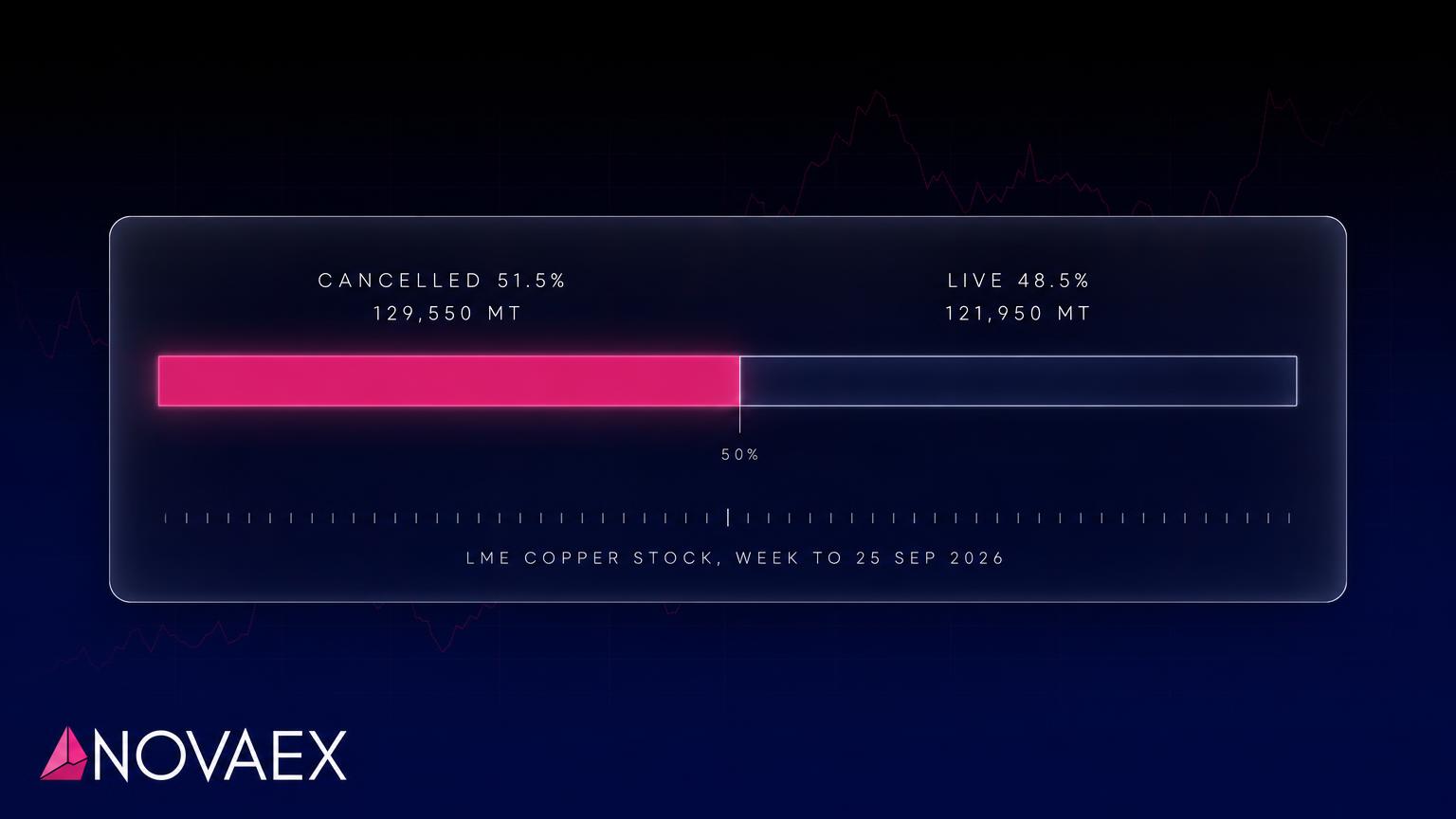
LME copper's cancelled share passed 50% in the week to 25 September 2026. The headline stock total barely moved. The metal a near-dated hedge can actually settle against did.
A cancelled warrant is LME metal whose holder has asked to take it out of the warehouse system. It still counts in the stock total, but it is no longer available to deliver against a contract. In the week to 25 September 2026, 129,550 mt of LME copper was cancelled, 51.5% of the 251,500 mt total.
Total stock fell 3,600 mt that week. Available warrants fell 17,700 mt. For a desk with near-dated exposure, that gap is the number to read.
What is a cancelled warrant, and how does it differ from a live one?
A live warrant is a title document for a set quantity of metal in a named LME-approved warehouse, and it can be held, traded or delivered. A cancelled warrant is the same metal after the holder has asked for it to be released. It is earmarked for removal and no longer available to clear contracts.
A copper warrant covers roughly 25 mt. At that size, 121,950 mt of live metal is about 4,878 warrants, and 129,550 mt of cancelled metal is about 5,182. LME Insight's weekly review calls live metal "available warrants". Same thing, and the two add up to the total: 121,950 + 129,550 = 251,500 mt.
So yes, cancelled metal is still inside the stock figure until it leaves the warehouse. That is why the total misleads.
Why does the total stock figure mislead a desk?
Because the total includes metal already on its way out. In the week to 25 September, total LME copper stock fell 3,600 mt, but available warrants fell 17,700 mt, or 12.7%, to 121,950 mt. Cancellations rose 14,100 mt.
The week before, cancelled copper stood at 115,450 mt, 45.3% of 255,100 mt. One week took it past the halfway mark.
The spread moved with it. Cash–3s went from $21.50 backwardation to $106 backwardation, after touching $125 on Thursday. LME Insight read the fall in available warrants alongside the stronger back as pointing to "materially tighter nearby conditions".
What does "deliverable stock" mean for a near-dated hedge?
For a desk with near-dated exposure, deliverable stock is the live number, not the total. A hedge that rolls, settles or prices off the nearby leg depends on how much metal can reach the prompt date. With cancelled metal above half the total, that pool is smaller than the headline suggests.
Take a short being rolled forward. In backwardation you pay the spread on every roll: $106 a tonne at the 25 September close, or $10,600 on 100 mt if the spread holds where it closed. A desk holding physical priced off the cash leg reads the same spread from the other side.
Does a cancelled share above half mean the nearby spread keeps tightening?
No. The cancelled share is a pressure gauge, not a trigger. Cancelled metal can be re-warranted, and the spread also reflects financing, positioning and physical demand. The same week's other metals show the share and the spread do not always move together.
Metal Cancelled share of stock Cash–3s, 25 Sep close
Copper 51.5% (129,550 mt) $106 backwardation
Tin 23.6% (1,085 mt) $101 contango
Zinc 9.0% (10,975 mt) $96.50 backwardation
Nickel 6.1% (17,508 mt) $179 contango
Aluminium 1.6% (3,900 mt) $11 contango
Source: LME Insight weekly review, week to 25 September 2026. Nickel's share is 17,508 mt over 284,946 mt; LME Insight reports 93.9% available.
Read it two ways. Copper is the clean case: half the stock cancelled, a wide back. Zinc is the awkward one: a $96.50 back with only 9.0% cancelled, which LME Insight attributed to rebuilt stocks making the exchange balance "less constrained than the spread alone might suggest".
Tin is the reminder to read tonnes beside share. 23.6% sounds large, but it is 1,085 mt of a 4,590 mt stock.
Demand can lean the other way too. SMM noted on 7 October that steep backwardation was discouraging downstream purchases, one way a back can ease without any metal returning.
What should a desk check before its prompt date?
Four things, in this order:
Live tonnes, not total. Available warrants against cancelled, in tonnes and as a share.
The week's change in each. If available warrants fall several times faster than the total, as 17,700 mt did against 3,600 mt, cancellations are doing the work.
Whether the spread agreed. If cancellations rise and cash–3s does not move, find out why before you price it in. Re-warranting and rebuilt stock are the usual suspects.
What the spread costs on your tonnage. Multiply it by the near-dated book that touches the cash leg, and put that figure next to your hedge date.
One caution on freshness. These figures are LME Insight's for the week to 25 September, and the split moves daily. LME copper stock had fallen to 242,975 mt by 6 October per SMM, though we could not verify the cancelled share on that date. Pull the current split before you act on ours.
The read
The total tells you how much metal is in the warehouses. The live number tells you how much can reach your prompt date, and in the week to 25 September that was 121,950 of 251,500 mt, or 48.5%.