COMEX Aluminum Hedge Accounting Workflow Reference
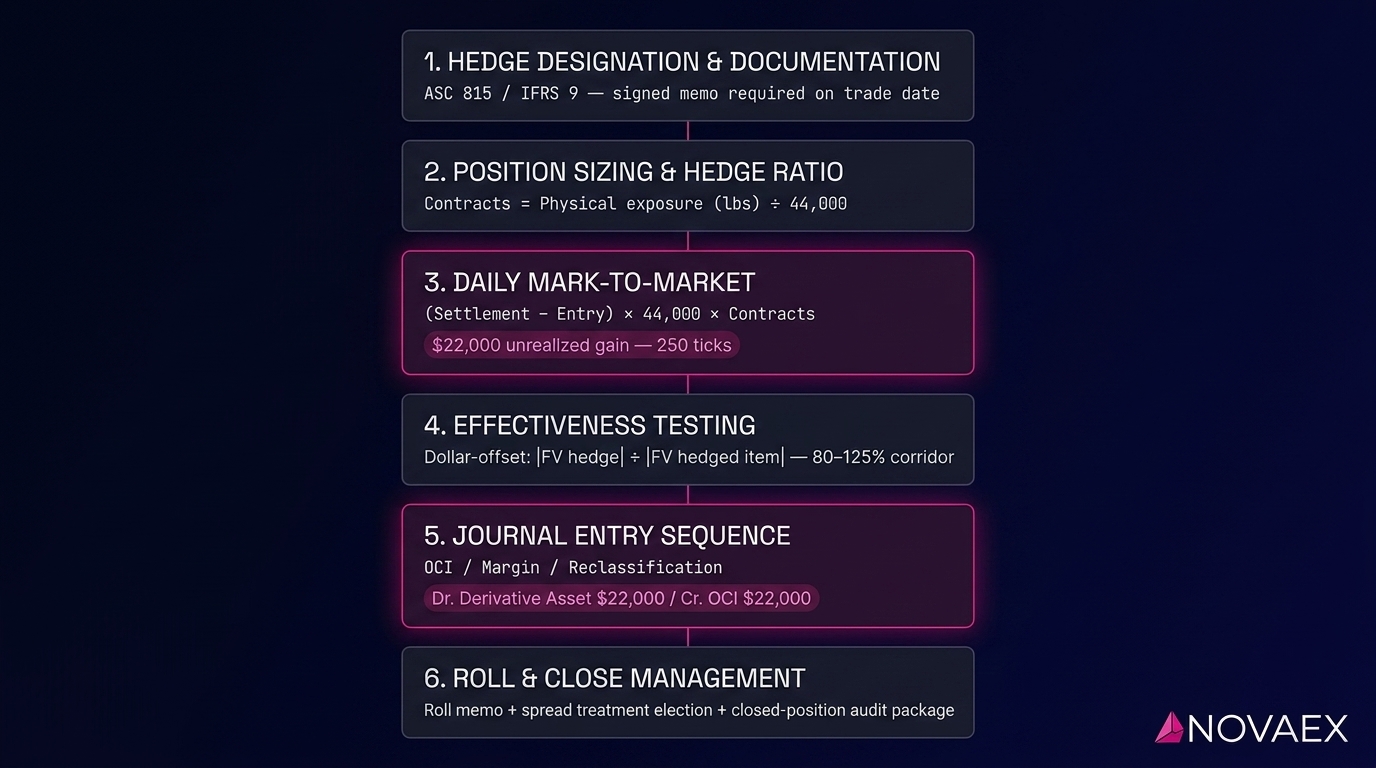
TL;DR: A COMEX aluminum hedge accounting workflow runs six sequential stages: (1) formal hedge designation under ASC 815 or IFRS 9, (2) position sizing using the 44,000-lb contract unit, (3) daily mark-to-market using the $4.40-per-tick value, (4) quantitative effectiveness testing against the 80, 125% corridor, (5) OCI journal entry execution, and (6) roll and close management. Every stage is documented below with specific inputs, calculations, and outputs.
Standard hedge accounting guidance frequently treats aluminum as a generic commodity. Applied to COMEX positions, this approach produces systematic errors: incorrect fair values, disqualified hedging relationships, and adverse audit findings.
COMEX aluminum carries exchange-specific mechanics that alter every calculation in this workflow. Lot size, tick value, and margin convention are not interchangeable with LME or MCX parameters. Applying LME aluminum assumptions to COMEX positions generates incorrect fair values, inaccurate hedge ratios, and failed effectiveness tests.
This document is a desk reference: sequential, named, and executable from designation through settlement. It provides the internal documentation framework for each stage of the workflow.
COMEX Aluminum Contract Mechanics: The Foundation of Every Calculation
No COMEX aluminum hedge accounting workflow is more reliable than the contract mechanics underpinning it. These are the non-negotiable inputs that every downstream calculation depends on.
According to CME Group's official contract specification, the COMEX aluminum futures contract (ticker: ALI) carries the following parameters:
- Contract size: 44,000 pounds of primary aluminum (approximately 19.96 metric tonnes)
- Price quotation: U.S. cents per pound
- Minimum price fluctuation (tick size): $0.0001 per pound = $4.40 per contract
- Trading hours: Sunday, Friday, 6:00 p.m., 5:00 p.m. ET (60-minute break at 5:00 p.m.)
- Settlement: Physical delivery via CME-approved warehouse warrants, or cash-settled equivalent
- Contract months: January, March, May, July, September, December (plus spot month)
- Last trading day: Third-to-last business day of the delivery month
What is the tick value on a COMEX aluminum futures contract?
The tick value on a COMEX aluminum futures contract is $4.40 per contract per tick. This figure is derived by multiplying the minimum price increment ($0.0001/lb) by the contract size (44,000 lbs). A 10-tick move ($0.0010/lb) produces a $44.00 gain or loss per contract; for a 100-contract position, that same 10-tick move equals $4,400.
Convert every settlement price movement into ticks before computing fair value. If tick-based and dollar-offset calculations produce different results, review the contract size assumption for errors before proceeding.
What is the contract size for COMEX aluminum futures?
Each COMEX aluminum futures contract represents 44,000 pounds of primary aluminum. This is the unit that defines hedge ratios, position sizing, and the denominator for per-pound price exposure calculations. COMEX aluminum quotes and settles in pounds rather than metric tonnes. Conversion errors at this stage propagate through every downstream calculation.
Step 1: COMEX Aluminum Hedge Designation and Documentation Under ASC 815
Hedge accounting begins with a formal designation document before any trade occurs. Under FASB ASC 815-20-25, a derivative cannot be retroactively designated as a hedge. Documentation must be completed at or before the date the hedging relationship is entered into. This requirement is non-negotiable and represents the most common root cause of hedge accounting restatements.
According to a 2022 Deloitte derivatives and hedging survey, 70% of companies that restated hedge accounting results cited inadequate inception documentation rather than subsequent measurement errors as the primary cause.
A valid ASC 815 hedge designation requires seven documented elements:
- Risk management objective: e.g., "To hedge exposure to changes in the COMEX aluminum price for forecasted purchases of primary aluminum ingot in Q3 20XX"
- Nature of risk being hedged ; commodity price risk referenced to COMEX ALI settlement prices
- Identification of the hedging instrument ; specific contract month(s), number of contracts, trade date, and execution price in $/lb
- Identification of the hedged item ; the forecasted transaction: quantity in pounds, expected settlement date, and evidence the transaction is probable
- Hedge type ; cash flow hedge (for forecasted purchases) or fair value hedge (for firm commitments with contractually fixed pricing)
- Effectiveness assessment method, all documented on or before trade date
- Reclassification trigger ; the point at which OCI balances transfer to earnings (typically the period in which the hedged purchase affects cost of inventory or COGS)
What documentation is required to designate a commodity cash flow hedge?
To designate a commodity cash flow hedge under ASC 815, a signed hedge designation memo must identify the hedging instrument, the hedged item, the risk being hedged, the hedge type, and the effectiveness assessment method, all documented on or before trade date. Without this memo, the derivative is marked to market directly through P&L with no OCI offset, regardless of how economically effective the hedge performs.
Output of Step 1: A completed, signed, and timestamped hedge designation memo filed on trade date. This document is the audit anchor for every entry that follows.
ASC 815 hedge accounting documentation checklist
Step 2: COMEX Aluminum Position Sizing and Hedge Ratio Calculation
Position sizing converts a physical aluminum exposure in pounds into COMEX contract count. An over-hedge or under-hedge that exceeds the 80, 125% effectiveness corridor will disqualify the relationship and force immediate OCI reclassification to earnings.
Input: Physical aluminum exposure in pounds.
Calculation:
Number of contracts = Physical exposure (lbs) ÷ 44,000 lbs per contract
Example: A manufacturer forecasts purchasing 880,000 lbs of primary aluminum in Q3.
880,000 ÷ 44,000 = 20 contracts
If the physical position is denominated in metric tonnes, convert first using the exact factor:
1 metric tonne = 2,204.623 lbs
For a 400-tonne purchase: 400 × 2,204.623 = 881,849 lbs → 881,849 ÷ 44,000 = 20.04 contracts → round to 20 contracts
Rounding is unavoidable. The residual unhedged exposure (1,849 lbs in this example) flows to earnings and must be disclosed in the designation memo as an intentionally unhedged component.
Hedge ratio calculation:
Hedge ratio = (Contracts × 44,000 lbs) ÷ Physical exposure (lbs)
(20 × 44,000) ÷ 880,000 = 100%
According to IFRS 9 paragraph 6.4.1(c)(iii), an entity must not designate a hedge ratio that reflects an imbalance designed to avoid recognizing ineffectiveness. The ratio must represent the actual quantities used in the hedging relationship, explicitly documented.
Output of Step 2: Number of COMEX ALI contracts, hedge ratio as a percentage, and residual unhedged exposure in pounds. All three figures belong in the designation memo.
Step 3: Daily Mark-to-Market: Fair Value Calculation for COMEX Aluminum Positions
Every business day, each open COMEX ALI futures contract is marked to the CME official daily settlement price. This fair value change drives the balance sheet entry for the derivative asset or liability and feeds the effectiveness test in Step 4.
According to CME Group, daily settlement prices for COMEX aluminum are published by 7:00 p.m. ET and represent the authoritative mark for all margin and accounting purposes.
Input:
- Entry price (execution price in $/lb)
- CME daily settlement price (in $/lb)
- Number of contracts
Fair value calculation:
Fair value change = (Settlement price − Entry price) × 44,000 lbs × Number of contracts
Example: 20 long contracts entered at $1.1200/lb. Today's CME settlement price: $1.1450/lb.
($1.1450 − $1.1200) × 44,000 × 20 = $0.0250 × 44,000 × 20 = $22,000 unrealized gain
Tick verification (must match):
Price move in ticks = $0.0250 ÷ $0.0001 = 250 ticks
250 ticks × $4.40 × 20 contracts = $22,000
If these two methods produce different results, there is a contract size or tick conversion error. Resolve it before posting any journal entry.
Cumulative fair value is tracked from inception for the effectiveness test:
Cumulative FV = (Current settlement − Entry price) × 44,000 × Contracts
Output of Step 3: Daily fair value change per contract and in aggregate, cumulative fair value from inception date, and the derivative asset/liability balance for balance sheet posting.
CME Group COMEX aluminum daily settlement prices
Step 4: COMEX Aluminum Hedge Effectiveness Testing Workflow
Effectiveness testing determines hedge accounting status. A relationship that fails in any reporting period loses its designation, and all deferred OCI gains or losses immediately reclassify to earnings.
Under ASC 815 post-ASU 2017-12, quantitative effectiveness testing is not required every period if a qualitative assessment is supportable. However, for COMEX aluminum hedges, a quantitative dollar-offset test remains the most defensible approach in audit unless a critical-terms match is formally documented at inception.
How do you test hedge effectiveness for COMEX aluminum futures?
Hedge effectiveness for COMEX aluminum futures is tested by dividing the absolute cumulative change in fair value of the hedging instrument by the absolute hypothetical change in fair value of the hedged item. The result must fall within the 80, 125% corridor to maintain hedge accounting qualification. For physically settled COMEX-referenced purchase contracts, a critical-terms match designation can eliminate the need for periodic quantitative testing under ASU 2017-12.
Dollar-offset method calculation:
Effectiveness ratio = |Cumulative FV change of hedging instrument| ÷ |Cumulative FV change of hedged item (hypothetical derivative)|
Example (continuing from Step 3):
- Cumulative FV change of 20 long ALI contracts from inception: +$22,000
- Hypothetical change in fair value of 880,000 lbs at market (the hedged item): (−$0.0250) × 880,000 = −$22,000
Effectiveness ratio = $22,000 ÷ $22,000 = 100% ← Passes the 80, 125% test
Critical-terms match requirements (eliminates periodic quantitative testing):
- Same notional quantity in pounds (exactly matched)
- Same maturity/settlement date
- Same commodity grade (primary aluminum, LME Grade A equivalent or CME-approved)
- Same pricing index (COMEX ALI settlement)
- No credit risk that could invalidate the hedge
Output of Step 4: Effectiveness ratio for the period, pass/fail determination, and written confirmation of whether the qualitative or quantitative method governs the next reporting period.
Step 5: Journal Entry Sequence: OCI, Margin Calls, and Reclassification
The journal entry sequence for a COMEX aluminum cash flow hedge covers three distinct event types: (A) mark-to-market, (B) variation margin activity, and (C) settlement-date OCI reclassification. Each has a different accounting treatment and a different balance sheet destination.
How are COMEX aluminum margin calls recorded in hedge accounting?
COMEX aluminum variation margin calls function as collateral movements rather than hedge accounting transactions. When CME issues a margin call, the journal entry is Dr. CME Margin Deposit (asset) / Cr. Cash. This entry does not affect the derivative fair value account or OCI. Under ASC 815-20-45 and CME rulebook conventions, daily variation margin on futures is treated as daily settlement of the contract, meaning realized gains and losses accumulate in the margin account and must be tracked separately from unrealized OCI entries.
A. Mark-to-Market Entry (Daily):
For a gain on the long position (settlement price increased):
Dr. Futures Contract: Derivative Asset $22,000
Cr. OCI: Unrealized Gain on Cash Flow Hedge $22,000
For a loss (settlement price decreased):
Dr. OCI: Unrealized Loss on Cash Flow Hedge [amount]
Cr. Futures Contract: Derivative Liability [amount]
B. Variation Margin Entry (When CME Issues a Call):
Margin paid out:
Dr. CME Margin Deposit Account $X
Cr. Cash $X
Margin returned:
Dr. Cash $X
Cr. CME Margin Deposit Account $X
Maintain a running reconciliation of the margin deposit account to CME's daily margin statements. Discrepancies between the internal ledger and the CME statement are an audit flag and may indicate position recording errors.
C. OCI Reclassification at Hedge Settlement:
When the hedged purchase occurs (the 880,000 lbs of primary aluminum is received and invoiced), reclassify the accumulated OCI balance to the cost of the hedged item:
Dr. OCI: Cash Flow Hedge Reclassification $22,000
Cr. Cost of Inventory (or COGS, if inventory is consumed immediately) $22,000
This entry converts the hedge gain into a reduction of the effective cost of purchased aluminum. It is the accounting mechanism that delivers the economic outcome the hedge was designed to achieve.
Output of Step 5: Three-entry journal set for each settlement period, margin deposit account reconciled to CME daily statements, and OCI balance fully cleared upon physical purchase receipt.
Step 6: Rolling and Closing COMEX Aluminum Hedge Positions
Physical aluminum purchase timelines rarely align with a single COMEX contract month. Rolling forward is standard practice. It requires specific accounting treatment to avoid inadvertent discontinuation of the hedging relationship.
Roll procedure (execute in sequence):
- Identify roll date: Typically 5, 10 business days before first notice day of the front month
- Close the front-month position: Execute an offsetting sell order (sell 20 contracts if long 20)
- Record close fair value: (Close price − Entry price) × 44,000 × 20 contracts
- Open the deferred-month position: Buy 20 contracts in the next relevant contract month
- Record new entry price: The execution price of the deferred-month contracts
- Amend hedge designation memo: Update contract month, new entry price, new expiration date, and roll spread treatment election
Roll realized gain/loss = (Close price − Original entry price) × 44,000 × Contracts
If the original entry was $1.1200/lb and the front-month is closed at $1.1450/lb:
($1.1450 − $1.1200) × 44,000 × 20 = $22,000 realized
This realized amount remains deferred in OCI if the hedge relationship continues uninterrupted. It does not move to earnings until the hedged purchase occurs.
Roll spread treatment: The price difference between the closed front-month contract and the opened deferred-month contract is a basis component. According to FASB ASC 815-20-25-83A, an entity may exclude the forward points or futures roll spread from the hedge effectiveness assessment and account for the excluded amount using a systematic and rational amortization method. This election must occur at the inception of each roll rather than after observing whether the spread creates ineffectiveness.
Closing the position entirely:
When the hedge is closed and the hedged transaction has occurred, complete the following checklist before period-end close:
- [ ] OCI balance fully reclassified to inventory cost or COGS
- [ ] Margin deposit account reconciled to zero or transferred balance documented
- [ ] Realized roll P&L confirmed against CME trade confirmations
- [ ] Hedge designation memo marked closed with actual settlement date and final cumulative P&L
- [ ] Effectiveness test completed for final period (even if qualitative)
COMEX aluminum front-month roll calendar
Novaex aluminum position roll management workflow
Running This COMEX Aluminum Hedge Accounting Workflow Against Live Positions
Each stage in this workflow produces a defined output that feeds the next. The sequence is deterministic. Omitting or compressing any step breaks the audit trail.
The six outputs in order:
- Designation memo: signed and timestamped on trade date
- Contract count, hedge ratio, and residual unhedged exposure in pounds
- Daily fair value: verified by both dollar-offset and tick calculation methods
- Effectiveness ratio: with method election documented
- Three-entry journal set per settlement period: mark-to-market, margin, and reclassification separated
- Roll memo and closed-position package: with spread treatment election and final OCI clearance
Both represent process failures rather than accounting failures. The appropriate solution is a system that ingests CME settlement prices automatically, calculates fair value and effectiveness ratios without manual intervention, and maintains the designation memo as a living record attached to each position.
Novaex COMEX aluminum hedge accounting module
COMEX ALI futures contract specifications: CME Group
Manual execution of this workflow (settlement prices entered by hand, effectiveness tests maintained in disconnected spreadsheets, designation memos stored outside position records) introduces compounding operational risk at each stage. The exposure is measurable: it surfaces at month-end close, during auditor review, and in fast-moving markets where rolling multiple contracts requires immediate execution while effectiveness documentation must remain current.
This workflow defines the standard. The operational question is whether your systems execute it with the consistency and documentation integrity the standard requires.