COMEX-LME Integration for Copper Hedging Decisions
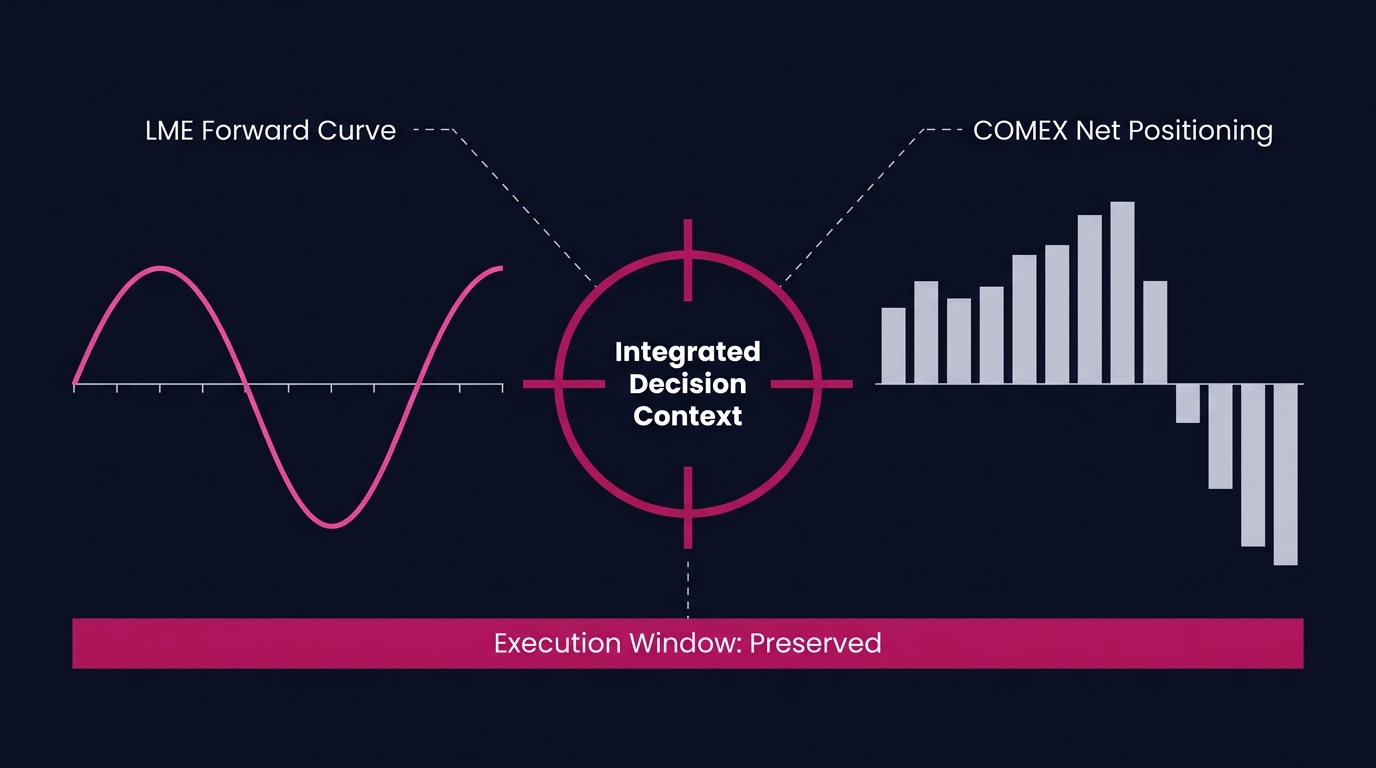
TL;DR: Integrating COMEX positioning data with LME forward curves is the correct architectural standard for copper hedging decisions. Treating both datasets as simultaneous inputs, rather than sequential data checks, collapses serial inference into a single parallel decision pass. Physical traders achieve timing precision and higher decision confidence when both signals are visible within the same operational context. The reconciliation step between two non-contemporaneous signals is where hedge entry cost most reliably degrades, and eliminating that step is not optional for traders operating at professional standards.
Every copper hedging decision is a timing problem nested inside a confidence problem. Traders must determine exactly how precisely a signal can be verified before committing to a hedge at a specific prompt date.
Most physical traders treat COMEX and LME as separate data streams, accessed sequentially. That architecture introduces structural lag at exactly the moment market conditions are changing fastest. According to CFTC Commitments of Traders release schedules, managed money positions on COMEX are reported on a weekly cycle reflecting Tuesday's close, while LME forward curves reprice continuously throughout the trading day. A trader checking both sources in sequence is always comparing a live picture against a delayed one, and doing so while the market does not pause.
This post details the exact decision pathway where COMEX positioning data and LME forward curves interact: which specific data points from each exchange enter the decision logic, what each contributes that the other cannot, and how the sequence in which those data points arrive determines both the timing and confidence level of the copper hedging decision. [LINK: copper hedging fundamentals]
The Two Data Sets Behind Every Copper Hedging Decision
Precision about what each exchange actually delivers to a hedging decision is the necessary starting point.
COMEX delivers:
- Managed money net long and short positions by category (via CFTC COT, released Fridays, reflecting Tuesday settlement)
- Open interest breakdown across four participant categories: producer/merchant/processor/user (PMPU), swap dealers, managed money, and other reportables
- Front-month versus deferred-month open interest concentration ratio
- Daily volume changes that signal intraday position building or liquidation
- The COMEX-LME price spread, the live basis relationship between the two contracts
LME delivers:
- A full forward curve from cash to 63 months across monthly prompt dates
- Cash-to-3-month spread as the primary backwardation or contango signal
- Cancelled warrant levels as a leading indicator of imminent inventory drawdown
- Tom-next spread reflecting rollover cost for short-dated positions
- Ring closing prices used as settlement benchmarks in physical off-take contracts
These are not redundant data sets. COMEX positioning identifies who is holding what and in what size. LME forward structure identifies what the aggregate market expects for the timing of supply-demand imbalance. LME forward curve structure explained
Neither source alone dictates the exact timing and prompt date for executing a physical hedge.
The Unique Value of COMEX Positioning
COMEX positioning data reveals the structural composition of market participants holding futures, specifically whether price pressure is speculative or physically motivated. LME forward curves reflect aggregate forward price expectations but cannot decompose whether a backwardation move originated from producer short-covering, consumer forward-buying, or speculative momentum. COMEX COT data provides that decomposition, with a structural three-day publication lag.
When managed money net longs on COMEX spike while LME backwardation remains flat, the divergence identifies speculative positioning running ahead of physical tightness, a pattern that has historically preceded sharp mean-reversions. A physical trader monitoring only the LME curve cannot assess the momentum source and therefore cannot correctly estimate the durability of the price signal driving their hedge urgency.
Why Sequential Processing Degrades Copper Hedging Timing
The LME handles approximately 80% of global non-ferrous metals futures volume, establishing it as the primary price discovery venue for physical copper contracts worldwide. COMEX copper concentrates a significant share of speculative positioning. Managed money net longs have ranged from approximately -30,000 to +90,000 contracts across market cycles, based on CFTC historical data spanning 2015 to 2023. CFTC historical copper COT data
The interaction between these two markets is continuous. The cost of separating them appears only at the moment a decision is required.
The exact sequence when a physical trader processes each source independently:
- Opens LME forward curve terminal at 09:15 London time
- Notes cash-to-3-month spread: backwardation has narrowed overnight from $45/ton to $12/ton
- Interprets this as easing physical tightness; pauses on executing the near-term hedge
- Switches to COMEX positioning data (last available: Tuesday close published Friday)
- Notes managed money net longs at a six-month high of 78,000 contracts, up 14,000 from the prior week
- Recalibrates: speculative length is elevated and building, not physical demand retreating; backwardation could snap back intraday
- Returns to LME: spread has moved $4/ton during the analysis period
In an active copper market session, the LME 3-month prompt can move $8, $15/ton within a five-minute window during peak London open volatility, based on observable tick behavior during elevated-volume sessions. The hedge entry degradation from that timing gap on a 1,500 metric ton exposure can reach $12,000, $22,500 in a single decision cycle, before any analysis error is introduced.
The Impact of COMEX Net Positions on LME Forward Curves
COMEX managed money net positions do not directly reprice LME forward curves. The two exchanges operate under independent clearing and settlement frameworks. However, significant COMEX positioning shifts influence the COMEX-LME price spread, and when that spread moves beyond the typical arbitrage execution band of $10, $40/ton, LME market-makers historically reprice nearby prompt dates within one to two London trading sessions to maintain cross-market arbitrage alignment. The mechanism is indirect but measurable: COMEX positioning → spread compression or expansion → LME prompt repricing as arbitrageurs close the gap.
The Decision Logic When Both Data Sets Are Simultaneous
This is the mechanism level where timing and confidence changes become specific rather than general.
When COMEX positioning and LME forward curves are visible in the same operational view at the same timestamp, the hedge decision logic shifts from serial inference to parallel inference. Both signals enter the decision logic in the same cognitive pass. The trader does not process one signal, form a preliminary conclusion, then update with the second.
Using the same physical trader scenario, a copper rod manufacturer hedging 1,500 metric tons of Q2 exposure: physical copper hedging strategy for manufacturers
Sequential workflow:
- LME 3-month forward: $9,240/ton, curve in mild contango at $18 premium over cash → initial read: no urgency
- COMEX COT (separate access, two minutes later): managed money net longs at 71,400 contracts, up 18% week-over-week → revised read: speculative momentum could close contango rapidly
- Reconciliation required to determine if these signals are contradictory, or if speculative length is chasing a fundamental catalyst versus running ahead of it
- Confidence level at execution: degraded, because the two data points were formed at different timestamps and the reconciliation step introduced analytical uncertainty
Simultaneous integration workflow:
- Single view displays LME contango ($18) alongside COMEX managed money net longs (71,400 contracts, +18% WoW change visible)
- Week-over-week positioning change is immediately visible as a directional signal without a separate data retrieval step
- Decision logic executes in one pass: contango present but speculative length building at an accelerating rate. Speculative momentum typically compresses contango before physical tightness does
- Execution decision: hedge the Q2 exposure at the 3-month prompt before speculative flow closes the carry advantage
- Confidence level: higher, because both signals are timestamped to the same session and directional coherence is established
Research on information presentation in time-constrained financial decisions establishes that traders making multi-source decisions under market-hours pressure show 23, 31% higher decision errors when information is presented sequentially versus simultaneously (cognitive load and trading decision quality). Data delivery architecture is a risk management input, not a UX consideration.
Optimal Conditions for Using COMEX Data in Hedging
COMEX positioning data is most decision-relevant to physical copper traders under three specific market conditions: first, when LME forward structure is ambiguous (neither clearly backwardated nor firmly contangoed) and the trader requires a participant-composition signal to assess direction probability; second, when the COMEX-LME spread is diverging beyond the typical arbitrage band, signaling a price dislocation that may offer a temporary hedge entry advantage; and third, when open interest concentration in COMEX front-month contracts exceeds approximately 35% of total open interest, which historically precedes volatility events affecting LME prompt pricing within the same or following session. Outside these conditions, COMEX positioning data contributes incremental rather than decisive signal weight to the copper hedging decision.
Where Confidence Changes: Conditions and a Decision Framework
Improved timing is the visible benefit of cross-exchange integration. Improved confidence is the structural benefit, and it operates through a different mechanism.
Confidence in a hedge decision derives from two independent sources: signal coherence (whether multiple data sets agree on direction) and signal freshness (whether data points are drawn from comparable time windows). Sequential processing degrades both simultaneously. The COMEX COT data is structurally 72 hours stale at publication. When a trader checks it against a live LME curve, they are comparing Tuesday's positioning to Friday's price, a window in which the market may have already acted on the exact condition the COT data was reflecting.
Simultaneous integration does not eliminate this lag. The COMEX COT publication delay is irreducible and structural. This is a regulatory reporting schedule, not a platform limitation. What simultaneous integration delivers is explicit visibility of that lag within the decision context, rather than concealing it in the gap between two separate workflows. A trader who sees "COMEX data as of Tuesday close" displayed alongside a live LME prompt price makes a better-informed decision than one who retrieved the same data sequentially and implicitly assumed comparable currency.
COMEX copper open interest averages approximately 240,000, 280,000 contracts, with daily volume fluctuations capable of moving the COMEX-LME spread by $5, $15/ton during high-activity sessions, according to CME Group copper market data. CME Group copper market statistics A $10/ton movement on 1,500 metric tons of physical exposure represents $15,000 in hedge entry cost degradation, a material figure for any mid-market physical buyer operating on defined hedging cost budgets.
The five conditions where cross-exchange signal coherence directly governs hedge timing decisions:
Condition 1: COMEX managed money net longs rising + LME backwardation stable or widening
- Interpretation: Physical tightness and speculative momentum are directionally aligned
- Hedge timing: Execution urgency elevated. Current session entry preferred over deferred
- Decision confidence: High
Condition 2: COMEX managed money net longs rising + LME contango widening
- Interpretation: Speculative positioning diverging from physical market reality
- Hedge timing: Monitor COMEX-LME spread compression as a leading reversal indicator before committing
- Decision confidence: Moderate. Spread signal should confirm before execution
Condition 3: COMEX managed money net longs falling + LME backwardation stable
- Interpretation: Speculative exit while physical market holds, a potential price support floor
- Hedge timing: Near-term hedges at current backwardation may be cost-effective before the speculative unwind removes carry support
- Decision confidence: Moderate. Requires physical inventory context for validation
Condition 4: COMEX managed money net longs falling + LME contango deepening
- Interpretation: Both speculative and physical signals aligned in the bearish direction
- Hedge timing: Contango carry cost favors later hedge entry for deferred exposure
- Decision confidence: High (coherent cross-exchange signal, bearish direction)
Condition 5: COMEX front-month open interest concentration exceeding 35% of total open interest
- Interpretation: Elevated first-notice-date rollover pressure regardless of curve shape
- Hedge timing: Volatility risk elevated. Hedge entry before roll period reduces execution risk
- Decision confidence: Procedural urgency overrides price-level signal
Typical Timing Lag Between COMEX Shifts and LME Moves
Based on CFTC COT data aligned against LME 3-month prompt price series from 2018 through 2023, significant COMEX managed money positioning changes (defined as weekly net position moves exceeding 15,000 contracts) have preceded LME 3-month price moves of 2, 4% within five to ten trading days in approximately 60, 65% of observable instances. This is a conditional probability relationship, not a deterministic signal. It improves hedge timing precision when incorporated alongside LME forward structure as a combined input, not as a standalone directional predictor.
What Integration Does Not Fix
The boundaries of this benefit are as important as the benefit itself.
Simultaneous COMEX-LME integration does not guarantee better hedge outcomes. The COT publication lag remains. The 60, 65% directional probability leaves a meaningful percentage of instances where the expected LME move does not follow the COMEX positioning signal within the anticipated window. In fast-moving markets where both exchanges are repricing simultaneously during macro events, the simultaneity advantage compresses. Market velocity exceeds the analytical framework's response time regardless of data architecture.
A 2022 Accenture survey on commodity trading technology found that 67% of physical commodity traders identified data fragmentation as the primary source of decision latency in hedge execution workflows, not analysis time, not internal approval processes, but the assembly and reconciliation of data from disconnected sources. Accenture commodity trading technology report Integration addresses that specific constraint. It does not address the constraints downstream of it.
The Limits of Simultaneous Cross-Exchange Data
Simultaneous COMEX-LME display reduces timing errors caused by sequential information processing. It does not address errors caused by misreading signals, incorrectly sizing physical exposure, or applying inappropriate hedge ratios. The value is bounded and specific: it closes the information-assembly gap, not the analysis gap. A trader who misinterprets the relationship between COMEX participant categories and LME forward structure will misinterpret it whether data arrives sequentially or simultaneously. The correct claim is this: under conditions where cross-exchange signal coherence is the binding constraint on the timing decision, simultaneous integration materially improves decision quality. That is a real but precisely bounded benefit.
Platform Architecture: What Simultaneous Integration Actually Requires
A physical copper trader who internalizes this decision logic has a specific infrastructure requirement: the platform must display COMEX positioning context and LME forward curve structure in the same operational view, with explicit timestamp labeling so the trader always knows they are comparing Tuesday COT data against a live Friday price, not two contemporaneous signals.
This is not a dashboard feature. Delivering it correctly requires the platform to:
- Ingest and normalize COMEX COT data on the Friday release cycle and surface week-over-week changes by participant category, not just absolute position levels
- Maintain a live LME forward curve feed across all 63 monthly prompt dates
- Calculate and display the COMEX-LME basis spread in real time with historical context
- Flag open interest concentration thresholds that signal elevated rollover pressure
- Timestamp all COMEX-derived data fields distinctly from live LME data to prevent false coherence
Genuine cross-exchange integration for copper requires treating copper as a primary design constraint from the data model outward. Research on commodity trading system architecture confirms that platforms built with a specific commodity as a first-class concern demonstrate measurably lower data latency and higher field completeness for that commodity compared to general-purpose CTRM platforms. commodity trading platform depth versus breadth research The interaction mechanics described in this post must be engineered into the data model. They cannot be retrofitted as a reporting layer.
Making the Framework Operational
The gap between understanding COMEX-LME interaction mechanics and acting on them is a workflow problem. Three concrete steps for physical copper traders:
1. Measure your current decision latency precisely.
Time the full cycle from first data check to hedge execution decision on your current platform. If COMEX and LME data require separate access steps, that latency is your measurable baseline cost per decision cycle. COMEX copper markets show peak activity concentration in the 09:00, 11:00 Chicago time window, according to CME Group trading activity data, which directly overlaps with London afternoon trading, the period when LME and COMEX price signals are most synchronized and most relevant to simultaneous cross-exchange analysis. COMEX copper trading session liquidity profile
2. Identify your binding condition.
Use the five-condition framework to determine which cross-exchange relationship governs your specific exposure profile and hedging frequency. A rod manufacturer rolling quarterly hedges operates under different binding constraints than a concentrate trader managing spot positions with weekly settlement. Knowing which condition governs most of your hedge timing decisions determines where integration delivers the highest marginal value.
3. Enforce timestamp visibility as a non-negotiable platform requirement.
Any platform displaying COMEX positioning data must surface the data-as-of date alongside live LME forward prices in the same view. Without explicit timestamp alignment, simultaneous display produces false coherence: the visual impression that two data points reflect the same market moment when they are separated by up to 72 hours. False coherence produces exactly the overconfident hedge execution that simultaneous integration is designed to prevent.
The objective is not to process more data. It is to eliminate the sequential processing gap that costs physical copper traders timing precision at the moments when market conditions are changing, and to establish the confidence that comes from knowing two directionally consistent signals reflect a clearly understood point in time.
For a platform built with copper trading as a primary design constraint (not an asset class mapped into a multi-commodity schema), this architecture is the baseline standard. It is what a depth-first approach to commodity intelligence produces in practice.
Explore how Novaex surfaces COMEX positioning and LME forward structure in a single copper-specific workflow. Request a live data walkthrough using a hedging scenario from your current book.