Copper curve tightens: what cash minus three-months, cancellations and premiums say
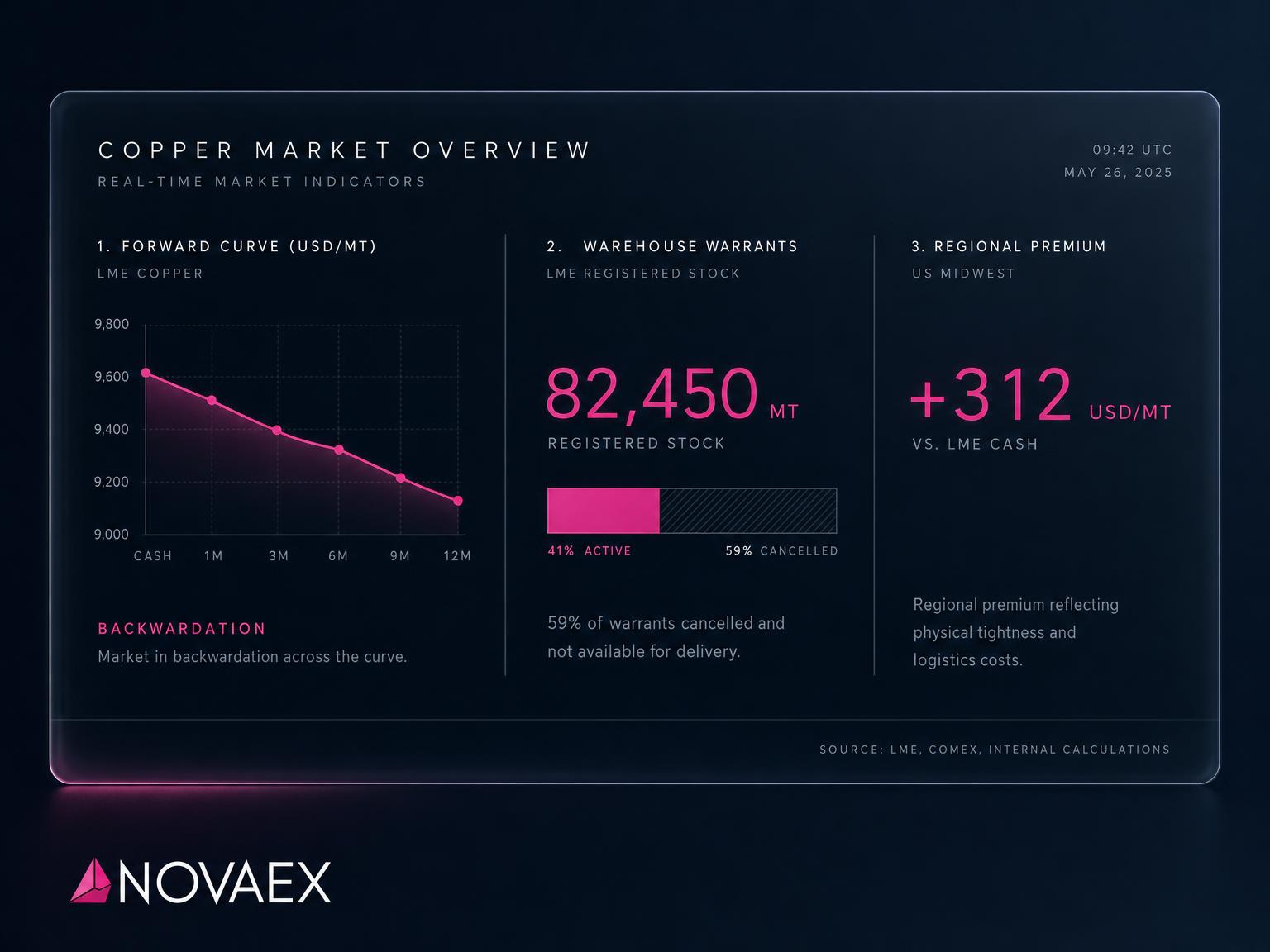
Cash to three-months, cancelled warrants and the regional premium rarely agree. Here is how to read the three together and set copper hedge cover.
When the warehouse, the curve and the regional premium disagree, hedge cover comes down to one call: which contract, on which exchange, for which quotation period. Cash tightness says buy prompt. Cancelled warrants say metal is already spoken for. The regional premium says it may still move. Read the three together and you hold cover at a cost. Read one alone and you learn the rest at month-end.
What is the cash to three-month spread actually pricing?
The cash to three-month spread prices prompt availability in the LME warehouse network. When cash trades above three-month, the market pays to hold metal now rather than later. That premium is backwardation, and it is the direct cost of being short prompt.
That cost ran hard through August. The spread touched $545 a tonne, the widest since 2021, then settled at a $248 a tonne backwardation after more than 20,000 tonnes was placed on warrant in a single day, the largest one-day build since April collapse of the copper backwardation. On-warrant stock was still down roughly 75% from its mid-April peak in the same account. Tom/next, the cost of rolling one day forward, printed $110 before closing at a $79 premium.
For a risk owner the read is narrow. A wide cash to three-month backwardation raises the cost of rolling a short hedge forward and punishes a quotation period mismatch. If your sale prices on cash and your hedge sits three months out, the gap is paid in margin.
What does it mean when half the warrants are cancelled?
A cancelled warrant is metal earmarked to leave the LME warehouse network. It is still in the shed, but it is no longer offered to the market.
Recent reports put cancelled warrants at 50% of total LME copper stocks, at 240,250 tonnes, concentrated in US and Asian locations metal earmarked to exit LME. That matches the pattern seen through July, when on-warrant stocks fell toward 102,000 tonnes and most cancellations sat in Asia.
Cancelled share matters more than headline stock. Headline stock counts metal that is already booked out. Available stock is what is left. When half the board is cancelled, a modest headline figure overstates what can be bought prompt by half. Check on-warrant and available separately, by location, before you judge cover adequate.
Why is China paying up while the US premium cools?
The Yangshan premium is the fee paid on top of benchmark prices to bring refined copper into China. It measures real import pull.
That pull strengthened into early October. The Yangshan copper premium rose 7% to $118 a tonne, its strongest in almost four years, with LME three-month copper at $14,237 a tonne China import premium hits high. Buyers were restocking after a pullback from record levels, according to the same account.
At the same time the premium US buyers paid on COMEX over LME benchmarks cooled, with inflows into COMEX warehouse stocks slowing after Reuters reported the White House had still not decided whether to place tariffs on refined copper. When one regional premium rises and another fades, shipments redirect toward the higher-paying market. Metal follows the premium, and the LME prompt tightens or loosens on the flow.
LME and MCX are live on screen at Novaex, with COMEX and SHFE computed into the cross-exchange arbitrage view. The distinction matters here. The decision is where metal will land next, not only where it sits now.
Two readings of the same three signals
Reading one: this is physical tightness. Cancelled warrants say deliverable stock is thin, cash to three-month says the market pays for prompt units, and Yangshan says China will pull units east. Under this reading, keep hedge cover close-dated, keep quotation periods matched to physical pricing, and do not run short prompt into a date where liquidity concentrates.
Reading two: this is a paper squeeze that deliveries cure. August showed the mechanism. At $545, selling prompt and buying back forward finally paid more than holding metal for a US tariff decision that has still not arrived. Over 20,000 tonnes answered in a day and the spread halved. Under this reading, chasing cash extends cover at the worst moment, and staggered forwards with room to take delivery hold up better.
Both readings use the same inputs. The difference is whether cancelled metal has left for good or returns when the backwardation pays it to return.
What to square before you extend cover
Check three lines against each other. First, your quotation periods against the forward positions hedging them, date by date. Second, on-warrant stock by location against cancelled share, not headline stock alone. Third, your exchange choice against the regional premium, with the COMEX-LME and SHFE-implied arb computed to show where the next pull comes from.
Where the three point the same way, extend. Where they disagree, hold the tenor short and recheck on fresh warehouse data.
FAQ
How do I hedge copper in backwardation?
Match the hedge tenor to the physical quotation period first, then carry less short prompt than in a flat curve. Backwardation charges you each time a short prompt position is rolled, so a mismatched sale priced on cash against a hedge three months out leaks margin while the spread stays wide.
Do cancelled warrants mean a real shortage?
Not on their own. Cancellation means intent to withdraw, and metal often re-warrants when the spread pays it to return, as August showed. Treat a high cancelled share as a warning on available prompt stock by location, and confirm against on-warrant tonnage and the cash to three-month level before adding cover.
Should I switch the hedge to another exchange when premiums diverge?
Only when the physical can follow. A rising Yangshan premium pulls cathode east and a cooling COMEX premium slows flows into the US, which feeds back into LME prompt tightness. Price the switch on the premium net of freight, duty risk and quotation-period terms, not on the headline spread alone.
Three signals, one position. Square physical, hedge and broker line by line and the curve stays a cost to manage. The trail is there to check the working.