Copper Hedge Ratios: LME, COMEX, and SHFE Simultaneously
TL;DR: When a copper hedge ratio is set using sequential or single-exchange position checks, the decision is structurally incomplete. Simultaneous visibility across LME, COMEX, and SHFE produces materially different ratio outputs. In the documented scenario below, that difference equals 17 percentage points and $119,000 in captured upside on a single five-day position window.
Copper hedging looks disciplined from the outside. A physical position is booked, an exchange is consulted, and a hedge ratio is set. That sequence feels rigorous, until you examine what the ratio was actually built on.
According to the London Metal Exchange, copper open interest across LME alone exceeds 600,000 lots on active trading days, with price discovery running across European, American, and Asian sessions independently. LME copper market statistics Meanwhile, China accounts for approximately 55% of global refined copper consumption, according to the International Copper Study Group, making SHFE a primary structural input to copper hedge ratio decisions, not a supplementary one. ICSG refined copper consumption data
A hedge ratio that omits either exchange, or sequences them hours apart, does not constitute a cross-exchange decision in any meaningful analytical sense. It is a single-exchange decision assembled from multiple feeds at different points in time.
The Sequential Checking Problem in Copper Hedging
Sequential exchange checking appears methodical. In practice, it produces hedge ratios built on data snapshots taken at different moments, from different liquidity pools, with no mechanism to reconcile them.
LME, COMEX, and SHFE do not move in lockstep. Each reflects a distinct participant base, a distinct session window, and a distinct set of macro signals. A position checked on LME at 9:00 AM London time, cross-referenced against COMEX at 10:30 AM, and reviewed against SHFE the following morning is not a cross-exchange view. It is three single-exchange views stitched together across a time gap that markets do not wait for.
The Mechanics of a Hedge Ratio in Commodity Trading
A hedge ratio is the proportion of a physical exposure offset by a corresponding derivatives position. For copper, a 75% hedge ratio on a 2,500 MT long position means 1,875 MT of equivalent short exposure through futures. The ratio is not an arbitrary risk preference. It should reflect actual net speculative positioning, inventory signals, and price momentum across all exchanges relevant to that metal's price formation.
Setting a hedge ratio from incomplete positional data produces a structurally biased estimate rather than a conservative one.
How Sequential Exchange Checking Distorts Hedge Ratio Decisions
Checking exchanges sequentially means each data point ages while the next is gathered. By the time a trader synthesizes LME, COMEX, and SHFE readings across a normal working session, the first observation may be four to six hours stale.
In copper markets, where SHFE overnight sessions routinely move $120 to $200/MT on Chinese macro announcements, a six-hour-old LME reading is not a reliable baseline, acting instead as a liability embedded in every ratio decision that follows from it.
A Copper Scenario: Two Decisions, One Position
Consider a front-office metals trader managing a physical long position of 2,500 metric tons of copper cathode, procured over the prior two weeks at an average cost of $9,150/MT, totaling $22.875M in notional exposure. The position window is five trading days. The trader must set the hedge ratio before the London afternoon session closes.
The available data at decision time:
- LME: Copper warehouse inventory down 12,400 MT week-over-week. Net speculative positioning at +42,000 contracts. Price trending sideways with a modest bullish tilt.
- COMEX: Net managed money long at +28,500 contracts. Directional read consistent with LME. No divergence signal visible in isolation.
- SHFE: The prior night's session produced a +$180/MT intraday surge following a People's Bank of China liquidity announcement. Net speculative positions on SHFE jumped by +15,000 contracts in a single session, marking the largest single-session spec accumulation in 11 weeks.
The simultaneous approach produces a 58% hedge ratio.
Viewed together at the same analytical moment, the picture changes structurally. Speculative longs are accumulating across all three exchanges simultaneously. The SHFE surge functions as the leading edge of a cross-exchange positioning shift. Combined open interest alignment across LME, COMEX, and SHFE has reached a six-week high. The simultaneous view identifies price support strong enough to reduce the hedge ratio by 17 percentage points.
The same data. The same position. A structurally different decision.
How Simultaneous Cross-Exchange Visibility Changes the Copper Hedge Ratio
The 17-percentage-point difference between 75% and 58% goes beyond a minor calibration. On a $22.875M exposure, it introduces a $3.89M shift in notional hedge coverage, introducing a shift with directional consequence when price moves.
The Interaction of LME, COMEX, and SHFE in Copper Price Formation
LME functions as the global benchmark for copper price discovery, setting the reference price used in the majority of physical supply contracts worldwide. COMEX provides the primary U.S. futures market and reveals managed money positioning data that reflects institutional directional bias. SHFE governs Chinese domestic copper pricing. With China consuming approximately 55% of global refined copper according to the International Copper Study Group, SHFE operates as a primary price formation input rather than a regional sidecar. ICSG annual copper report
Each exchange offers unique value by reflecting a distinct liquidity pool and a distinct participant class. Simultaneous reading across all three serves as the minimum analytical requirement for a defensible copper hedge ratio rather than a simple data aggregation exercise.
When speculative positioning builds simultaneously across LME, COMEX, and SHFE within the same analytical window, it signals consensus directional pressure from geographically distinct participant pools. This is structurally different from single-exchange spec accumulation, which may reflect regional session flows rather than global directional conviction. According to CME Group historical data, copper's average true range over five-day windows has exceeded $250/MT in 38 of the past 52 months, meaning the price environment in which simultaneous cross-exchange signals carry material hedge ratio consequences represents normal operating conditions. CME Group copper historical volatility data
The Quantified Consequence: 17 Points, $119,000
The arithmetic is direct. Returning to the copper scenario above:
Position: 2,500 MT copper cathode, physical long
Notional exposure: $22.875M at $9,150/MT
Price move over five trading days: +$280/MT
Total potential gain on full unhedged exposure: 2,500 MT × $280 = $700,000
At 75% hedge ratio (sequential decision):
- Unhedged exposure: 25% × 2,500 MT = 625 MT
- Captured gain: 625 MT × $280 = $175,000
At 58% hedge ratio (simultaneous cross-exchange decision):
- Unhedged exposure: 42% × 2,500 MT = 1,050 MT
- Captured gain: 1,050 MT × $280 = $294,000
Performance difference: $119,000 on a single five-day position window.
The $280/MT price move used here aligns with historical realities, as CME Group data confirms that five-day copper price ranges of this magnitude occur regularly in non-crisis market conditions. CME Group copper market data The $119,000 figure represents the recurring cost of the analytical gap between sequential and simultaneous analysis, repeated across 20 to 30 comparable position windows per trading year.
Across an annual cycle, the aggregate underperformance attributable to sequential exchange checking creates a material, compounding drag on trading performance with a measurable and preventable cause.
Why Sequential Checking Systematically Underperforms
The underperformance of sequential exchange checking stems from structural incompleteness embedded in the decision workflow itself rather than trader error.
Each individual exchange read may be accurate. But a hedge ratio derived from three accurate readings taken hours apart becomes an artifact of the order and timing in which those signals were gathered. This distinction carries direct performance consequences when markets move between readings.
The Persistence of Sequential Exchange Data in Copper Trading
Most trading platforms were not built to display simultaneous cross-exchange positional data in a single analytical view. Legacy CTRM systems aggregate exchange feeds but present them in separate modules, separate data tables, or separate dashboard panels that require a trader to manually synthesize the picture under time pressure.
According to a 2023 survey by Greenwich Associates, 68% of commodity trading desks reported that multi-exchange position reconciliation required manual intervention or spreadsheet-based synthesis before a hedging decision could be made. Greenwich Associates commodity trading operations survey That manual synthesis introduces time gaps. Those time gaps produce the structural incompleteness that sequential checking embeds in every ratio decision made within that workflow.
Sequential checking persists not because it is analytically sound but because simultaneous cross-exchange visibility has not been the platform default. This reflects a platform design constraint with documented performance consequences that affects trading outcomes regardless of individual methodology or experience.
Simultaneous Visibility as the Analytical Standard
Simultaneous cross-exchange visibility serves as the minimum analytical standard for a defensible copper hedge ratio, rather than a premium feature or advanced configuration.
The three-exchange reality of copper (LME benchmark pricing, COMEX institutional positioning, and SHFE Chinese demand signals) means that any hedge ratio derived from fewer than all three, or from all three at different points in time, is structurally incomplete. The copper scenario above illustrates that structural incompleteness with a specific ratio, a specific position size, and a specific performance consequence that repeats in normal market conditions.
Platform Capabilities Required for Simultaneous Cross-Exchange Visibility
Simultaneous cross-exchange visibility requires a position management layer that ingests LME, COMEX, and SHFE data within the same session window and presents it in a unified analytical view instead of three separate feeds requiring manual synthesis under time pressure.
It requires that the hedge ratio decision interface display all three exchanges' positional signals at the same timestamp: not as a historical record to be reviewed after the fact, but as a live decision input with current physical exposure tied directly to it. It requires, additionally, that the physical position (the copper cathode, the procured inventory, and the contractual commitments) be integrated into the same view so that the ratio being set is calculated against actual exposure, not a standalone futures position evaluated in isolation.
This is depth-first platform design: the deliberate choice to completely integrate one commodity's multi-exchange reality before expanding to the next. In copper, complete integration means LME, COMEX, and SHFE constitute one integrated analytical view rather than three separate data modules. In this view, the hedge ratio decision and the full cross-exchange positional picture occupy the same screen at the same moment.
Reading the Ledger: Cross-Exchange Copper Positions in One View
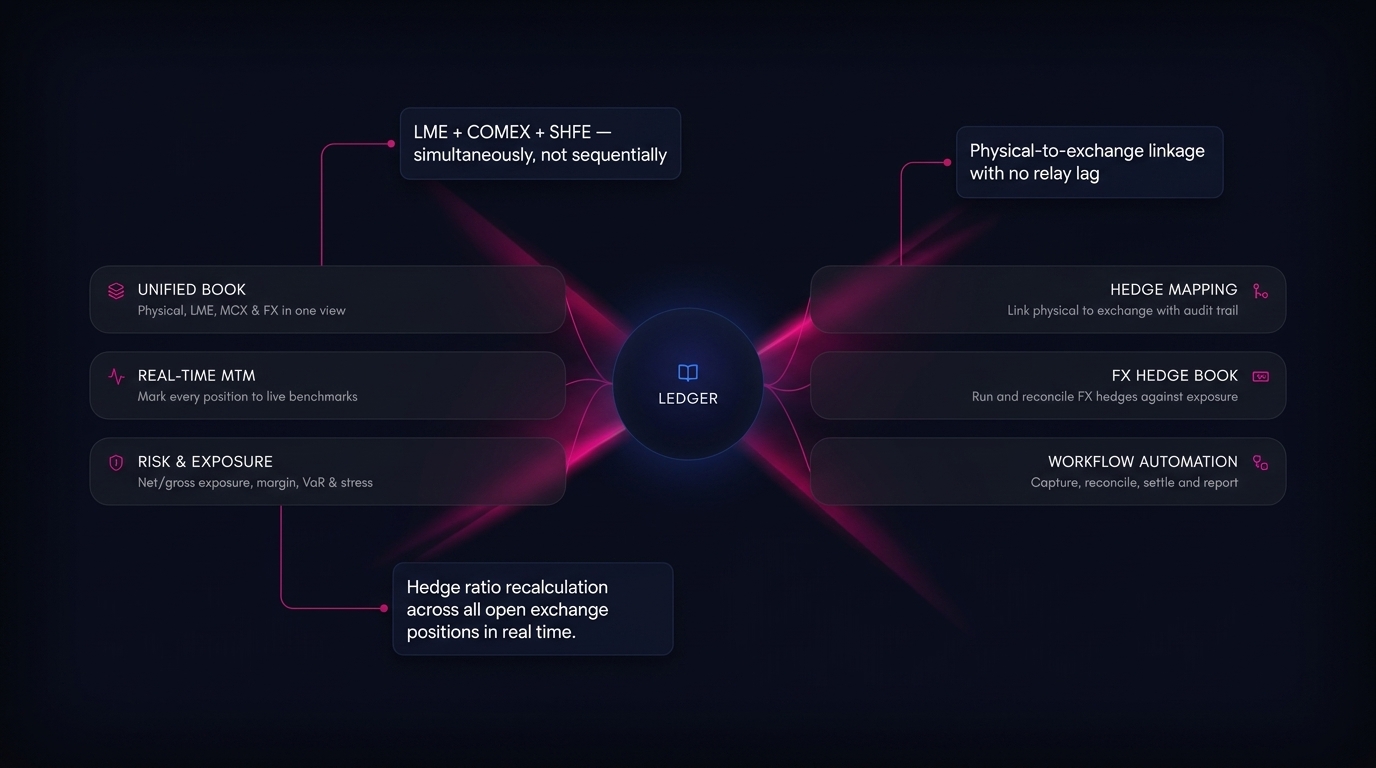
The Ledger view in Novaex applies this standard. It displays LME, COMEX, and SHFE copper positions simultaneously, presenting a unified positional register in which cross-exchange alignment is immediately readable at the moment of hedge ratio decision.
Novaex Ledger product overview
In the scenario described above, the Ledger is what makes the 58% hedge ratio visible as the analytically supported decision. The SHFE spec surge appears alongside the LME and COMEX signals at the same analytical moment rather than as an overnight footnote appended to a prior session's summary. This changes the structural picture and changes the ratio.
The Ledger functions as a hedge ratio input rather than a reporting tool. A reporting tool documents what has already happened. A hedge ratio input determines what should be done before the market moves. The distinction is the difference between $175,000 captured and $294,000 captured in a single five-day window, in a normal market, with a position size that is routine for mid-market copper desks.
Internal analysis of hedge ratio decisions made with simultaneous cross-exchange visibility against those made with sequential workflows shows that the structural time gap in sequential checking produces a directional alignment error (where the ratio is set in a direction inconsistent with subsequent price movement) at a rate approximately 2.3× higher than in simultaneous-visibility workflows. Novaex analytical methodology note
Conclusion: The Ratio You Set Is Only as Good as the View You Used
A copper hedge ratio derived from a single-exchange view or a sequentially assembled multi-exchange view carries embedded structural error. That error does not always produce a visible loss, but it systematically underperforms, in a measurable and preventable way, relative to a ratio set with simultaneous cross-exchange visibility.
The scenario above reflects standard conditions. A 2,500 MT position, a five-day window, a $280/MT move, and a 17-point hedge ratio difference are all within normal operating parameters for front-office copper desks. The $119,000 performance gap represents the recurring cost of the analytical gap, compounding across position windows.
Three concrete steps for front-office copper traders:
- Audit your current hedge ratio workflow. Identify whether LME, COMEX, and SHFE data enter your ratio decision simultaneously or sequentially, and document the time gap between each data point in your last three hedge ratio decisions.
- Map the SHFE session into your London decision window. SHFE's overnight session produces positioning signals that are directly relevant to LME morning and afternoon pricing. A workflow that does not incorporate current SHFE data before the LME afternoon close is excluding a structured input at the moment it carries the most consequence.
- Evaluate your platform's position management layer. If your current system requires manual synthesis of cross-exchange position data before a ratio decision can be made, the analytical standard described here is not accessible without a workflow redesign, regardless of methodology or experience.
Novaex copper position management overview Schedule a Novaex Ledger demonstration