Copper premium 2027: what an LME hedge leaves floating in your delivered cost
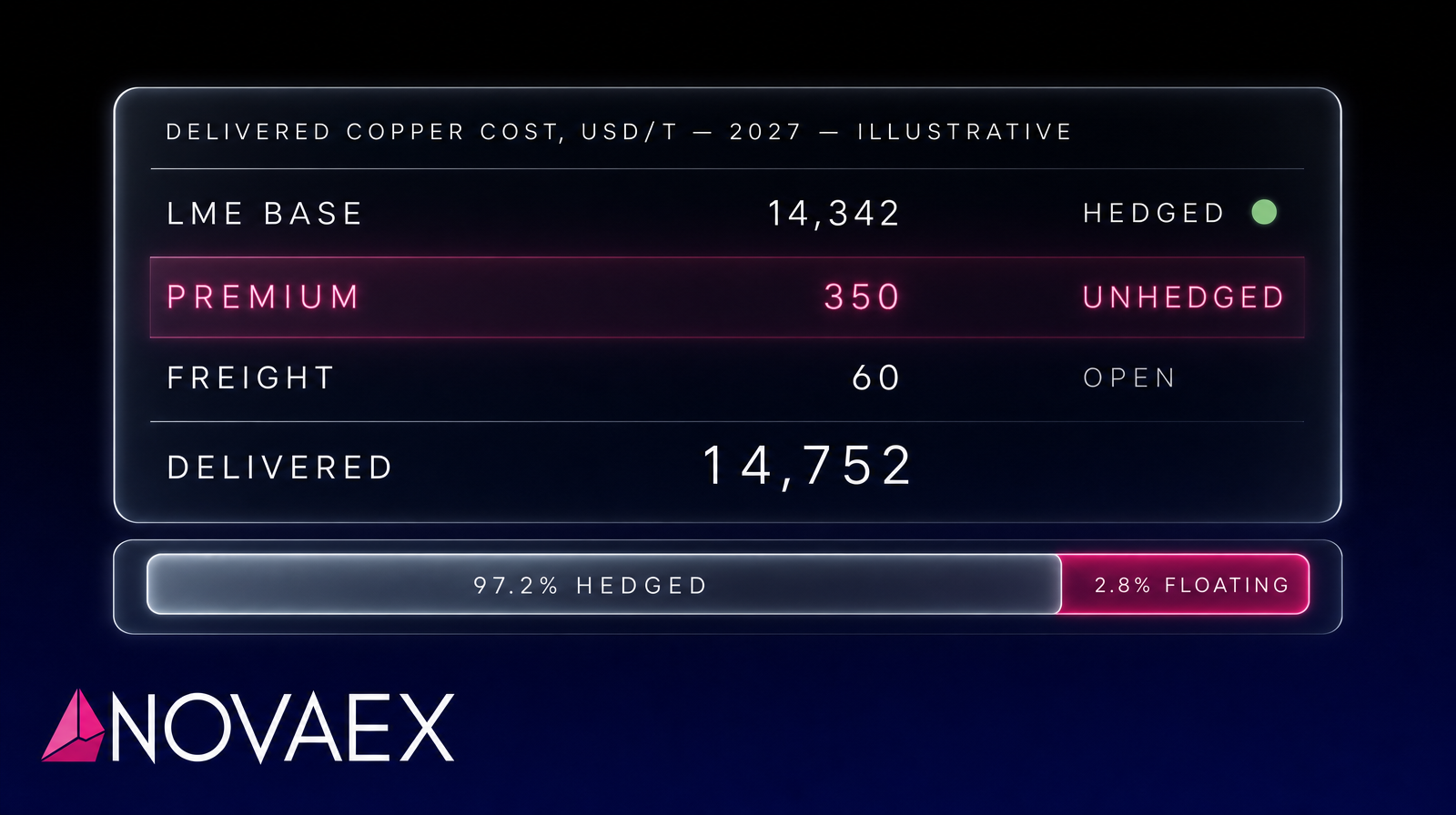
Codelco's reported 2027 European premium is $350 a tonne. Here is what that does to a fixed-price contract, and what to settle before terms close.
Codelco's reported 2027 European copper premium is $350 a tonne, up $25 from $325 this year. Aurubis is at $347, up from $315. An LME hedge fixes only the LME line of a delivered copper cost. The premium and freight stay open until contract terms fix them, so a fixed-price sale can lose margin on a fully hedged book.
What is the 2027 copper premium, and what was it this year?
Codelco's reported 2027 European premium for refined copper is $350 a tonne, up $25 (7.7%) from $325 for 2026. Aurubis's is $347, up 10% from $315. Both are paid on top of the LME price, and both are records.
The Codelco figure comes from Reuters reporting on 20 October 2026, which cites two people with knowledge of the matter. Codelco had not confirmed it at the time, so read it as reported, not published. The Aurubis figure comes from Reuters on 14 October 2026, citing three market sources.
Against an LME three-month price of $14,342 on 19 October, $350 is about 2.4% of the metal price. Reuters ties the rise to tight European supply, with metal shipped to the US ahead of possible import tariffs. How long that pull lasts depends on tariff decisions that have not been made, so treat it as a scenario, not a forecast.
Physical premium and value-added product terms are normally concluded by the end of November, per CRU. That is the window this note is written for.
Why doesn't an LME hedge cover the premium?
An LME hedge fixes the exchange price of the copper. The premium is what a supplier charges on top to deliver physical cathode to a European consumer, and it is set in the supply contract, not on the exchange. A book can be fully hedged on LME and still carry a floating line.
The LME's own hedging workshop material shows the same split for consumers buying cathode at LME plus a fixed premium: futures manage the price risk, and the premium is fixed separately. Where it is not fixed in the contract, nothing in the hedge touches it.
So the delivered cost has three lines. LME base, premium and freight. Only the first one is hedged.
What does that do to margin on a fixed-price contract?
Take a cable maker buying 1,200 t of cathode for 2027 and selling on fixed prices. The numbers below are illustrative. LME is the $14,342 level from 19 October, freight is an assumed $60 a tonne, and the sale price was built on the 2026 premium of $325 with a $150 a tonne metal margin.
Line USD/t 1,200 t (USD) Status
LME base 14,342 17,210,400 Hedged
Premium 350 420,000 Unhedged
Freight 60 72,000 Unhedged
Delivered cost 14,752 17,702,400 97.2% hedged
The sale price was 14,342 + 325 + 60 + 150 = $14,877 a tonne. With the premium at $350, delivered cost is $14,752 and the margin is $125. That is $25 a tonne, or $30,000 across 1,200 t, one-sixth of the margin gone on a book the desk would report as fully hedged.
The hedge did its job. LME copper is up 17% this year and the hedged line is fixed. The gap is in the reading: coverage is 100% on the LME line and 97.2% on the delivered cost.
The floating lines are $410 a tonne against a $150 margin. They are 2.8% of delivered cost, and the margin is about 1% of the sale price. Every $10 a tonne the premium moves is $12,000 on this book, so the open 2.8% is larger than the whole margin.
What can a cost owner do before terms close?
Three decisions, in this order.
Lock the premium terms
Ask the supplier to fix the 2027 premium for the full volume, and freight with it, in the contract. A premium reviewed each quarter is a floating line again, only on a slower clock. The end-November window is when those terms are normally concluded, so that is when the conversation is cheapest to have.
Match the quotation period
The LME leg is priced over the quotation period in your supply contract, for example the average of the month of shipment. The hedge should sit on the same days and the same tonnage, and the sale should price against the same reference. Where the three differ, basis moves in the gap and the hedge reads as covered when it is not.
Decide what to hedge and what to accept
Some floating cost is acceptable if you have chosen it. Write down how much you will carry, in dollars, against the margin on the contracts it touches. If the open lines are bigger than the margin, as in the example, the fixed-price sales are where to close them.
Check the sale terms as well. A premium pass-through clause moves the line to your customer. A fixed all-in price leaves it with you.
How do you see this on your own book?
Ledger holds physical, hedge and broker books as one reconciled position, so the delivered cost and the coverage on it sit together, with the trail behind each line. That is where the 97.2% shows up before month-end. Pulse makes the per-metal call: which contract to hedge in, and when, with live LME and MCX pricing on screen.
nNovaex pulse for which contract, and when.
Live prices for the base line as it moves.
Spreadsheet for the lines from this example, to put your own numbers through.
Worth closing the premium line before the window shuts. Seeing it run on your own book is a call away.