Copper TC/RC at $0: which number should a producer's book carry for 2027?
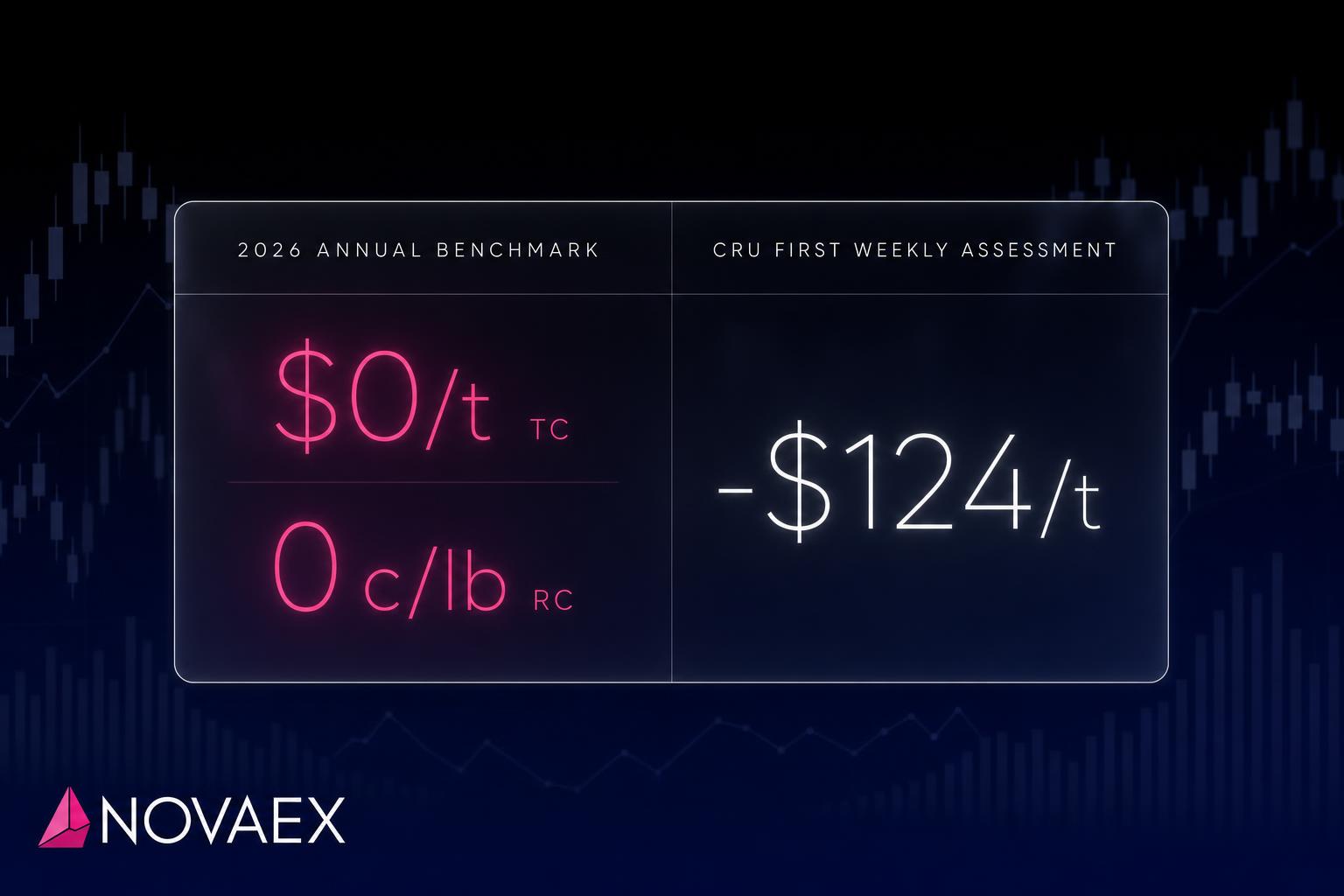
The 2026 benchmark settled at $0 a tonne. Spot is deeply negative, and CRU now assesses it weekly. Here is how to carry each tonne before the 2027 terms are printed.
The 2026 annual copper concentrate benchmark settled at $0 per tonne, while spot terms sit deeply negative: the SMM weekly index read -$231.68/dmt on 30 September. A producer's book should carry the number each contract actually pays on. Fixed terms for the benchmark tonnes, the named assessment for index-linked tonnes, and the gap between them shown as its own line.
What did the 2026 copper benchmark settle at, and where is spot?
The annual treatment charge settled at $0 per tonne and the refining charge at 0 cents per pound, the first zero on record according to Skillings Mining Review. The IEA puts it as the lowest benchmark ever agreed, with spot terms negative since 2024.
Spot has kept falling underneath it. Here is the spread, from three assessments that measure slightly different things.
Reference Date Level Source
2026 annual benchmark Settled January 2026 $0/t TC, 0 c/lb RC IEA; Skillings
CRU monthly miner/trader spot March 2026 -$120/t CRU
CRU first weekly assessment 14 to 21 April 2026 -$124/t CRU
SMM imported concentrate index, weekly 30 September 2026 -$231.68/dmt SMM
CRU and SMM assess different markets with different methods, so read the rows as direction, not as one series. CRU puts the 2000 to 2023 average gap between spot and contract at $12, and about $90 in 2024 and 2025. Its April weekly was more than ten times the historical gap.
Why does a $0 benchmark stop describing the contract?
Because fewer tonnes sit on it. CRU's July read of the Antofagasta mid-year talks says provisional settlements with Chinese smelters reference trader-to-smelter indexes, hybrid mechanisms, or both. Next year's talks, it says, are likely to turn on the level, the mechanism and the proportion of volume priced each way.
The two sides want different things. Miners favour terms that follow the market while it is this tight. Many smelters still want the fixed number to lock in cost. SMM's 30 September review says smelters' acceptance of index-linked deductions continued to decline while they preferred fixed numbers.
A $0 benchmark can be accurate and still tell you little about the tonne you are holding.
Which TC/RC should the book carry for 2027?
Carry each tonne at the term its contract pays, and show the distance to spot as a separate line. One blended "benchmark" figure misstates revenue for a miner and cost for a smelter, because the two bases have drifted apart.
In practice that is three lines:
Fixed-term tonnes. The signed number, whatever it is. If it is the $0 benchmark, the book says $0.
Index-linked tonnes. The named assessment, plus the deduction, floor or cap written in the contract. Name the index. CRU assesses miner/trader and trader/smelter terms separately, and they are not the same price.
Uncommitted tonnes. Marked at the latest spot assessment, dated.
Then the gap line: fixed term less spot, times tonnes. As an illustration only, $0 against CRU's -$124 first weekly is $124 a tonne, so $12.4 million on a hypothetical 100,000 dmt. For a smelter that is protection the contract is providing. For a miner it is value the contract is leaving on the table. CRU makes the smelter-side point itself: benchmark contracts priced well above spot have helped smelters subsidise spot purchases.
What should the 2027 terms paper settle before Asia Copper Week?
Asia Copper Week runs 17 to 19 November, which makes the second half of October the window to agree internally what each outcome does to the book. Five questions are worth having answers to before the number is printed.
How many tonnes stay fixed, and how many go to an index? CRU expects the answer to matter as much as the benchmark level.
Which index, and which side of the trade? Fastmarkets, CRU and SMM differ on level and method.
Is there a floor or a cap? Fastmarkets' January preview reported suppliers expecting to use a cap or floor, or to link supply to the index, which would produce different numbers across miners and smelters.
What happens when spot recovers? CRU notes index-linked pricing passes a recovery through to realised terms faster than a fixed benchmark does, in both directions.
What does quality do to the headline? Skillings points out that impurity penalties can erode or eliminate the advantage of a negative TC.
Will the annual benchmark disappear?
Not yet, on CRU's reading. It says it is too early to conclude the fixed annual benchmark will go, and one possible outcome is a benchmark that applies to fewer tonnes. That is the case the book has to be ready for: a reference number still printed, and fewer contracts that pay on it.
What we'd put on the page
We would want every tonne on the book to say which number it is marked on, and when that number was last refreshed. That is a position you can prove on the day someone asks, and it does not depend on the benchmark holding.
Which line is your 2027 book carrying: the $0, the weekly, or both with the gap showing?