Cross-Exchange Execution Slippage: The Compounding Risk
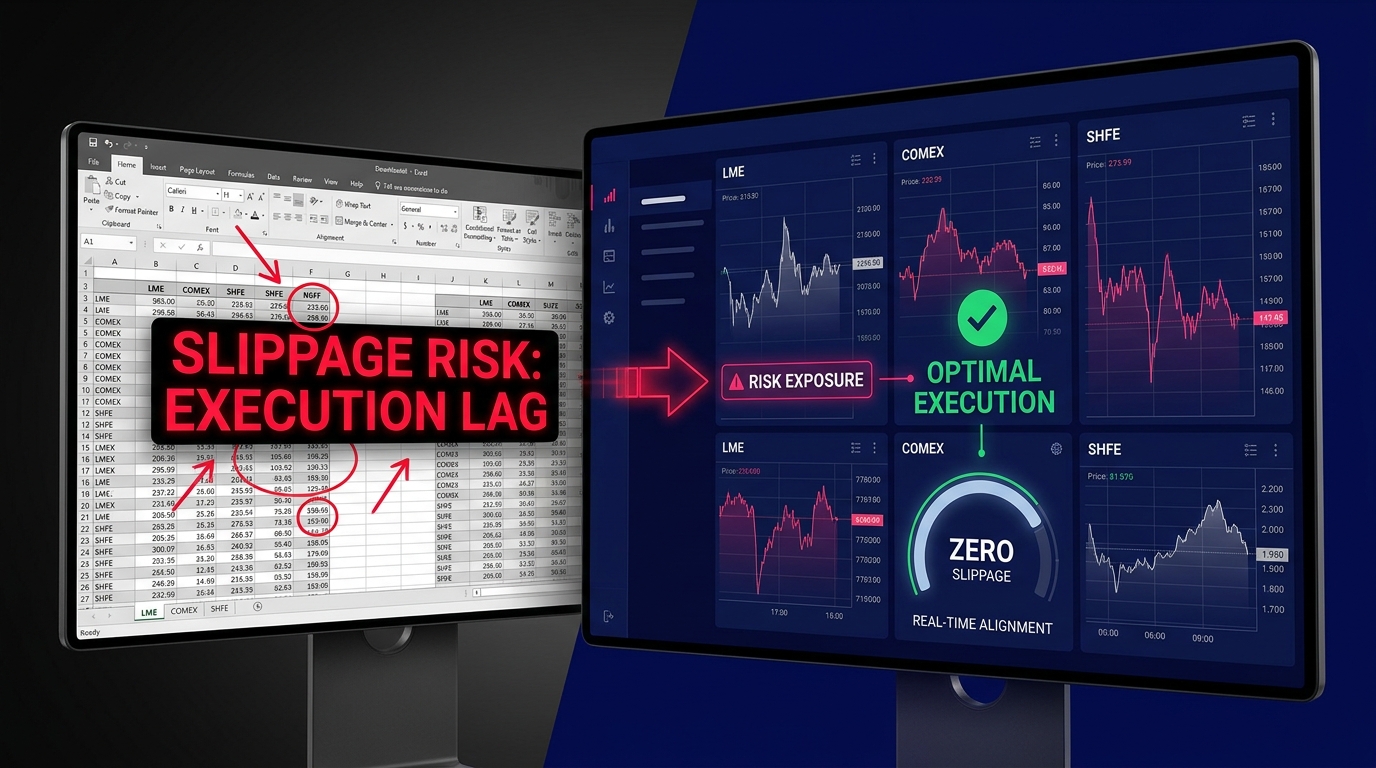
Hedging a metals position without simultaneous LME, COMEX, and SHFE pricing context does not simply create execution slippage. It compounds it. Cross-exchange execution slippage ranges from $5 to $30 per metric ton on a single copper execution under normal market conditions and accumulates into measurable book-level exposure across a trading quarter. Simultaneous multi-exchange alignment at the point of execution is a structural risk control, not an optional workflow convenience.
Most metals trading operations have not formally measured this cost. It is absorbed into volatility attribution, treated as an unavoidable feature of multi-exchange markets, and excluded from execution quality reports because no cross-exchange benchmark was established at the time of the trade. This analysis provides the framework to isolate it, quantify it, and treat it as the documentable liability it represents.
What Cross-Exchange Execution Slippage Actually Measures
Execution slippage in a single-venue context refers to the difference between the intended execution price and the actual fill price. In a cross-exchange metals context, the definition is more precise: it is the cost incurred when a hedging decision is executed using pricing context from one exchange without confirming alignment across the full cross-exchange price curve at the same moment.
Copper trades simultaneously across three major venues: the LME in London, COMEX in New York, and SHFE in Shanghai. These markets are highly correlated. Intraday correlation between LME and COMEX copper prices consistently exceeds 0.95 based on observable exchange-reported tick data LME-COMEX price correlation research, but correlation is not equivalence. The LME-COMEX copper basis, adjusted for contract size and FX normalization, routinely fluctuates by ±$15, $40 per metric ton within a single trading session.
The slippage event occurs in the gap. A trader references LME pricing to size and time a hedge, unaware that COMEX has moved $22/MT directionally in the preceding four minutes, or that SHFE inventory data released during the Asian session has established a $50/MT discount that materially changes the effective hedge ratio.
That gap is not random. It is structural, and it recurs on every execution where cross-exchange context was assembled sequentially rather than accessed simultaneously.
Execution Slippage Volume Without Cross-Exchange Alignment
On an isolated basis, cross-exchange execution slippage from a context gap typically falls in the $5, $30/MT range for copper under normal market conditions. During elevated volatility (supply disruption events, major macroeconomic data releases, or significant SHFE inventory moves), that range expands to $30, $80/MT, consistent with documented LME-SHFE spread variance during high-volatility periods visible in exchange-reported pricing histories.
At a standard LME lot size of 25 MT, a $20/MT context gap produces a $500 cost on a single lot. At 500 MT per trade and four executions per week, the same gap compounds to $40,000 weekly before any book-level accumulation is applied. The figure is not outsized in isolation. Measured across a quarter, it becomes a reportable exposure.
The Sequential Pricing Problem Across LME, COMEX, and SHFE
The phrase "sequential pricing" describes a workflow reality that most trading operations have accepted as an unavoidable constraint rather than recognized as a risk factor. A trader checking LME prices on one terminal, opening a separate screen for COMEX, and consulting a third source for SHFE inventory levels is not accessing cross-exchange context. They are constructing a time-series of snapshots, each stale by the time the next one loads.
This is the context-gap problem in its most operational form. Industry workflow analysis consistently finds that the majority of commodity traders rely on two or more separate data sources to assemble cross-exchange pricing context commodity trading workflow analysis. Each source transition introduces latency. In an actively moving market, a 45, 90 second delay in completing the sequential picture can represent a pricing environment that no longer matches any of the three individual snapshots used to construct it.
According to research on commodity execution infrastructure, data fragmentation at the front-office layer is among the most consistently underestimated sources of execution cost in physical and derivatives hedging operations commodity execution infrastructure research. The cost is invisible precisely because it is absorbed into the volatility attribution that every trading operation already accepts as background noise.
How Sequential Pricing Increases Cross-Exchange Execution Risk
Sequential pricing increases execution risk because each exchange snapshot is accurate only at the moment of capture. By the time a trader has assembled LME, COMEX, and SHFE data from separate sources, the composite view is a time-weighted average of three different market moments, not a real-time cross-exchange reference price.
The LME copper cash price can move $8, $15/MT within a 60-second window during active London or New York trading hours, based on observable tick-level data. If a trader's COMEX reference is 90 seconds older than their LME reference at the moment of execution, they are operating against a basis relationship that may no longer exist. The execution is not incorrect. It is priced against an incomplete signal, and the cost of that incompleteness is embedded in every fill.
Quantifying Cross-Exchange Slippage in $/MT and Basis Points
To appear on a risk report, cross-exchange execution slippage must be expressed in terms that can be traced, benchmarked, and trended. The following framework uses observable spread variance data to establish a realistic and defensible slippage range.
LME-COMEX Basis Variance:
The LME-COMEX copper spread, after FX normalization and contract-size adjustment, has historically ranged from near parity to ±$50/MT during periods of significant divergence, with intraday movements of $10, $25/MT routinely observable during active trading sessions. The context-gap component (the fraction of that daily range captured during a 60, 90 second sequential pricing window) is estimated at $3, $12/MT under normal conditions.
SHFE Premium and Discount Variance:
The SHFE copper price, expressed in LME-equivalent USD/MT terms, carries a structural premium driven by import parity, VAT accounting, and Shanghai bonded warehouse dynamics. According to SHFE and Reuters-reported pricing histories, that premium has ranged from near zero to over $200/MT across different market regimes, with week-over-week shifts of $30, $80/MT occurring during inventory-driven moves. A trader executing an LME hedge without real-time SHFE context during a $60/MT premium shift is executing against a materially incomplete signal.
Basis Points Translation:
At a copper reference price of $9,500/MT, a $15/MT slippage event represents approximately 16 basis points. A $30/MT event reaches 32 bps. In fixed income or equity execution, 15, 30 bps of execution cost would trigger an immediate post-trade review. In metals hedging, the same cost is routinely absorbed into volatility attribution because no simultaneous cross-exchange benchmark was established at the time of the trade.
The Role of LME, COMEX, and SHFE Spreads in Execution Gaps
LME, COMEX, and SHFE spreads create execution gaps because each exchange reflects a distinct participant base, contract structure, and regional supply-demand signal. This means the spread between them is not stable and does not hold position while a trader assembles their sequential pricing picture.
The SHFE/LME spread encodes Chinese domestic consumption signals, yuan-dollar FX movements, and bonded warehouse inventory levels. None of these inputs are directly visible on LME screens. A trader executing an LME hedge without real-time SHFE context is not hedging against the global copper price. They are hedging against the London slice of it, which may or may not reflect the full cross-exchange equilibrium at that moment.
How Slippage Compounds Across a Cross-Exchange Trading Book
The distinction between an isolated slippage event and a compounding book-level exposure is a function of two constants in any active metals hedging operation: trade frequency and position size. Neither variable changes when slippage is unmanaged, which means the cost accumulates on schedule.
Consider a trading book with the following parameters:
- 50 hedge executions per quarter
- Average position size: 500 MT per trade
- Average context-gap slippage: $12/MT (mid-range, normal market conditions)
These are not stress-scenario figures. They represent the expected cost of a systematic workflow gap running at mid-range assumptions across ordinary market conditions. The compounding mechanism requires no unusual volatility to function. It requires only repetition applied to an uncontrolled and unmeasured variable commodity trading cost benchmarking.
According to Oliver Wyman's global commodity trading research, execution efficiency improvements consistently rank among the highest-return infrastructure investments available to mid-market trading operations, with payback periods measured in single-digit quarters for books trading above 5,000 MT monthly [LINK: Oliver Wyman commodity trading performance].
The Quarterly Cost of a Context Gap
Across a trading quarter, a cross-exchange context gap compounds along three variables: trade frequency, average position size, and the prevailing spread environment between LME, COMEX, and SHFE. At normal volatility with 40, 60 executions per quarter and 500 MT average size, the context-gap cost component (isolated from market volatility) falls in the $200,000, $500,000 range for a mid-sized metals trading book.
During a quarter with elevated spread variance (a supply disruption, a major macro shift, or a period of significant SHFE inventory displacement), the same book can accumulate $600,000, $1.2M in context-gap slippage. The variable driving the upper range is not trade count; it is the spread environment in which those trades occur without simultaneous cross-exchange context in place.
Market Volatility vs. Context Gap: Separating the Risk Factors
Attributing all execution slippage to market volatility is the most common analytical error in post-trade review. It carries a specific consequence: it makes the context-gap component permanently invisible and therefore permanently unmanaged.
A rigorous decomposition of execution slippage in metals hedging identifies at least three separable components:
- Market impact slippage: Price movement caused by the trade itself, a function of position size relative to available liquidity.
- Volatility slippage: Price movement during the execution window attributable to general market activity, a legitimate and accepted cost.
- Context-gap slippage: The pricing error introduced by executing against an incomplete or time-lagged cross-exchange reference, a preventable cost.
This is the core analytical gap. A slippage event that appears as normal volatility cost may contain a $10, $15/MT component that was entirely preventable through simultaneous cross-exchange alignment. Without the benchmark, the context-gap component is not just unmanaged. It is structurally invisible to the post-trade review process.
According to McKinsey research on commodity trading performance, **firms that invest in execution quality infrastructure consistently outperform peer groups by 10, 20 bps on hedge execution costs. This differential, applied at scale across an annual trading book, represents a durable and compounding competitive advantage McKinsey commodity trading performance research.
Simultaneous Cross-Exchange Context as a Structural Risk Requirement
The analytical conclusion above carries a direct architectural implication: simultaneous LME, COMEX, and SHFE pricing at the point of execution is not an enhancement to an existing workflow. It is a structural requirement for measuring and controlling cross-exchange execution quality.
"Simultaneous" is the operative word. A dashboard that displays LME, COMEX, and SHFE prices in a single interface but refreshes them at different polling intervals does not resolve the context-gap problem. It may mask it, creating an appearance of cross-exchange alignment while maintaining sequential latency at the data layer.
The requirement has three components, each of which must be present for simultaneous context to function as a genuine risk control:
- Synchronized data refresh: LME, COMEX, and SHFE prices updating from the same timestamp within the same interface, drawn from direct exchange feeds with minimal processing latency
- Basis display at point of execution: LME-COMEX and SHFE-LME spreads visible as live, calculated figures (not assembled manually from separate feeds during the execution window)
- Historical context overlay: Current spread displayed against its rolling average, enabling a trader to assess whether the prevailing basis represents a normal or anomalous execution environment before committing
Cross-Exchange Slippage: Platform vs. Market Data
Cross-exchange execution slippage is both, and the distinction matters because each layer requires a separate solution. The market data problem is structural: LME, COMEX, and SHFE publish prices through separate feeds with distinct protocols, update frequencies, and currency conventions. Assembling them into a synchronized, normalized view requires deliberate architecture, not incidental aggregation.
The platform problem is operational: most multi-commodity trading platforms were built to display prices from multiple exchanges, not to maintain synchronized cross-exchange context for execution quality purposes. A platform that aggregates LME and COMEX data but presents them on non-synchronized screens perpetuates the context gap regardless of underlying data quality. Both layers must be addressed simultaneously (raw feed quality and interface synchronization) for simultaneous cross-exchange context to function as a genuine risk control at the execution layer.
The Path Forward: Measuring and Closing the Context Gap
Addressing cross-exchange execution slippage at the book level begins with treating it as a documented risk factor with a measurable exposure range, not as an accepted feature of trading in multi-exchange markets. The implementation path follows a defined sequence.
Step 1: Establish a baseline. For one full quarter, record the LME, COMEX, and SHFE prices at the exact timestamp of each hedge execution. Calculate the spread between the execution price and the simultaneous cross-exchange reference. This is the actual context-gap exposure (separate from volatility, traceable to individual trades).
Step 2: Decompose slippage by type. Using the baseline data, categorize slippage events as market impact, volatility, or context-gap. The context-gap component is identifiable as slippage that occurred when the cross-exchange reference differed materially from the single-exchange price used for execution.
Step 3: Quantify book-level exposure. Apply the measured context-gap rate in $/MT across quarterly trade frequency and average position size. The result belongs on the execution quality report and in risk committee review. It is a documented liability with a calculable range.
Step 4: Require simultaneous cross-exchange context at the execution layer. This is the structural solution. Whether through platform upgrade, data infrastructure redesign, or workflow change, the standard is clear: LME, COMEX, and SHFE pricing must be available simultaneously, not sequentially, at the moment a hedging decision is made and sized.
Research on commodity trading operational efficiency consistently finds that the highest-return infrastructure investments are those that reduce per-trade execution cost at scale, because the benefit compounds identically to the slippage it replaces. It scales measurably and predictably across every trade in the book commodity trading operational efficiency research.
Key Findings: Cross-Exchange Execution Slippage as a Documented Liability
Cross-exchange execution slippage is not a theoretical risk category. It is a recurring cost with a calculable range, a compounding mechanism, and a structural cause that is directly addressable. The findings from this analysis:
- Isolated slippage per execution: $5, $30/MT under normal conditions; $30, $80/MT during elevated spread volatility
- Basis point equivalent: 5, 32 bps at current copper prices, depending on slippage severity and market conditions
- Quarterly book-level exposure: $200,000, $1.2M for a mid-sized hedging book at 40, 60 executions per quarter and 500 MT average position size
- Root cause: Sequential rather than simultaneous cross-exchange pricing context at the point of execution: a structural gap, not a market-driven inevitability
If the current platform does not provide synchronized LME, COMEX, and SHFE context at the execution layer, that is not a feature gap. It is a risk control gap. Quantifying it with the framework above is the first step toward closing it.
Experience simultaneous cross-exchange context at the execution layer. Novaex cross-exchange pricing capabilities Novaex was built depth-first for base metals. This means LME, COMEX, and SHFE alignment is not a dashboard feature added to a generic platform. It is the structural foundation the platform was designed around. Explore how synchronized cross-exchange pricing redefines execution quality standards for a metals hedging book.