Cross-Exchange Position Visibility for Metals Traders
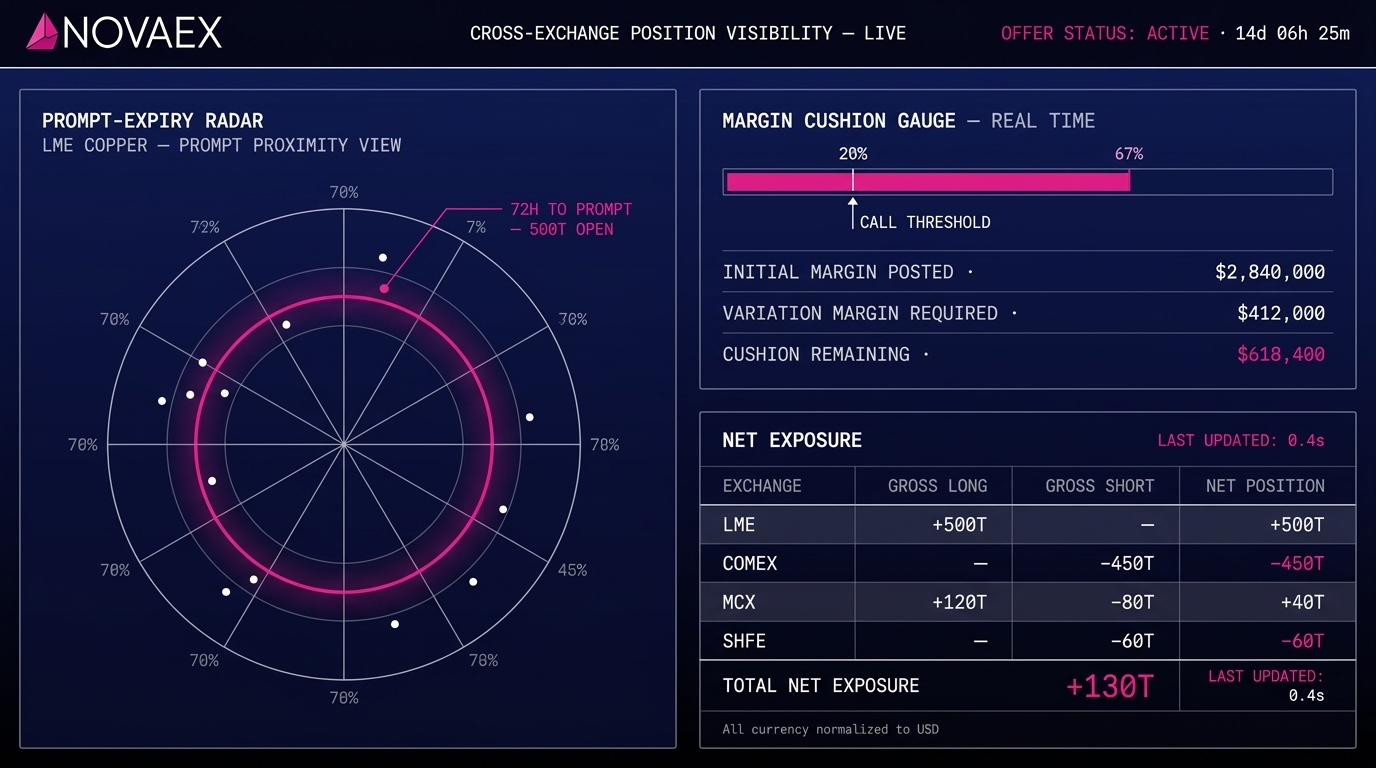
Real-time cross-exchange position visibility means your actual exposure across LME, COMEX, MCX, and SHFE updates continuously in a single interface, eliminating the 20-to-45-minute reconciliation lag that separates what your book actually holds from what your spreadsheet says it holds.
That gap serves as a structural failure that turns risk management into a historical record of decisions made without complete information.
This analysis traces the latency gap in precise operational terms: where it originates, what it costs at specific decision moments, and what three elements of integrated cross-exchange position visibility close it: the Prompt-Expiry Radar, the Margin Cushion gauge, and the Net Exposure figure.
The Latency Gap That Defines Spreadsheet-Based Risk Management
In cross-exchange metals trading, two versions of your position exist at any given moment: the actual position and the reported position.
The actual position is live. It reflects every fill, every roll, and every hedge adjustment made across LME, COMEX, MCX, and SHFE in real time.
The reported position is what your spreadsheet shows after the last manual update cycle.
The distance between those two figures is information latency, and in active markets, it is rarely zero.
The True Time Cost of Spreadsheet-Based Reconciliation
Manual cross-exchange reconciliation (pulling confirmations from LME, COMEX, MCX, and SHFE into a consolidated spreadsheet) typically consumes between 20 and 45 minutes per cycle, based on workflow analyses of mid-market trading operations. For firms running multiple metals books simultaneously, that window extends further.
The reconciliation window creates a decision blackout during which risk decisions are priced against stale data. Every trade executed during that window is sized against a position figure that may no longer be accurate.
A metals trader running a copper hedge across LME and COMEX faces a specific version of this problem: the two exchanges operate in overlapping windows where volatility concentrates exactly when reconciliation is least reliable. According to CME Group data, LME and COMEX copper spreads can shift by $8 to $15 per tonne within a 30-minute window during peak overlapping hours. If reported exposure lags by that same 30 minutes, you are pricing decisions against a book that no longer reflects market reality.
Defining Information Latency in Commodity Trading
Information latency in commodity trading is the measurable time gap between when a position change occurs on exchange and when that change is reflected in your risk management system. This latency carries a calculable cost in every market that moves faster than your update cycle.
In spreadsheet-based environments, information latency is structural. It cannot be engineered away because the architecture itself requires human intervention to move data between exchange confirmations and the consolidated risk view. Even with automation scripts layered on top, the reconciliation logic must be maintained, validated, and rerun every time exchange data formats change. This happens frequently and without warning.
The industry benchmark for acceptable latency in active metals risk management is under two minutes for position updates, according to published CTRM vendor performance standards CTRM latency benchmarks. Most spreadsheet-based workflows operate at latency measured in hours, not minutes. The benchmark and the operational reality are not close.
What Cross-Exchange Position Visibility Actually Means, Operationally
"Integrated" is a term applied without consistent operational definition across CTRM marketing. Most platforms claim it. Few define it with sufficient operational precision to be verifiable.
Integrated cross-exchange position visibility, defined operationally: a single interface that ingests confirmed position data from LME, COMEX, MCX, and SHFE through direct exchange connectivity, reconciles that data against your internal book in real time, and surfaces a net exposure figure accurate to the most recent trade confirmation. This occurs without manual intervention at any point in the chain.
That definition requires precision for a practical reason. A vague integration claim does not change the decision quality of a trader watching a copper basis move at 14:30 London time.
According to a 2023 survey by the International Swaps and Derivatives Association, 61% of commodity trading firms cited data fragmentation across trading venues as their primary barrier to effective intraday risk management ISDA commodity risk survey. That figure reflects a problem that has not improved as markets have grown more complex. The problem has compounded, because the number of venues requiring simultaneous management has expanded while the architecture for managing them has not.
Novaex resolves this by building exchange connectivity natively for LME, COMEX, MCX, and SHFE. Rather than using a generic API layer that treats all exchanges identically, it uses venue-specific data modeling that understands prompt structures, settlement conventions, and margin methodologies for each market individually. That specificity is what makes the word "integrated" operationally meaningful when a position changes at 09:30 MCX time and the net exposure figure updates before the next keystroke.
The Prompt-Expiry Radar and the 72-Hour Decision Window
The Prompt-Expiry Radar in the Novaex dashboard provides a real-time visualization of open positions mapped against their proximity to prompt dates and expiry windows across every exchange in your book.
The operational significance is specific to how LME positions actually work. The LME prompt structure is uniquely granular: daily prompts for the first three months, weekly prompts for months three through six, and monthly prompts beyond that. Managing a book with positions across multiple prompt dates requires a view that shows not just what you hold, but when each position demands a decision, and how that urgency changes as time elapses.
According to LME data, approximately 80% of LME open interest is closed before delivery, meaning the roll decision is not an exception in metals trading. It is the primary management event for most positions LME delivery statistics. If your risk system does not show prompt proximity in real time, you are managing the most common event in your book with the least visibility.
The Prompt-Expiry Radar makes the decision window visible and spatial. A position 72 hours from prompt presents differently than one at 30 days. Instead of burying this as a flag in a spreadsheet column requiring a sort and a filter, it provides a live representation of urgency that updates as time elapses and positions change. When the clock on a prompt is compressing, the Radar shows it compressing.
This is what integrated means for prompt management: the system holds the LME prompt calendar natively, maps your live positions against it, and maintains that mapping continuously without a reconciliation cycle standing between you and the current state of your book. When a roll decision needs to happen today and not tomorrow, the Radar is already showing you that state.
Margin Cushion Visibility When Markets Move Against You
The Margin Cushion gauge in the Novaex dashboard shows current margin headroom against initial and variation margin requirements across exchanges in real time.
This is the figure that matters most in the 20 minutes before a margin call.
Margin calls in commodity markets operate on compressed timelines with no tolerance for latency in your risk view. LME margin calls are typically issued before 10:00 London time with same-day response requirements. COMEX issues intraday margin calls during periods of high volatility, with a four-hour response window in standard cases. MCX operates on a T+1 settlement cycle but issues intraday margin calls during circuit-breaker events, where the response window can compress further.
The Cost of Delayed Exposure Reporting During a Margin Call
The cost of delayed exposure reporting during a margin call is the difference between a managed response and a forced liquidation. If your margin cushion figure lags by 30 minutes during a volatility event, you may not know you are approaching a call threshold until after the call is issued. This delay eliminates the option to add collateral, reduce position size, or execute a hedging adjustment before the deadline closes.
According to the Bank for International Settlements, intraday margin calls in commodity markets increased by 47% between 2020 and 2023, driven by sustained energy and metals volatility BIS intraday margin call report. As call frequency increases, the latency cost of delayed cushion visibility does not stay constant. It compounds, because more frequent calls mean more frequent windows where stale data can produce the wrong response.
The Margin Cushion gauge eliminates this latency for margin management. It pulls current mark-to-market values from live exchange feeds and calculates available cushion against posted margin in real time, rather than waiting for the next reconciliation cycle, a manual refresh, or the call itself.
When copper dropped 2.3% in a single session on March 8, 2023 (driven by dollar strength and demand revision), a trader with real-time margin cushion visibility had a defined, proactive decision window. A trader whose spreadsheet was last updated 30 minutes earlier did not know how close the threshold was until the call arrived. Those are two different experiences of the same market event, separated entirely by information latency.
Net Exposure Across LME, COMEX, MCX, and SHFE: One Figure, Real Time
The Net Exposure figure in the Novaex dashboard consolidates gross long and gross short positions across all four exchanges into a single net figure, updated continuously as positions change on any venue.
This number is the foundation of every intraday risk decision. Every hedge sizing decision, every new position evaluation, and every margin calculation begins with knowing actual net exposure, rather than exposure as of the morning's last reconciliation.
In a multi-exchange metals book, gross positions can obscure net risk substantially. A trader long 500 tonnes on LME and short 450 tonnes on COMEX holds a net long of 50 tonnes, but only if the netting calculation correctly accounts for currency conversion between USD and GBP settlement, lot-size differences between venues, and settlement date alignment across prompt structures. Spreadsheet-based netting logic fails silently when any one of these variables changes, and the error does not surface until the next manual validation cycle.
The Impact of Real-Time Position Visibility on Intraday Trading
Real-time position visibility changes intraday trading decisions by closing the gap between execution and awareness. When a trader knows their true net exposure at the moment a new opportunity appears, they can size the position accurately, evaluate margin impact immediately, and execute without waiting for a reconciliation lag that may invalidate the entry point before it completes.
According to a 2022 McKinsey analysis of commodity trading operations, firms with real-time risk visibility captured 12, 18% more of their identified hedging opportunities compared to firms using batch-refresh risk systems, because the real-time firms could act within the decision window rather than after it had closed McKinsey commodity trading operations report. The opportunity cost of latency is not hypothetical; it is the spread between what the market offered and what you were positioned to take.
The Net Exposure figure operationalizes this advantage as a live calculation that changes the moment any position changes on any of the four exchanges. It is visible on the same dashboard as the Prompt-Expiry Radar and the Margin Cushion gauge, so the relationship between net exposure, prompt urgency, and margin headroom can be evaluated simultaneously at any point in the trading day.
The Calculable Cost of Cross-Exchange Reconciliation Delays
Every argument in this analysis resolves to a single operational question: what does the latency gap cost, specifically and in measurable terms?
The answer requires only three inputs: position size, average intraday price move, and reconciliation cycle time.
On a 500-tonne copper position with LME copper at $8,400 per tonne, a 1% price move in a 30-minute window represents $42,000 in untracked exposure change. If hedge size was calculated before that move, the resulting position is either over-hedged or under-hedged by a figure your system cannot show until the next reconciliation, which may be another 15 to 30 minutes away.
According to LME data, LME copper front-month prices have moved more than 1% intraday on 34% of trading days since 2021 LME copper price volatility data. For a trader running 30-minute reconciliation cycles, roughly one in three trading days carries the structural risk of a materially mispriced hedge. This high frequency demands inclusion in daily operational planning.
The Limitations of Multi-Commodity Platforms
Multi-commodity platforms do not solve cross-exchange latency because their architecture optimizes for breadth rather than depth. A platform built to cover energy, agriculture, and metals simultaneously cannot develop venue-specific connectivity for LME prompt structures, MCX lot conventions, and SHFE settlement methodologies without sacrificing the generic flexibility that makes breadth commercially viable.
The result is a platform that covers four exchanges with the same API logic built for none of them specifically, introducing reconciliation gaps, lot-size translation errors, and settlement date mismatches that require manual correction, recreating the spreadsheet problem within a more complex system. The latency changes form; it does not disappear.
Novaex's depth-first approach means the platform was built for base metals specifically, starting with LME, COMEX, MCX, and SHFE as first-class venues with first-class data models. The Prompt-Expiry Radar understands LME daily prompt granularity because the underlying data model was built for it. The Margin Cushion gauge accounts for MCX intraday circuit-breaker margin calls because the margin logic was written for MCX specifically rather than adapting from a generic commodity margin template. Depth-first, defined operationally, means the intelligence in the platform is proportional to the specificity with which each market was modeled.
What Integrated Cross-Exchange Position Visibility Changes About Your Workflow
The shift from spreadsheet-based reconciliation to integrated cross-exchange position visibility fundamentally reverses the sequence of the decision process.
In a spreadsheet environment, the sequence is: execute, then wait for reconciliation, then understand exposure, then evaluate risk, then determine whether the original decision was correctly sized.
With real-time integrated position visibility, the sequence becomes: understand exposure, evaluate risk, execute with full awareness of net position and margin impact.
That sequence reversal eliminates the category of errors that occur when execution precedes awareness. This represents the most costly error category in active metals trading, and the most structurally preventable.
According to Accenture's 2023 commodity trading technology report, firms that migrated from spreadsheet-based to integrated CTRM position management reported a 23% reduction in reconciliation-related trading errors and a 31% improvement in margin call response times Accenture CTRM technology report. Both figures reflect the same underlying change: decisions made with current information rather than lagged information.
Three immediate workflow changes that integrated cross-exchange position visibility enables:
- Reconciliation time reallocation. The 20, 45 minutes per cycle currently consumed by manual cross-exchange reconciliation redirects to analysis when position data integrates automatically. The desk recovers time during the hours when markets are moving.
- Proactive margin management. With the Margin Cushion gauge showing real-time headroom, margin response becomes proactive rather than reactive. Collateral can be added or position size reduced before a call is issued, well before the deadline is already in motion.
- Planned roll execution. The Prompt-Expiry Radar gives prompt proximity a spatial urgency that a spreadsheet date column cannot replicate. The roll decision becomes a planned event with visible lead time instead of a sudden calendar reminder.
Closing the Latency Gap
The Prompt-Expiry Radar shows when positions demand action. The Margin Cushion gauge shows what the book can absorb. The Net Exposure figure shows what is actually held across LME, COMEX, MCX, and SHFE right now, rather than after the next reconciliation cycle.
Together, these three elements define what integrated cross-exchange position visibility means when the definition has to hold under the conditions of an actual trading day. This establishes a measurable operational state where reported exposure and actual exposure match exactly.
Three diagnostic steps to calculate your current latency cost:
- Measure your current reconciliation cycle time from last execution to confirmed position update in your risk system. If that number exceeds five minutes, it represents a structural risk in any actively moving market.
- Calculate the exposure change possible in that window. On your standard position size in copper or aluminum, use LME's average intraday move to price your reconciliation lag in dollar terms. The result is your latency cost per cycle.
- Map your last three margin calls against your position update cycle. If any call arrived before your system showed an approaching threshold, you have direct evidence of what spreadsheet-based risk management costs at the specific decision moment that matters most.