Cross-Exchange Reconciliation Failures in Metals Trading
TL;DR: Cross-exchange reconciliation failures in metals trading trace to specific, documented data standard mismatches: LME prompt date conventions, MCX INR conversion timing windows, COMEX lot basis normalization, and SHFE warehouse warrant classification. Each creates a distinct, measurable operational consequence that compounds across multi-leg books.
Every metals desk running cross-exchange hedges absorbs a daily reconciliation tax. Position breaks between LME, MCX, COMEX, and SHFE persist because four exchanges operate on fundamentally incompatible data standards, and most CTRM platforms normalize those differences incorrectly rather than resolving them at the source.
This reference maps ten cross-exchange reconciliation failure modes by exchange. Each entry identifies the exchange, the specific data standard mismatch at the root, and the downstream consequence expressed in trading terms. It is structured for distribution to operations and mid-office teams conducting a platform audit.
Why Cross-Exchange Reconciliation Failures Are Systematic, Not Random
The instinct on most desks is to treat reconciliation breaks as data errors like a feed outage, a timing gap, or an entry mistake. Instead, they are the predictable output of exchanges built on incompatible settlement, denomination, and inventory standards that multi-exchange platforms routinely collapse into generic normalization logic. CTRM platform architecture metals
According to a 2023 survey by the Futures Industry Association, firms operating across three or more derivatives venues report an average of 14 reconciliation exceptions per trading desk per day. That figure understates the actual burden because it captures only confirmed breaks, excluding the time spent investigating positions that resolve without formal exception logging.
The operational consequence of misattributing systematic failure to random data error is significant: desks build data-cleaning workflows instead of addressing root causes. The breaks persist across quarters, and the daily cost becomes background noise that never appears on a trading loss report.
How do cross-exchange reconciliation failures affect daily P&L?
Unresolved reconciliation failures distort intraday P&L by creating phantom positions: exposure that appears in one system and not another. For a desk running simultaneous LME and COMEX copper hedges, a single 1-lot position mismatch translates to approximately $2,500 in notional exposure at $10,000/MT copper, enough to skew margin utilization calculations and trigger false risk limit alerts.
The downstream effect is not friction alone. It is forced conservatism: desks hold positions below optimal size to absorb the noise margin created by reconciliation failures they cannot consistently explain or eliminate.
LME Cross-Exchange Reconciliation Failures: Prompt Date and Lot Structure
The London Metal Exchange operates on prompt date conventions with no direct equivalent on any other major metals exchange. Every reconciliation failure between LME and other venues traces to one of three structural mismatches.
Failure Mode 1: Prompt Date vs. Calendar Month Settlement
- Exchange: LME
- Data Standard Mismatch: LME prompt dates are specific business-day-based settlement dates: cash settles T+2, and the 3-month contract settles on a rolling forward business day, not a standardized calendar month expiry. Most CTRM systems ingest LME prompts and map them to the nearest calendar month for cross-exchange position netting.
- Operational Consequence: A position entered on LME for the third-Wednesday prompt in a given month is netted against a COMEX monthly contract settling on the last business day of the same month, creating a basis difference of up to 15 calendar days. The desk carries what appears to be a flat hedge but holds a prompt mismatch that generates mark-to-market noise of $3 to $8/MT daily in a normal carry environment.
- Exchange: LME
- Data Standard Mismatch: LME inter-office carry rates (the bid/offer spread between cash and 3-month on ring) are not structurally equivalent to the standard futures calendar spread captured in COMEX or SHFE data formats. Platforms that feed LME carry into a generic "spread" field collapse this structural distinction without flagging it.
- Operational Consequence: Position-level P&L attribution mixes carry P&L with outright directional P&L. Carry positions appear to generate delta exposure they do not hold, producing incorrect hedging signals on any automated risk system reading the aggregated field. Desks frequently identify this only after a manual position-level audit.
Why do LME lot conventions cause reconciliation failures?
LME lot sizes vary by metal: 25 MT for copper, 6.01 MT for primary aluminum, 6.00 MT for zinc. These are not round numbers relative to COMEX (25,000 lbs per lot) or SHFE (5 MT per lot). Systems that convert lot equivalence using fixed ratio approximations rather than live contract specification reference data generate fractional lot mismatches that accumulate across large books without triggering individual trade-level errors.
According to LME contract specifications, one copper lot equals exactly 25 metric tons. One COMEX HG copper lot equals exactly 25,000 lbs, or 11.3398 MT. The conversion factor is 2.2046 LME lots per COMEX lot. Every approximation introduces systematic position error.
Failure Mode 3: Variable Lot Size Reference Misalignment
- Exchange: LME
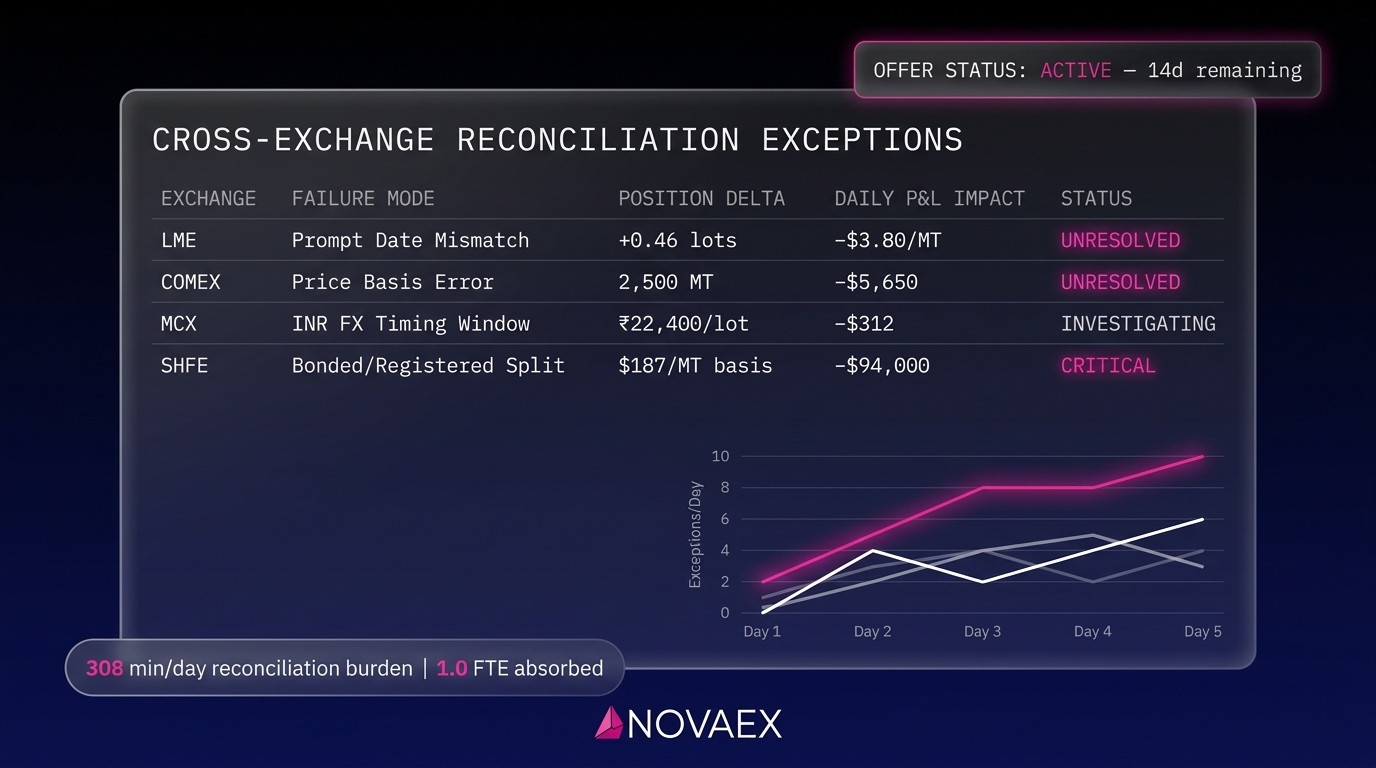
- Data Standard Mismatch: Converting LME copper lots to COMEX or SHFE equivalents requires exact lot-size reference data applied per conversion cycle. A copper position of 100 LME lots equals 2,500 MT. The COMEX equivalent at 25,000 lbs per lot is 220.46 lots. Systems rounding to 220 lots hold an uncaptured short of 0.46 lots, which is 10.4 MT or approximately $104,000 at $10,000/MT copper.
- Operational Consequence: Rounding errors accumulate silently across metals and tenors. A desk running 500 LME copper lots across 10 active tenors can carry a hidden aggregate position of 50+ MT without a single trade-level error appearing in any system log.
MCX Cross-Exchange Reconciliation Failures: INR Timing and Contract Divergence
The Multi Commodity Exchange of India introduces two failure modes that are nearly invisible in systems not built specifically for MCX-to-LME reconciliation. Both trace to the exchange's domestic denomination and expiry structure.
Failure Mode 4: INR/USD Conversion Timing Window Mismatch
- Exchange: MCX
- Data Standard Mismatch: MCX copper contracts are denominated in Indian Rupees per kilogram. The exchange references the Reserve Bank of India's daily fixing rate, published at approximately 12:30 IST, for currency-adjusted P&L settlement. LME-denominated positions are settled in USD. Systems applying a single daily FX fix, typically the 4:00 PM London WM/Reuters rate, to translate MCX P&L introduce a structural timing gap of 4.5 to 7 hours of INR/USD market movement.
- Operational Consequence: On days when INR/USD moves more than 0.5%, the FX fix mismatch generates P&L variance of ₹15,000 to ₹40,000 per MCX lot (1 MT) that is misattributed to the commodity position instead of currency translation. A desk hedging MCX exposure with LME reads FX timing noise as commodity basis noise, calibrating its hedge incorrectly.
What causes position mismatches between MCX and LME copper?
MCX copper contracts are 1 MT per lot; LME copper contracts are 25 MT per lot. This 25:1 ratio creates compounding rounding exposure in any position not structured in exact multiples of 25 MCX lots. According to the MCX Annual Report for FY2023, average daily copper contract volume exceeded 45,000 lots. The institutional hedging activity embedded in that volume rarely operates in lot counts that convert cleanly to LME equivalents, making rounding exposure a structural feature of cross-exchange MCX positions.
Failure Mode 5: MCX Expiry vs. LME Prompt Roll Misalignment
- Exchange: MCX
- Data Standard Mismatch: MCX copper contracts expire on the last business day of the contract month. LME 3-month copper settles on a rolling forward business day that changes daily. No fixed MCX monthly expiry maps cleanly to a specific LME prompt, and the roll events are structurally different: MCX terminates a contract while LME extends a continuously rolling forward date.
- Operational Consequence: Desks running a delta-neutral book across MCX and LME face an artificial roll cost at each MCX expiry with no corresponding LME roll. This generates a reported roll loss in cross-exchange P&L attribution that is architectural. Most systems misattribute this to trading performance instead of platform mismatch. The misattribution compounds over multiple expiry cycles.
COMEX Cross-Exchange Reconciliation Failures: Lot Basis Normalization
COMEX copper (HG) trades in U.S. cents per pound with a 25,000-pound lot size. Every reconciliation between COMEX and LME copper requires two simultaneous unit conversions: price denomination and lot weight. Each conversion is an independent failure opportunity.
Failure Mode 6: Cents-Per-Pound to USD-Per-MT Price Basis Mismatch
- Exchange: COMEX
- Data Standard Mismatch: COMEX HG copper prices are quoted in U.S. cents per pound. LME copper prices are quoted in USD per metric ton. The exact conversion constant is 22.0462 (derived from 2.20462 lbs/kg × 100 cents per dollar). Systems that use 22.05 as a rounding approximation introduce a $2.26/MT systematic error per conversion cycle.
- Operational Consequence: On a 100-lot LME copper position (2,500 MT), a $2.26/MT systematic pricing error generates a $5,650 daily mark-to-market discrepancy attributed to unexplained P&L variance. Accumulated over a 65-trading-day quarter, this systematic error produces $367,250 in cumulative mark-to-market noise that permanently distorts P&L attribution without appearing on a trading loss report.
What is the operational cost of COMEX lot basis normalization errors?
The conversion from COMEX 25,000-lb lots to LME 25-MT lots requires acknowledging that these are not equivalent units: 25,000 lbs equals 11.3398 MT, defying commonly applied approximations like 12.5 MT. CME Group HG copper contract specifications According to CME Group contract specifications, one COMEX HG lot contains exactly 25,000 lbs of Grade 1 copper. One LME copper lot contains exactly 25 MT, or 55,116 lbs. The ratio is 2.2046 COMEX lots per LME lot. Every approximation below four decimal places introduces systematic error that scales with position size.
Failure Mode 7: COMEX ASTM B115 Grade vs. LME Grade A Equivalence
- Exchange: COMEX
- Data Standard Mismatch: COMEX deliverable copper must meet ASTM B115 Grade 1 specification. LME copper must meet LME brand approval list Grade A specification. These are commercially near-equivalent but technically distinct, and their physical delivery premiums diverge during periods of tight supply or warrant scarcity. Systems that assume zero basis between grade specifications in physical delivery cost modeling produce incorrect optionality estimates.
- Operational Consequence: Desks modeling physical delivery optionality on COMEX vs. LME warrants under a zero-grade-basis assumption can misstate delivery cost by $15 to $45/MT in elevated premium environments. The Q1 2022 LME nickel market event, during which grade and brand premiums across base metals moved by multiples of normal ranges, demonstrated the realized scale of this failure mode under stress conditions, a scenario where a $15/MT modeling error becomes operationally material within hours.
SHFE Cross-Exchange Reconciliation Failures: Warehouse Warrant Standards
The Shanghai Futures Exchange introduces the most complex reconciliation environment of any major metals venue. Three distinct failure modes are rooted in its warehouse warrant classification system and domestic currency settlement structure.
Failure Mode 8: Bonded vs. Registered Warehouse Warrant Classification
- Exchange: SHFE
- Data Standard Mismatch: SHFE copper inventory exists in two structurally distinct categories: bonded warehouse warrants, held in Shanghai free-trade zones, priced in USD, with no import duty applied; and registered warrants, held onshore, priced in CNY, subject to VAT and import duty. Most cross-exchange reconciliation systems aggregate SHFE inventory as a single figure without distinguishing warrant type or pricing basis.
- Operational Consequence: A hedge built against aggregated SHFE copper inventory can be structurally unhedgeable if the physical position sits in bonded warrants while the hedge is sized against onshore registered inventory. According to SMM market data, the price basis between bonded and registered copper in Shanghai ranged from $80/MT to $300/MT during 2022 to 2023. Aggregated inventory data produces a hedge ratio error of proportional magnitude, leaving the desk with no visibility into where that error originates.
How do SHFE warehouse warrants affect cross-exchange position reconciliation?
SHFE copper warrants are issued in 5-MT lots. LME copper warrants are issued in 25-MT lots. COMEX copper warrants are issued in 25,000-lb lots. A cross-exchange inventory position requires three simultaneous lot-size conversions to reconcile physical copper holdings across all three venues, and each conversion uses a different unit system. According to SHFE weekly inventory reports, published each Friday before market open, aggregate copper figures in public data do not break out inventory by warrant type or grade. Desks relying on public data feeds cannot perform a warrant-level reconciliation without direct SHFE data access.
Failure Mode 9: SHFE VWAP Settlement vs. LME Ring Official Price
- Exchange: SHFE
- Data Standard Mismatch: The SHFE copper settlement price is calculated as the volume-weighted average price of the final 30 minutes of the afternoon trading session. The LME official price is set during Ring trading in the morning session. These are structurally different price observations separated by multiple hours of active market movement across different time zones.
- Operational Consequence: Cross-exchange P&L comparison using same-date settlement prices from both venues compares non-equivalent price observations. A desk marking books using LME official prices and SHFE settlement prices on the same calendar date is comparing figures separated by 4 to 7 hours of live copper market movement. The resulting P&L variance is an artifact of settlement methodology divergence. It is routinely reported as unexplained P&L until manually investigated.
- Exchange: SHFE
- Data Standard Mismatch: SHFE copper futures P&L is settled in Chinese Yuan. Translation to USD for cross-exchange reporting requires a CNY/USD conversion rate. The PBOC daily midpoint fixing and the live onshore CNY rate (CNY) can diverge by 0.3 to 0.8% during managed-band intervention periods. Systems using only the PBOC midpoint introduce a systematic FX translation error whenever the PBOC is actively intervening.
- Operational Consequence: At SHFE copper's average daily volume of approximately 200,000 lots in 2023 (5 MT each, 1,000,000 MT daily notional), a 0.5% CNY rate discrepancy applied at the desk level generates P&L translation variance of $50,000 per $10M of SHFE notional exposure. Desks do not see this as currency risk. They see it as unexplained commodity P&L, and the misattribution persists until the intervention period ends and the two rates reconverge.
How Cross-Exchange Reconciliation Failures Compound Across Multi-Leg Positions
Individual failure modes are material in isolation. Their interaction in multi-leg cross-exchange positions is where operational cost reaches critical scale.
Consider a standard copper spread structure: long LME 3-month, short COMEX front month, with an MCX position sized to hedge domestic India physical exposure. This three-leg structure carries simultaneous exposure to Failure Modes 1, 3, 5, and 6 (prompt date mismatch, lot rounding error, MCX roll misalignment, and COMEX price denomination error) in every active tenor.
According to a 2022 operational risk assessment published by the International Swaps and Derivatives Association, multi-leg positions across three or more derivatives venues generate reconciliation exceptions at 3.4 times the rate of single-venue positions. ISDA operational risk framework Each exception requires manual investigation averaging 22 minutes per break. A desk running 14 daily exceptions, the FIA benchmark figure, carries a 308-minute daily reconciliation burden before a single hour of trading analysis begins.
The FIA's 2023 Operations and Technology Survey found that commodity trading desks operating across four or more venues allocate between 18% and 27% of mid-office staff time to reconciliation exception management. For a five-person operations team, that is one full-time equivalent absorbed entirely by reconciliation workflows, a staffing cost that runs at $150,000 to $250,000 annually at mid-market compensation levels without appearing in trading P&L.
Building a Cross-Exchange Reconciliation Architecture That Eliminates These Failure Modes
The ten failure modes documented above share a structural cause: they require exchange-specific data standard handling at the position level, and generic CTRM normalization logic cannot deliver it. An architecture that resolves these failures at the root requires five specific components.
- Prompt-level date mapping that preserves LME business-day prompt semantics rather than collapsing to nearest calendar month for cross-exchange netting
- Dual FX fix reference for MCX positions that captures the RBI 12:30 IST rate and the WM 4:00 PM London rate separately, with per-position attribution flags
- Exact conversion constants for all COMEX-to-LME lot and price normalization: 22.0462 lbs/kg × 100, applied without rounding, per conversion cycle
- Warrant-type classification for SHFE inventory that maintains bonded and registered warrant pools as independent positions with independent pricing references
- Settlement methodology flags that prevent same-date comparison of non-equivalent price observations across LME Ring official prices, SHFE VWAP closes, and MCX session prices
The depth-first methodology that governs Novaex's development means each exchange integration is built to the level of specificity required to eliminate these failure modes, rather than normalizing them into acceptable daily variance. For desks that have absorbed these costs as operational background noise, the operational difference is 308 minutes per day recovered, one full-time mid-office equivalent redeployed, and the permanent elimination of systematic P&L noise that has never appeared on a trading loss report. The noise has always been present.
Conclusion: Use This Map to Audit Your Current Architecture
The ten failure modes documented here are active in every cross-exchange metals book running positions across two or more of these venues today, accumulating at known rates with known operational consequences.
Three immediate steps for any desk head distributing this reference to their team:
- Pull the last 30 days of reconciliation exceptions and tag each against the failure mode categories above (prompt mismatch, lot rounding, FX timing window, warrant classification, or settlement methodology divergence) to identify where your operational cost is concentrated
- Quantify the daily minute burden by exception type using the 22-minute-per-break benchmark, then calculate the annualized staffing cost of your current reconciliation workflow
- Audit your platform's exchange-specific handling against the five architectural components listed above, specifically whether LME prompt dates, MCX INR fix timing, COMEX conversion constants, and SHFE warrant types are resolved at the position level or collapsed into generic normalization before they reach your risk system