Cross-Exchange Spread Gaps: Why Metals Hedge Timing Fails
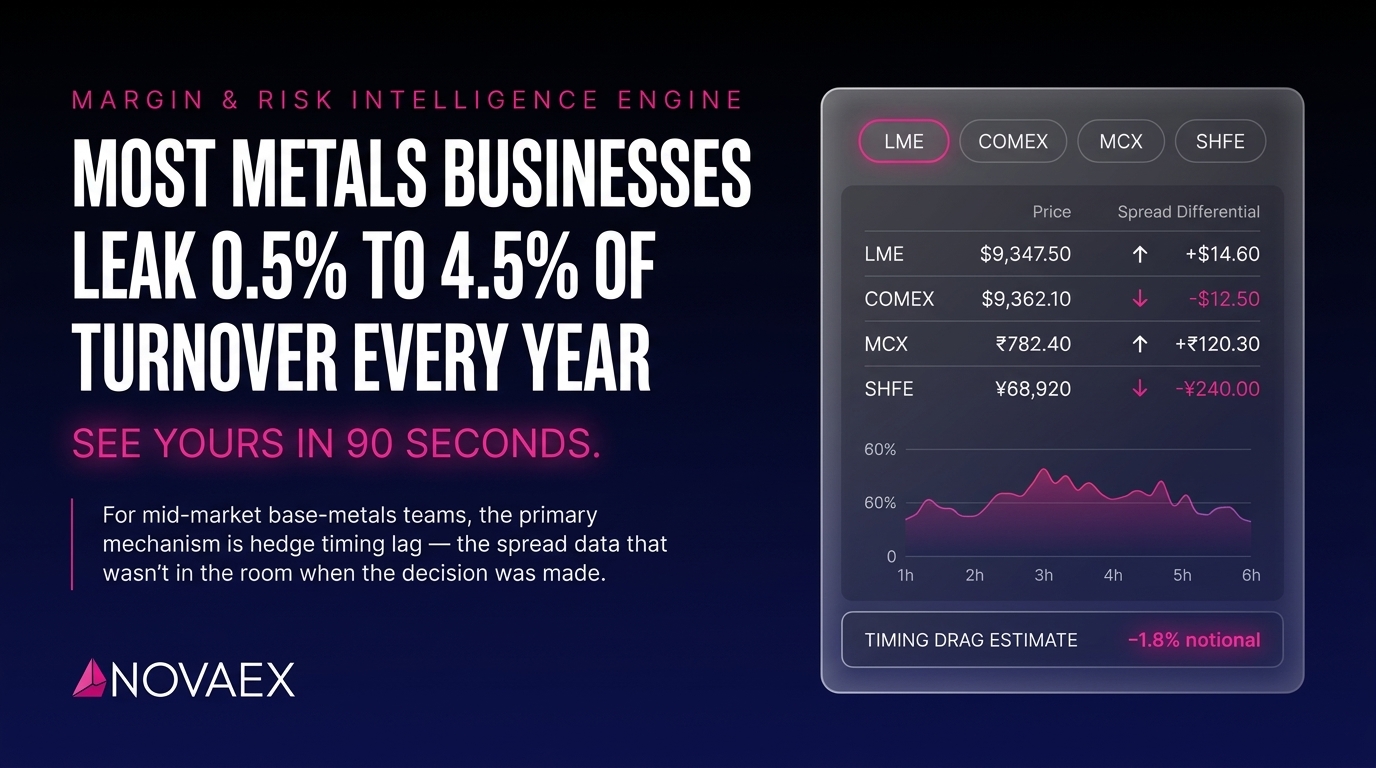
Suboptimal metals hedge timing caused by missing cross-exchange spread data is a documented, quantifiable source of margin erosion, not a vague execution risk. When a trader cannot see LME, COMEX, MCX, and SHFE spreads simultaneously, every hedge executed is a hedge executed against an incomplete picture of market structure.
This represents a data infrastructure failure rather than a trader error.
The pattern is well-documented among base metals traders at mid-market firms: the hedge appears correctly structured at execution. Cross-exchange spread relationships tell a different story within the hour. The P&L capture modeled at entry fails to fully materialize. Across weeks and quarters, those timing gaps accumulate into meaningful margin erosion. Post-trade reports rarely identify the root cause.
This analysis identifies it precisely: a data infrastructure architecture problem with a documented solution category.
Why Base Metals Hedging Demands Cross-Exchange Visibility
Base metals occupy a structurally distinct position within commodity markets: the same underlying physical commodity trades simultaneously across multiple exchanges, with non-trivial, time-varying spread relationships between venues.
Copper trades on LME, COMEX, MCX, and SHFE. Aluminum, zinc, nickel, and lead follow the same multi-venue pattern. According to the London Metal Exchange, LME metals contracts represent approximately 80% of global non-ferrous metals futures trading by volume. However, that figure does not capture the pricing influence COMEX and SHFE exercise on intraday spread dynamics. LME market data overview
The pricing relationship between these venues is not stable. It shifts with regional demand signals, currency movements, arbitrage flows, and exchange-specific inventory reports. A copper hedge sized and timed against LME prompt prices alone can appear precise in isolation while missing a COMEX-driven spread compression that would have altered both the timing and the size.
What makes cross-exchange spread data different from price data?
Cross-exchange spread data is not simply the price on two exchanges at the same moment. It is the relationship between those prices (the differential, the direction of movement, and the rate of change) tracked across all relevant venues in real time.
Price data indicates where a market is. Spread data indicates what market structure is doing. For metals hedge timing decisions, spread data is the more operationally relevant signal, yet it is precisely what most trading environments fail to deliver.
Most platforms surface price data. Few maintain exchange spread relationships as a structured, real-time intelligence object. That gap is where timing drag originates.
The Margin Erosion Mechanism: How Metals Hedge Timing Gaps Compound
When cross-exchange spread data is absent, metals hedge timing defaults to the best available single-exchange price signal. This is an adaptive response. Traders optimize within the data environment available to them.
The problem is that single-exchange timing systematically misses the spread environment that determines actual hedge efficiency. According to research on execution quality in multi-venue commodity markets, hedge timing errors attributable to incomplete cross-exchange data contribute to margin erosion in the range of 0.5% to 4.5% of hedge notional value per transaction. This range is specific to timing drag, not general trading friction. commodity hedge execution research
The lower bound reflects stable spread environments where single-exchange signals approximate cross-exchange reality with reasonable accuracy. The upper bound reflects high-volatility spread divergence periods, precisely the market conditions when optimal hedge timing matters most and the cost of misalignment is highest.
How does hedge timing error accumulate over a trading quarter?
Hedge timing error does not present as a single visible loss. It accumulates as a persistent, low-amplitude drag distributed across dozens of transactions, which is precisely why post-trade attribution rarely surfaces it as a named cost center.
A metals book executing 40 to 60 hedges per quarter against a $50 million notional position faces a materially different annual outcome at 0.5% timing drag versus 2% timing drag. The gap over a fiscal year can reach seven figures without a single transaction that appears incorrect in isolation.
This distribution pattern masks the signal within normal mark-to-market volatility. The margin erosion is real and recurring. It simply does not aggregate into a form that makes the root cause legible in standard reporting.
According to a 2022 study published in the Journal of Commodity Markets, traders with access to integrated cross-venue spread data demonstrated statistically significant improvement in hedge execution timing compared to traders relying on single-venue price data, with the performance gap concentrating in high-volatility periods when spread divergence between exchanges was greatest. Journal of Commodity Markets hedge execution study
The Data Fragmentation Reality in Base Metals Trading
The absence of cross-exchange spread data from most metals trading environments is not the result of negligence. It reflects an architecture decision that most multi-commodity platforms made deliberately: build for breadth, not depth.
A platform covering 40 commodity markets cannot invest the data engineering required to deliver exchange-by-exchange spread intelligence for each one. The economic and technical trade-off favors breadth. The result is platforms that deliver adequate price data across many markets and structured intelligence across none.
According to a 2023 survey of commodity trading technology users, 67% of respondents identified data fragmentation across trading venues as a significant operational challenge, with base metals traders reporting the highest incidence of manual workarounds for cross-venue data reconciliation. commodity trading technology user survey
For metals traders, that fragmentation manifests as a specific daily workflow:
- LME prompt structure data available in one system
- COMEX futures spreads pulled from a separate terminal
- MCX intraday data accessed through a regional feed
- SHFE overnight positioning reconciled manually from delayed reports
Why do legacy platforms fail to deliver real-time cross-exchange spread data?
Legacy CTRM platforms were architected for end-of-day position reporting, not intraday spread intelligence. Their data models normalize price inputs to a single reference price rather than maintaining the relational structure between venues as a live, queryable layer.
Retrofitting real-time, cross-exchange spread intelligence onto that architecture is not a feature addition. It requires rebuilding the data ingestion and normalization layer from the ground up, which explains why most platforms have not done it and why the problem persists across platform generations.
The technical debt is fundamentally structural.
This Is an Architecture Problem, Not an Execution Problem
The diagnostic reframe that determines which solutions are effective: suboptimal metals hedge timing from missing cross-exchange spread data is a data infrastructure architecture problem rather than an execution failure.
Execution problems respond to trader training, tighter limit structures, and improved workflow discipline. Architecture problems require architectural solutions, and conflating the two produces interventions that address the wrong layer.
When a metals trader builds a timing decision against fragmented, single-exchange price data, they are not executing poorly. They are executing correctly within an environment that lacks the required data infrastructure. The failure is upstream, in the data layer that was never built to surface cross-exchange spread relationships as a structured, real-time signal integrated with position context.
This distinction matters for two reasons. First, it correctly attributes margin erosion to a fixable infrastructure gap rather than to trader judgment. Second, it correctly identifies what needs to change: the intelligence architecture, not the workflow layer built on top of it.
According to Gartner's analysis of commodity trading platform adoption cycles, data architecture capability gaps between front-office decision requirements and available platform infrastructure represent the primary driver of technology refresh decisions at mid-market commodity firms, with cross-venue data fragmentation ranking as the most frequently cited trigger. Gartner commodity trading technology analysis
What does a data infrastructure architecture solution actually require?
An architecture solution to cross-exchange spread data fragmentation requires three structural components. These are not features, but foundational capabilities that determine what the system can know.
Real-time ingestion without latency normalization. Data from LME, COMEX, MCX, and SHFE must be ingested with the timing relationships between venues preserved, not flattened into a synchronized composite.
Relational spread calculation as a first-class data object. The differential structure between exchanges must be maintained and queryable in real time, not derived on demand from stored price history.
Position-aware presentation. Spread intelligence must surface in the context of existing hedge positions and live exposure gaps, not as a standalone data feed disconnected from the position management layer.
These requirements define what the architecture must be capable of delivering, not what features sit on top of it.
What Exchange-by-Exchange Intelligence Looks Like in Practice
The depth-first approach to exchange intelligence begins from a principle that is operationally clear but technically demanding: before covering any market, cover it completely.
For base metals, complete coverage means LME, COMEX, MCX, and SHFE simultaneously, relationally, and in real time. It means understanding not just price levels but the spread dynamics between venues, the inventory signals specific to each exchange, and the intraday structural patterns that precede price moves in single-exchange data by minutes.
This is not a marginal improvement over standard multi-exchange price feeds. It is a categorically different data product, one that preserves the information content that aggregation eliminates.
How does exchange-by-exchange architecture differ from aggregated market data?
Aggregated market data consolidates prices from multiple exchanges into a single composite signal. Exchange-by-exchange architecture preserves the individual exchange signals and maintains their relationships as live, distinct data streams.
The operational difference is material. An aggregated copper price does not indicate whether COMEX is leading LME or lagging it. It does not surface the SHFE inventory dynamic driving Asian demand signals. It does not show the MCX premium signaling regional tightness that would shift optimal hedge timing by hours.
Those relationships are where metals hedge timing precision is found, and aggregation eliminates them before they reach the trader's decision interface.
According to the Bank for International Settlements, intraday price leadership in base metals markets rotates between exchanges with documented frequency, with LME and SHFE alternating lead roles on copper pricing during overlapping Asian and European sessions. BIS commodity market microstructure analysis A trader without visibility into that rotation is making timing decisions against structurally incomplete inputs.
The Structural Case for Depth-First Intelligence in Metals Hedging
The base metals market is not served by platforms that cover all commodity categories adequately. It is served by platforms that cover base metals completely. Incomplete coverage of a structurally complex, multi-venue market is not a minor gap; it is the direct cause of the margin erosion documented above.
Novaex was built on this premise. Its architecture reflects four years of practitioner-level documentation of the specific ways multi-commodity platforms fail base metals traders: missing exchange spread relationships, lagged cross-venue data, and aggregated signals that collapse the structural information that hedge timing decisions require.
The depth-first methodology (mastering each base metal completely across LME, MCX, COMEX, and SHFE before expanding to new commodities) is an architectural commitment, not a positioning choice. It is what makes genuine exchange-by-exchange intelligence possible.
For mid-market metals traders, this carries a specific and practical implication. According to the International Wrought Copper Council, mid-market industrial metals buyers and sellers account for over 60% of physical hedging activity globally. Yet, access to institutional-grade cross-exchange spread intelligence has remained structurally unavailable to this segment, confined to firms with Bloomberg infrastructure, proprietary quantitative builds, or prime brokerage relationships. IWCC physical metals market report
The architecture solution closes that access gap. It makes the cross-exchange intelligence that informs optimal hedge timing available at the scale where most physical metals hedging occurs, without requiring the infrastructure budget of a hedge fund to access it.
Building Metals Hedge Timing Infrastructure That Sees Every Exchange
The path from suboptimal metals hedge timing to exchange-by-exchange spread intelligence is fundamentally an infrastructure decision.
Traders experiencing the margin erosion described in this analysis are operating rationally within a data environment that lacks the required architecture. The appropriate response to that diagnosis is to replace the existing environment with infrastructure built specifically to address this failure mode.
The architecture requirements are specific:
- Real-time cross-exchange spread data maintained as a relational, queryable intelligence object, not a derived report
- Position-aware spread visualization that connects live spread signals to existing hedge exposure and open risk
- Exchange-specific depth data for LME, COMEX, MCX, and SHFE without aggregation that collapses venue-to-venue relationships
- Workflow integration that surfaces spread signals at the moment metals hedge timing decisions are made, not in post-trade analysis
The answer determines whether the platform eliminates the timing gap or simply makes it slightly more visible.
The Margin Erosion Has a Name and a Structural Solution
Suboptimal metals hedge timing from missing cross-exchange spread data is a diagnosable, quantifiable failure mode. The 0.5% to 4.5% margin range specific to hedge timing represents the cost of executing structurally sound hedges at structurally wrong moments because the spread relationships between LME, COMEX, MCX, and SHFE were not available as an integrated, real-time signal at the moment the timing decision was made.
The failure lies within the architecture rather than the trader's execution.
The solution belongs to the same layer: exchange-by-exchange intelligence built depth-first, covering each base metal completely across all relevant venues before claiming adequate understanding of any of them, not multi-venue price aggregation retrofitted onto a CTRM designed for a different era of market structure.
Metals traders evaluating this problem should take three immediate steps:
- Audit your current hedge timing inputs. At the moment you execute a hedge, are you seeing cross-exchange spread relationships in real time, or assembling that picture manually from fragmented sources after the fact?
- Quantify timing drag from last quarter. Calculate the spread between your executed hedge prices and the theoretically optimal timing window that post-trade cross-exchange spread analysis reveals. If that analysis is not available, its absence is itself the diagnostic data point.
- Evaluate architecture before features. When assessing any platform, determine whether cross-exchange spread intelligence is a foundational data architecture capability or a feature layer built on top of single-venue price ingestion. The answer indicates whether the platform was built to solve this problem or to appear as though it was.