CTRM Implementation Timeline vs. Pilot Sprint Reality
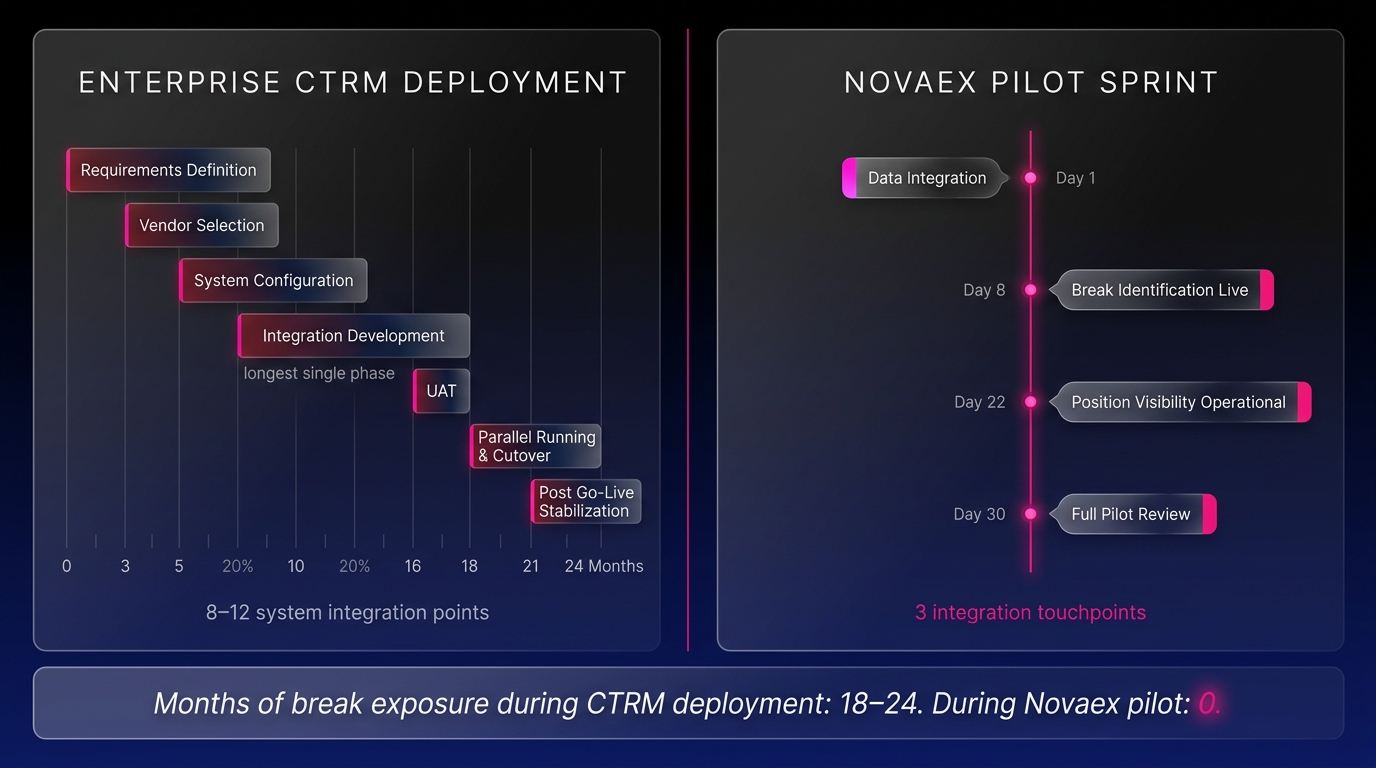
Executive Summary: The average CTRM implementation takes 14 to 24 months from contract signature to go-live. A Novaex Depth-First Pilot Sprint delivers integrated position visibility, real-time pricing intelligence, and risk analytics within weeks. For trading desks whose upgrade path runs through a full CTRM deployment, that timeline represents a quantifiable operational exposure window that warrants direct assessment.
Most metals trading desks operate under a default assumption: the logical progression from spreadsheets or a legacy platform is a full CTRM deployment. That assumption merits rigorous examination, not because enterprise CTRM platforms lack capability, but because the CTRM implementation timeline represents a material operational cost that is rarely modeled with precision before the contract is signed.
This post documents what enterprise CTRM deployment actually requires, what a structured pilot sprint delivers within the same window, and the cost of accepting unnecessary exposure while a full deployment runs.
What the CTRM Implementation Timeline Actually Looks Like
The 14 to 24 month figure is not a worst-case scenario. It is the industry median.
According to Commodity Technology Advisory (ComTech), fewer than one in three CTRM implementations go live on their original schedule and within initial budget parameters. Among implementations involving physical commodity workflows (which describes every base metals trading operation), complexity compounds at each project phase.
A realistic CTRM deployment sequence looks like this:
- Vendor selection and contracting , 2 to 4 months
- Requirements documentation and gap analysis , 1 to 3 months
- System configuration and customization , 3 to 6 months
- Integration development , 3 to 6 months (often the longest single phase when ERP and market data connectivity are involved)
- User acceptance testing (UAT) , 1 to 2 months
- Parallel running and cutover , 1 to 3 months
- Post-go-live stabilization , 1 to 3 months
The True Duration of a CTRM Implementation
A mid-market CTRM implementation typically takes 14 to 24 months from contract signature to go-live. Enterprise deployments involving physical commodity workflows, multi-exchange exposure, and ERP integration routinely run 24 to 36 months. These figures represent median outcomes, not edge cases.
The 14-month lower bound assumes clean source data, available internal IT resources, minimal customization requirements, and a vendor project team that remains fully engaged throughout. Those conditions rarely exist simultaneously on an operational trading desk.
CTRM selection criteria for base metals desks
The Integration Footprint Behind Every CTRM Timeline
Timeline overruns in CTRM implementations are rarely caused by core trading functionality. They are caused by integration.
A typical metals trading desk sits at the intersection of three to five existing systems: an ERP or accounting platform, one or more market data feeds, a trading execution system or broker interface, a risk reporting tool, and often a spreadsheet layer that has accumulated years of embedded business logic. Each of those systems requires a defined, tested, and validated integration with the new CTRM.
According to Gartner research on enterprise application deployments, integration work accounts for 35 to 45 percent of total project effort in complex platform migrations. For commodity trading specifically, that figure can run higher. Market data connectivity is real-time, latency-sensitive, and operationally non-negotiable from day one of production.
Typical CTRM Integration Requirements
A full CTRM deployment requires integrations to ERP and general ledger systems, market data providers (LME, COMEX, SHFE pricing feeds), broker and execution connectivity, regulatory reporting systems, and often a document management layer for physical contracts and confirmations. Each integration point requires scoping, development, testing, and sign-off, and those phases run largely in sequence, not in parallel.
That sequential dependency is what turns a twelve-month estimate into an eighteen-month reality. One integration delay does not push the go-live date by the length of that delay. It pushes everything downstream with it.
The CTRM implementation timeline is not extended by inadequate project management. It is extended by the structural complexity of connecting a new platform to an existing operational environment where data integrity during parallel running is non-negotiable. According to the Project Management Institute, integration complexity is cited as the leading cause of schedule overrun in over 60 percent of enterprise software projects exceeding twelve months in duration.
commodity trading platform integration requirements checklist
What Carries While You Wait: The Exposure Cost of Deployment Delay
A critical question that receives insufficient analytical attention during CTRM vendor selection: What is our operational exposure profile for the next twenty-four months while this deployment runs?
During a CTRM deployment, trading desks do not stop trading. They continue operating on the legacy system or spreadsheet stack that prompted the upgrade decision in the first place. Every risk visibility gap, every manual reconciliation step, every position reporting delay that motivated the upgrade continues for the full deployment duration.
For a base metals desk with active LME hedges, that means:
- Delta risk on physical inventory positions is tracked manually or on legacy tooling throughout the implementation period
- Basis risk across LME prompt dates and physical delivery windows remains unintegrated
- Mark-to-market P&L across LME, COMEX, and SHFE requires manual consolidation before it is visible
- Stress scenarios are run outside the system, disconnected from live position data
The Real Cost of Delaying Commodity Risk Visibility
The cost of delay is quantifiable. Every month of deployment extends the period in which position visibility depends on manual processes that are subject to error, latency, and version-control failure. For metals desks carrying active hedges, that means mark-to-market exposure, basis risk, and delta positions are all tracked outside an integrated system. These are precisely the conditions under which undetected risk events occur.
According to a 2023 Accenture survey on commodity trading operations, 62 percent of commodity trading firms reported that risk reporting delays directly contributed to a risk event or near-miss in the previous 24 months. A delayed implementation does not simply defer an upgrade. It extends the window in which those events are most likely.
The gap is not about missing features. It is about time spent operating without the controls your desk has already determined it requires.
How a Novaex Pilot Sprint Compares to CTRM Implementation
The Novaex Depth-First Pilot Sprint is not a lightweight alternative to a CTRM. It is a structured, time-bounded deployment of integrated position management, pricing intelligence, and risk analytics, scoped specifically for base metals desks operating across LME, COMEX, MCX, and SHFE.
The implementation footprint differs materially across every critical dimension:
| Dimension | Enterprise CTRM | Novaex Pilot Sprint |
|---|---|---|
| Deployment timeline | 14 to 36 months | Weeks, not quarters |
| Integration requirements | ERP, execution systems, market data, GL | Market data feeds + position input layer |
| Customization scope | Full multi-commodity workflow configuration | Pre-configured for base metals workflows |
| Go-live definition | Full production cutover | Live position visibility operational |
| Exposure during deployment | Continuous: full deployment period | Minimal: accelerated to value |
The integration footprint differential is the defining variable. A pilot sprint does not connect to an ERP system, rebuild a GL interface, or configure a multi-commodity execution framework. It connects to the market data and position inputs a metals desk already has and surfaces integrated risk visibility against those inputs immediately.
Achieving Risk Visibility Without a Full CTRM Deployment
A structured pilot sprint can deliver integrated position visibility, real-time LME, COMEX, and SHFE pricing intelligence, and mark-to-market risk analytics within weeks by scoping to the specific workflow requirements of a base metals desk rather than configuring a multi-commodity enterprise platform. This is a depth-first approach that delivers complete capability within a defined market scope, not a partial solution.
According to McKinsey's 2022 research on commodity trading transformation, firms that implement targeted, workflow-specific analytics tools before deploying full enterprise platforms achieve faster ROI and lower implementation risk than firms that attempt enterprise-wide transformation in a single program. A two-year deployment gap is the quantifiable operational cost of the alternative.
base metals hedging workflow requirements
The Depth-First Methodology: Why Scope Defines Speed
A Novaex pilot delivers in weeks rather than months because of disciplined scope architecture, not accelerated project management.
Most enterprise CTRM platforms are built to cover every commodity across every workflow. That architectural breadth; crude oil swaps, soft commodity forwards, power purchase agreements, base metal physicals; generates the configuration surface area and integration complexity that extends deployment timelines to twenty-four months.
Novaex applies a depth-first methodology: one commodity group, completely. Every base metal across LME, COMEX, MCX, and SHFE (with full understanding of prompt structures, basis relationships, physical delivery workflows, and exchange-specific margin requirements) before any expansion to adjacent markets.
That depth is the mechanism that makes rapid deployment structurally achievable.
A pre-configured base metals workflow means:
- LME prompt date structures are already built and validated
- COMEX and SHFE cross-exchange basis logic is pre-integrated
- Physical versus financial position reconciliation logic exists on day one
- Pricing intelligence covers the carry, basis, and spread structures base metals traders actually use
Pilot Sprint Versus Full CTRM Deployment in Practice
A pilot sprint delivers a live, integrated view of position, P&L, and risk within a defined base metals scope. This requires no ERP integration, no multi-commodity configuration, and skips the six-to-twelve month integration development phase that extends CTRM timelines. In practice, a metals desk can be operationally live on a pilot sprint before most CTRM deployments complete their requirements documentation phase.
According to the Project Management Institute, scope reduction is the single most effective lever for accelerating enterprise software deployment, consistently reducing timeline by 30 to 50 percent when scope is defined deliberately rather than reactively. A platform scoped to your actual workflow is a delivery strategy, not a trade-off.
depth-first commodity analytics methodology
Pressure-Testing Your Upgrade Path Assumptions
If your current plan is to improve risk visibility through a full CTRM deployment, three areas require rigorous analysis before that project begins.
1. Your operational exposure profile for the next twenty-four months.
Model the gap explicitly. Document every manual process, every reconciliation step, every position reporting delay your current state requires. Then assess whether that exposure profile is acceptable for another fourteen to thirty-six months while deployment runs. Most desks that complete this exercise find the documented gap extends materially beyond initial estimates.
2. The integration timeline for your specific environment.
Most initial timeline estimates are generated before the integration scope is fully understood. Require your IT team and the vendor's technical team to produce a bottom-up integration timeline, phase by phase, system by system, before contract signature. According to Forrester Research, over 40 percent of enterprise software buyers report that initial platform selection was over-scoped for their actual operational requirements, and over-scoping was the primary driver of deployment overruns in those cases.
3. Whether a full CTRM deployment is actually required for the problem you are solving.
The base metals desk that needs real-time position visibility across LME, COMEX, and SHFE, with integrated mark-to-market and basis risk analytics, does not necessarily require a platform configured for crude oil swaps, agricultural forwards, and power purchase agreements. Scope drives timeline. A platform scoped to your actual workflow delivers faster, and delivers first.
The CTRM implementation timeline is extended because enterprise platforms are architected to serve every workflow by design. That is a sound architectural decision for the vendor. It is not automatically the correct implementation decision for your desk.
commodity trading platform scoping framework
What a Pilot Sprint Delivers Before Your CTRM Decision Is Made
During a CTRM vendor evaluation cycle, your desk is consuming sales demonstrations, RFP responses, reference calls, and technical workshops. None of those activities reduce your operational exposure or improve your real-time position visibility. They defer both.
A Novaex Depth-First Pilot Sprint runs concurrently with your evaluation cycle and delivers live capability before that process concludes:
- Integrated position visibility across your active base metals book without manual consolidation
- Real-time LME, COMEX, MCX, and SHFE pricing intelligence connected to live position data
- Mark-to-market risk analytics that do not require a spreadsheet step between data and decision
- Basis and carry analysis calibrated to actual base metals market structure, not a generic multi-commodity model
- Operational proof of concept with your own data before any long-term commitment is required
The pilot sprint and a future enterprise deployment are not mutually exclusive. The pilot delivers integrated risk visibility now and generates the operational data required to make a more rigorous CTRM selection decision later, without carrying the two-year exposure gap in the interim.
schedule a Novaex pilot sprint scoping session
The Timeline Gap Is the Decision
The case for reconsidering your upgrade path is not a feature comparison. It is an analytical assessment of the CTRM implementation timeline as an operational cost that warrants the same rigor applied to every other risk decision on your desk.
Fourteen to thirty-six months is a significant period to carry a risk visibility gap your desk has already determined is unacceptable. The pilot sprint does not require abandoning the CTRM path. It requires stopping the acceptance of unnecessary exposure while you pursue it.
Three concrete steps worth taking this week:
- Build a bottom-up integration timeline for your CTRM deployment, including the integration phase, system by system. Most teams find the honest number is materially longer than the initial vendor proposal.
- Model your exposure cost during deployment by documenting every manual process currently required for position visibility, basis tracking, and risk reporting, and multiplying it by twenty-four months.
- Request a scoping conversation with Novaex to understand what a Depth-First Pilot Sprint delivers within your specific base metals environment before your CTRM evaluation concludes.