CTRM Vendor Risk: Signals That Outweigh Any Sales Pitch
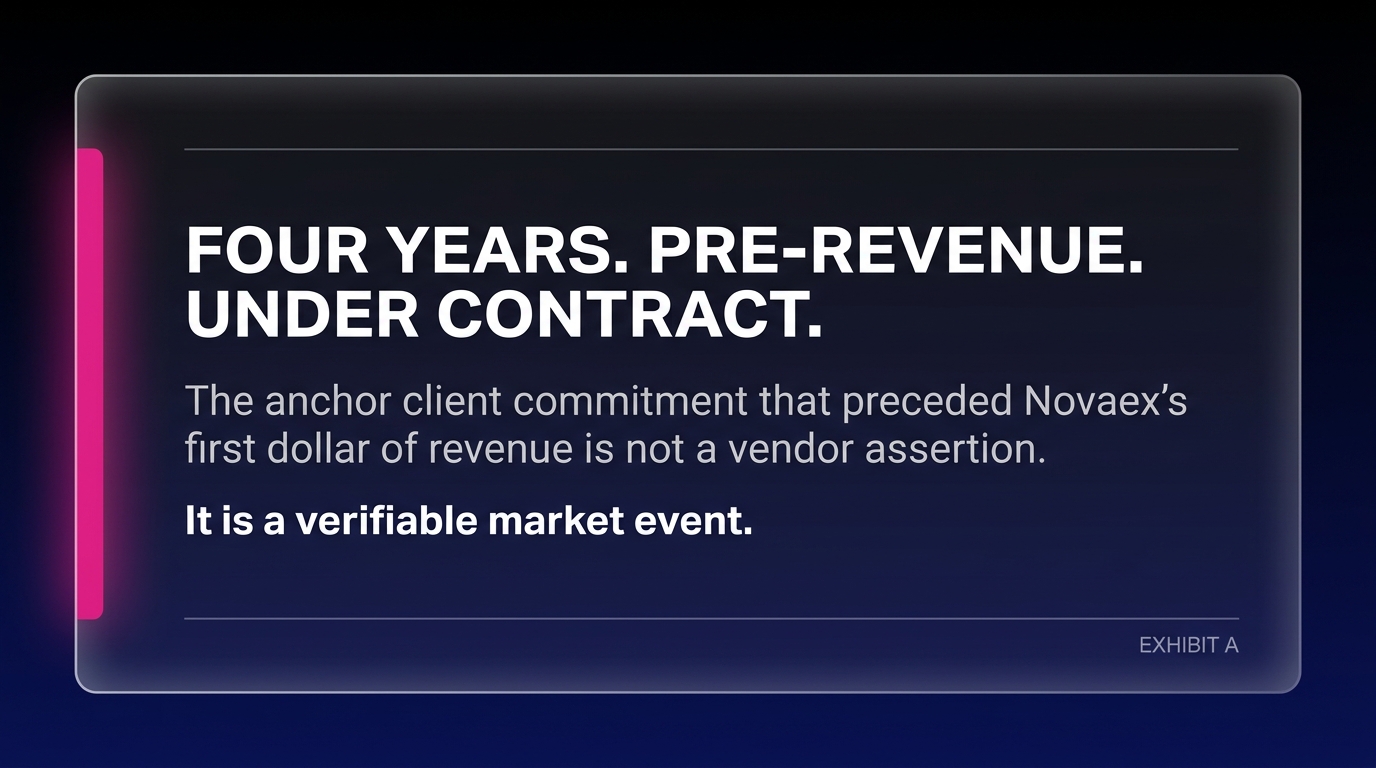
Before a platform generates its first dollar of revenue, the clients who commit contractually reveal more about vendor conviction than any RFP response ever will.
In base metals trading, CTRM vendor risk carries operational and financial consequences that generic software evaluation frameworks do not fully account for. The wrong platform does not simply slow operations down. It creates direct exposure when the LME moves against your position and the system cannot reconcile physical inventory against mark-to-market exposure in real time.
TL;DR: In CTRM vendor risk assessment, the most defensible evidence of platform conviction is observable, pre-revenue contractual commitment. Novaex's anchor client signed a four-year contract before the platform generated revenue. This is a verifiable market signal that belongs alongside financial stability checks, reference calls, and product demonstrations in any structured vendor evaluation.
Most evaluation frameworks weight evidence that vendors can prepare specifically for your process. This article argues for weighting the evidence they cannot.
Why CTRM Vendor Risk Differs From Standard Software Risk
Most enterprise software failures are operationally disruptive. CTRM failures in metals trading carry materially greater operational consequences.
According to Gartner, fewer than 30% of enterprise software implementations deliver their expected business value within the projected timeline. Gartner enterprise software implementation research For a finance or HR platform, that statistic represents productivity drag. For a front-office metals trading operation, it represents unhedged positions, margin calls that arrive before the system has processed the triggering trades, and manual reconciliation procedures assembled under time pressure.
The stakes of CTRM vendor risk are asymmetric. The upside of a successful implementation is a more efficient workflow. The downside is material financial exposure with a latency problem at its center.
Base metals trading amplifies this asymmetry further. LME copper, aluminum, and zinc contracts move intraday with volatility that renders stale position data operationally insufficient. A platform that refreshes position data in batch cycles rather than in real time is not a partial solution. It introduces operational constraints that become most consequential precisely when the market is moving fastest.
What Makes CTRM Vendor Selection Uniquely High-Stakes?
CTRM selection is uniquely high-stakes because implementation complexity, data migration scope, and organizational workflow dependency accumulate faster than in most software categories. According to research from PwC's commodity trading technology practice, full CTRM implementations for mid-market metals firms require between 18 and 36 months from contract signing to operational stability. PwC commodity trading technology research That timeline creates switching-cost lock-in that extends the effective vendor relationship well beyond the initial contract term. The evaluation question is therefore not only whether the platform is capable today, but whether the vendor has the operational conviction to build what metals-specific operations will require over the next five years.
The Evidence Hierarchy in CTRM Vendor Risk Assessment
Standard vendor risk frameworks rely on four evidence categories: financial stability, client references, product demonstrations, and contractual terms. Each carries a signal-to-noise problem.
Financial stability data reflects the past. Client references are curated by the vendor's sales team. Product demonstrations show precisely what the vendor chooses to show. Contractual terms are negotiated. They document what each party agreed to at the conclusion of the process.
A fifth evidence category (observable market behavior before the vendor required your business) is rarely codified in evaluation frameworks, but it carries the highest evidentiary weight of any available signal. Pre-revenue contractual commitment is the only evidence a vendor cannot manufacture for your RFP process. It predates the process entirely.
According to McKinsey & Company's analysis of B2B technology vendor selection, buyers who incorporated pre-market commercial traction into their evaluation criteria reported materially lower rates of post-contract disputes over platform capability gaps. McKinsey B2B technology vendor selection The underlying logic is direct. A vendor that accepted a four-year contractual obligation before generating revenue took on downside risk alongside their first client. That is a structurally different risk posture than one that commits only after market validation is secured.
What Signals Best Predict CTRM Vendor Commitment?
The signals that best predict long-term CTRM vendor commitment are those the vendor cannot reconstruct for your evaluation. These include the identity and tenure of their first clients relative to platform launch date, the term structure of those earliest contractual relationships, and whether those commitments were made before or after revenue generation began. A vendor that signed anchor clients before going to market had no external validation to rely on. This context provides strictly evidentiary value.
Pre-Revenue Client Commitment as a Verifiable Market Signal
Vendors regularly characterize themselves as trusted partners, proven platforms, and category leaders. These are assertions. They require the audience to accept the vendor's characterization without independent verification. A rigorous vendor risk assessment requires observable facts that exist independent of what the vendor tells you about itself.
Consider this verifiable fact. Novaex's anchor client signed a four-year contract before the platform generated revenue.
This represents a contractual commitment made under standard commercial risk conditions by a client who evaluated the platform before it had a production revenue track record, and committed to a four-year term regardless.
The evidentiary weight of that fact operates on two dimensions.
First, it is independently verifiable. Contract existence and term length are documented commercial facts subject to standard verification during due diligence. due diligence frameworks for CTRM vendor selection Any structured evaluation can confirm them.
Second, the timing eliminates survivorship bias. Post-revenue client references, by definition, reflect a vendor who has already navigated early-market uncertainty with the benefit of initial revenue and iterative feedback. A pre-revenue commitment reflects a client who accepted that uncertainty as an explicit condition of the relationship. That is a materially different risk signal, and it belongs in a different evidence tier.
According to Harvard Business Review's analysis of early-stage enterprise technology adoption, pre-revenue enterprise contracts are statistically rare (fewer than 12% of B2B software platforms secure multi-year agreements before generating revenue) and correlate strongly with domain-specific conviction on the part of both vendor and client. HBR enterprise technology early adoption research The rarity of the signal increases its informational value.
Why Does a Pre-Revenue Contract Matter in Platform Selection?
A pre-revenue contract matters because it documents that a sophisticated commercial counterparty, one operating under its own fiduciary obligations and carrying its own vendor risk exposure, evaluated the platform without the safety net of existing customer validation and committed to a multi-year term regardless. That decision reflects independent due diligence reaching an affirmative conclusion under conditions of maximum uncertainty. It belongs in your evidence file alongside your own assessment, weighted as the independent corroboration it is.
What the Depth-First Build Methodology Signals About Conviction
Understanding why a pre-revenue commitment was achievable requires understanding what Novaex built, and more specifically, what it declined to build prematurely.
The prevailing development approach in CTRM has been multi-commodity breadth. Vendors construct a framework that covers oil, gas, metals, and agriculture simultaneously, then optimize each commodity segment incrementally. The commercial logic is straightforward. The operational result is platforms that deliver generalized functionality across multiple markets while achieving depth in none.
Novaex's depth-first methodology takes a different approach. The platform achieves full operational depth for each base metal, across LME, MCX, COMEX, and SHFE, before expanding to new commodity categories. That means full workflow integration for physical position management, mark-to-market analytics, and hedging execution, built specifically for how base metals trade.
According to LME annual statistics, average daily volume across its six primary base metals contracts exceeds 600,000 lots, representing notional value in the hundreds of billions of dollars annually. LME annual statistics and trading volume data The operations executing against that volume require platforms that understand LME prompt date structures, three-month forward mechanics, and exchange-specific margining natively rather than as configuration options applied to a generic data model.
The depth-first methodology was developed by a trader who spent four years identifying the operational gap that no existing platform had addressed. That origin explains why a sophisticated anchor client found the pre-revenue conviction credible enough to commit to for four years.
How to Read CTRM Vendor Risk Signals During Evaluation
If your organization is currently conducting a CTRM vendor evaluation, the following framework structures the evidence categories by predictive weight for base metals operations.
Tier 1: Observable Market Behavior (Highest Evidentiary Weight)
- Pre-revenue contractual commitments and their documented term lengths
- Client tenure relative to platform general availability date
- Founder operational background and the specific workflow gap the platform was built to address
Tier 2: Verifiable Product Architecture
- Whether LME prompt date mechanics, COMEX delivery grade structures, and SHFE lot specifications are native architecture or configured overlays
- Real-time position refresh rates versus batch-cycle processing under load
- Physical-to-financial position reconciliation workflow without manual intervention steps
Tier 3: Standard Reference Validation
- Client references from firms with comparable base metals exposure and position complexity
- Implementation timeline actuals versus contract estimates
- Support escalation response times documented during high-volatility market periods
Most evaluations allocate the majority of their assessment time to Tier 3. The evidence tier most predictive of long-term vendor performance is Tier 1.
According to Forrester Research on enterprise software vendor selection, buyers who incorporated vendor market-commitment signals, including pre-market client traction, into their evaluation frameworks reported 34% fewer mid-contract disputes over platform capability gaps compared to buyers relying exclusively on reference-based assessment. Forrester enterprise software vendor selection research
How Do You Verify a CTRM Vendor's Claimed Expertise in Base Metals?
You verify base metals CTRM expertise by testing the platform against the operational specifics that generic frameworks routinely mishandle. These include LME three-month forward carry calculations, cross-venue position netting across LME and COMEX copper simultaneously, physical inventory lot tracking reconciled against financial hedge positions in real time, and margin call calculation across multiple exchange memberships under simulated volatility conditions. A platform with genuine depth handles these natively. A platform approximating depth requires configuration-dependent workarounds to produce equivalent results.
The Operational Cost of Misreading CTRM Vendor Risk
The cost of selecting a CTRM vendor without genuine metals-specific operational depth is not fully visible at contract signing. It accumulates through implementation customizations, embedded workaround workflows, and the specific failure mode that affects front-office metals traders most directly. System latency during high-volatility windows represents the most severe risk.
When copper moves 3% intraday on macro news or a supply disruption event, a front-office trader requires position data that simultaneously reflects executed trades, open orders, and physical delivery commitments. According to operational risk research published by Oliver Wyman, commodity trading firms with fragmented position visibility systems incur an average of 23 basis points of additional hedging cost per transaction due to delayed reconciliation between physical and financial books. Oliver Wyman commodity trading operations research Across a mid-market metals book with meaningful daily volume, that figure compounds into material annual drag.
The more common operational pattern is incremental rather than acute. Traders build manual workarounds (spreadsheet overlays, third-party data pulls, informal reconciliation procedures) that perform adequately under normal conditions and create exposure under stress. According to the Basel Committee on Banking Supervision's operational risk framework, manual override procedures that become embedded in standard daily workflows constitute a recognized category of operational risk accumulation. Basel Committee on Banking Supervision operational risk guidance That risk accumulates directly from vendor capability gaps. A platform built for generic commodity coverage cannot eliminate the workarounds that metals-specific workflows require. It can only defer the point at which their operational cost becomes clearly attributable.
What Are the True Costs of Switching CTRM Vendors Mid-Cycle?
The true costs of mid-cycle CTRM vendor switching extend well beyond licensing fees. They include data migration (typically six to twelve months for a mid-market metals book with physical delivery history), workflow retraining across front, middle, and back office, and the operational exposure window during parallel-run periods when neither system is fully trusted for position of record. According to PwC's commodity trading technology practice, total switching costs for CTRM platforms in mid-market firms average 2.3 times the annual platform licensing cost when all direct and indirect costs are fully attributed. PwC CTRM switching cost analysis Selecting the right platform at the outset is a risk management decision with a documented cost baseline.
Building a Vendor Risk Framework for Base Metals Operations
The following structure provides a defensible foundation for CTRM vendor risk assessment in base metals trading operations.
Step 1: Establish the Evidentiary Baseline
Document what each vendor can verify independently rather than what they assert. Pre-revenue commitments, implementation timeline actuals, and client tenure relative to platform release date belong in this tier. These facts exist independent of the vendor's interest in your contract.
Step 2: Audit Exchange-Specific Architecture
Request technical documentation on LME, COMEX, MCX, and SHFE integration. Ask explicitly whether prompt date mechanics, margining calculations, and physical delivery workflows are native data model features or configured parameters applied to a generic schema. The answer is verifiable through architecture review.
Step 3: Stress-Test the Position Visibility Architecture
Request documented evidence of real-time position refresh rates under simulated high-volume conditions. Batch-cycle limitations that are not visible in a controlled demonstration become operational constraints during market stress, which is when system performance is most consequential.
Step 4: Weight Pre-Revenue Commitment Evidence
If a vendor secured contractual commitments before generating revenue, document the fact, verify the term length through standard due diligence, and weight it appropriately in your risk assessment. It is independently verifiable evidence of conviction that predates your evaluation process entirely.
Step 5: Map Vendor Depth Against Your Workflow Specificity
For base metals operations, generic CTRM functionality does not adequately support metals-specific workflows. Your evaluation framework should explicitly test for metals-specific depth, including LME carry structures, cross-exchange netting, and physical lot tracking. Avoid relying on general commodity functionality that requires configuration to approximate those requirements.
According to Gartner's Market Guide for CTRM software, organizations that align vendor selection criteria with commodity-specific operational requirements report 41% higher platform satisfaction scores at the 24-month mark compared to organizations using generic enterprise software evaluation frameworks. Gartner CTRM Market Guide The gap widens as operational complexity increases, which is the direction base metals trading consistently moves.
Conclusion
The vendor risk signals that carry the highest predictive weight in CTRM selection for base metals operations are not the ones most evaluation frameworks measure rigorously.
Financial stability checks, curated references, and product demonstrations are necessary, but each is filtered through the vendor's interest in your contract. Observable market behavior before the vendor required your business is the only evidence category that cannot be prepared for your evaluation process. It is either present in the record or it is not.
Novaex's anchor client committed to a four-year contract before the platform generated revenue. That fact is independently verifiable. It represents a documented commercial decision made under standard risk conditions by a counterparty with its own due diligence obligations, and it belongs in your vendor risk assessment with the weight that evidence, rather than assertion, deserves.
Three immediate steps for metals trading operations in active vendor evaluation:
- Request pre-revenue commitment documentation from every vendor under consideration. Ask for client start dates relative to platform general availability. The answer provides a verifiable fact rather than a qualitative claim.
- Test exchange-specific depth before general functionality. Run LME prompt date scenarios, SHFE lot structure calculations, and cross-venue position netting through the platform against your actual workflows before evaluating the interface.
- Schedule a Depth-First Pilot Sprint with Novaex. Novaex Depth-First Pilot Sprint scheduling The sprint is structured to generate verifiable position visibility and hedging workflow performance data against your actual base metals book rather than a demonstration environment. The evidence produced belongs in your assessment alongside everything else.