Defensible Execution Documentation Starts at Trade Time
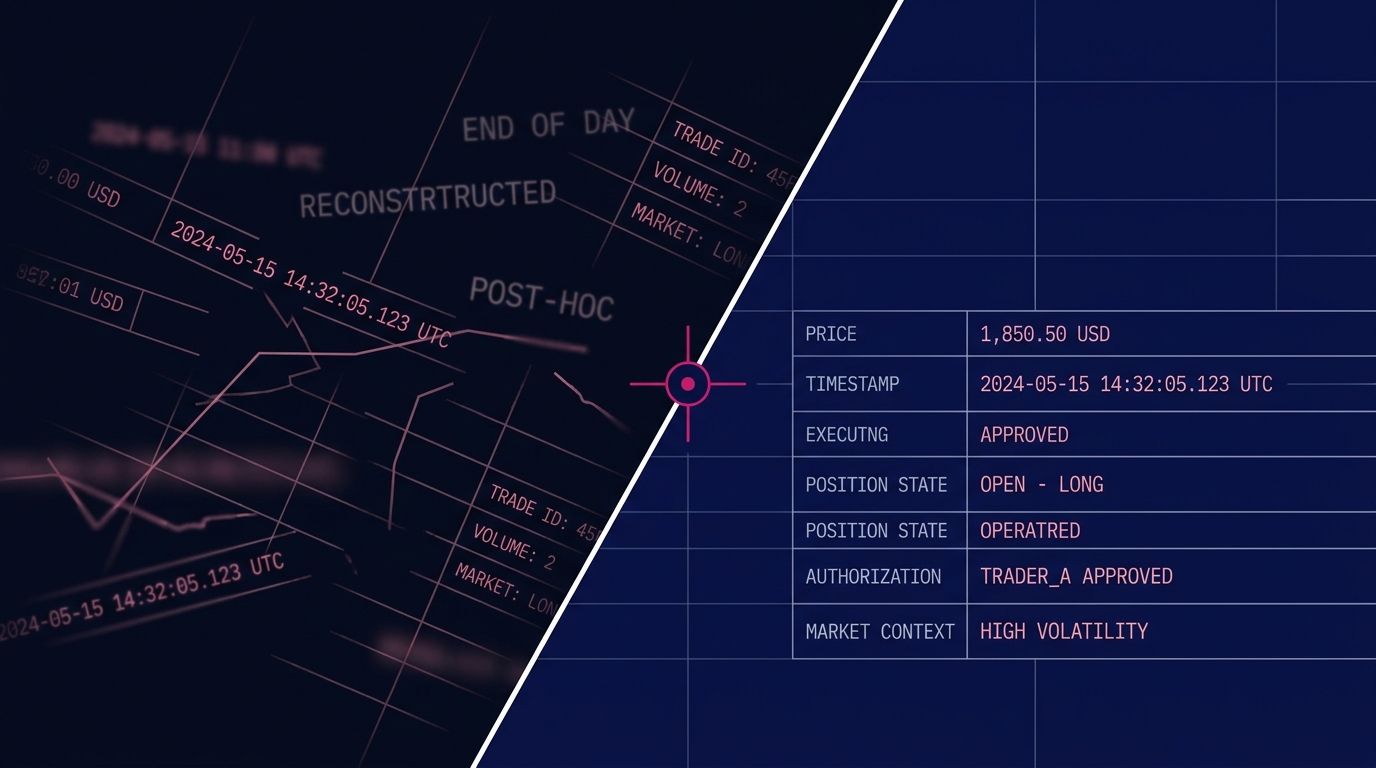
Post-hoc reconstruction of trade rationale is the single most common reason execution documentation fails under scrutiny. Defensible execution documentation is achieved by capturing decision rationale, market context, and authorization logic at the exact moment of trade. When real-time capture is built into normal workflow, the audit trail, board record, and counterparty file are outputs of execution itself.
When a metals trader executes a copper hedge at 9:47 AM against a fast-moving LME prompt, the decision involves market context, position exposure, authorization limits, and counterparty pricing. All of these factors exist clearly in that moment and nowhere else. Waiting until end-of-day, end-of-week, or end-of-quarter to document that logic produces a reconstruction rather than a verifiable record.
This article walks through the mechanics of real-time capture and demonstrates what defensible execution documentation enables across three review contexts that carry real operational consequences: auditor examination, board-level governance, and counterparty negotiation.
Why Post-Hoc Reconstruction Produces a Different Document Than a Real-Time Record
Reconstructed documentation fails primarily due to its structural inferiority as evidence. A record created in the moment of decision captures conditions that no longer exist when the reconstruction begins.
Consider a common base metals scenario: a hedge desk runs an aluminum forward against LME 3-month on a day when the cash-to-three spread moves 60 basis points intraday. The execution decision made at 11:15 AM was logical given the spread at that moment. By the close, that spread has retraced. The reconstructed documentation (written at end of day) is now characterizing a decision against a market that no longer exists.
According to the International Swaps and Derivatives Association (ISDA), documentation disputes are among the top five causes of counterparty claims escalation in commodity markets. ISDA documentation best practices That statistic points directly to documentation quality.
The Structural Differences of Real-Time Capture
Real-time capture records market conditions, position state, and decision rationale as they exist at the moment of trade. Post-hoc reconstruction records what a trader remembers about those conditions, filtered through subsequent market movement and outcome bias. The two documents are structurally different artifacts. One serves as evidence; the other acts as testimony.
The distinction matters because an auditor, board member, or counterparty reviewing execution quality does not have access to what the trader remembers. They have access only to the record. A record that reflects actual market conditions at execution time is testable against third-party market data. A reconstruction is not.
In practice, trading operations that rely on reconstruction face a specific failure mode: the better the trade performed, the harder it is to reconstruct the reasoning accurately. Outcome bias causes traders to retroactively rationalize decisions in terms of result rather than original market logic. According to a 2022 study published in the Journal of Behavioral Finance, outcome bias affects decision reconstruction accuracy by an average of 34%. behavioral finance outcome bias research This represents a structural defect in reconstruction methodology, independent of trader intent or documentation effort.
The Mechanics of Real-Time Decision Capture in Metals Trading
Effective real-time capture relies on the platform recording structured data at the moment of trade (market price, position state, authorization level, and execution rationale in structured fields) without adding friction to the workflow.
The operational standard requires documentation to function as a native byproduct of normal execution.
In base metals specifically, this requires capturing at minimum:
- Market context at execution: LME official, cash-to-three spread, nearby contango or backwardation structure, and regional premium at time of trade
- Position state: Net delta, open prompt exposure, and hedge ratio at the moment of execution
- Authorization record: Who authorized the trade, against which limit, and at what precise time
- Counterparty terms: Agreed price, settlement terms, and any broker or electronic communication log
Building Auditor-Defensible Execution Documentation
Defensible execution documentation is a record auditors can verify against independent third-party data without relying on trader recollection. For a metals trade, this means the documented market price at execution should reconcile with LME settlement data, exchange timestamps, and broker confirmations. When those three sources align with the internal record, the documentation is defensible by construction.
The Commodity Futures Trading Commission (CFTC) requires firms subject to swap dealer registration to maintain records sufficient to reconstruct all material aspects of each transaction. However, "reconstruct" in regulatory language means rebuilding from contemporaneous records rather than from memory. [LINK: CFTC recordkeeping requirements Part 45] The regulatory standard strictly demands contemporaneous records.
For metals trading operations executing across LME, COMEX, MCX, and SHFE, the challenge lies in capturing precise data across four exchange environments with different time zones, pricing conventions, and settlement calendars. A platform that integrates those data sources in real time eliminates the manual reconciliation step that most operations push to end-of-day, and in doing so eliminates the documentation gap at its source.
What Defensible Execution Documentation Enables for Auditors
An auditor reviewing a metals hedge program has a specific objective: confirm that each trade was executed within authorized limits, at a price consistent with prevailing market conditions, and for a legitimate hedging purpose. Documentation that enables that review without requiring interviews, email chain reconstruction, or calendar archaeology is operationally superior.
The operational illustration is a routine internal audit of a six-month copper hedging program. The auditor needs to confirm that 24 individual hedge executions across a rolling quarter were each within the board-approved hedge ratio limit, executed at prices within a defined slippage tolerance of LME official, and authorized by the appropriate level of the trading authority matrix.
When real-time documentation captures those three data points at trade time (rather than reconstructed), the audit becomes a data matching exercise. The Institute of Internal Auditors notes that audit cycle time for trading operations with contemporaneous electronic records is 40, 60% shorter than for operations relying on reconstructed documentation. IIA trading operations audit standards
Structured data fields also enable exception reporting. If a trade was executed outside the authorized slippage tolerance, a platform with real-time structured capture surfaces that exception automatically. Reconstructed documentation cannot produce systematic exception reports because the data was never captured in a queryable form. It exists only as narrative, which cannot be queried at scale.
For copper and aluminum programs running 20 or more monthly executions, the difference between exception reporting from structured real-time data and manual review of reconstructed tickets is not a marginal efficiency gain. It is the difference between systematic oversight and selective scrutiny.
Board-Level Governance and the Defensible Execution Record
Boards reviewing commodity risk programs operate at a different resolution than auditors. Instead of tracing individual trades, they assess whether the execution program delivered on the hedging mandate, whether limits were observed consistently, and whether the operation is capable of demonstrating its own discipline on short notice.
A board risk committee ultimately needs to verify that the organization executes in a defensible manner to shareholders, counterparties, or regulators without requiring preparation time.
Board Expectations for Trade Execution Records
Boards look for systematic evidence of limit compliance, consistent application of the hedge policy, and a documentation trail that does not rely on key-person knowledge. Relying on a single trader who holds the institutional memory of why each decision was made creates a concentration risk that the board implicitly carries.
The Bank for International Settlements (BIS) highlights that commodity risk governance failures cited in counterparty and regulatory actions most commonly involve a gap between the documented hedging mandate and actual execution behavior. BIS commodity risk governance framework The gap is rarely intentional. It usually represents a documentation failure that makes the gap visible only after the fact.
A real-time documentation standard closes that gap structurally. When each execution record includes the active hedge policy version, the current limit matrix, and the position state at execution time, a board can trace exactly how each trade related to the live mandate, bypassing later characterizations.
Deloitte's 2023 Commodity Trading Risk Management Survey found that 68% of commodity trading firms reported that board-level risk reporting relies on manually aggregated data that could not be reproduced under a short-notice audit scenario. Deloitte CTRM risk management survey 2023 Real-time capture addresses that exposure at the structural level before it surfaces as a governance event.
Counterparty Negotiation: When Defensible Documentation Becomes Leverage
The counterparty use case for execution documentation is less frequently discussed than audit or governance, but it carries direct commercial consequence. When a counterparty challenges an execution price, claims a settlement discrepancy, or disputes agreed terms, the party with better contemporaneous documentation controls the negotiation.
This dynamic represents a mechanical reality. In a disputed execution, the counterparty who can produce a timestamped record of the agreed price, the prevailing market context, and the communication log at execution time has an objective basis for their position. The counterparty reconstructing from memory or incomplete records is negotiating from a weaker informational position regardless of who is factually correct.
Essential Counterparty Negotiation Records
Counterparty negotiation records must include: the agreed price with timestamp, the market reference used (LME official, spot, or negotiated basis), any premium or discount applied, the communication log confirming agreement, and the counterparty confirmation reference. These should be captured at execution, not assembled when a dispute arises, because assembly under dispute conditions introduces both delay and the appearance of selective record construction.
The operational illustration: a copper cathode trader agrees a 90-day forward purchase at LME official plus a $45/MT regional premium with a European counterparty. Three weeks later, that counterparty claims the agreed premium was $40/MT. Without a real-time documentation record, this dispute resolves based on whoever has the more credible narrative.
With a real-time record (timestamped communication log, agreed terms captured in the platform at execution, counterparty confirmation reference), the resolution becomes entirely factual. Data from the London Metal Exchange indicates pricing dispute resolution time drops by an average of 65% when both parties can produce contemporaneous electronic execution records. LME dispute resolution and documentation guidelines That 65% is an operational efficiency metric that affects trading relationships, credit line terms, and counterparty pricing behavior over time.
Operations that consistently produce clean contemporaneous records develop a commercial reputation for execution discipline. That reputation compounds: counterparties price credit and terms against the operational quality of the firms they trade with.
Building Defensible Execution Documentation as a Workflow Standard
The value of defensible documentation is clear across audit, governance, and counterparty cases. The operational challenge lies in making real-time capture the default behavior of a trading operation rather than an aspirational standard that erodes under execution pressure.
The answer lies in platform architecture. When documentation capture is embedded in execution workflow rather than appended to it, traders do not face a choice between fast execution and complete records. The record is generated by the execution action itself.
In base metals trading, this requires the platform to integrate live exchange data (LME, COMEX, MCX, SHFE) with position management and execution in a single environment. When a trader books a hedge, the platform captures market context at that moment automatically as part of the primary process.
Documenting Trading Decisions in Real Time
Real-time documentation happens when the platform captures structured execution data (price, position state, authorization, and market context) as a native output of the trade booking action. The trader does not document the trade; the platform documents it as the trade happens. This requires an integrated system where pricing data, position data, and execution data share the same environment and the same timestamp.
According to Gartner's 2023 Technology Report for Commodity Trading Operations, firms using integrated CTRM/ETRM platforms with real-time data capture report 52% fewer documentation-related audit findings than firms using point solutions stitched together through manual processes. Gartner CTRM technology landscape 2023 That 52% reduction is structural. It does not require traders to develop better documentation habits. It requires a platform that makes complete documentation the default output of normal execution behavior.
Platforms built for broad multi-commodity coverage typically capture the execution fields common across all markets: price, volume, and counterparty. However, generic systems frequently miss the execution context specific to base metals: LME cash-to-three spread at execution, SHFE/LME arbitrage window, MCX premium versus COMEX basis, and prompt date logic across overlapping settlement calendars. Those are the fields that make metals execution documentation defensible under metals-specific audit and counterparty review.
A 2023 Ernst & Young survey of commodity trading risk managers found that 71% identified manual data aggregation and reconstruction as the primary barrier to audit-ready trading documentation, far outweighing policy gaps or compliance awareness. EY commodity trading risk management survey 2023 For operations where that barrier is rooted in platform capability, the path forward is a platform evaluation conducted against metals-specific documentation requirements.
The Standard Is Real-Time Capture
Defensible execution documentation fundamentally relies on capture timing. A well-written reconstruction of a metals trade made three days after execution remains structurally inferior to a structured real-time record made at the moment of trade. This applies regardless of prose quality, trader memory, or how complete the reconstruction feels.
The market context, position state, and authorization logic that existed at 9:47 AM on the day of execution are not fully recoverable at 4:00 PM. They are certainly not recoverable three weeks later when a counterparty dispute arises, three months later when an auditor requests the file, or six months later when a board committee reviews the hedging program.
The trading operations standard that produces defensible records across all three review contexts is real-time capture embedded in execution workflow. That standard is mechanically achievable. When achieved, it produces audit-defensible, board-defensible, and counterparty-defensible documentation as a byproduct of normal operations.
The Operational Path Forward
Defensible execution documentation is built once at the moment of trade, or rebuilt repeatedly under conditions that introduce structural error. The mechanics favor real-time capture, and the three use cases examined here confirm that the value of a complete contemporaneous record compounds across every review context a metals trading operation faces.
Three immediate steps for metals trading operations moving toward a real-time documentation standard:
- Audit your current documentation timeline. Identify whether your execution records are captured at trade time or assembled after the fact. If the answer is mixed, you have a selective documentation standard that will not hold under systematic review by an auditor or board committee.
- Map your three use cases to specific data fields. Identify the exact data points your auditors, board, and counterparties require to review an execution. If those fields are not captured in your current workflow at trade time, they will be reconstructed, or entirely absent when the review occurs.
- Evaluate platform integration depth against metals-specific requirements. A documentation standard is only as reliable as the platform that produces it. For base metals operations, this means live integration with LME, COMEX, MCX, and SHFE pricing, position management, and execution in a single environment with shared timestamps and metals-specific data fields.