Depth-First Intelligence: The New Metals Trading Standard
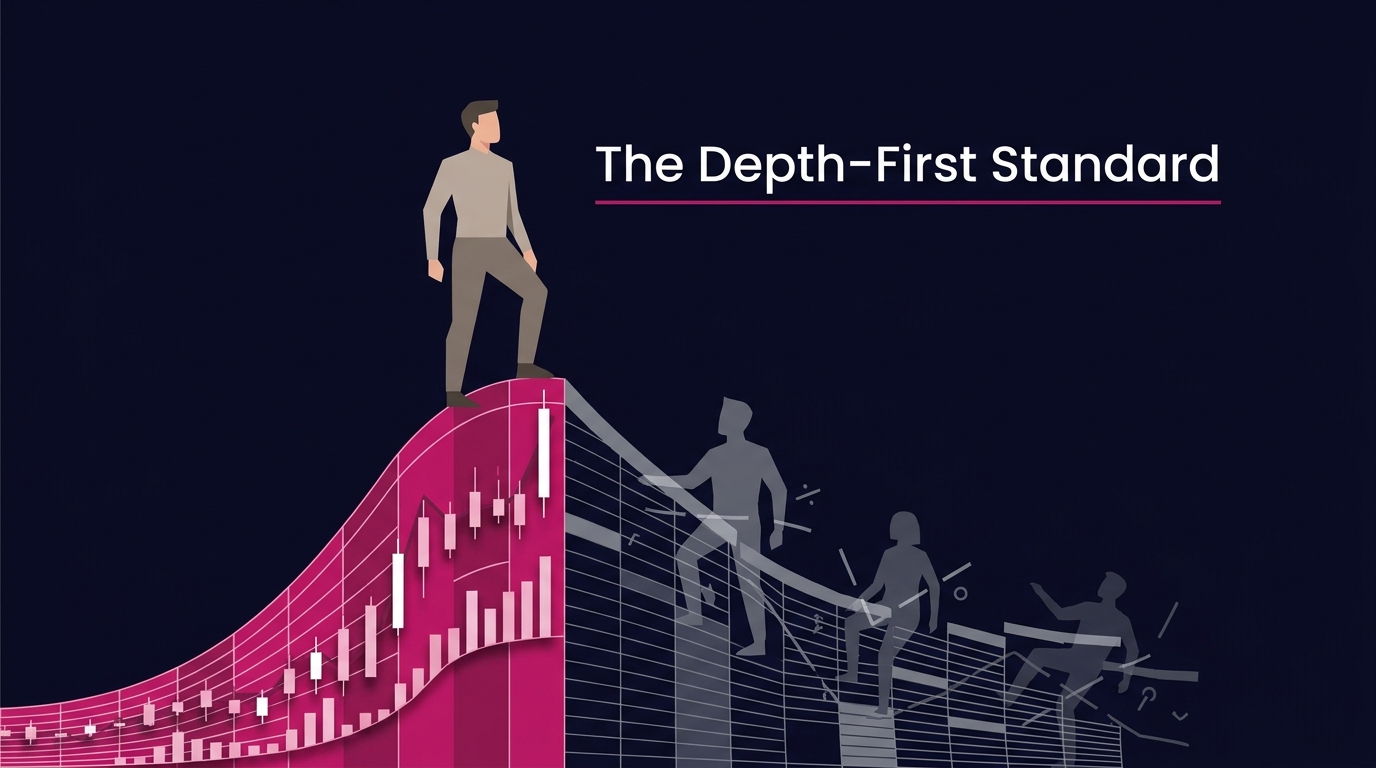
Depth-first intelligence (the disciplined mastery of each base metal before expanding to the next) is becoming the structural standard for metals trading platforms. Traders operating on this standard gain compounding advantages in position visibility, risk analytics, and execution support that breadth-first legacy platforms are architecturally unable to replicate.
According to a 2023 survey by Opimas, over 61% of commodity trading firms cite fragmented data infrastructure as their primary operational bottleneck in volatile market conditions [LINK: commodity trading infrastructure research]. The cause is architectural: platforms built for breadth deliver coverage approximations instead of domain mastery.
The practitioners positioned before the industry's broader convergence on this standard are making a reasoned professional positioning decision. This choice accumulates measurable advantage over every month competitors continue operating on platforms that structurally misrepresent base metals data.
The Structural Limitations of Multi-Commodity Platforms for Metals Traders
The premise of multi-commodity platforms (one system for every market) encounters a consistent limitation in practice: insufficient analytical depth distributed uniformly across every commodity vertical covered.
According to Gartner's 2022 Market Guide for CTRM Solutions, fewer than 30% of commodity trading firms report high satisfaction with their platform's analytics depth in any single commodity vertical CTRM market research. That figure narrows further when isolated to base metals, where exchange microstructure, margin methodologies, and physical delivery logistics create layers of complexity that generalized platforms model inadequately.
The mechanism is straightforward. A platform allocating development resources across crude oil, natural gas, agricultural commodities, and base metals simultaneously cannot build genuine depth in any one vertical. It builds surface coverage everywhere.
For a copper trader managing LME cash-to-three-month spreads against a physical supply book, surface coverage functions as a structural liability that compounds through every decision made on imprecise data.
Defining Depth-First Intelligence in Metals Trading
Depth-first intelligence is the systematic prioritization of complete understanding over broad coverage. Instead of building a platform that approximates every commodity, it builds one that comprehensively models each metal it covers: its exchange microstructure, seasonal demand patterns, inter-market spread behavior, and physical delivery requirements. For base metals, this means integrated pricing intelligence, position management, and risk analytics calibrated to how copper, aluminium, zinc, and lead actually trade across LME, MCX, COMEX, and SHFE, instead of how a generalized commodity model approximates them. This distinction separates a platform that accurately models your market from one that simply approximates it.
The Base Metals Challenge for Multi-Commodity Platforms
Base metals present data complexity that exposes the limits of breadth-first architecture. Unlike energy commodities, base metals trade across four major exchanges simultaneously (LME, COMEX, SHFE, and MCX), each with distinct contract specifications, margin methodologies, and liquidity profiles. The LME's unique daily prompt-date structure, which no other commodity exchange replicates, requires specialized data models that breadth-first platforms consistently handle as edge cases instead of core functionality LME contract specifications. When the prompt-date structure is treated as an edge case, every downstream calculation inherits that approximation error: position valuations drift, hedge effectiveness metrics lose precision, and risk managers work from numbers they already know are imprecise.
The Compounding Cost of the Workaround Economy
Front-office metals traders have adapted to platform limitations through a parallel workflow economy: spreadsheets that reconcile what the platform misreports, manual checks that verify what the system should confirm automatically, and latency that compresses the decision window on positions that require fast execution.
According to a 2023 Coalition Greenwich study, front-office commodity traders spend an average of 2.3 hours per day on manual data reconciliation tasks that purpose-built platforms should eliminate coalition greenwich commodity research. Annualized, that is approximately 575 hours of skilled trading capacity redirected to error-correction instead of position management.
Beyond the time expense, manual reconciliation introduces a compounding error rate. In a market where LME copper can move $50 per tonne in a single session on macro news, a 20-minute lag in position visibility acts as a quantifiable risk event.
Depth-first intelligence eliminates the workaround economy by resolving the structural cause. When a platform accurately models base metals pricing architecture, real-time position visibility emerges natively as an output of correct design.
Essential Evaluation Criteria for Metals Trading Platforms
Metals trading platforms require specific evaluation criteria. First, verify that the platform natively models LME prompt-date structure without workarounds or approximations. Next, confirm that position management integrates physical and financial books in a single view without manual reconciliation. Then, assess whether risk analytics are calibrated to base metals volatility regimes. Finally, evaluate whether pricing intelligence covers inter-exchange spreads across LME, COMEX, SHFE, and MCX as built-in capability. A platform meeting all four criteria is operating at depth-first intelligence standards.
What Depth-First Intelligence Looks Like in Practice
Depth-first intelligence transforms the trading day in precise scenarios where legacy platforms create the most friction.
Real-time position visibility means knowing copper exposure across physical and financial books simultaneously, updated as the market moves, without a reconciliation step between data sources. For an operation running simultaneous LME hedges against a physical supply book, this is the baseline capability that current platforms approximate through workarounds.
Integrated risk analytics means that when you stress-test an aluminium book against a 5% adverse LME move, the platform models actual position behavior (including gamma on options exposure, physical delivery obligations, and basis risk between LME and SHFE) instead of applying a simplified delta approximation.
According to the International Wrought Copper Council, base metals physical trading volumes have increased 14% annually since 2020, reflecting infrastructure investment demand across renewable energy and electric vehicle supply chains IWCC commodity demand research. The analytical infrastructure serving that volume growth has not kept pace with the market it supports.
Execution support calibrated to base metals means that when the LME Ring opens and liquidity concentrates in that session, decision support tools recognize that market structure instead of treating it as anomalous data. The Ring represents the core of how LME copper trades. A depth-first platform is built with that fact at its center.
Novaex's Depth-First Methodology
Novaex was built from a practitioner's direct observation: after four years inside the metals trading industry, no available platform accurately modeled base metals. The response involved building a depth-first system, mastering copper, aluminium, zinc, and lead completely across LME, MCX, COMEX, and SHFE before expanding coverage. The architectural consequence is that every capability (pricing intelligence, position management, risk analytics) was designed around how base metals actually trade. LME prompt-date structure functions as a first-class data object. Physical and financial position integration functions natively. The result is a platform where the intelligence correctly models base metals trading.
The Compounding Advantage of Operating Ahead of the Standard
Professional advantage in commodity trading rarely arrives as a single decisive event. It compounds through the accumulation of operational gains: faster position visibility, tighter risk models, reduced reconciliation overhead, better-calibrated execution support. Each gain is modest in isolation. Aggregated over six months of daily trading, they constitute a material performance differential.
A McKinsey & Company analysis of commodity trading operations found that top-performing firms generated 23% more revenue per front-office headcount than median performers. This gap is attributable primarily to operational efficiency over raw market access [LINK: McKinsey commodity trading performance research]. The efficiency differential begins accumulating from the first day of operating on the correct platform.
Traders operating on depth-first intelligence today build this differential before competitors recognize the standard's primacy. The advantage compounds in two directions simultaneously.
Operational efficiency gains accumulate as recovered capacity: the 575 annual hours recaptured from manual reconciliation redirected to position analysis, market intelligence, and relationship management. Institutional knowledge accumulates as traders develop analytical reflexes calibrated to a platform that correctly models base metals markets, instead of spending cognitive resources translating between what the platform shows and what they know the market is actually doing.
Adoption Timelines for Trading Technology Standards
Technology adoption cycles in commodity trading span several years. A 2022 Accenture survey of commodity trading firms found that the median technology replacement cycle for core trading platforms is 4.2 years, driven by data migration complexity, workflow disruption costs, and organizational inertia Accenture commodity technology research. A firm evaluating a new platform standard today will, at the median, complete adoption 4.2 years from now. Firms that have not yet identified the standard will arrive later still. The operational gap between a trader on depth-first intelligence today and a competitor arriving 18 months from now does not close at the moment of their adoption. The operational gap persists as accumulated institutional knowledge, workflow efficiency, and risk model calibration that have been compounding since the transition.
Building Your Depth-First Position Before Competitors Arrive
The metals traders best positioned in this environment are those making platform decisions grounded in operational evidence (evaluating the documented performance record of breadth-first platforms against the specific technical requirements of base metals trading) instead of waiting for industry consensus to consolidate around what the data already demonstrates.
According to a 2023 Financial Times Commodity Markets survey, 67% of mid-market metals trading operations identified "inadequate real-time analytics" as a top-three strategic risk FT commodity markets research. The problem is widely recognized across the industry. The solution, depth-first intelligence architecture, is available now instead of existing on a future product roadmap.
The LME reported that base metals open interest increased by 18% between 2021 and 2023, reflecting institutional capital rotation into industrial metals as an inflation hedge and energy transition proxy LME market statistics. That capital brings more sophisticated counterparties, tighter spreads, and higher execution precision requirements to every trade in the market.
Operating on a platform that approximates base metals in this environment carries a quantifiable cost: degraded analytical accuracy at precisely the point where market conditions (more sophisticated counterparties, tighter spreads, higher execution precision requirements) are increasing the premium on correct data.
Validating the Depth-First Approach in Live Trading
The depth-first methodology originated from a practitioner who spent four years inside base metals trading, identified specific capability gaps between available platforms and actual market requirements, and built Novaex to close those gaps precisely. The methodology is grounded in the actual data architecture of LME, COMEX, SHFE, and MCX contracts, validated against real position management and hedging workflows, and priced to be accessible to mid-market trading operations alongside institutional desks operating at hedge-fund scale. For practitioners evaluating the standard, the relevant question revolves around whether the specific implementation under evaluation meets the four operational criteria outlined above. Novaex was built to meet all four.
The Timing Decision: A Reasoned Professional Positioning Decision
The depth-first intelligence standard for base metals trading serves as a conclusion reached by evaluating the documented performance record of breadth-first platforms against the specific technical requirements of base metals trading across four global exchanges.
Practitioners positioned before the industry's broader recognition of this standard operate on correct methodology while competitors remain on structurally limited infrastructure, allowing the compounding advantage of that decision to accumulate over the months that follow.
This gap resists recovery through catch-up adoption alone. Institutional knowledge, calibrated workflows, and refined analytical reflexes built on a correct platform cannot be transferred by switching platforms at a later date. They are the product of time spent operating correctly.
Three immediate steps for metals traders evaluating this transition:
- Audit your current reconciliation workload. Calculate the hours per week your team spends manually reconciling position data that a depth-first platform should produce automatically. Multiply by your fully-loaded cost per trading hour. That figure is your baseline operational cost of remaining on the current standard.
- Evaluate Platform Depth Over Breadth. When assessing any trading platform, test it specifically against the complexity of base metals: LME prompt-date structure, inter-exchange basis relationships across LME and SHFE, physical-financial position integration without manual steps. Structured technical evaluations reveal the approximations hidden within generic product demonstrations.
- Request a Novaex demonstration Novaex demo request calibrated to your actual book. Expect a structured evaluation against the specific position management and risk analytics challenges your operation faces today.