Enterprise CTRM Cost: What Six Figures Actually Buys
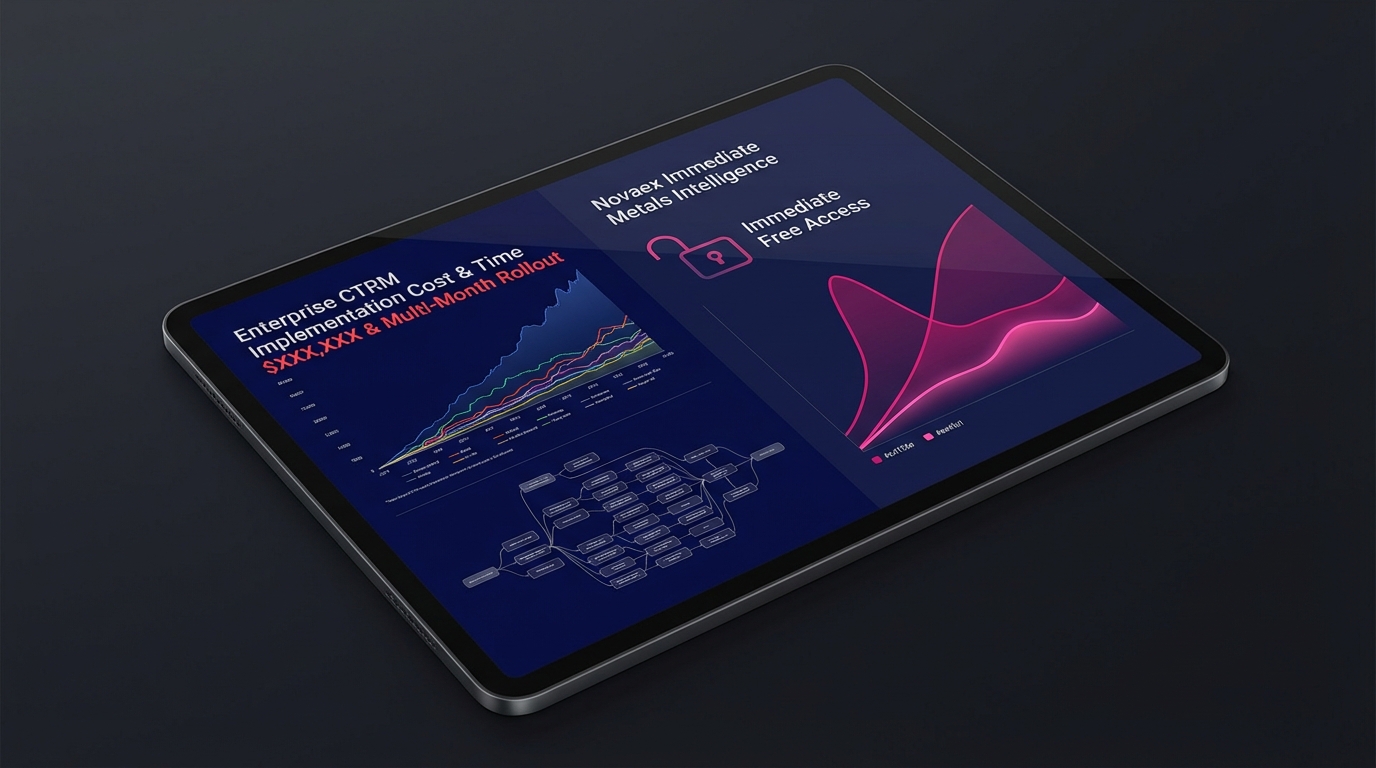
Enterprise CTRM implementations carry a total first-year spend of $500,000 to $2 million and require 9, 18 months before a trader logs a single live position. These platforms were engineered for organizational compliance and multi-commodity book governance, rather than spread accuracy or rollover cost precision. For physical metals traders, that architectural distinction defines the entire value question.
The front-office metals trader requires millisecond-responsive spread data, precise carry cost calculations, and real-time position visibility across LME, COMEX, MCX, and SHFE. Enterprise CTRMs were architected for enterprise governance, and the pricing reflects that design mandate.
Understanding the structural gap between enterprise CTRM cost and what metals traders require operationally is the foundation for making a properly scoped platform decision.
Enterprise CTRM Implementation Costs
The published cost ranges for enterprise CTRM deployments are not proprietary. Commodity Technology Advisory (ComTech), which has tracked the CTRM market annually for over two decades, reports that enterprise deployments regularly land between $500,000 and $2 million in total cost of ownership when license fees, implementation services, data migration, and initial customization are aggregated ComTech CTRM market study.
That range understates the ongoing commitment. Annual maintenance and support contracts, standard in enterprise software, typically run 15, 22% of the initial license fee per year, according to benchmarks published by Gartner [Gartner enterprise software total cost of ownership]. On a $600,000 platform license, that adds $90,000, $132,000 annually before a single customization request is submitted.
CTRM Implementation Costs
A full enterprise CTRM implementation (including software license, systems integration, data migration, and first-year support) commonly ranges from $500,000 to over $2 million. Smaller mid-market configurations from the same vendors rarely fall below $200,000 once implementation services are included. These figures align with publicly reported ranges from ComTech Advisory and consultant-published deployment guides.
The cost structure has three compounding layers:
- License fee: Typically $150,000, $600,000 for initial deployment, often quoted as the headline number
- Implementation services: Systems integrators commonly bill at $150, $350 per hour; a 12-month project at modest staffing levels generates $300,000, $500,000 in services spend alone
- Customization and configuration: Every commodity has unique contract specifications; adapting a multi-commodity platform to LME lot sizes, prompt date structures, and SHFE bonded warehouse rules requires paid customization cycles
The six-figure spend is real. Whether it addresses the right problem is determined entirely by the buyer's operational profile and requirements.
The Rollout Timeline That Defines Enterprise CTRM
Nine months is an optimistic go-live for an enterprise CTRM. ComTech's annual market study consistently reports implementation timelines of 9, 18 months for enterprise deployments, with multi-commodity configurations trending toward the longer end ComTech annual CTRM market study.
That timeline reflects genuine platform requirements: integration with ERP systems, mapping to organizational credit limit hierarchies, audit-ready P&L reporting chains, and compliance workflow configuration across multiple desks and geographies. This is necessary, substantive engineering for organizations operating at enterprise scale.
Enterprise CTRM Implementation Timelines
Enterprise CTRM implementations take 9, 18 months from contract signing to go-live, with the median near 12 months for multi-commodity deployments. This timeline reflects data migration complexity, systems integration requirements, and the multi-team user acceptance testing that governance-oriented platforms require before sign-off. The duration is structural to the problem these platforms were built to solve, rather than a function of vendor inefficiency.
Three phases consume the majority of that timeline:
- Data mapping and migration: Translating legacy position data, counterparty hierarchies, and historical contract structures into the new system's schema, consistently the most underestimated phase in pre-project scoping
- Systems integration: Connecting to ERP, treasury management systems, and market data feeds across multiple exchange venues and legal entities
- User acceptance testing (UAT): Front-office, risk, and back-office teams validate separate workflow layers independently before go-live approval, a governance requirement rather than a formality
The Core Purpose of Enterprise CTRMs
Accurate assessment of this category requires acknowledging what it does well. Enterprise CTRMs deliver tangible results for specific organizational problems:
- Regulatory reporting: Position aggregation and audit-ready reporting for EMIR, Dodd-Frank, MiFID II, and equivalent frameworks across jurisdictions
- Credit limit management: Real-time credit exposure monitoring across counterparties, legal entities, and netting agreements for large operations
- Multi-commodity book consolidation: Single P&L view across energy, agriculture, and metals desks within a large diversified trading organization
- Back-office workflow automation: Trade confirmation matching, settlement instruction generation, and invoice reconciliation at enterprise transaction volumes
According to a 2022 McKinsey report on commodity trading operations, back-office automation can reduce operational cost by 20, 30% for large trading organizations McKinsey commodity trading operations. Enterprise CTRMs targeting that efficiency gain are solving the correct problem for that organizational profile.
The front-office metals trader at a mid-market physical trading firm or specialized hedge fund represents a structurally different buyer with structurally different requirements. Applying an enterprise governance platform to a precision data problem delivers neither the governance outcomes it was designed for nor the precision the trading workflow requires.
The Daily Metals Workflow Enterprise CTRM Misses
Physical metals trading generates a specific set of daily calculation requirements that multi-commodity platforms were not designed to meet at the precision the market demands. The LME structure alone illustrates this gap clearly.
Core Trading Platform Requirements for Metals
Metals traders require three capabilities on a daily basis: real-time spread visibility across prompt dates, accurate carry and financing cost calculation for rollover decisions, and position reconciliation across exchange venues without manual re-entry. These requirements are specific to metals market microstructure and consistently underserved by platforms designed to span energy, agriculture, and metals on a shared data architecture.
The LME's daily prompt date structure is unlike any other liquid derivatives market. On any given trading day, the three-month copper forward, the cash settlement price, and the tom-next carry rate interact to determine the true cost of holding or rolling a position. According to the LME's published market data documentation, the three-month contract actively trades across more than a dozen prompt dates simultaneously LME market data and contract specifications.
Treating this as a generic forward curve only approximates the LME structure. That approximation carries a quantifiable operational cost. When the bid-offer spread on LME copper moves five basis points in fifteen minutes during a volatility event, a trader working from approximated carry data is making decisions on incomplete information, while paying for precision-grade infrastructure.
Enterprise CTRM Support for LME Spread Trading
Enterprise CTRM platforms can record LME spread positions, but most are not designed to provide real-time LME inter-prompt spread analytics as a native front-office tool. The LME's unique daily prompt date structure requires bespoke data modeling that multi-commodity platforms (built to serve energy, agriculture, and metals on shared infrastructure) rarely implement at the depth physical trading requires.
This distinction matters. Recording a spread position is not equivalent to providing a live view of the carry structure, financing cost, and contango or backwardation structures that determine whether the spread is correctly priced at the moment of execution. Front-office traders require the latter. Back-office workflows require the former. Enterprise CTRMs are optimized for the back-office use case.
Cross-venue complexity compounds this gap. According to CME Group's published contract specifications, COMEX copper contracts settle in U.S. cents per pound, while LME copper settles in U.S. dollars per metric ton CME Group copper contract specifications. SHFE copper trades in yuan per metric ton under bonded and non-bonded warehouse designations that affect the effective import arbitrage window. Traders managing cross-venue exposure require a platform that natively understands these structural differences, rather than one that normalizes them into a flattened data model for multi-commodity architecture.
According to a 2023 survey by the International Swaps and Derivatives Association (ISDA), data quality issues in commodity risk systems contributed to operational errors at over 40% of respondent firms ISDA commodity risk operations survey. Imprecision in position data surfaces primarily during high-volatility sessions when spreads move fastest and execution decisions carry the highest consequence.
The Depth-First Alternative to Enterprise CTRM Cost
Novaex was built from a different architectural premise: that metals intelligence requires complete mastery of each market's specific microstructure before it can deliver substantive value. Under the depth-first methodology, LME prompt date mechanics, COMEX settlement mechanics, MCX lot structures, and SHFE bonded warehouse conventions form the architectural foundation rather than acting as approximations or configuration options.
Defining Depth-First Metals Intelligence
Depth-first metals intelligence means mastering every dimension of a single commodity market (its exchange microstructure, prompt date behavior, cross-venue arbitrage opportunities, and physical delivery specifications) before expanding to the next commodity. It is the structural opposite of the multi-commodity platform approach, which optimizes for breadth across markets at the cost of precision within any individual market.
For copper, this means native support for LME ring trading conventions, tom-next carry calculation, COMEX basis relationships, and SHFE import arbitrage windows. These function as core platform architecture built by a practitioner who spent four years documenting exactly where existing platforms failed to deliver on their own specifications, rather than acting as add-on modules.
The access model reflects the same philosophy. Novaex provides immediate, free access to depth-first metals intelligence: no implementation project, no systems integration timeline, no six-figure license commitment before value is demonstrated. Traders evaluate the platform's precision on day one against real trading scenarios, rather than waiting for a vendor presentation nine months before go-live.
This provides a purpose-built answer to a distinct and well-defined problem, rather than a direct feature comparison with enterprise CTRM.
Mapping Cost to the Problem Being Solved
The value equation is clear when the buyer's problem is precisely defined.
Enterprise CTRM earns its six-figure price tag when the buyer's primary requirements are multi-commodity book consolidation, regulatory reporting automation, and large-scale credit management. The 9, 18 month implementation timeline and seven-figure total cost of ownership are proportionate to the organizational complexity being addressed.
For that buyer, the investment is justified. For the front-office metals trader whose primary requirements are spread accuracy, carry cost precision, and real-time cross-venue position visibility, the same investment purchases infrastructure designed for a different operational profile.
Metals traders evaluating any platform should verify specific capabilities:
- Native modeling of LME prompt date carry mechanics rather than approximations.
- Cross-venue metals position visibility without manual reconciliation steps.
- Spread data derived from actual market microstructure instead of normalized multi-commodity models.
- The financial impact of mispriced rollover decisions based on imprecise carry data.
The Tool Decision Starts With the Problem Definition
Enterprise CTRM implementations deliver tangible results for the governance and compliance problems they were designed to address. The six-figure price tag and 9, 18 month rollout timeline are proportionate to the genuine complexity of integrating multi-commodity book management, regulatory reporting, and enterprise credit governance into a single auditable system.
Physical metals traders, however, face a precision problem at the point of execution: real-time spread accuracy, carry cost calculation, cross-venue position visibility, and rollover cost confidence in markets that move in minutes. That is a distinct requirement from governance infrastructure.
Applying a governance platform to a precision problem is a category mismatch. It manifests as spreadsheet workarounds, manual carry calculations, and offline reconciliation steps, precisely when markets are moving fastest and those workflow gaps carry the highest cost.
Three steps for any metals trader auditing their current platform:
- Document your daily workarounds. Every offline spreadsheet, manual re-entry step, or approximated carry calculation is a workflow signal: your platform fails to solve your actual daily requirement.
- Price one bad rollover decision. A single mispriced roll in a volatile LME session can exceed the annual cost of a dedicated metals precision platform. The cost of imprecision is rarely counted in platform budget conversations, though it warrants inclusion.
- Access Novaex at no cost today. Depth-first metals intelligence is available immediately, with no implementation timeline or licensing commitment. Evaluate it against your real daily workflow before committing to any platform decision.
Novaex platform: free access to depth-first metals intelligence