Enterprise CTRM Implementation Cost: The Full Picture
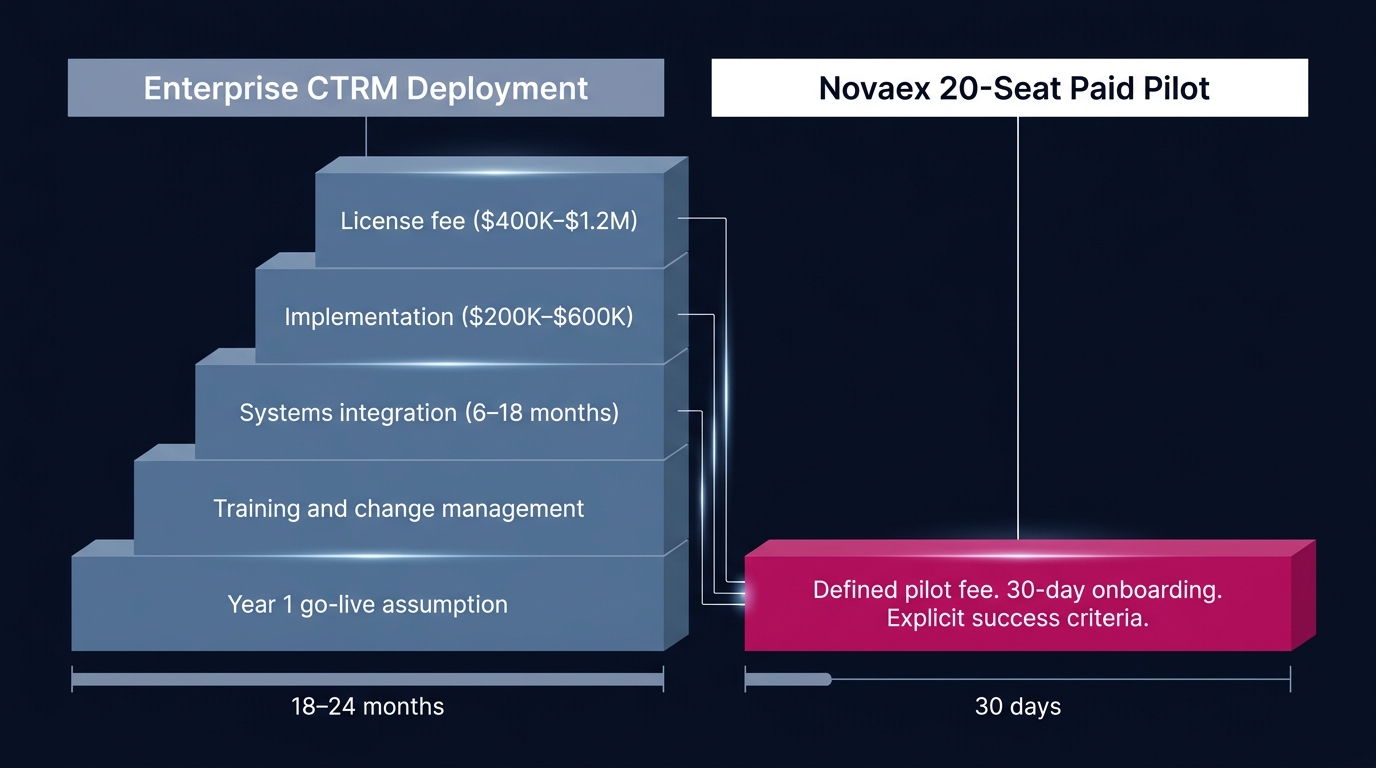
TL;DR: Enterprise CTRM deployments carry documented total first-year costs of $3M, $10M and implementation timelines of 12, 24 months before production go-live. A 20-seat paid pilot is not a discounted variation of that commitment. It is a structurally different category of decision, defi
ned by bounded scope, fixed duration, and measurable reversibility.
A commodities trading desk evaluating a new CTRM platform faces two structurally distinct commitment categories. The first requires multi-year budget allocation, organizational mobilization, and a technology dependency that takes 12, 24 months to become operational. The second produces verifiable platform intelligence within weeks, with predefined exit terms.
Understanding both categories with precision is the prerequisite for a sound evaluation decision. Here is the documented cost and timeline structure of each.
What Enterprise CTRM Implementation Costs in 2025
Enterprise CTRM implementations involve cost categories that operate at materially different scales and timelines. According to industry analyses from ComTech CTRM Market Snapshot and Gartner enterprise software cost frameworks, total cost of ownership for an enterprise-grade CTRM deployment typically falls between $3M and $10M across the first three years.
Breaking that figure down requires separating four primary cost centers.
Software Licensing
Annual licensing fees for enterprise CTRM platforms, including ION, Brady Technologies, Aspect Enterprise Solutions, and Openlink, range from $500,000 to $2M+ per year, depending on user count, asset class coverage, and module selection. According to the Commodity Technology Advisory (ComTech) CTRM Market Snapshot ComTech CTRM Market Snapshot 2023, multi-commodity enterprise platforms command pricing that reflects broad functional scope rather than depth of specialization in any single commodity class.
Implementation and Professional Services
Implementation consulting fees typically run 1.5x to 3x the annual license cost. On a $1M license, that translates to $1.5M, $3M in professional services before customization. According to a 2023 survey by Energy Risk Energy Risk CTRM implementation survey, 68% of CTRM implementations required external consulting hours that exceeded initial project estimates.
Systems Integration
Connecting an enterprise CTRM to existing ERP infrastructure, market data feeds, exchange connectivity, and back-office settlement systems introduces integration costs rarely captured in initial vendor proposals. API development, data feed licensing, and middleware configuration add $200,000, $500,000 to project cost depending on existing infrastructure complexity.
Infrastructure and Hosting
On-premise deployments require hardware procurement, security architecture, and dedicated IT staffing. Cloud-hosted deployments carry SaaS fees, data sovereignty compliance obligations, and ongoing DevOps overhead. Either model adds $150,000, $300,000 in annual infrastructure cost at enterprise scale.
Combined first-year cost across all four categories typically falls between $3M and $6M for a mid-market deployment, and exceeds $10M for large, multi-site, multi-commodity rollouts.
How do CTRM vendors calculate implementation fees?
CTRM vendors calculate implementation fees using a combination of module licensing (per commodity, per function), named user counts, and professional services day rates. Implementation fees are quoted separately from licensing and scaled to project complexity, data migration volume, and integration scope, making total cost difficult to determine from a licensing proposal alone. According to the ComTech CTRM Market Snapshot 2023, change orders on implementation projects added an average of 23% above original professional services budgets, a figure that does not appear in any vendor-originated cost proposal.
Change orders accumulate because requirements surfaced during user acceptance testing (and during configuration itself) are billed as scope additions. The mechanism is standard practice.
The Enterprise CTRM Deployment Timeline, Phase by Phase
Cost is one axis of the commitment structure. Timeline is the other. For metals trading desks operating in real-time markets across LME, COMEX, MCX, and SHFE, the two cannot be evaluated independently.
Enterprise CTRM deployments follow a documented phase structure. According to implementation data compiled from multiple vendor case studies and analyst reports CTRM implementation phase benchmarks, the following timeline represents standard practice for a mid-market deployment.
Phase 1: Discovery and Requirements Definition: 2 to 4 months. Interviews with key personnel, workflow mapping, data architecture review, and vendor configuration workshops. No trading functionality is available during this phase.
Phase 2: Configuration and Development: 4 to 8 months. Platform configuration to match trading workflows, custom reporting development, and integration build-out. This phase expands when post-contract scope additions are requested, which they routinely are.
Phase 3: Data Migration: 2 to 4 months. Historical trade data, counterparty records, product configurations, and market data histories are migrated and validated. Data quality issues consistently extend this phase beyond initial estimates.
Phase 4: User Acceptance Testing: 2 to 3 months. Front-office, middle-office, and risk teams validate functionality against documented requirements. UAT cycles frequently identify gaps that require additional development cycles before approval.
Phase 5: Parallel Run and Go-Live: 1 to 3 months. Parallel operation with legacy systems before cutover. Post-go-live stabilization typically requires dedicated vendor support for 30, 90 days before the implementation is formally closed.
Total elapsed time: 12 to 24 months. For complex multi-site or multi-commodity deployments, 18, 36 months is documented industry practice.
According to Gartner's research on enterprise software implementations Gartner enterprise software delivery benchmarks, fewer than 40% of enterprise software projects complete within original timeline estimates. In the CTRM sector, commodity market volatility during implementation phases creates additional pressure to accelerate go-live before systems are fully validated. This risk factor compounds post-deployment defects.
How long does CTRM implementation take?
A standard enterprise CTRM implementation takes 12 to 24 months from contract execution to production go-live, with complex deployments running 18 to 36 months. The timeline spans discovery, configuration, integration, data migration, testing, and parallel operation phases. Trading functionality on the new platform is not available until go-live, meaning the existing system must remain fully operational, and fully supported, throughout the entire implementation period.
The Hidden Cost Drivers That Expand Enterprise CTRM Budgets
The figures above represent standard, documented cost structures. Several additional factors consistently expand total project costs beyond initial estimates. None of these appear in any vendor-originated cost proposal.
Internal Resource Allocation
Enterprise CTRM implementations require sustained commitment from internal subject-matter experts, typically senior traders, risk managers, and IT leads. A 12-month implementation drawing 20, 30% of a senior trader's productive capacity represents a measurable cost that does not appear on any vendor invoice. A front-office team managing active base metals positions across multiple exchanges cannot reallocate that capacity without direct operational consequences.
Parallel System Maintenance
During the implementation period (and frequently extending through early post-go-live), the legacy system must remain fully operational. This means maintaining two technology environments simultaneously, including licensing, support contracts, and IT maintenance overhead for both. According to a 2022 survey by Accenture on enterprise software transitions Accenture enterprise technology transition research, the cost of maintaining parallel environments added an average of 18% to total project budgets in complex financial software deployments.
Training and Productivity Dip
Vendor-delivered training rarely achieves operational proficiency at go-live. According to Accenture's enterprise software adoption research, organizations that invested in structured change management programs saw 33% higher adoption rates than those relying on vendor training alone. Post-launch retraining, workflow redesign, and the productivity impact during transition affect trading performance directly and are absent from every cost model a vendor provides.
What is included in CTRM total cost of ownership?
CTRM total cost of ownership (TCO) includes software licensing, implementation and consulting fees, systems integration, infrastructure, data migration, training, ongoing maintenance (typically 15, 20% of license cost annually), internal resource allocation, and parallel system operation during transition. Analyst frameworks from Gartner and IDC consistently find that initial licensing represents 20, 35% of three-year TCO. The remaining 65, 80% consists of implementation, integration, and ongoing operational costs. This portion does not appear in vendor-led cost comparisons.
How Enterprise CTRM Contracts Create Structural Lock-In
Enterprise CTRM contracts are structured to create organizational dependency before verifiable value is delivered. Several contract features are standard practice across the sector.
Multi-Year License Commitments
Annual licensing is typically invoiced on multi-year terms (commonly 3 to 5 years) with termination provisions that include financial penalties or forfeiture of implementation investment. The organizational switching cost at the 24-month mark, when the platform is live and embedded in active workflows, makes contract non-renewal structurally difficult regardless of platform performance.
Implementation Investment as Exit Barrier
Once a $2M, $3M implementation is complete, the organizational case for revisiting that process is structurally weak. This dynamic, known in enterprise software research as implementation lock-in, operates independently of platform satisfaction. According to research from Forrester Forrester enterprise software switching cost study, 61% of enterprise software buyers who rated their platforms as below expectations maintained their contracts primarily due to switching cost concerns.
Customization That Creates Vendor Dependency
Platform customizations built during implementation are typically proprietary to the deployment. Extracting those configurations in a future migration requires vendor cooperation and additional professional services fees, further compounding the exit cost of an underperforming system. For metals-specific workflow configurations (LME prompt-date structures, SHFE warrant management, COMEX spread calculations), this dependency is concentrated precisely where workflow accuracy matters most.
What a 20-Seat Paid Pilot Commits You To
The Novaex 20-seat paid pilot is a defined, bounded commitment structure. Examining what it requires, and what it explicitly excludes, demands the same precision applied to the enterprise cost analysis above.
A 20-seat paid pilot is a fixed-scope, fixed-duration engagement that produces verifiable operational data about platform performance within a specific commodity workflow. For base metals trading desks, that means real-time position visibility across LME, COMEX, MCX, and SHFE, with live market data integration and risk analytics operating against actual trading activity from the first week of deployment.
The commitment structure differs from enterprise deployment on four measurable dimensions.
Capital commitment: A paid pilot involves a fixed, pre-disclosed fee structure without multi-year lock-in, implementation consultancies, change-order exposure, or infrastructure investment. The full financial scope is known before the engagement begins.
Timeline to operational data: A pilot reaches operational use where trading desk staff are working with live platform functionality against real positions in days to weeks. There is no discovery phase, no data migration runway, no parallel system transition period requiring sustained management.
Organizational resource requirement: A 20-seat pilot requires no dedicated internal project management function, no IT infrastructure mobilization, and no sustained senior-trader time allocation to vendor configuration workshops during a period when those traders need to be running books.
Exit structure: At the conclusion of the defined pilot period, the organization holds verified performance data from live operational use across its actual base metals workflows. Continuation is a decision informed by evidence. Non-continuation is a clean outcome with no penalty structure and no stranded implementation investment.
What is a CTRM pilot program?
A CTRM pilot program is a time-bounded, limited-scope deployment of a trading and risk management platform against live operational workflows. Unlike a vendor demonstration or a proof-of-concept exercise, a paid pilot runs on real trading data with actual user workflows, producing measurable performance evidence before a full platform commitment is entered. The pilot structure is designed to replace assumption-based vendor selection (informed by sales demonstrations and curated reference calls) with verifiable operational data from the buying organization's own trading environment.
Enterprise CTRM Cost vs. Pilot: The Decision-Category Difference
The figures in this analysis cannot be used for direct price comparisons. Price comparisons involve products in the same purchasing category evaluated by cost per unit of function delivered. The enterprise CTRM deployment and the 20-seat paid pilot occupy entirely different purchasing categories.
An enterprise CTRM deployment is an organizational transformation project. It requires capital allocation in the $3M, $10M range, 12, 24 months of implementation runway, sustained internal resource commitment from active trading and risk personnel, and contractual terms that create lasting dependency before the platform delivers live trading functionality.
A 20-seat paid pilot is a structured intelligence-gathering mechanism. It produces verified evidence about platform performance (position accuracy, execution speed, risk analytics depth, workflow integration across exchanges) within a defined timeframe, at a defined cost, with a defined exit structure.
The decision to proceed with an enterprise CTRM deployment after completing a pilot is a fundamentally different decision than one made on the basis of vendor demonstrations and reference calls alone. According to research from IDC on enterprise software selection IDC enterprise software selection methodology, organizations that ran structured pilots or proof-of-concept programs before final vendor selection reported 40% fewer post-implementation performance gaps than those that relied on vendor-led evaluations.
According to a 2022 survey by Commodity Technology Advisory ComTech CTRM user satisfaction data, 54% of CTRM users reported that platform performance on their primary commodity workflows fell below pre-implementation expectations. For metals-specific workflows, that gap is disproportionately concentrated in real-time position aggregation across multiple exchanges and multi-exchange spread analytics. These are the exact workflows where a depth-first, metals-specialist platform and a generalist multi-commodity platform produce materially different outputs.
How much does a CTRM system cost?
An enterprise CTRM system costs $3M, $10M in first-year total expenditure when licensing, implementation, integration, infrastructure, and internal resource costs are included. Annual ongoing costs ; maintenance, support, and operational staffing ; typically add $500,000, $1.5M per year thereafter. These figures reflect mid-market to enterprise deployments across multiple commodities, sourced from ComTech, Gartner, and Energy Risk benchmark data. Single-commodity or limited-scope deployments may carry lower costs but are generally not offered at production quality by the multi-commodity enterprise vendors that dominate the sector.
The Structural Question in Every CTRM Evaluation
Every CTRM evaluation reaches a decision inflection point: the moment when an organization must determine whether it holds sufficient verified evidence to justify the full commitment structure.
For metals trading desks, that evidence requirement is specific. Multi-commodity platforms frequently demonstrate adequate general CTRM functionality in vendor presentations while delivering fragmented intelligence on LME prompt-date structures, SHFE warrant systems, and COMEX copper spread dynamics. These are the exact workflows where position visibility and execution speed under market stress determine trading outcomes.
A platform evaluation based on vendor demonstrations and reference calls produces a different information state than one based on four weeks of live operational use across a 20-seat team running actual base metals positions. The enterprise CTRM commitment ($3M, $10M, 12, 24 months, multi-year contractual lock-in) is a defensible decision when made from the second information state. It is a structurally higher-risk decision when made from the first.
The pilot structure exists to close that information gap before the commitment structure is entered. That is its function. It is neither a promotional mechanism nor a discounted trial. It is the operationally rational precursor to a technology decision that will define a trading desk's infrastructure for the next three to five years.
Evaluate the Evidence State, Then the Commitment
The data in this analysis represents documented industry benchmarks for enterprise CTRM deployments, drawn from ComTech, Gartner, Forrester, IDC, and Energy Risk research. These are the verified cost and timeline structures that metals trading desks have encountered in every enterprise CTRM procurement of the last decade. They are not projections.
The Novaex 20-seat paid pilot occupies a different position in the decision sequence. It acts as a mechanism for generating verified platform intelligence before the enterprise commitment structure is entered.
Three concrete next steps for trading teams currently in a CTRM evaluation:
- Construct the full TCO model for any enterprise platform under consideration (including implementation consulting, integration, infrastructure, and internal resource allocation) before evaluating any licensing proposal in isolation.
- Define your platform validation criteria for base metals workflows specifically: real-time LME position aggregation by prompt date, multi-exchange spread calculation across COMEX and SHFE, physical position management against warrant inventory, and execution speed under market stress conditions.
- Request the Novaex pilot structure Novaex depth-first pilot program and evaluate it against those validation criteria as the evidence-generation mechanism that should precede the deployment decision.