Exchange-Specific Metals Intelligence: Your Entry Point
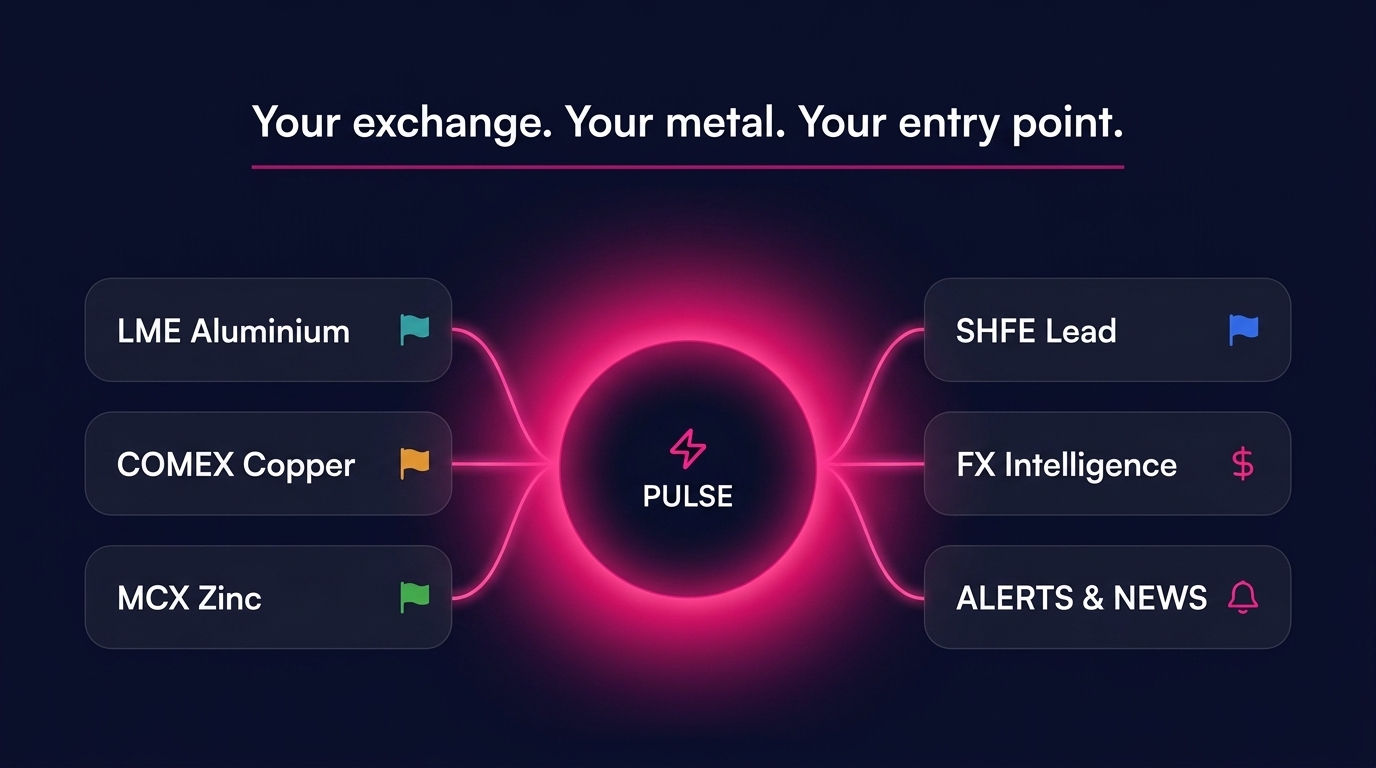
Novaex covers four distinct exchange-metal combinations (LME aluminum, COMEX copper, MCX zinc, and SHFE lead), each structured as a dedicated analytical territory built from the exchange's own mechanics outward. Your book determines which one is operationally relevant. This post maps the analytical depth already built at each specific entry point.
The building phase established one argument with consistent evidence: depth beats breadth in metals trading intelligence. The documentation is specific: what LME aluminum's contango structure requires, how COMEX copper's dollar sensitivity behaves, what MCX zinc's domestic basis logic demands, and how SHFE lead's secondary supply dynamics determine price. Each market has been treated as its own analytical problem.
The evidence for exchange-specific metals trading intelligence is no longer a matter of debate. The relevant question is where your book sits on that map, and what analytical infrastructure is already built for you at that position.
According to the London Metal Exchange, aluminum contracts account for more than 45% of total LME traded volume, making it the exchange's single largest contract by notional value. Yet most multi-commodity platforms treat LME aluminum as one row in a contract database rather than a complete analytical territory with its own curve dynamics, warrant behavior, and regional premium structure. That gap is precisely what depth-first intelligence was built to close.
Why Exchange-Specific Metals Trading Intelligence Changes Decisions
The case against generic platform coverage is operational.
When a front-office trader needs to roll a large aluminum position on the LME, the relevant intelligence is: what is the shape of the forward curve at this moment, where is the cash-to-three-month spread relative to its 90-day range, and what does current warrant inventory imply about near-term carry costs?
That is a different question. It requires a different kind of platform.
According to a 2023 Oliver Wyman report on commodity trading operations, 64% of trading firms identified data fragmentation across multiple systems as the leading cause of delayed decision-making during volatile market periods. The same report found that firms relying on consolidated multi-commodity platforms for granular exchange-level data experienced an average 18-minute lag in actionable intelligence versus firms using exchange-specialized tools.
Eighteen minutes of delay costs you a position in base metals markets.
What Exchange-Specific Intelligence Actually Means
Exchange-specific intelligence means the platform's analytical architecture is built specifically for a given exchange-metal pair.
For LME aluminum, that means native understanding of the three-month forward structure, the prompt date system, and the relationship between LME official prices and physical delivery premiums. For COMEX copper, it means dollar-index correlation models, warehouse location differentials across CME-approved facilities, and options market positioning integrated directly into risk views.
This is an architectural question. The platform's analytical logic must be constructed from each exchange's own mechanics outward, ensuring every output reflects how that specific market actually works.
Why Multi-Commodity Platforms Cannot Deliver Exchange Depth
According to McKinsey's Global Commodity Markets Outlook, the average multi-commodity CTRM platform covers between 12 and 40 commodity markets simultaneously. Across that breadth, genuinely deep exchange-specific analytics for any single metal is structurally impossible; the development and maintenance cost would exceed any realistic R&D allocation for a single market.
The result is a consistent pattern the building phase has documented: broad coverage, shallow intelligence. Every market is listed. No market is truly known.
Novaex's depth-first methodology addresses this pattern. The platform is built from each exchange's mechanics outward.
LME Aluminum: Depth-First Intelligence for the World's Largest Base Metals Contract
LME aluminum forward curve analytics
LME aluminum is the global benchmark for primary aluminum pricing. According to the London Metal Exchange's 2023 annual report, aluminum contracts traded a total notional value exceeding $6.2 trillion across the year, making it the largest single commodity volume on the exchange and one of the largest futures markets globally.
For traders whose books carry LME aluminum exposure, the primary analytical questions are structural. The LME prompt date system creates a daily granularity of forward pricing that does not exist on any other exchange. Knowing which dates are liquid versus which are thin on any given trading day serves as the foundation of every roll decision and hedging instruction.
How LME Aluminum Differs from Other Exchange-Metal Combinations
LME aluminum differs from COMEX copper primarily in its forward structure and settlement mechanics. LME contracts settle against official prices struck at specific ring trading sessions, with the cash-to-three-month spread serving as the primary carry signal. COMEX copper settles against an electronic close and expresses its forward curve in monthly, not daily, granularity.
These mechanics determine how a hedge is constructed, how a roll is timed, and how a physical position is priced against the paper book. A platform treating both exchanges identically introduces structural basis error into every trade.
For LME aluminum specifically, Novaex's depth-first architecture covers:
- Forward curve analytics across all prompt dates simultaneously, with liquidity weighting
- Cash-3M spread behavior with historical context and rolling volatility banding
- LME warrant inventory as a leading indicator for physical premium behavior
- Regional premium differentials (Midwest, Rotterdam, Tokyo) integrated against LME flat price in a single view
COMEX Copper: Exchange-Specific Metals Trading Intelligence for Dollar-Sensitive Books
COMEX copper COT and dollar-basis analysis
COMEX copper is the primary pricing benchmark for copper in the Americas and the reference point for all USD-denominated copper transactions globally. According to CME Group's 2023 market data, COMEX copper futures carry an average daily open interest exceeding 75,000 contracts, with a developed options market that adds a further layer of positioning intelligence.
For traders running COMEX copper books, the dollar index relationship acts as a primary risk variable with a measurable statistical signature.
According to Goldman Sachs Commodities Research, COMEX copper has demonstrated a statistically significant negative correlation of approximately -0.68 with the DXY dollar index over rolling 90-day periods during non-crisis conditions. That correlation fluctuates with credit cycle positioning, Chinese demand signals, and speculative flows in the Managed Money category of the CFTC Commitments of Traders report.
A platform that displays copper flat price without integrating dollar index context presents one variable of a multi-variable equation as if it were the complete picture.
Applying COMEX Copper Positioning Data to Hedging
COMEX copper positioning data (specifically the weekly CFTC Commitments of Traders disaggregated report) provides a direct read on speculative versus commercial positioning in the market. When Managed Money net long positions reach historically elevated levels relative to open interest, the market is structurally vulnerable to a positioning reversal that flat-price models alone will not anticipate.
Novaex integrates COT data directly into its COMEX copper risk views, flagging positioning extremes as a contextual overlay on physical hedge recommendations. This architectural integration makes positioning risk visible at the point of decision.
COMEX Copper Versus LME Copper
COMEX copper and LME copper frequently move in close directional alignment, but they carry distinct basis risk for firms holding exposure across both exchanges simultaneously. The COMEX-LME basis reflects currency conversion, warehouse location differentials, and market microstructure differences that create meaningful spread volatility.
According to the World Bureau of Metal Statistics, the COMEX-LME copper basis ranged from approximately -$50/t to +$120/t during the 24-month period ending mid-2024, a spread range sufficient to materially affect the hedge ratio on any cross-exchange position that is not actively monitored. Treating the two prices as interchangeable creates unmonitored risk.
MCX Zinc: Where Domestic Basis Intelligence Becomes a Competitive Edge
MCX zinc domestic basis and import duty monitoring
MCX zinc is India's domestic zinc market benchmark, with pricing determined simultaneously by LME zinc flat price, the INR/USD exchange rate, prevailing import duty structures, and domestic physical supply conditions. According to the Multi Commodity Exchange of India, zinc is consistently ranked among the top five traded commodity contracts on the exchange by volume.
For traders with exposure to Indian zinc consumption or domestic Indian physical positions, MCX zinc functions as a distinct analytical territory with its own price-determining logic.
The Requirements of MCX Zinc Analysis
MCX zinc requires its own analytical framework because the variables driving its price are fundamentally different from those driving LME zinc. The INR/USD exchange rate affects the MCX price level directly and independently of any movement in London. Import duty changes, which have historically been announced without extended advance notice, can create immediate structural repricing events that persist for weeks.
According to India's Ministry of Finance, India's import duty on zinc has been revised multiple times in the past five years, with each revision creating a measurable step-change in the MCX-LME basis that persisted through subsequent trading sessions. Modeling MCX zinc purely as INR-converted LME zinc builds a systematic hedge basis error into every Indian physical position.
Novaex's MCX zinc framework tracks:
- INR/USD rate sensitivity on the MCX-LME basis in real time
- Import duty regime monitoring as a structural pricing variable
- Domestic physical premium behavior relative to MCX settlement prices
- Seasonal consumption patterns linked to Indian construction activity and galvanizing demand cycles
SHFE Lead: The Exchange-Specific Intelligence Most Platforms Have Ignored
SHFE lead secondary supply and import arbitrage analysis
SHFE lead sits at the intersection of Chinese domestic supply dynamics, secondary battery recycling economics, and import arbitrage feasibility, a combination that makes it analytically distinct from every other exchange-metal combination in Novaex's coverage map.
According to the International Lead and Zinc Study Group, China accounted for approximately 44% of global refined lead production in 2023, with secondary production (processing end-of-life lead-acid batteries) representing roughly 70% of that total output. Changes in China's battery recycling policy, scrap lead availability, and environmental compliance enforcement move SHFE lead prices in ways that are disconnected from LME lead fundamentals.
This drives the primary analytical story in the SHFE lead market, a narrative that multi-commodity platforms consistently miss.
Drivers of SHFE Lead Price Behavior
SHFE lead price behavior is primarily driven by China's secondary smelting capacity utilization rate and scrap battery feedstock availability. When secondary smelter margins compress due to feedstock cost increases, energy price spikes, or regulatory enforcement, SHFE lead prices respond with volatility that lacks a direct LME-equivalent catalyst.
This creates a fundamental disconnect between the two markets that cannot be bridged by currency conversion or flat-price correlation. For firms with Chinese physical exposure or cross-exchange lead arbitrage activity, managing SHFE lead risk through an LME proxy introduces timing mismatches, currency risk, and structural fundamental errors that compound under volatile conditions.
Novaex treats SHFE lead as a standalone analytical territory: secondary supply dynamics, import arbitrage window monitoring, cross-exchange basis tracking, and CNY-denominated position risk are all integrated into a single system.
Locating Your Exchange-Specific Entry Point in Novaex's Coverage Map
Novaex platform overview and demonstration
These four exchange-metal combinations represent the specific territories where Novaex's depth-first methodology has been built from the exchange mechanics outward, each featuring its own analytical architecture, explicitly modeled primary price drivers, and operational intelligence layer.
Your entry point is determined by your book.
According to a 2024 survey by the Commodity Markets Council, 71% of mid-market commodity trading firms reported using three or more separate systems to aggregate the intelligence required for a single hedging decision. The operational cost of that fragmentation, in latency, reconciliation time, and error rate, is measurable and compounds across every trade these firms execute.
Depth-first intelligence consolidates those inputs into a single platform built around your exchange, your metal, and the specific analytical questions your book actually generates:
- If your largest hedging exposure is LME aluminum, your entry point is the forward curve analytics, prompt date liquidity profiling, warrant inventory intelligence, and regional premium integration built specifically for that market's mechanics.
- If your position risk is concentrated in COMEX copper, your entry point is the COT-integrated positioning overlay and dollar-basis analytics that contextualize every flat price movement against speculative and commercial flow.
- If your firm operates in the Indian market with MCX zinc exposure, your entry point is the domestic basis framework that models import duty regime changes, FX sensitivity, and seasonal demand cycles as primary variables.
- If your book includes Chinese physical lead exposure or SHFE arbitrage activity, your entry point is the secondary supply market intelligence and cross-exchange basis monitoring built as a first-class analytical priority.
Your Next Step: Enter at the Combination That Matches Your Book
The building phase delivered the evidence for depth-first intelligence through specific exchange mechanics, documented platform gaps, and the operational cost of shallow coverage at the moment markets move fastest.
Select the next step specific to your position:
Request a walkthrough of LME aluminum forward curve and prompt date analytics if your book carries primary aluminum exposure.
Ask specifically about the COMEX copper COT integration and dollar-basis risk overlay if you run USD-denominated copper positions.
Explore the MCX zinc domestic basis framework and how it handles import duty regime changes in real time if your firm operates in the Indian physical market.
Examine Novaex's SHFE lead secondary supply intelligence and cross-exchange basis monitoring if you carry Chinese physical exposure or manage cross-exchange lead arbitrage.
Each entry point leads into a platform built from scratch around the exchange mechanics defining how each market actually behaves. Choosing the entry point that matches your book unlocks the specific intelligence your operations require.