Five Questions to Ask the Copper Curve Before LME Week
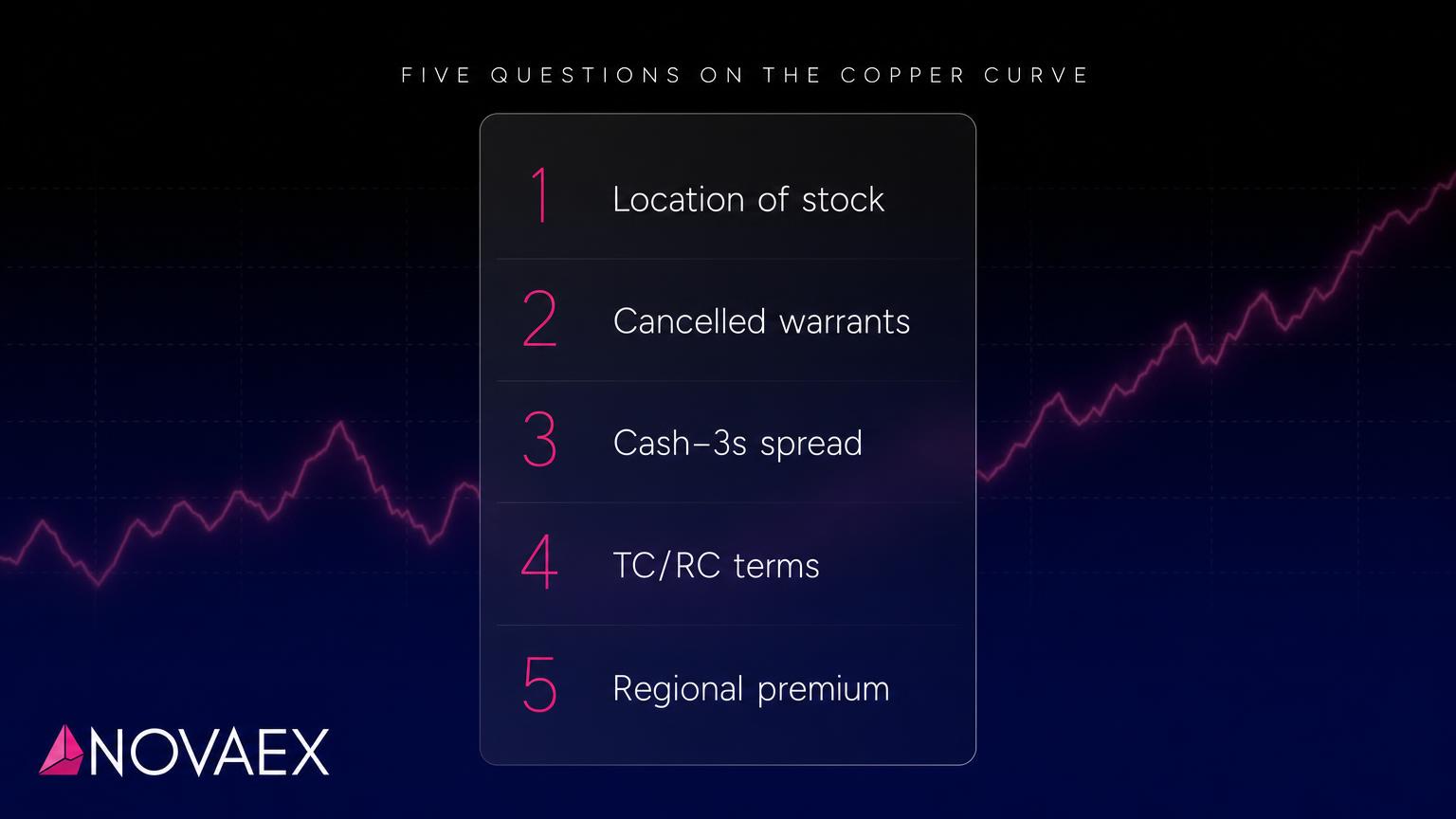
Location, cancellations, spread, treatment charges and premium: the five questions that decide whether a copper hedge holds, with the latest published figure beside each.
Before you extend copper hedge cover, ask the curve five things: where the metal sits, how much of it is cancelled, what the cash to three-month spread charges, whether your TC/RC terms still describe the market, and which regional premium your physical pays. The answers below carry published figures for the week to 2 October.
Every figure is dated and linked to its source. Copper moves daily, so treat the numbers as a reading to refresh, and the questions as the part that lasts.
Where is the copper, and can your hedge reach it?
Visible copper stock has moved to the US while LME and Shanghai stocks drained, so the LME price now reflects a smaller pool of metal than the global total suggests. Ask which exchange's stock your delivery or pricing depends on before you judge a short prompt position safe.
The shift is large. COMEX copper stocks rose from about 320,000 short tons to nearly 770,000 between September 2025 and September 2026. Over the same period LME inventories fell from an interim peak of about 400,000 tonnes in April to roughly 250,000, and SHFE stocks fell from 359,100 tonnes at the end of March to 47,100 on 24 September, according to SMM's analysis of the US copper tariff trade.
Metal that arrived on a tariff bet does not leave quickly. SMM points to financing, handling and re-export costs keeping it anchored while the refined-copper decision stays open. The window for that decision implied 28 September, and it passed without an announcement.
How much of the LME stock is already spoken for?
A cancelled warrant is metal booked out of the LME warehouse network, so the cancelled share, not total stock, shows what is left to buy prompt. In the week to 2 October, cancelled stock was 114,000 tonnes, 45.8% of the 248,650 tonne total, leaving 134,650 tonnes of available warrants, per LME Insight's weekly review.
A week earlier the picture was tighter. Cancelled stock stood at 129,550 tonnes, 51.5% of the total, with available warrants at 121,950 tonnes, according to LME Insight's review of 21 to 25 September. The share dropped below half in seven days, and available warrants rose by 12,700 tonnes.
A cancellation is an intention to withdraw, not a withdrawal. Track the share week on week, and read it beside the spread before you size cover.
What is the cash to three-month spread charging you?
The cash to three-month spread is the price of holding copper now rather than in three months. When cash trades above three-month, that is backwardation, and every short prompt position you roll pays it. It eased to a $53.50 a tonne backwardation in the week to 2 October, from $106 the week before.
The range inside those two weeks is the point. The back reached $125 on 24 September, fell to $21.50 on the Monday, then rebuilt through the week, per the two LME Insight reviews above. In August it had reached $545 before collapsing to $248 in a single day when more than 20,000 tonnes landed in LME warehouses.
Put the working on one line. Roll 1,000 tonnes once at $53.50 and the carry is $53,500. A week earlier, at $106, the same roll cost $106,000. The quotation period on each tonne matters more than the headline direction.
Do your TC/RC terms still describe the market?
The 2026 annual copper concentrate benchmark settled at $0 a tonne, while spot terms trade deeply negative. If your concentrate is priced off benchmark terms, a refined copper hedge does not cover the gap to spot. Ask which terms each tonne carries: benchmark, spot-indexed or fixed.
CRU's first weekly assessment, for 14 to 21 April, put spot treatment charges at -$124 a tonne against contract terms of $0 for sales to Chinese smelters. From 2000 to 2023 the gap between spot and contract averaged $12. CRU puts it near $90 in 2024 and 2025.
Spot reached -$126.80 a tonne at the end of June, and Antofagasta has agreed spot-indexed sales with some Chinese smelters, subject to a price floor. That is the latest spot figure we could cite from a public source. Check CRU's weekly number before you rely on it.
Which regional premium is your physical paying?
A regional premium is what a buyer pays over the LME price to take metal in one place. Hedging on LME leaves it open. Ask which premium your physical prices off, COMEX, Yangshan or the Chinese domestic cathode premium, because through September they moved in different directions.
The COMEX gap to LME was about $420 a tonne at the end of July, per the ICAA weekly brief. By 29 September the October COMEX contract traded $46.94 below LME three-month and November $38.99 above, per SMM, a spread too thin to cover freight, financing and storage.
China told a different story. The SMM #1 cathode premium approached $205 a tonne, its highest since October 2023, and on 8 October SMM's Yangshan average warrant price was $125 a tonne, in a $110 to $140 range. A tariff decision either way would move the COMEX gap first and the other two through flows.
What to do with five answers
Set the five side by side against your own book, one row per bucket of tonnes: where it sits, how much of the stock is cancelled, which quotation period it prices on against the hedge date, which TC/RC terms it carries, and which premium it pays. For how COMEX positioning reads against the LME curve, see our earlier note on COMEX-LME integration for copper hedging decisions.
Where the answers agree, extend. Where they disagree, the disagreement is the finding. The figures above will have moved by the time you read them. The five questions will not, and the answers are worth writing down with a date beside them.