How to quote a fixed price for 2027 when the metal cost floats
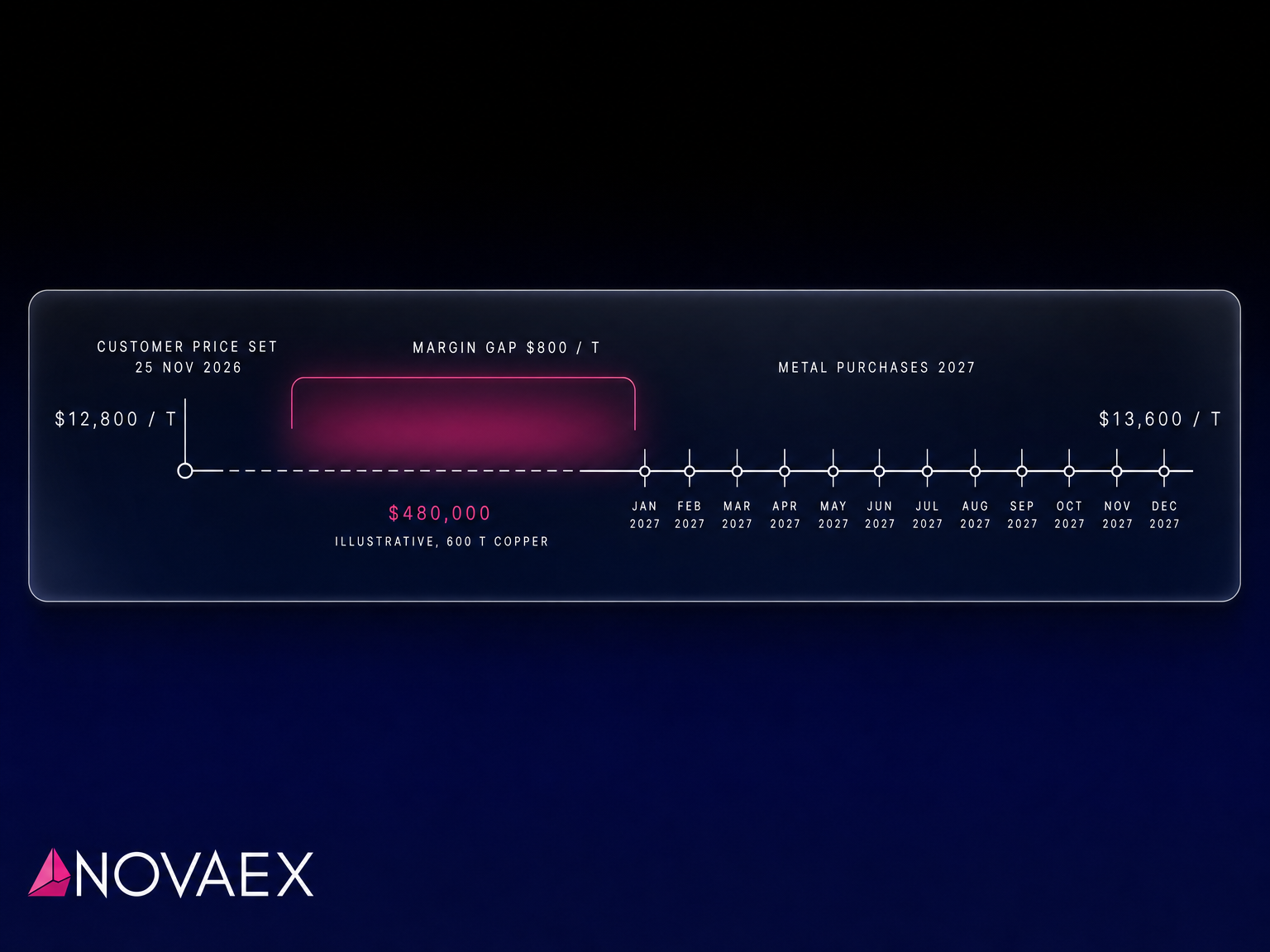
The margin leaks between the day the customer's price is set and the months the metal is bought. A worked copper example, what to lock per metal, and what a hedge leaves open.
To quote a fixed price for 2027, treat the metal as its own line. Lock the committed tonnes, in the months you will buy them, on the day the customer's price is agreed, and carry the rest as a stated allowance. That gives you a landed cost you can hold with one decision per metal, not a hedging desk.
Where does the margin go between the customer's price and the metal purchase?
It goes in the gap between two dates. The customer's price is fixed on the day you sign, while the metal is bought month by month through 2027 at whatever the market is then. Any move in between lands on your margin, on every tonne you have not locked.
Take an illustrative cable maker, not a client. On 25 November 2026 it signs a 12-month fixed-price contract worth $11.0m with $900,000 of gross margin, built on copper at $12,800 a tonne and 600 t of copper over the year, 50 t a month. The $12,800 is an illustrative level, not a market quote.
The copper is bought as each month arrives. If every purchase lands $800 a tonne above the quoting level, the extra cost is $800 × 600 t = $480,000. That is more than half the contract's margin, and nothing in the plant has changed.
Now suppose the customer has committed to 450 t of copper content and the other 150 t is forecast. Lock the 450 t by buying LME copper for the months you will buy the physical metal. The same $800 rise adds $360,000 to the locked purchases and the hedge pays back $360,000, which leaves $120,000 on the open 150 t.
The hedge works the other way too. If copper falls $800, the locked tonnes cost $360,000 less to buy and the hedge gives that back. That is what certainty costs.
What does the Beige Book tell you about a 2027 quote?
It tells you about your customers' demand, not your metal cost. The Federal Reserve publishes the Beige Book at 2:00 p.m. on 25 November, per its November calendar. Each Reserve Bank gathers anecdotal information from its directors and business contacts, and the Board publishes the summary eight times a year.
Use it for the volume side of the quote. How firm customer orders sound sets how many tonnes you treat as committed, and committed tonnes are the ones you lock. This piece was written before the release and takes nothing from it.
What should you lock, when, for each metal?
Lock the metal content of the committed tonnes, for the month you will buy it, on the day the price is agreed. The quotation period on the purchase should match the one on the sale. What you lock differs by metal because the price you pay is built differently.
Metal What to lock What stays open
Copper LME copper for each purchase month, on committed tonnes The premium over LME. Any US copper duty decision is a scenario until it is published
Aluminium The LME price and the regional premium, as two separate lines Premium and freight, where your supplier floats them. See aluminium all-in cost
Zinc LME zinc for each purchase month, on committed tonnes Premium, and the cost of any roll between contract months
Nickel The nickel content in the form you buy it, whether metal or an alloy or stainless grade on a surcharge The other components of the alloy price, and the month the surcharge fixes
Tin and lead follow the same logic: the LME leg of committed tonnes, month by month, with any premium read as its own line.
In order:
Split the quote into metal, premium or surcharge, conversion and margin.
Count committed tonnes per metal per month. Everything else is forecast.
Lock on the day the customer's price is agreed, not at the next purchase.
Match the quotation period on each purchase to the month you locked.
Price the open tonnes with a written allowance, chosen on purpose.
On the mechanics, the LME's beginners guide to physical and financial hedging describes how a manufacturer can use forwards, swaps or futures to exchange a floating price for an agreed one. Its averaging guide covers monthly average futures and traded average price options, which suit a supplier that prices on the monthly average.
What does a hedge not cover?
A hedge fixes the metal price on the tonnes you hedged and nothing else. Volume, premium, currency and cash timing stay with you, and risk is reduced rather than removed.
Volume. If the customer takes less than the committed tonnes, you hold a hedge with no purchase behind it.
Premium and freight. An LME hedge does not fix them.
Currency. Metal priced in dollars and a contract sold in another currency leaves a second exposure.
Cash. A falling price calls variation margin at the broker before the cheaper metal reaches your purchases. Finance should see that in the cash forecast.
Do you need a hedging desk to hold a landed cost?
No. You need a call per metal and a view of the position that finance can check. Pulse supplies the first and Ledger the second.
Pulse reads the forward curve, the cross-exchange spreads and margin exposure for each metal, and calls the contract and the timing. That is what to do, not only what the market did. LME and MCX prices are live on screen at Live prices, with COMEX and SHFE computed into the arbitrage view. The per-metal call is at Pulse.
Ledger puts the physical purchases, the hedges and the broker confirmations into one position. The metal you have locked and the tonnes still open sit side by side, with the trail behind each figure. If you would rather start on paper with your own tonnage, there is a spreadsheet.
Quote the locked tonnes at a price you can hold, and write the rest down as an allowance.
Seeing it run on your own book is a call away.