How to reconcile physical, hedge and broker books when premiums move by location
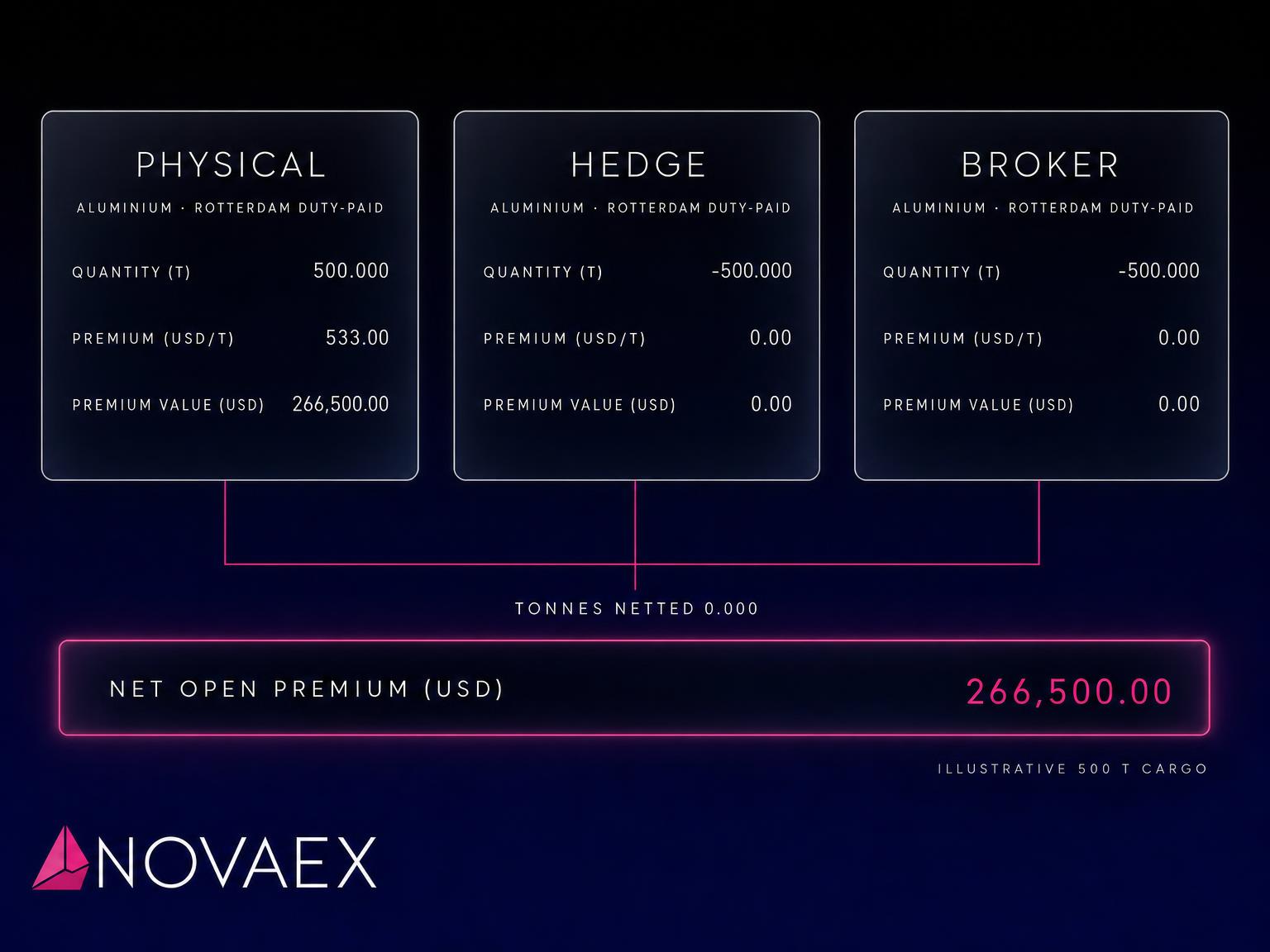
A location move lands in one book first. Key every line the same way, net it daily, and the gap shows up as a line you can read, on the systems you already run.
Reconcile the three books on the location leg, not just the tonnage. Physical books price a regional premium, hedge books price one exchange, and broker statements mark to exchange settlement, so a location move lands in one book first. Key every line by metal, prompt and location basis, net it daily, and leave your systems where they are.
Why do physical, hedge and broker books drift apart?
Each book records a different slice of the price. The physical book carries the invoice: a reference price plus a regional premium, duty and freight. The hedge book carries the exchange leg. The broker statement carries what the clearer says you hold and owe.
When location moves a premium or a spread, the three update at different speeds. The physical book reprices when someone revises the contract or the premium assessment. The hedge book moves with the exchange. The broker marks to settlement. The gap sits open until someone lines the three up.
Book What it holds What a location move does to it
Physical Tonnes, quotation period, reference price plus premium, duty, freight The premium reprices the invoice. The hedge leg is untouched.
Hedge Lots, prompt, exchange, hedge designation Moves with the exchange price and any spread between exchanges. Knows nothing about the premium.
Broker Statement positions, settlement prices, margin Marks the hedge to settlement. Cannot see the cargo it is meant to cover.
What does a location break look like in the numbers?
It looks like a premium or a spread that moved in one book and in neither of the others. Three prints from the last few weeks show the shape. Each carries its date, because the figures move and the mechanism does not.
Rotterdam, aluminium. CRU put the Rotterdam duty-paid premium at $533 a tonne on 23 September, up $10 in a week, with the duty-paid over duty-unpaid spread at $79 a tonne. On a hypothetical 500 t cargo, a $10 move is $5,000 that reprices in the physical book and nowhere in an LME hedge.
Yangshan, copper. SMM's Yangshan warrant premium averaged $125 a tonne on 8 October, in a range of $110 to $140. A cargo sold into China carries that premium on top of the LME reference. No LME future covers it.
COMEX against LME, copper. The COMEX–LME gap was about US$420 a tonne at end-July, roughly eight times its 20-year average, and COMEX traded only marginally above LME by the week ending 2 October. Where a hedge sits on one exchange and the physical prices off the other, that swing is a basis position nobody traded on purpose.
How do you reconcile the three books without changing your systems?
Leave the systems of record where they are and reconcile on top of them. The CTRM, the ERP and the broker statements already hold the data. What is missing is a common key and a daily match, so the location leg shows up as its own line instead of a month-end surprise.
Extract, don't migrate. Take read-only extracts of the physical book, the hedge book and the broker statements. Nothing moves and nothing is re-keyed into a new system of record.
Give every line the same key. Metal, prompt or quotation period, location basis, tonnes. A line that cannot be keyed is a break in itself.
Split each physical line into a price leg and a premium leg. The price leg should match a hedge. The premium leg is unhedged unless something matches it, and the reconciliation should say so.
Net in tonnes first, then in dollars. Tonnes show whether the hedge covers the cargo. Dollars at the day's settlement and the day's premium show what the gap is worth.
Sort the breaks by cause. Timing, quantity, price, location. Location breaks move with the market, so they get reviewed first.
Keep the trail line by line. A total tells the board there is a gap. The trail tells the desk which line it is.
That is the job Novaex Ledger does over the CTRM, ERP and broker systems already in place: one reconciled position, with the working attached, live in weeks.
How often should the three books be reconciled?
Daily for position and break classification, because the location legs reprice daily. Month-end stays the accounting close. It should be the point where the numbers are confirmed, not the first time anyone sees the gap.
A daily match also changes what a break is. Found the same day, a premium move is a decision about whether to cover the leg. Found three weeks later, it is an explanation.
What should the net look like?
Zero where the hedge covers the cargo, and a named number where it does not. A net that reads zero because the premium leg was left out is the one to distrust. The honest net shows the price leg matched, the premium leg open, and the location basis written next to it.
Which of your three books moves first when Rotterdam does? Square that one and the rest stay a correction.