How to show the board that hedges match policy at year-end
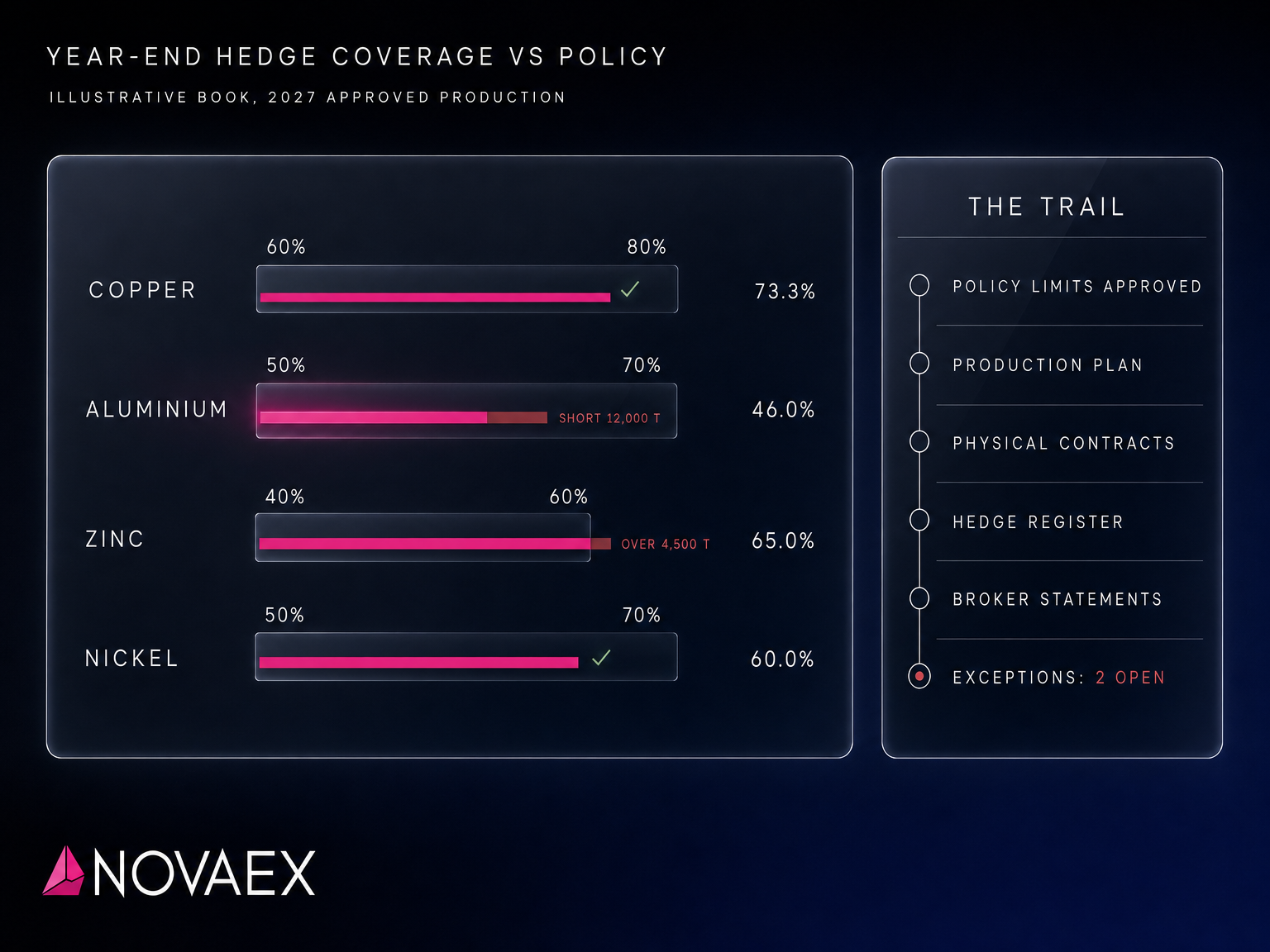
Coverage against policy per metal, the reconciliation trail beneath each figure, and the exceptions: what a year-end hedge review needs to produce on the day it is asked.
A defensible answer to the board's hedging question has three parts: hedge coverage against approved policy for each metal, a reconciliation trail from every reported figure back to its physical, hedge and broker lines, and a written list of exceptions with owners. All three must be producible on the day the question is asked, not assembled afterwards.
What does the board ask at year-end?
The board asks whether the hedges held at year-end match the policy it approved, across both the physical and the financial books. The question concerns the whole position, and the board expects a figure that audit can trace to its source.
Annual review of the hedging policy is a common governance pattern. Mobius Risk Group, a commodity risk advisory firm, states that the board or a risk committee approves a commodity hedging policy and that the policy should be reviewed at least annually. The same page observes that, when prices move against a business, the board asks what the policy was, not what happened.
No single industry date governs this cycle. Each producer's pack follows its own fiscal calendar and committee schedule, and the drafting usually begins in the weeks before the committee meets.
What does a defensible answer contain?
A defensible answer contains coverage against policy for each metal, the reconciliation trail beneath each coverage figure, and the exceptions. Each element answers a separate question: where the position sits against the band, whether the figure can be traced, and what lies outside policy and who owns it.
Coverage against policy, per metal
Coverage is hedged tonnage divided by approved production for the policy period, stated per metal against the band the board set. A single blended percentage conceals the metal that has drifted. The table below uses a hypothetical producer; the figures are illustrative and are not customer data.
Metal Approved 2027 production (t) Policy band Band in tonnes Hedged (t) Coverage Status
Copper 120,000 60% to 80% 72,000 to 96,000 88,000 73.3% Within band
Aluminium 300,000 50% to 70% 150,000 to 210,000 138,000 46.0% Below floor by 12,000 t
Zinc 90,000 40% to 60% 36,000 to 54,000 58,500 65.0% Above ceiling by 4,500 t
Nickel 24,000 50% to 70% 12,000 to 16,800 14,400 60.0% Within band
Two of the four metals sit outside the band. Aluminium is short of its floor by 12,000 t, and zinc is above its ceiling by 4,500 t. The board should see both, because an over-hedged metal is as much a departure from policy as an under-hedged one.
The reconciliation trail
The trail connects each coverage figure to its source lines: the approved production plan, the physical contracts with their quotation periods, the hedge register and the broker statements. The test is direct. Select any figure in the pack and reach the underlying lines in one step.
Where the hedge register and a broker statement disagree on tonnage, the trail shows the difference line by line. A netted total would hide it.
Exceptions
Each departure from the band is listed with its size, the date it opened, the approver and the intended action. In the example, the 12,000 t aluminium shortfall needs a stated cause and a decision: close it, or seek approval to carry it. The zinc excess needs the same.
An exception log with owners tells the board that the departures are known and managed. An empty log, found to be wrong, tells it the opposite.
Where do reconstructions fail?
Reconstructions fail where the figures come from different systems at different times. The physical, hedge and broker books close on separate schedules, so a pack assembled by hand at year-end reconciles to no single date, and any difference found late must be explained rather than corrected.
Four points recur:
Timing. The broker statements, the hedge register and the physical forecast carry different as-of dates, so coverage is computed on a mixture of dates.
Quotation periods. A physical sale priced on one quotation period against a hedge placed on another leaves basis that a coverage percentage does not show.
Netting. A netted total can hide two offsetting errors, so the figure looks correct while the lines beneath it are wrong.
Provenance. A number pasted into the pack from a spreadsheet carries no record of who changed it or when, so when audit asks for the working, the working must be rebuilt.
Each of these can be found. The cost is that they are found during the review, after the question has been asked.
How does Ledger keep the trail behind every figure?
Ledger reconciles physical, hedge and broker positions into one view and holds the lines behind each figure, so the coverage number and its trail are the same record. Audit trails, role-based access control (RBAC), AES encryption and SOC 2 Type 2 readiness sit behind every figure. Your system of record stays where it is.
Audit trail. Every figure carries an audit trail, so the working is available when audit asks for it.
RBAC. Access is set by role, which supports the separation between those who transact and those who confirm and report. Mobius lists clear segregation of duties as essential to a hedging policy.
AES encryption. Position data is protected with AES encryption.
SOC 2 Type 2 readiness. This is stated as readiness, and the security review is welcome to examine it directly.
Ledger runs over the CTRM, ERP and broker systems already in place. The board pack reads from the reconciled position and the existing systems are left as they are.
To see how the position and its trail read on a real book, visit Ledger Platform.
A pack built from a trail takes the same effort in December as in any other month. Seeing it run on your own book is a call away.