How to Turn a Floating Metal Price Into a Landed Cost You Can Quote
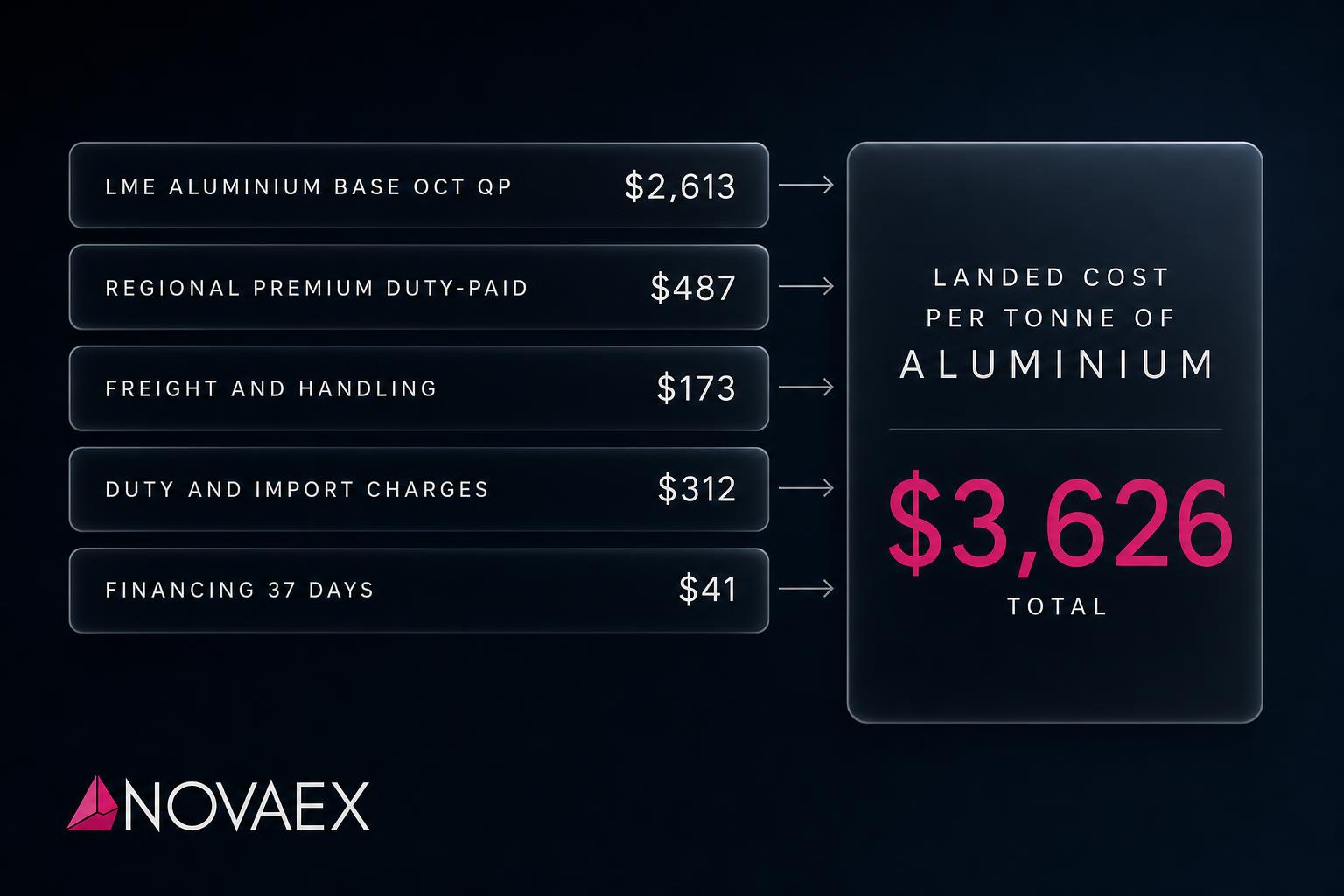
Metal, premium, freight, duty, financing — one build-up that turns a floating input into a fixed customer price.
To quote a fixed price on floating metal, build the landed cost line by line: base price plus regional premium plus freight and handling plus duty under the regime in force plus financing to the sale date, then hold that total with a hedge matched to the same metal and quotation period.
Most downstream quotes fail in one place. The screen price goes on the quote and the rest arrives later. Premium moves. Freight lands higher than allowed. Duty applies under a regime nobody priced. The metal floats between purchase and sale and the margin pays for it.
A landed cost you can quote reverses that. Every component is named before the customer sees a number, and the hedge sits against the same exposure the quote creates.
What goes into a landed cost on floating metal?
A landed cost on floating metal is the full delivered cost of one tonne in your yard on the date you need it: base price for the metal, regional premium for shape and place, freight and handling to your door, duty and import charges under the regime in force, and financing for the days you carry it. Standard landed-cost methods describe the same build-up as product plus freight plus duties plus insurance plus handling.
For a manufacturer, two lines matter most because they move after you quote. The base floats with the exchange. The premium floats with region and form. If either is left open, you are carrying it personally.
How do you build it up line by line?
Work from one tonne and keep each line visible, so the customer price traces back to its parts. The figures below are illustrative and internally consistent, not a market quote.
Line Illustrative value per tonne
LME aluminium base, October quotation period $2,613
Midwest premium, duty-paid basis $487
Inland freight, port and handling $173
Duty and import charges, illustrative only $312
Financing and holding, 37 days at your current rate $41
Quotable landed cost $3,626
The arithmetic is the point. $2,613 plus $487 is $3,100.
Plus $173 is $3,273.
Plus $312 is $3,585. Plus $41 is $3,626. One number leaves your desk.
Name the quotation period on the base line. Name the premium basis. Name the duty regime and date. A downstream buyer can accept a high number with named parts. What they cannot accept later is a new line that was always there.
Live LME and MCX pricing sits on screen in Novaex; COMEX and SHFE values are computed into the cross-exchange view rather than displayed live. That distinction matters here because the base line has to state which market it is priced against.
Where does the duty line come from?
The duty line comes from the regime in force on the date of entry, not from last quarter's file.
For US aluminium, that means the Section 232 framework as revised by proclamation on 2 April 2026 effective 6 April 2026, described in the NMMA summary of the April 2026 proclamation, then modified by proclamation on 1 June 2026 effective 8 June 2026 through 31 December 2027, detailed in C.H. Robinson's June 2026 advisory. Check your broker for the rate that applies to your form and origin before you quote. The $312 above holds the shape of the line, not a rate.
Regional premiums carry the same discipline. Price reporters publish them by place and form, including the LME aluminium premiums page, and a Midwest duty-paid premium is a different input from an untaxed one.
How do you stop carrying the movement yourself?
You match the quote with a hedge that fixes the floating lines.
The mechanism is standard: financial hedges use forwards, swaps or futures to offset physical price risk, and the manufacturer pattern is a cable maker offsetting copper purchase rises with COMEX futures. An auto maker case shows the same cover for aluminium, where futures hedge forward purchases against movement either way.
For this quote that means three matches. Same metal. Same tonnage. Same quotation period as the purchase. Hedge 24.7 tonnes against a 25-tonne physical need and the 0.3 tonnes left open is still yours. Hedge October exposure with a November contract and the basis between them is still yours.
This is the work built from four years on a base-metals desk doing this reconciliation by hand. The hedge is not a view on direction. It is cover for a price already given to a customer.
What do you put in front of the customer?
One figure, with the build-up behind it.
Your customer sees $3,626 per tonne delivered, fixed for the validity you state. Your desk sees the five lines beneath it and the hedge tickets against the floating ones. When premium ticks up $12, you know which line moved and whether cover holds it.
Build the next quote that way. Name each component, date the duty, fix the float.
Quote the build-up, and the hedge holds it.