Indonesia's nickel price reset: which of your nickel lines does it reach?
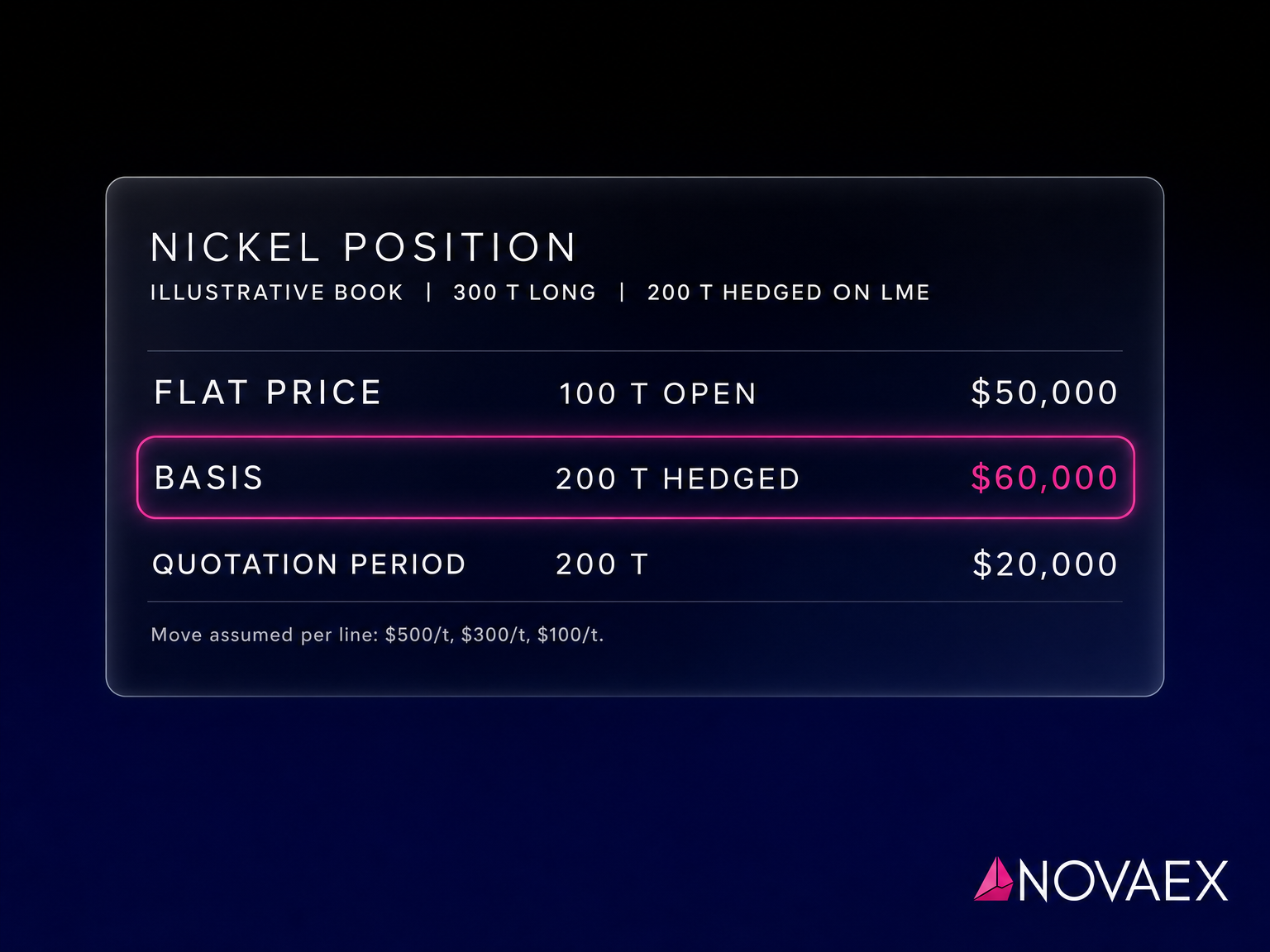
The 1 November reset and the cut talk reach a nickel book through flat price, basis and quotation-period timing. A worked example on 300 t shows which line is open, and what to check before the 15 November RKAB deadline.
Indonesia's 1 November nickel reference price reset reaches a book through three lines, not one: flat price on LME, the basis between your physical index and LME, and the timing of your quotation period. On a hedged physical position, basis and timing can move before flat price does, so check those two lines first.
What did Indonesia reset on 1 November, and what is the cut talk?
On 1 November, SMM reported that Indonesia's energy ministry (ESDM) had published its nickel reference price (HMA) for the first period of November at $15,478.67 a tonne, down $369 or 2.33% on the prior period. The 25 October SEAIEA note flagged that reset alongside possible nickel cuts and the 15 November deadline for 2027 quota submissions.
The cut talk is separate from the reset, and it is talk. Indonesian miners have applied for more than 500 million tonnes of 2027 ore, roughly double the 2026 cap, and four Chinese producers in Indonesia met on 20 October to discuss halving output. No cut is confirmed.
Context for the desk: the same source has LME nickel at $14,885 a tonne on 15 October, its lowest cash price of 2026, and LME stocks at 278,814 t on 28 October. Indonesia is a supply watch here, not a call on direction.
Which part of a nickel book does the reset reach?
A nickel position carries three separate exposures: flat price (the tonnes left open on LME after hedges), basis (the gap between the physical index and LME on the tonnes you have hedged), and quotation-period timing (the gap between when your physical prices and when your hedge was struck). The reset can reach one line without touching the other two.
Flat price
This is the line everyone watches. It is the net tonnes open after hedges, multiplied by whatever LME does. A fully hedged book has none, and a partly hedged one has exactly the unhedged tonnes.
Basis
Indonesian nickel pig iron (NPI) prices off its own physical assessments, not off LME. Yuze Metal, a Shanghai stainless supplier, calls the spread between NPI offers and the LME quote a discount meter. A reference price that feeds smelter costs reaches that spread before it reaches the LME screen, which is our reading, not a measured result.
Timing
If the physical prices on a monthly average and the hedge was struck on one day, the two never close at the same number. Headlines that arrive mid-quotation period move the average and leave the strike where it was.
Worked example: 300 t of nickel, 200 t hedged
This is an illustrative book, not a client's. A merchant is long 300 t of contained nickel in NPI, priced on the physical index for November. He sold 200 t on LME three-month on 3 November.
The arithmetic assumes LME near $15,500 a tonne. That is an assumption, not a quote.
Line What it measures Move assumed Result
Flat price 100 t left open $500 a tonne $50,000
Basis 200 t hedged on LME, physical on the index Index weakens $300 a tonne against LME $60,000
Timing 200 t, hedge struck 3 Nov, physical priced on the November average $100 a tonne between strike and average $20,000
The three lines add to $130,000 if all three go against the book at once: $50,000 plus $60,000 plus $20,000. Only the first sits on the flat-price line. A desk that watches the LME screen alone sees under half of it.
For this book, the reset is a basis story first. The hedge is on LME, the physical is on an Indonesian-linked index, and 200 t is the tonnage where the two can part.
Which contract to hedge, and when?
Hedge the line that is open, in the contract that matches the date those tonnes price. Flat price closes with LME tonnes against net open length. Timing closes by matching the hedge to the quotation period, not to the day the headline lands.
Basis is different, because an LME hedge does not close it. The decision there is how much physical to leave floating on the index.
Line Check Contract When
Flat price Net open tonnes against your policy band LME nickel, the prompt that matches when the open tonnes price When open tonnes sit outside the band
Basis Physical index against LME on hedged tonnes LME hedge stays; the question is how much physical floats on the index When the spread moves past what the book can carry
Timing Quotation period against hedge strike date LME prompt aligned to the end of the quotation period Before the period opens, not after a headline
That is the call Pulse makes per metal: which contract, and when. It reads the forward curve and the cross-exchange spread for nickel, with LME and MCX live on screen and COMEX and SHFE computed into the arbitrage view. Check the live LME and MCX prices before you size anything.
Our October read on stocks against the quota cut covers the other side of the same hedge.
RKAB on 15 November: a watch item, not a date
RKAB is the annual production quota each Indonesian miner needs approved. Applications close on 15 November. No official, dated November announcement of the 2027 quota has been verified, so what follows is scenarios.
Approvals near or below the 2026 cap, and the output cuts carried out. Supply reads tighter. Check the flat-price line first, because open length matters most.
Approvals well above the 2026 cap. The surplus case holds. Check flat price and how far the physical index sits below LME.
No quota news before year-end. The same source notes 2026 quotas came on 10 February; on that timetable the decision would sit in the first quarter. That is a reading of last year, not a date.
None of these is a forecast. Each is a reason to know which of your three lines is open before the news, not after it.
Seeing it run on your own nickel book is a call away.