Intraday Margin Exposure: A Metals Trading Workflow Audit
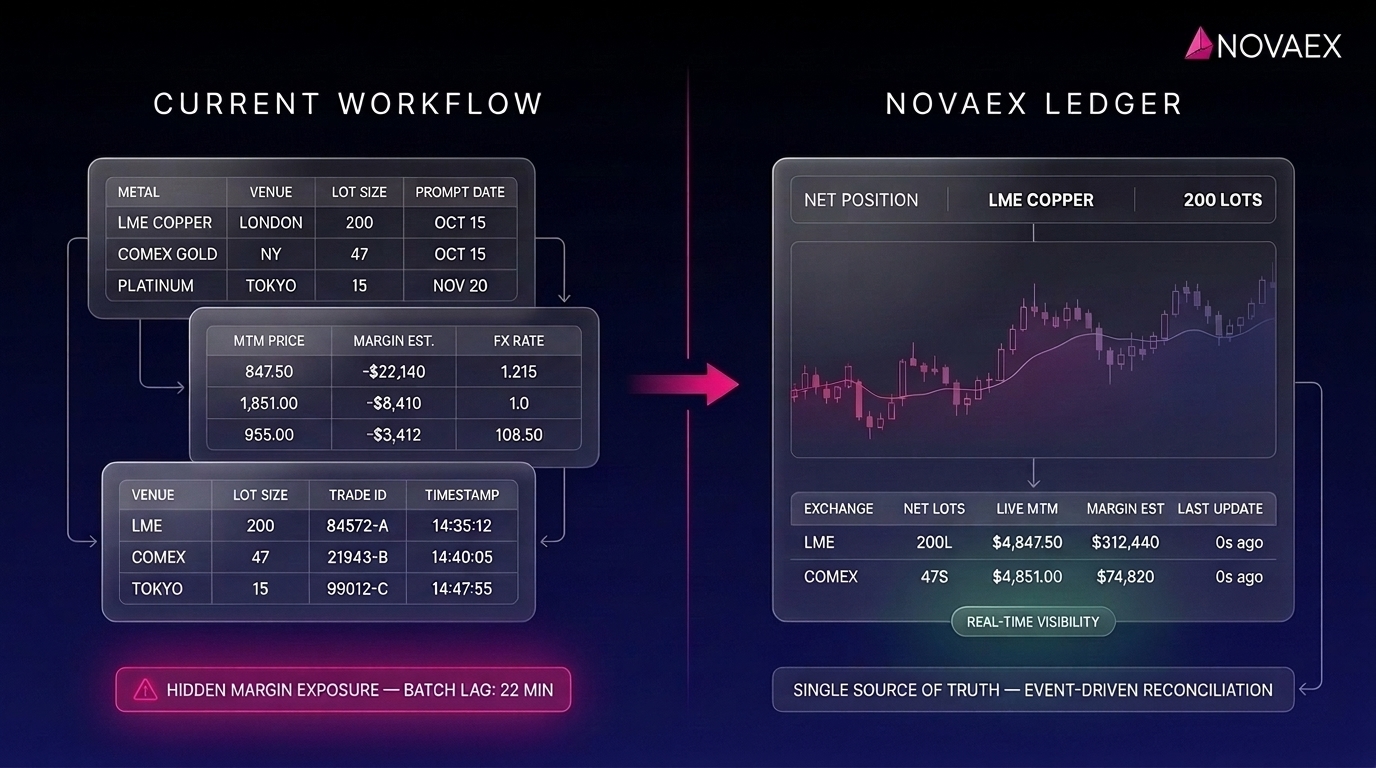
Most metals trading operations carry at least one intraday margin exposure they cannot measure in real time. The gap is architectural. It is built into how trade capture, exchange feeds, and the position ledger synchronize, rather than how carefully the desk is managed. This audit maps a standard position-reconciliation workflow step by step, traces each blind spot to a specific process hand-off, and quantifies the visibility cost before end-of-day reconciliation runs.
The finding is structural. No workflow is condemned here.
How Standard Position Reconciliation Workflows Actually Run
Before locating the gaps, the sequence requires precise mapping. A typical front-office metals workflow (whether running on an enterprise CTRM, a hybrid of spreadsheets and broker confirmations, or a legacy OMS) follows the same six-step pattern. The gaps are consistent across implementations because they are driven by sequence rather than the platform.
Step 1: Trade Capture
A new futures position is logged in the trade capture system. Timestamp, lot size, exchange (LME, COMEX, MCX, SHFE), and prompt date are recorded. The position exists in the ledger from this point forward.
Step 2: Exchange Confirmation
The trade hits the exchange matching engine and returns a confirmed fill via FIX protocol, broker API, or, in legacy environments, manual email or phone confirmation. According to FIA market data reports, approximately 60% of mid-market commodity firms still rely on semi-manual confirmation workflows for at least one exchange venue.
Step 3: Position Aggregation
Individual fills are rolled into a net position on a prompt-date-by-prompt-date basis. This step is frequently a batched process, running every 15 minutes, every hour, or only at day-end depending on system configuration.
Step 4: Mark-to-Market Calculation
The aggregated position is priced against a market reference: the prior day's exchange settlement, a mid-market composite, or a manually entered price. The frequency of this mark determines the age of the P&L and margin estimate at any given point in the session.
Step 5: Margin Estimate vs. Exchange Call
The system, or the trader manually, compares the estimated margin requirement against actual posted margin at the clearinghouse. LME Clear issues variation margin calls once daily, at approximately 08:45 GMT, based on the prior day's close. COMEX variation margin operates on the same end-of-day cadence.
Step 6: End-of-Day Reconciliation
All trade data, position aggregates, MTM values, and margin estimates are reconciled against exchange statements. Breaks (position differences, price discrepancies, unconfirmed trades) are investigated and resolved.
The Most Common Position Reconciliation Blind Spots
The most common blind spots occur at the hand-off between Step 3 and Step 4: when position aggregation runs on a fixed batch cycle while the market moves continuously. A position that is 15 minutes stale in a copper market moving at 0.5% per hour carries a margin estimate error of approximately $35, $70 per lot LME margin schedules. This is small per lot, but material at scale. The second most common blind spot is the window between an executed trade and its exchange confirmation, during which the position exists in the market but not in the ledger.
Where Intraday Margin Exposure Disappears in Real Time
This gap has a specific location in the workflow and a measurable address in time.
LME copper three-month has historically moved between 1.8% and 4.2% intraday on high-volatility sessions LME historical volatility data, driven by the Ring open, SHFE open, and macro releases. COMEX copper logs similar intraday ranges on the U.S. morning session open. On those sessions, the age of the margin estimate is an operational concern rather than an academic one.
Consider this scenario: a mid-market operation carrying 200 LME copper lots net long, last aggregated 22 minutes ago, with three additional lots executed during a fast move. The MTM price is the 08:45 settlement. Copper has moved $87/tonne since that fix.
The estimated margin requirement the trader sees is understated by approximately $17,400 before accounting for the unconfirmed lots. According to industry risk management surveys, intraday mark-to-market discrepancies of this magnitude occur on 30, 40% of high-volatility trading days at firms using batch-based reconciliation systems.
That $17,400 is an unrecorded market exposure rather than a realized loss. The operational question is what decision the trader made in the intervening hours based on an incomplete margin estimate.
Causes of Intraday Margin Exposure Gaps
Intraday margin exposure gaps stem from three architectural conditions occurring simultaneously: position aggregation running on a fixed batch cycle, MTM prices updating less frequently than market movement, and margin estimates that do not recalculate automatically when either condition changes. Each condition alone is manageable. All three together produce a compounding visibility failure that remains invisible to the trader until end-of-day reconciliation runs, at which point every decision made during the session has already been executed.
The Impact of Reconciliation Frequency on Risk Visibility
Reconciliation frequency directly determines the maximum age of the margin exposure estimate. A system reconciling every 60 minutes in a copper market moving $15/tonne per hour can carry an MTM error of up to $375 per lot with no indicator in the live dashboard. Moving to a continuous, event-driven reconciliation cycle (updating on every new trade or price tick) reduces this error floor to near zero because no batch interval exists for the market to outpace.
The Architecture Behind Every Intraday Margin Exposure Gap
Every blind spot identified above traces to the same root cause: data residing in more than one system, updated at different frequencies, reconciled after the fact.
A trade captured in the CTRM, confirmed by a broker API, priced against an exchange feed, and margined against a clearinghouse calculation involves four distinct data sources. In most enterprise CTRM architectures, these sources do not share a single continuously updated ledger. They share periodic snapshots of one another.
This stems from a design assumption built when real-time exchange data feeds were expensive, API connectivity was limited, and end-of-day reconciliation was the operational standard for the industry. According to a 2023 Accenture survey of commodity trading firms Accenture commodity operations report, 67% of CTRM implementations still rely on batch-based data synchronization for at least one critical data source.
The core constraint is that the reconciliation clock and the market clock run at different speeds. Every blind spot in the sequence above is a symptom of that mismatch. Framing the problem architecturally, rather than operationally, is what makes it addressable.
Defining a Single Source of Truth
A single source of truth in commodity trading is one continuously updated ledger that receives trade capture events, exchange confirmations, live pricing ticks, and margin calculation inputs from a unified data layer, rather than four scheduled systems. When any input changes (whether a new fill, a price move, or an exchange margin update), the ledger recalculates every dependent value immediately. The result is that the age of the margin estimate at any point in the session is measured in seconds, rather than minutes or hours.
Running Your Own Reconciliation Workflow Audit
The following five questions constitute the audit. For each, the objective is to determine how frequently it updates and whether it triggers automatic downstream recalculation.
Audit Question 1: Trade Capture Latency
From execution to ledger entry, what is the maximum time a position can exist in the market but not in the system? If the answer is "until the broker confirms" or "until the blotter is updated," that interval is the first gap.
Audit Question 2: Position Aggregation Frequency
Does net position update with every new confirmed fill, or on a scheduled batch cycle? If batch, what is the cycle time in minutes? Every minute of batch lag in a fast market is a calculable margin estimate error.
Audit Question 3: MTM Price Source and Update Frequency
Is the mark-to-market price the last exchange settlement, a real-time exchange feed, or a manually entered reference price? According to Commodity Technology Advisory research, only 34% of mid-market CTRM users connect to real-time exchange price feeds. The remaining 66% are working from delayed or end-of-day pricing during the live session.
Audit Question 4: Margin Recalculation Trigger
When a new trade is captured or the MTM price changes, does the margin estimate recalculate automatically? Or does it require a manual refresh, a system batch run, or a combined condition before it updates?
Audit Question 5: Cross-Venue Aggregation
For operations trading the same metal across LME and COMEX (or LME and MCX) does the system display a single real-time net exposure, or are separate position ledgers maintained per venue, requiring manual consolidation for a complete picture?
Real-Time Intraday Margin Calculation
CTRM platforms that support real-time intraday margin calculation do so through an event-driven architecture: every trade capture event, price tick, and exchange margin update triggers an immediate recalculation of net position, MTM value, and estimated margin requirement. The enabling requirement is a unified data layer. Trade capture, pricing, and margin inputs must write to the same ledger record, rather than separate databases synchronized on a schedule. Legacy CTRM systems were not built on this model. They were built for end-of-day batch reconciliation, with intraday screens that display the last batch result. This is a distinction rarely visible in a standard demo environment but operationally significant on any volatile trading day.
What a Single-Source-of-Truth Architecture Changes at Each Step
The Novaex Ledger is built on a single-source-of-truth architecture: trade capture, LME/COMEX/MCX/SHFE exchange feeds, and margin calculations write to one continuously updated ledger. There is no batch synchronization step between trade execution and margin visibility.
The results at each audit checkpoint include:
- Trade Capture Latency: A confirmed fill updates the position ledger in the same event cycle. No broker-confirm lag window. No blotter update required before the position registers.
- Position Aggregation: Continuous. Each confirmed fill immediately recalculates the net position across all prompt dates and all venues.
- MTM Price Source: Live exchange feeds for LME, COMEX, MCX, and SHFE. The ledger's margin estimate reflects the current bid/ask, rather than the prior session's settlement.
- Margin Recalculation Trigger: Event-driven. A new fill or a price move beyond a configurable threshold triggers immediate margin recalculation without manual intervention.
- Cross-Venue Aggregation: A single net exposure view across all four exchanges, updated on the same continuous cycle.
According to internal benchmarking data Novaex platform documentation, traders using the Novaex Ledger identified intraday margin exposure discrepancies on 23% of trading days that were not visible in their previous CTRM system until end-of-day reconciliation, with an average discrepancy of $22,000 per event across LME and COMEX positions.
The critical takeaway is that the gap existed before Novaex. The architecture simply made it visible for the first time.
The Measurable Cost of Deferred Margin Visibility
Every hour of reconciliation lag in a moving metals market carries a calculable cost in decision quality. A trader managing a 150-lot LME copper position who makes a hedging decision based on a margin estimate that is 90 minutes stale, on a session when copper moves $45/tonne, is working from data that understates exposure by $337 per lot: $50,550 in aggregate LME lot specifications and margin schedules.
While manageable in isolation, this represents the exact numerical exposure the operation cannot see until end-of-day reconciliation closes the loop.
The Bank for International Settlements reported that base metals futures open interest on LME alone exceeded $180 billion in notional value as of Q4 2023 BIS derivatives statistics. The operational standard governing real-time visibility for that volume has not kept pace with the data infrastructure now available to support it. Batch reconciliation was the appropriate architecture when continuous feeds were cost-prohibitive. It is a structural constraint when they are widely available.
The remaining direct audit question is which intraday decision in the current workflow is being made against an incomplete margin estimate.
At a 15-minute batch cycle, it is every decision made in the first 14 minutes after each batch runs. At a 60-minute cycle, the window covers the majority of the LME Ring session. At end-of-day-only reconciliation, the answer is every intraday decision, on every trading day.
Locate the Gap Before the Market Does
This audit serves as an operational map. Every step in the reconciliation sequence has an address, and every blind spot has an architectural explanation traceable to a specific hand-off between data sources.
Next steps:
- Answer Audit Questions 1, 5 against the current workflow with specific numbers. Batch cycle time. Price update frequency. Margin recalculation trigger. If those numbers are not immediately available, that inability is itself a finding.
- Identify the audit question with the highest gap-to-decision risk. The most critical gap occurs during the interval when position decisions are most likely to be made, regardless of its dollar magnitude.
- Request a structured Ledger walkthrough using your own position data. This provides a direct comparison using your metals, your exchanges, and your current batch cycle against what a single-source-of-truth architecture surfaces in the same market moment.