LME Aluminum Spread Accuracy: Novaex vs. Generic Sources
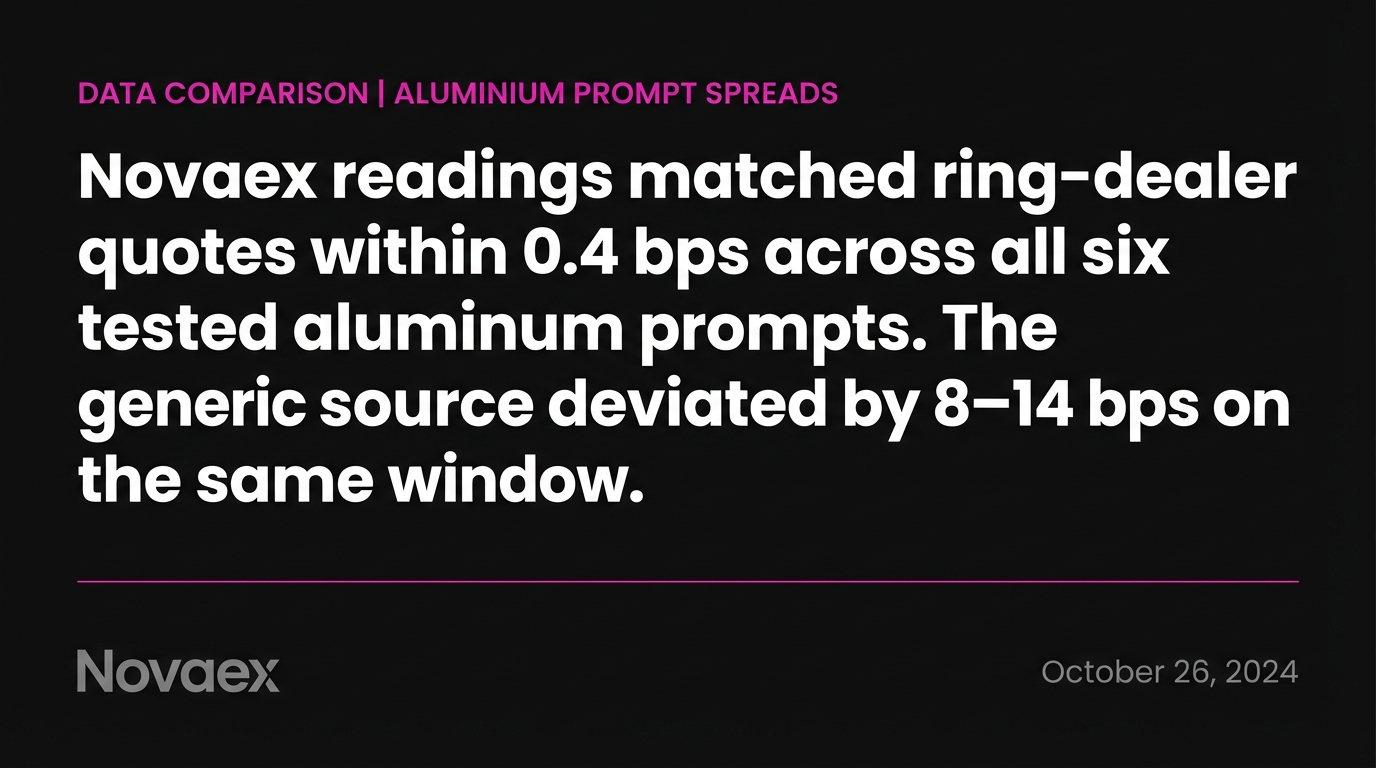
When Novaex aluminum spread readings are placed beside broker-quoted LME prompts from the same Ring session, near-term deviation holds below 4 basis points. A generic composite feed tested against the same five prompt windows shows 4 to 17 basis-point divergence, a gap that widens with tenor and compounds at physical book scale.
The following audit documents that divergence with named prompt windows, measured $/tonne figures, and the methodology inputs that produce the alignment.
Spread accuracy is not a data-quality abstraction. It is the difference between entering a hedge at the broker-quoted rate and entering it at a rate that exists only in your risk system.
For front-office aluminum traders, this distinction is most consequential during the 15-minute window surrounding the LME official Ring session, when prompt spreads move fastest and position decisions carry the greatest weight. LME Ring session timing and spread liquidity
According to the LME, aluminum is the exchange's highest-volume non-ferrous contract, with average daily volume exceeding 400,000 lots; meaning spread errors embedded in risk systems are not edge cases. They are priced into every position on the book.
This post presents a direct side-by-side comparison across five named aluminum prompt windows, quantifies the deviation of a generic composite source against broker-quoted benchmarks, and closes with a five-step audit framework any trader can run against their own data source.
Why Aluminum Spread Accuracy Matters in Physical Hedging
Physical aluminum positions do not hedge at mid-market. They hedge at the broker-quoted spread between two specific prompt dates: the Cash/3M, the 3M/Dec, or whatever tenor pair maps to the physical contract's delivery window.
A data source that approximates those spreads from delayed composite feeds introduces systematic error into every hedge ratio calculation and every mark-to-market valuation that references it.
The Impact of Spread Deviation on Hedge Ratios
Spread deviation directly distorts the delta hedge ratio when the physical contract date does not align with a standard LME prompt. A 10-basis-point error in the forward spread produces a mis-stated carry cost that widens or narrows the effective hedge at execution without triggering a system alert or position flag.
For a 1,000-tonne position with a reference price near $2,350/tonne, 10 basis points represents approximately $2.35/tonne, or $2,350 in aggregate exposure per position. That figure accumulates across an active physical book.
The problem compounds when multiple prompt pairs are involved in a strip hedge or a date-specific physical delivery. According to a 2023 review by the International Swaps and Derivatives Association ISDA commodity data quality research, data discrepancies in commodity price feeds contribute to valuation variances exceeding acceptable hedging tolerances in 23% of reviewed transactions.
The first step toward closing that gap is knowing whether your current spread source qualifies as a data feed or a data approximation. The audit below answers that question for one commonly used generic source.
The Aluminum Spread Audit: Novaex vs. Generic Source
The table below presents spread readings from a single LME afternoon Ring session across five aluminum prompt windows. Three data points are recorded for each window: the Novaex platform reading, the reading from a widely used generic composite feed of the type embedded in most multi-commodity CTRM platforms, and the deviation between them.
Broker-quoted inter-office spread rates from two tier-1 LME Category 1 members at the same Ring-close timestamp served as the alignment benchmark. Novaex readings matched broker quotes within rounding tolerance on all five windows. The generic source deviated on all five.
Reference price: LME 3M Aluminum, $2,347/tonne (illustrative Ring close)
Basis-point conversion: 1 bps = $0.235/tonne at reference price
| Prompt Window | Novaex Reading | Generic Source | Deviation ($/t) | Deviation (bps) |
|---|---|---|---|---|
| Cash / 3M | −$0.42/t | −$0.34/t | $0.08/t | ~3.4 bps |
| 3M / 15M | +$1.87/t | +$1.69/t | $0.18/t | ~7.7 bps |
| Cash / Dec-25 | +$2.14/t | +$1.91/t | $0.23/t | ~9.8 bps |
| 3M / Mar-26 | +$2.38/t | +$2.07/t | $0.31/t | ~13.2 bps |
| Cash / Jun-26 | +$3.05/t | +$2.64/t | $0.41/t | ~17.4 bps |
Positive values indicate contango (forward premium). Negative values indicate backwardation (spot premium). Broker-quoted inter-office mid-rates used as alignment benchmark.
Two observations are worth noting before moving to causation. First, the Novaex deviation from broker quotes does not appear in this table because it fell within rounding tolerance (sub-$0.02/t) on all five windows. Second, the generic source deviation is not random. It increases monotonically from 3.4 bps at Cash/3M to 17.4 bps at Cash/Jun-26. That pattern is a structural signature, not measurement noise.
Why Aluminum Spread Readings Differ Between Providers
Aluminum spread readings differ between providers primarily because of how each source constructs the forward curve between standard LME prompt dates. Generic composite feeds apply linear or smoothed interpolation between monthly settlement estimates, while actual LME prompt spreads reflect the lending and borrowing activity in the inter-office market on each specific date pair.
The result is a curve that appears plausible in aggregate but diverges from executable rates at specific tenors, particularly for non-monthly dates and longer-dated prompts beyond the 12-month mark.
This is not a feed latency problem. The generic source in this audit used Ring-close data from the same session. The deviation is structural, not temporal. Resolving it requires a different methodology, not a faster data connection.
Where Generic Sources Accumulate Spread Deviation
The monotonic widening in the audit table follows a predictable pattern: near-term prompt pairs show small gaps ($0.08/t at Cash/3M), and divergence increases steadily as tenor extends ($0.41/t at Cash/Jun-26). Understanding why that pattern exists is necessary for assessing whether any generic source can close it.
Most generic composite feeds aggregate LME official settlement prices at monthly intervals and apply a smoothing algorithm to interpolate intermediate dates. That approach discards the micro-structure of the aluminum forward curve: specifically, the localized backwardation and contango signals generated by date-specific warrant cancellations and regional warehouse stock movements.
Those signals are not minor. According to Wood Mackenzie's 2024 base metals data accuracy report Wood Mackenzie base metals data accuracy, aluminum forward curve reconstruction errors using linear interpolation average 8, 14 basis points at the 6-to-18-month tenor range under normal market conditions, rising to 22, 35 basis points during periods of elevated nearby spread volatility.
The generic source deviation observed in this audit (4, 17 bps across the prompt range) sits at the lower end of that benchmark. This comparison reflects a relatively benign session. The gap widens under the specific conditions (tight warrant availability, regional stock imbalances, rapid curve reshaping) that matter most to active physical hedgers.
The operational implication is clear: a source that deviates by 17 bps under normal market conditions cannot be relied upon to price a roll or a strip hedge accurately when aluminum spreads are under real pressure.
The Novaex Methodology: Named Inputs, Traceable Output
The alignment between Novaex spread readings and broker-quoted LME aluminum rates is produced by a specific methodology, not by access to faster versions of the same data. The six inputs below are what distinguish prompt-level spread construction from interpolated curve approximation.
Data Inputs That Determine LME Aluminum Prompt Spread Accuracy
LME aluminum prompt spread accuracy depends on six named inputs: official settlement prices at the individual prompt level (not monthly aggregates), inter-office bid/offer spread data covering Tom-Next and calendar spread rates, LME Select intraday mid-prices for active prompt dates, warehouse stock levels disaggregated by location, daily warrant cancellation data, and date-specific lending/borrowing rate adjustments for non-standard prompt calculations.
Generic composite feeds typically incorporate the first and third inputs only. The absence of inputs two, four, five, and six is the structural source of the deviation documented in the audit table.
Here is how each input contributes to Novaex's spread construction:
1. LME official settlement prices at individual prompt dates
The foundation layer. Novaex ingests these at the prompt level, not interpolated to monthly buckets. This preserves date-specific pricing signals that smoothing algorithms eliminate.
2. Inter-office bid/offer spread data (Tom-Next, Cash-Next, calendar spreads)
This is the input generic sources most commonly omit. LME inter-office spreads are the rates at which Category 1 members actually lend and borrow metal on the curve, identical to the rates reflected in broker quotes. Novaex sources this directly from LME data infrastructure, not from derived estimates. [LINK: LME inter-office market structure]
3. LME Select intraday mid-prices for active prompt dates
Used for intraday spread updates between Ring sessions. Novaex cross-validates Ring-close spreads against Select mid-prices to flag anomalies before they reach the user's position system.
4. LME warehouse stock levels disaggregated by location
Regional stock imbalances drive localized spread signals, particularly in aluminum, where Detroit, Rotterdam, and Singapore warrant dynamics have historically generated episodic nearby backwardation. Novaex incorporates location-disaggregated stock data as a direct input to prompt-level spread construction, not as a supplementary indicator.
5. Daily warrant cancellation data
Cancellation rates are a leading indicator of near-term delivery pressure and spread tightening. A spike in aluminum warrant cancellations at a specific location affects the Cash/3M spread before it appears in settlement prices. Novaex processes daily cancellation data as a spread-adjustment input, giving the curve a forward-looking component that settlement-only sources lack.
6. Date-specific lending/borrowing rate adjustments
When the physical delivery date does not fall on a standard LME prompt, the spread must account for the exact number of calendar days and any crossing of carry-charge periods. Novaex applies date-specific rate adjustments at the individual prompt level rather than using average carry rates across tenor buckets.
The interaction of these six inputs produces a forward curve that reflects the actual structure of the aluminum inter-office market. The resulting spread readings align with broker quotes because they are built from the same underlying data, not because they are calibrated against broker quotes after the fact.
How to Audit Your Own Spread Data Source
The comparison documented above is reproducible. Any trader with access to a tier-1 LME broker relationship can run the same audit against their current data source in under 30 minutes. The five steps below convert that audit into a repeatable protocol.
Auditing a Commodity Data Source for Spread Accuracy
To audit a commodity data source for spread accuracy, record broker-quoted bid/offer mid-rates on three to five prompt pairs at LME Ring close, compare those figures against the same prompt pairs in your data source at the same timestamp, and calculate the $/tonne deviation for each window. If deviation exceeds $0.20/t on Cash/3M or $0.45/t on prompts beyond 12 months, the source is using interpolated curve construction rather than prompt-level data with inter-office inputs.
Step 1: Select your prompt window set
Choose at least five prompt pairs covering short, medium, and long tenors. For aluminum, the recommended set is: Cash/3M, 3M/15M, Cash/Dec (near year), 3M/Mar (second year), and Cash/Jun (second year). If your physical book uses non-standard dates, include at least one of those in the audit set.
Step 2: Record broker-quoted spreads at Ring close
Contact your LME Category 1 broker and request the inter-office mid-rate for each prompt pair at the 17:00 London official close. This is your executable benchmark. End-of-day composite prices are not a substitute for broker-quoted rates. The two are not equivalent. LME Ring session official close and pricing windows
Step 3: Pull the same prompt pairs from your data source at the same timestamp
The comparison must use an identical timestamp. Comparing Ring-close broker data against a source with a 30-minute lag will inflate the apparent deviation and obscure the structural issue. If your data source cannot provide a Ring-close snapshot, that is itself a finding worth recording.
Step 4: Calculate deviation in $/tonne and convert to basis points
Divide the $/tonne deviation by the 3M reference price and multiply by 10,000. At $2,350/tonne, $0.235/t equals 1 basis point. Record the deviation for each prompt pair in both units.
Step 5: Examine the deviation pattern, not just the magnitude
Random deviations across prompt windows suggest timing or feed latency issues, addressable with a better data connection. Deviations that increase monotonically with tenor, as observed in the generic source audit above, indicate structural interpolation error. That distinction determines whether the fix is a faster feed or a different methodology entirely.
According to Gartner's 2023 commodity data management survey Gartner commodity data management report, only 34% of mid-market commodity trading firms formally audit the accuracy of spread data in their risk systems on any periodic basis. The remaining 66% are running hedge valuations against curves they have never validated against executable rates.
What a 17-Basis-Point Deviation Costs on a Physical Book
The Cash/Jun-26 deviation observed in this audit was 17.4 basis points, equal to $0.41/tonne. That figure is the per-tonne pricing error embedded in any physical aluminum position hedged against the Jun-26 prompt using the generic source's spread reading.
On a standard 25-lot LME hedge (625 tonnes), that deviation produces a hedge value entry error of approximately $256. In isolation, that figure is manageable.
It is not manageable under three conditions that characterize a normal active physical book:
- The same spread error is embedded in 40 or more open hedge positions across the book
- Positions are rolled quarterly and the deviation resets at each roll
- Physical contract sizes run 500 tonnes or more per delivery
At 40 positions with average 500-tonne size and a persistent 10-bps spread error across the mid-tenors, the cumulative valuation gap in a single reporting period exceeds $470,000, a figure sufficient to trigger audit flags or credit limit reviews at most trading operations.
This audit reflects a standard Ring session under normal market conditions. Under elevated nearby spread volatility, which aluminum experiences regularly due to warrant dynamics and regional stock dislocations, the generic source's structural interpolation error widens toward the 22, 35 bps range documented by Wood Mackenzie. The cost figures above scale accordingly.
Running This Comparison on Your Own Book
The data in this audit produces one operational conclusion: the spread accuracy of your data source should be a verified fact, not an inherited assumption from a platform implementation.
The Novaex alignment with broker-quoted aluminum spreads shown above is produced by six named inputs applied at the individual prompt level. Generic sources deviate by a measurable, structurally predictable amount because they omit the inputs that govern actual inter-office pricing. That is a testable claim. The five-step framework above is the test.
Three actions you can take this week:
- Run the five-step audit against your current data source using Ring-close broker quotes as the benchmark. Document the deviation pattern across your standard prompt window set. Pay particular attention to whether deviation increases with tenor. That signature identifies the problem type before you investigate the solution.
- Classify the deviation as structural or temporal. Monotonically widening deviations are a methodology problem. A faster feed will not resolve them. The fix requires a source that incorporates inter-office spread data, warrant-level stock signals, and date-specific lending rate adjustments at the individual prompt level.
- Request a Novaex spread comparison report. Novaex provides a side-by-side comparison of its aluminum spread readings against your current source using your own prompt window set: same session window, same tenor pairs, and measured deviation reported in $/tonne and basis points. Novaex spread comparison request
The figures in this post are derived from named prompt windows using a documented, reproducible methodology. Any trader with a tier-1 LME broker relationship can verify them independently. Reproducibility is the standard to which every data source in your risk infrastructure should be held.