LME Copper Mark-to-Market: Why EOD Reconciliation Fails
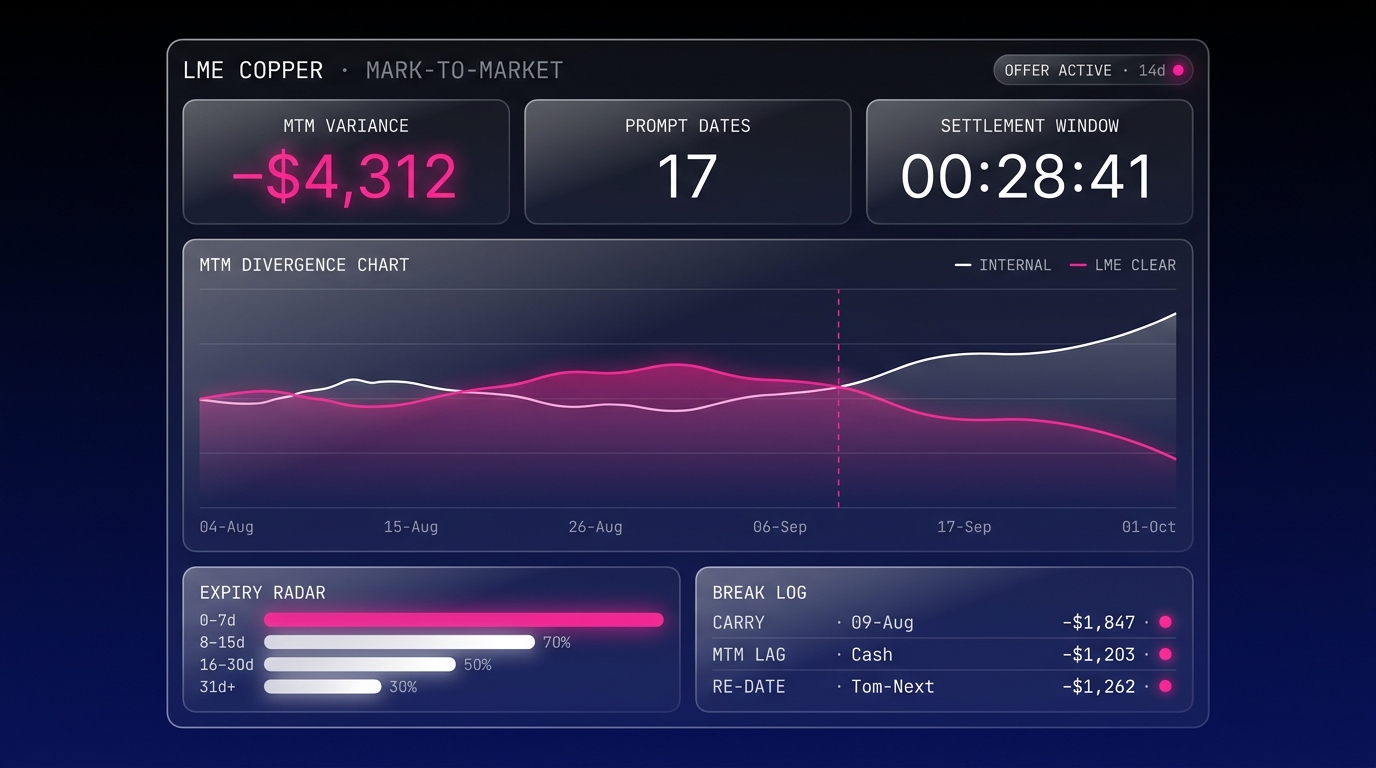
When the LME publishes official copper prices at approximately 12:30 GMT, the conditions for tomorrow's morning position mismatch are already in place. LME copper mark-to-market reconciliation breaks in the gap between official price ingestion and prompt date application, not at the trade level. Manual workflows cannot close that gap before LME Clear runs end-of-day settlement. The result is a position report that diverges from the exchange record by an amount that is small, named, and entirely preventable.
Most front-office copper desks receive a daily reconciliation alert before the open. The figure rarely rises to threshold-level risk exposure. The operational cost, however (analyst time, delayed resolution, and deferred capital deployment) accumulates every business day the underlying workflow remains unaddressed. What is consistently absent from that alert is a precise account of where the error entered the system.
This post traces that sequence mechanically. From the moment the second Ring session closes to the moment the morning position report generates, it identifies every step where a manual workflow introduces a traceable reconciliation error. By the end, the failure becomes a named chain of events with a specific root cause at each link.
The Silent Failure Between Last Trade and Morning Report
The London Metal Exchange publishes official prices following the second Ring session, typically between 12:25 and 12:30 GMT. LME official price methodology These prices (cash official, 3-month official, and the full prompt date carry series) are the settlement reference for every open position cleared through LME Clear.
The window between that publication and the end-of-day cut is where the failure originates. This window is short and unforgiving.
A desk running 15 to 20 open prompt dates in LME copper cannot manually ingest official prices, apply those prices to every open lot on every prompt date, calculate variation margin at the lot level, and reconcile the output against the LME Clear record within that window without introducing error. Research published by the Institute of Operational Risk establishes that manual data entry in financial workflows carries an error rate of approximately 1 to 4 percent per transaction cycle. Institute of Operational Risk manual entry error rates Across a copper book with dozens of prompt dates, that rate compounds through the netting chain.
The failure stems from a timing and volume problem that manual workflows are structurally incapable of solving.
Causes of Repeated LME Copper End-of-Day Reconciliation Failures
LME copper EOD reconciliation fails repeatedly because the settlement window is shorter than the time required to manually ingest official prices, map them across all open prompt dates at the lot level, and net positions before the LME Clear settlement run. Each manual step adds latency and introduces one of three named error types: stale carry application, lag-adjusted MTM failure, or prompt date re-dating error. These errors are structurally predictable and scale directly with book complexity.
A desk with five open prompt dates will experience smaller morning mismatches than a desk with twenty. This is simple arithmetic based on volume.
How LME Copper Official Price Ingestion Breaks Manual Workflows
The first failure point is price ingestion itself: specifically, what gets ingested and what gets missed.
The LME publishes official prices across a complete prompt date structure: cash, tom-next, the 3-month date, and forward dates extending to 123 months for primary metals, including copper. LME prompt date calendar A manual workflow typically ingests the visible headline cash official and the 3-month official. The carry dates (the spread prices between each prompt date in the LME calendar) are left to either the previous session's data or a hand-calculated interpolation.
This is the first named error type: stale carry application.
When a trader holds a position on a prompt date that falls between the standard cash and 3-month tenors, the mark-to-market on that leg must use the official carry for that specific date interval. If that carry is not updated from the official session, the MTM is definitively wrong. LME Clear settles using official carries. A manual workflow using stale or interpolated carries will produce a figure that does not match.
Differences Between the LME Cash Price and Prompt Date Settlement
The LME cash price is the official settlement price for the spot delivery date (the "cash" prompt), while each forward prompt date carries its own distinct official price derived from the cash price plus the official carry for that interval. Every open position must be marked against its specific prompt date price, not the cash or 3-month price alone. A workflow that uses either headline price as a proxy for non-standard prompt dates is mismarking every position that does not fall on those exact dates.
According to the LME's pricing methodology documentation, official carry rates are published as part of the daily settlement pack and are the required input for any compliant MTM calculation. LME pricing and settlement documentation The magnitude of the mismark caused by stale carry application varies with the shape of the forward curve.
In contango markets, using stale carries understates the forward value of positions. In backwardation (which LME copper has exhibited during supply-driven squeezes, including the 2021 period when cash-to-3M spreads moved sharply into backwardation), the error overstates it. Neither direction produces a position report that meets the standard required for a desk operating on margin.
Prompt Date Hierarchy and the Reconciliation Gap It Creates
The LME prompt date structure operates as an exchange-defined settlement calendar in which each business day from spot out to three months, and then weekly and monthly thereafter, constitutes a specific, tradable prompt date. LME prompt date structure Each date has its own official price. Each open position must be marked against that date's official price without interpolation or rounding to the nearest standard tenor.
This granularity is the product itself. It gives copper traders precise control over exposure duration and roll timing. Workflows that treat the LME prompt date calendar as a standard generic forward date field introduce errors that are structurally guaranteed.
The Role of Prompt Date Rolls in Copper Trading Reconciliation Errors
Prompt date rolls create reconciliation errors when a position's cash date advances overnight and the system does not automatically update the settlement date reference before the morning position report generates. A position booked against Monday's cash date must be re-referenced against Tuesday's cash date by Tuesday morning. In a manual workflow, this re-dating is performed by a person (often in a spreadsheet) after the fact. If it happens after the LME Clear settlement run, or if the incorrect date is entered, the internal position record maps to a prompt date that no longer matches the clearing record, generating an unmatched position that appears as a break.
LME Clear operates a matched principal model. LME Clear matched principal structure Every position in the internal system must correspond to a matched record in the clearing layer, date for date, lot for lot. A prompt date mismatch constitutes a structural unmatch that requires manual resolution before the next session opens.
According to the International Swaps and Derivatives Association's reconciliation guidelines, prompt date mismatches account for a disproportionately high share of metals reconciliation breaks compared to other asset classes, precisely because the LME prompt date calendar is more granular than standard OTC date structures. ISDA metals reconciliation guidelines The more active the roll program, the more frequent the breaks.
The Cash Settlement Chain: Where Manual Processes Lose the Thread
Cash settlement in LME copper follows a defined sequence. Official cash price publishes. Positions settling on that date are marked against it. LME Clear calculates variation margin. Calls go out. The cycle closes before the next session.
The variation margin calculation step is where the second named error type enters: lag-adjusted MTM failure.
Manual workflows that pull official prices and calculate MTM after the LME Clear margin window has opened are operating outside the settlement cycle. The MTM calculation reflects the official price, but the margin call has already been determined by LME Clear using the same price. If the internal calculation does not match LME Clear's output to the exact lot, the discrepancy appears as a position error the following morning.
The Importance of Variation Margin Timing in LME Copper Settlement
Variation margin in LME copper settlement is calculated by LME Clear within a narrow window immediately following official price publication, typically under 30 minutes. A manual workflow that ingests prices and runs MTM calculations after this window has closed is reconciling against a settlement that has already been finalized at the exchange level. Any arithmetic difference between the internal calculation and LME Clear's output (whether caused by rounding, currency conversion, or operation order) produces a figure that cannot match, generating a break that requires human investigation before trading opens.
The LME quotes copper prices in US dollars per metric tonne. LME copper contract specifications Lots are 25 metric tonnes. LME Clear applies the official price to the exact lot count on each prompt date and then aggregates. A manual system that aggregates positions first and then applies the official price will produce a mathematically different result than a system that applies price at the lot level and then aggregates, even if the underlying position is identical.
This is standard operation-order arithmetic. A 2022 Accenture analysis of commodity trading operations found that over 60 percent of reconciliation breaks in metals trading originated in the mark-to-market calculation step rather than the trade booking step. Accenture commodity trading operations analysis While the trade was correct, the mark was wrong, pointing to a post-trade failure.
LME Copper Mark-to-Market: How Position Errors Compound Overnight
A single prompt date mismatch is recoverable. The operational risk lies in compounding.
A copper book with 15 open prompt dates, two carry structures, and a series of tom-next rolls carries 15 independent points of exposure to the three error types described above. Stale carry application on prompt date seven affects the net position calculation on dates six and eight through the spread relationship. Lag-adjusted MTM failure on the cash date propagates into the tom-next valuation because the tom-next spread is calculated relative to cash. A prompt date re-dating failure on one leg misrepresents the aggregate book value by an amount that cannot be isolated without tracing every input.
By the time the morning position report generates, the compounded result becomes one consolidated position number that has absorbed every upstream failure without flagging any of them.
Causes of Position Mismatches in LME Copper Morning Reports
Position mismatches in LME copper morning reports are caused by the accumulation of named, mechanically traceable reconciliation errors during the EOD settlement cycle: stale carry application on non-standard prompt dates, lag-adjusted MTM failure from running calculations outside the LME Clear settlement window, and prompt date re-dating errors from manual cash date advancement. Each error is small in isolation, but when compounded across a multi-prompt-date copper book, they produce a consolidated position figure that diverges from the LME Clear record by an amount that scales with book complexity rather than operator error rate.
This scaling relationship is the diagnostic signal. Manual reconciliation fails predictably, in proportion to the number of open prompt dates, the number of active carry legs, and the number of tom-next rolls executed during the session. Desks running more active books experience larger morning mismatches because failure probability is a function of workflow architecture.
The LME copper market processes hundreds of thousands of lots annually across all prompt dates, according to LME annual volume statistics. LME annual market statistics A 0.1 percent position error rate across an active copper book represents a material operational risk exposure and a daily cost in analyst time spent tracing breaks that the workflow itself created.
How Automated LME Copper Mark-to-Market Reconciliation Closes the Gap
The three failure types described above (stale carry application, lag-adjusted MTM failure, and prompt date re-dating error) share a single structural cause: a human step exists between official price publication and position record update. Remove that step, and those specific errors become architecturally impossible.
Automated LME copper mark-to-market reconciliation ingests the full LME official price feed at the moment of publication, including the complete carry series alongside the headline prices. It applies those prices simultaneously to every open prompt date at the lot level, using the same arithmetic order as LME Clear. It advances cash dates on the LME settlement calendar automatically without manual re-entry, and completes the MTM calculation within the settlement window.
This creates a categorical difference in the types of errors that remain structurally possible.
McKinsey's research on commodity trading digitization establishes that firms automating post-trade reconciliation workflows reduce settlement breaks by up to 80 percent compared to manual processes. McKinsey commodity trading operations digitization The remaining 20 percent of breaks are trade-level issues (incorrect bookings, counterparty discrepancies) that no reconciliation workflow can resolve because the underlying trade record is the error source. Workflow automation specifically resolves the workflow problem.
Novaex's LME copper mark-to-market workflow is built on this principle. The platform ingests official LME data directly, applies marks at the prompt date and lot level against the full published carry structure, and produces a reconciled position report before the next session opens. Novaex LME copper MTM workflow The architecture is defined by LME copper settlement mechanics, and the result is a workflow in which the three named failure types in this post cannot occur, because the workflow never opens the gap between official price publication and position record update.
Name the Error Before the Next EOD Cycle
The failure sequence traced in this post runs every business day on desks where official LME prices are ingested manually, carry data is proxied or stale, prompt dates are re-dated by hand, and MTM calculations are run in aggregate rather than at the lot level. This serves as the standard architecture of most manual copper reconciliation workflows.
The diagnostic is precise. If your morning position report required a reconciliation call this week, trace the break to one of three named error types:
- Stale carry application: The official carry for a non-standard prompt date was not updated from the official session before MTM ran
- Lag-adjusted MTM failure: The internal calculation was completed after LME Clear's settlement window closed, using the correct price but outside the required timing
- Prompt date re-dating error: A cash-date position was not advanced to the next settlement date on the LME prompt calendar before the morning report generated
The next concrete step is to map your current EOD workflow against the LME settlement timeline: when does the official price land, when does your MTM run, when does your cash date advance, and where is a human in each of those loops. Novaex LME workflow assessment
Novaex is built specifically for this problem as a depth-first system in which LME copper settlement mechanics are the design foundation, unlike general-purpose commodity platforms. The standard for LME copper reconciliation is a workflow with no gap between official price publication and position record update. If your current process cannot meet that standard, it is worth examining what a process architected to that specification looks like.