LME Copper Settlement Workflow: Where Generic Platforms Fail
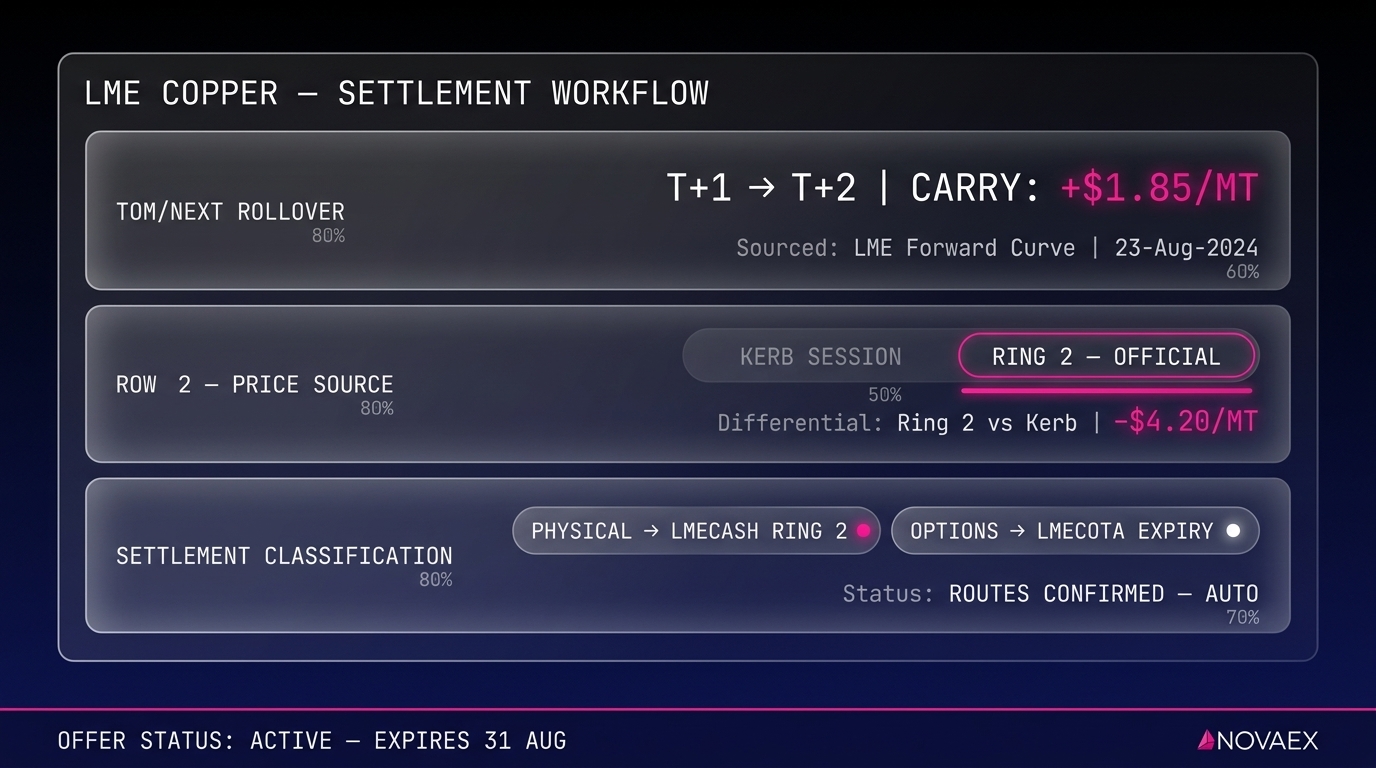
The LME copper settlement workflow exposes platform depth faster than any feature comparison. Three mechanics (tom/next rollovers, kerb-session price classification, and the official price versus cash settlement distinction) are daily operational requirements for any active LME copper book. Generic platforms misclassify all three, not through carelessness, but because they were never architected for the LME's unique settlement structure. The downstream result is position marks, P&L figures, and margin calculations that quietly diverge from exchange records until reconciliation forces the issue at the worst possible moment.
This post diagnoses each failure mode with enough specificity that any LME copper trader can validate it against their own experience, and closes with a three-question test that reveals more about a platform's actual depth than any product demonstration script.
Why the LME Copper Settlement Workflow Demands Purpose-Built Logic
The London Metal Exchange operates under a settlement architecture unlike any other major commodity exchange. Most multi-commodity CTRM platforms are built on a spot-plus-futures data model inherited from energy or agricultural markets: a contract has a fixed expiry month, a settlement price is published at close, and positions are marked accordingly.
LME copper does not work that way.
The LME trades copper across daily prompt dates: every business day is a valid settlement date for the first three months, followed by monthly dates out to 63 months. According to the LME's 2023 market data, copper remains the exchange's highest-volume metal by notional value, with average daily turnover exceeding $8 billion. That liquidity sits on a prompt-date structure that requires date-specific pricing, date-specific carry calculations, and daily position aging logic that a monthly-contract data model cannot approximate.
The consequence is that platforms built for energy or agricultural futures arrive at LME copper with the wrong foundational data architecture. These are structural gaps, not merely configuration errors.
Structural Differences Between LME and COMEX Copper
The LME uses a continuous daily prompt date system rather than fixed monthly delivery months. A copper position on the LME can carry any business day within the forward three months as its settlement date, whereas COMEX copper trades standardized monthly contracts. This distinction requires LME copper platforms to maintain date-specific position records, calculate carry between individual prompt dates, and process rollovers every business day. This is functionality that COMEX-centric architectures simply do not need and therefore do not build.
This structural difference is where the first layer of errors originates, and tom/next rollovers are where it becomes immediately visible.
Tom/Next Rollovers: The First Test an LME Copper Platform Must Pass
A tom/next rollover moves an LME copper position from tomorrow (T+1) to the next business day (T+2). For any book carrying overnight positions, this happens every trading day. The mechanics appear simple: close the near-date leg, open the far-date leg, and capture the carry between the two prompt dates.
Where generic platforms break down is in carry calculation and prompt date chain management.
In contango (where forward prices exceed spot), a long position rolling forward pays carry. In backwardation, the long collects. The carry between two specific prompt dates is a live market spread derived from the LME forward curve. Platforms that substitute a generic overnight financing rate for the actual LME tom/next spread introduce systematic error into every rollover calculation. The error is small per trade. Across a large book over a month of daily rolls, it is not.
According to LME Clear data, copper open interest regularly exceeds 300,000 lots. At that scale, even a $0.50 per metric ton carry misapplication represents meaningful P&L distortion per day across an active book.
The Cost of Tom/Next Rollover Errors
A misapplied tom/next carry creates an incorrect position cost basis that compounds with every subsequent roll. On a 500-lot book (12,500 metric tons), a $0.50 per metric ton carry error generates $6,250 in unreconciled carry exposure per day. Over 20 trading days, that gap exceeds $125,000 before a single market move. This is the figure that appears as an unexplained break when operations reconciles platform carry records against LME Clear margin statements.
The error surface extends further than the carry figure itself. When prompt dates are not managed as discrete identifiers, position aging fails. A position dated to a prompt date that has become cash (same-day settlement value) should trigger a delivery or rollover workflow. Platforms that track positions at contract-month granularity rather than prompt-date granularity miss this trigger entirely, leaving positions in a state the exchange no longer recognizes.
Managing Daily Prompt Date Progression
A correctly built system treats each prompt date as a discrete record identifier and advances position prompt dates each business day as part of overnight processing. When a prompt date reaches cash status (T+2 from today's date), the position is automatically flagged for delivery instruction or rollover decision. The tom/next carry is sourced from actual LME forward curve data for those specific dates, not a proxy rate. This is a basic requirement for an LME copper position management system, not an advanced feature.
The second test, kerb-session price classification, is where the failure mode becomes less obvious to detect, and therefore more costly to resolve.
Kerb-Session Pricing vs. LME Official Price: A Misclassification That Costs Real Money
The LME's price-setting process runs through structured Ring sessions. The official prices (those that govern physical contract settlement, LME-linked commercial offtake agreements, and regulatory reporting obligations) are established during the Second Ring of the afternoon session. For copper, the Second Ring typically completes between 12:35 and 12:45 PM London time.
What follows the Second Ring is the kerb session: an open trading period where prices continue to move in meaningful volume. Kerb prices are real. They trade in size. They appear in data feeds. But they are explicitly not official prices under LME rules.
Under the LME Rulebook, official prices are specifically those established during Ring trading. Any contract referencing the "LME official price" settles against Ring prices. That classification is unambiguous and non-negotiable under LME rules.
The Root Cause of Kerb Price Misclassification
Generic platforms ingest price data chronologically and classify by timestamp. If the platform's price feed labels prices by time rather than by session metadata, the final price before London close appears to be the day's "official" or "closing" price. That final price is a kerb price, potentially materially different from the actual official price established ninety minutes earlier in the Ring. The platform is not receiving bad data. It is applying the wrong classification to correct data, which is a harder problem to detect.
The error remains invisible until a physical contract settles. A copper offtake agreement priced at the LME official price will settle against the Ring 2 price. If the platform has been marking the position against a kerb price, the daily P&L and margin calculations have been using a number the counterparty and the exchange do not recognize. The reconciliation break appears at settlement, not at the time of the misclassification.
A commodity operations audit research review of settlement disputes across base metals books found that price classification errors (specifically session metadata failures rather than data feed errors) account for a disproportionate share of back-office remediation hours relative to their frequency. The reason is that data feed errors are caught quickly by cross-validation; session metadata errors are not caught until contract settlement creates a price reference event.
The correct architecture resolves this at the data ingestion layer. Every price entering the system carries a session tag: Ring 1, Ring 2 (official), or kerb, sourced from feed metadata at ingestion. The official price flag applies only to Ring 2 prices. Kerb prices are stored and queryable but are never promoted to official status regardless of their timestamp.
Official Price vs. Cash Settlement: Two LME Terms That Mean Different Things
This terminology distinction most reliably reveals whether a platform was designed around operational LME workflows or adapted from documentation alone.
In LME copper, "cash" refers to a specific prompt date: the spot-value date, two business days forward from today. The LME cash official price is the Ring-established official price for that specific prompt date, the most widely referenced LME copper benchmark for physical pricing.
"Cash settlement" refers to a different concept entirely: the financial settlement mechanism for LME options and LME Monthly Average Futures (LMEMAF), which settle against a specific reference price, typically the LME copper official settlement price (LMECOTA) on the option's expiry date, or the monthly average of official cash prices for LMEMAF instruments, rather than requiring physical delivery.
Distinguishing Official Price from Cash Settlement Price
The LME official price is the Ring 2-established price for a given prompt date, most commonly referenced for the cash (T+2) or three-month date. The cash settlement price for LME options (the LMECOTA) is the official cash price on the specific expiry date of the option, used as the reference for financial settlement of that instrument. Both reference the same underlying official price mechanism, but they apply to different instruments, different settlement dates, and different contractual obligations. Treating them as synonymous produces incorrect margin calculations, inaccurate risk reports, and delivery instruction errors.
LME Clear reported clearing over 58 million lots of metals contracts in 2022. A significant share of that volume comprises options and financially-settled instruments that reference specific LMECOTA or monthly average prices. Platforms that conflate the official cash price with the cash settlement reference price are mishandling the settlement logic for a material portion of that activity.
The downstream effect is not always immediately visible. A financial option position marked against the wrong price reference clears the daily risk report if the price difference is small. It surfaces as a settlement dispute when the option expires and the platform's settlement calculation disagrees with LME Clear's.
The LME Copper Settlement Workflow in Practice: What Correct Looks Like
A platform that correctly handles the LME copper settlement workflow runs three distinct classification processes simultaneously and without manual intervention.
Session tagging at price ingestion. Every price entering the system carries session metadata sourced from the feed at ingestion, not assigned after the fact. Ring 2 prices receive the official price flag. Kerb prices are stored and queryable but are never promoted to official status. The price database distinguishes between a 12:38 PM Ring 2 official price and a 1:15 PM kerb price even if both arrive in the same data stream.
Prompt date-aware position management. Each position record holds a specific prompt date as its primary settlement identifier. The system calculates daily prompt date aging, flags positions approaching cash status, calculates tom/next carry from actual LME curve data, and processes rollovers with carry amounts that reconcile to LME Clear margin records. Position reporting displays prompt-date granularity, not contract-month approximation.
Settlement instrument pathway routing. Physical LME copper positions settle against the Ring 2 official cash price on the prompt date. LME traded options settle against LMECOTA on the expiry date. LMEMAF instruments settle against the monthly average of official prices for the relevant calendar month. These are separate settlement pathways, and the system routes each position automatically based on instrument classification, not based on manual workflow selection.
According to a commodity technology advisory industry survey, 67% of mid-market commodity trading firms report relying on manual workarounds for at least one settlement price classification step. Those workarounds introduce the latency and human error risk that are most costly precisely when market conditions create time pressure.
Key CTRM Platform Requirements for LME Copper
Three specific capabilities confirm LME copper readiness during platform evaluation. First: can the system display open positions at prompt-date granularity, not contract month? Second: does the platform carry session metadata on historical price records, and can it demonstrate, on a specific historical date, which prices were Ring 2 official versus kerb? Third: does the system route physical and financial positions to separate settlement calculation pathways automatically, or does it require a manual override to distinguish them? A platform that cannot demonstrate all three capabilities in a live workflow does not have the architectural foundation required for LME copper operations.
Why These Three Mechanics Expose the Depth of a Platform's LME Copper Design
Tom/next rollovers, kerb-session classification, and official price versus cash settlement routing are not edge cases or advanced features. They are the daily mechanical requirements of any active LME copper book.
Generic multi-commodity platforms fail these tests not through poor execution but through architectural choices made before LME copper was in scope. A platform designed around monthly energy futures contracts requires structural changes at every layer to support LME copper: the position data model, the price ingestion architecture, the carry calculation engine, and the settlement routing logic all require foundational rebuilding rather than configuration additions.
Commodity platform architecture research shows that retrofitted platforms require significantly more manual workarounds and generate higher reconciliation break rates than purpose-built alternatives. Those manual workarounds are not workarounds in the IT sense. They are operations team members running spreadsheets alongside the platform to perform the classification logic the platform cannot execute itself.
According to Accenture's commodity operations research, trading firms running purpose-built commodity platforms reduce settlement reconciliation time by an average of 40% compared to firms on generalist ERP or retrofitted CTRM tools. For LME copper specifically, where daily rollovers and session-specific price classification create reconciliation events every trading day, that efficiency difference compounds across the full trading calendar.
The International Copper Study Group estimates global refined copper demand exceeded 26 million metric tons in 2023. The hedging, pricing, and risk management activity referencing LME copper is proportional. Traders and risk managers operating at that scale cannot absorb position errors that compound daily and surface at settlement.
Conclusion: Mechanical Accuracy Is the Minimum, Not the Ceiling
The LME copper settlement workflow (correct tom/next carry calculation, session-tagged price classification, and settlement instrument pathway routing) represents the technical baseline for a platform that can genuinely support an LME copper book. Getting these three mechanics right is the baseline admission requirement, not a differentiator.
What a correctly architected platform builds on that foundation is where the intelligence compounds: real-time position visibility that updates as prompt dates age through the curve, carry cost tracking that reflects actual LME forward structure rather than a generic financing proxy, and risk analytics that distinguish outright copper exposure from calendar spread exposure because the system understands that these are not the same position.
Before the next platform evaluation or renewal decision, three concrete steps will clarify more than any product demonstration script:
- Request a live tom/next carry calculation using LME forward curve data from a specific recent trading date. Ask the vendor to reconcile the carry figure against LME Clear's published tom/next spread for that date.
- Ask for session metadata on historical price records. Request that the platform display a price history from a recent trading day and show which prices carried a Ring 2 official flag versus a kerb flag. If that metadata does not exist in the data model, official price classification is a label applied by convention, not a structured data attribute.
- Run a settlement scenario with mixed physical and financial positions. Ask the system to process a physical prompt-date position and an LME traded option through settlement simultaneously. Confirm that each routes to the correct settlement reference price automatically.