LME Prompt Date Structure: Where Hedges Actually Break
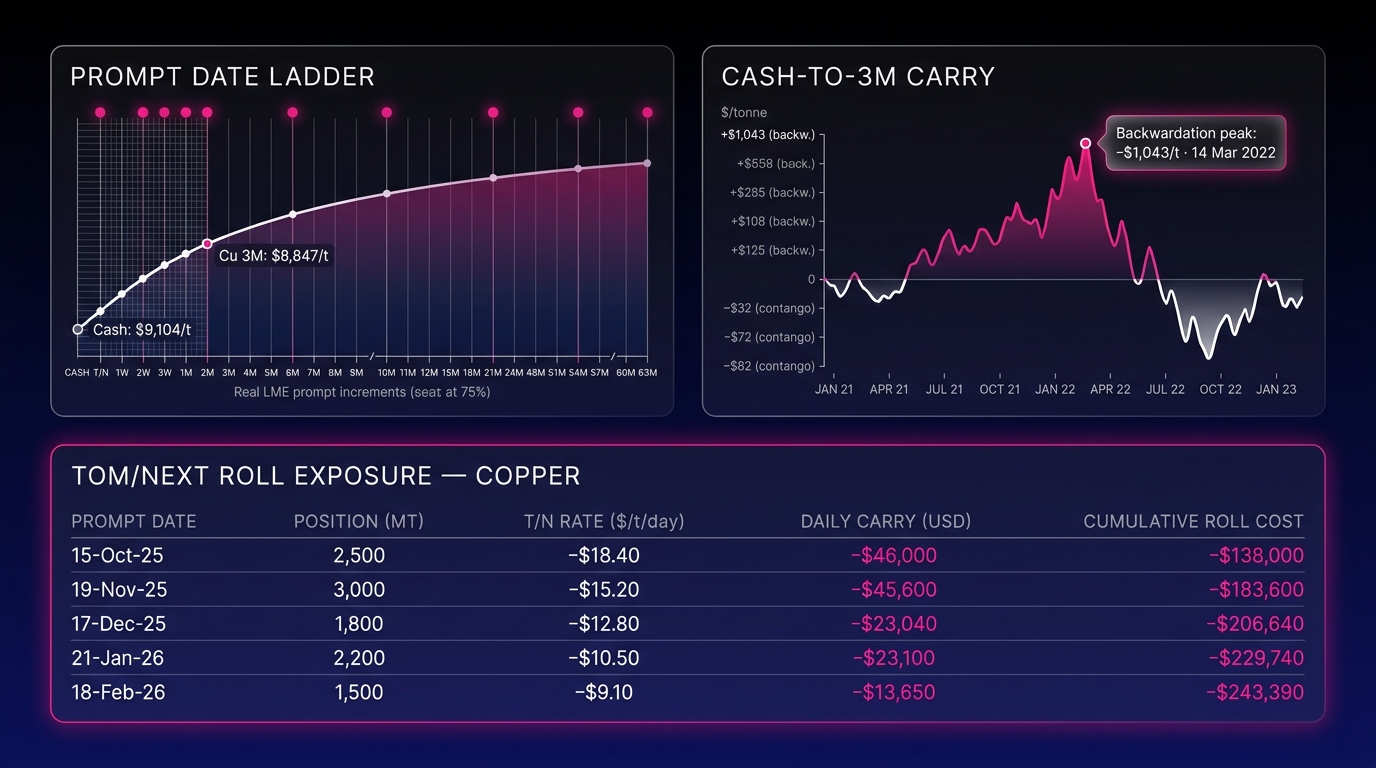
The LME does not work like other commodity exchanges. Its LME prompt date structure (a continuous ladder of daily, weekly, and monthly settlement points stretching 63 months forward) creates hedge timing exposures that are structurally invisible to platforms built around standard futures contract expiry cycles. A system that models LME positions by settlement date rather than prompt date will mismark the book.
That distinction is not semantic. It is the difference between knowing a copper position matures on a specific prompt and knowing when, exactly, the financial obligation settles relative to the physical delivery obligation, and what the carry cost is between those two points. Generic commodity platforms are built around contract expiry. The LME is built around prompts. These are architecturally distinct frameworks, and the practical consequences for position accuracy are direct.
How the LME Prompt Date Architecture Actually Works
The London Metal Exchange operates on a continuous prompt date ladder, not a monthly contract cycle. LME official prompt date calendar Every business day within the first three months from cash settlement (T+2) is an available prompt. Beyond three months, prompts shift to Wednesday weekly dates out to six months, then to the third Wednesday of each calendar month out to 63 months, covering copper, aluminium, zinc, lead, nickel, and tin.
According to the LME, this structure generates over 600 distinct prompt dates across the first 63 months of the forward curve for each primary metals contract. No other major commodity exchange operates with this density of settlement points.
The practical implication: a metals book is never just "long copper." It is long a specific prompt, such as Copper 15-Oct or Copper 3M, and that prompt carries precise settlement mechanics. Every prompt has a different liquidity profile, a different official price, and a different carry cost relative to cash.
What Is the Difference Between LME Prompt Dates and Settlement Dates?
An LME prompt date is the date on which a contract matures for delivery or cash settlement. A settlement date is the date on which the financial cash flow from that contract transfers. On the LME, these converge at the same point, but that single convergence conceals significant complexity upstream.
The critical exposure is not at the prompt itself. It is in the carry structure between prompts: what it costs to roll a position from one prompt to the next, how backwardation or contango behaves across that specific calendar interval, and whether the hedge's prompt aligns with the physical pricing date embedded in the off-take agreement. Settlement date awareness defines when. Prompt date structure modeling defines what it costs to get there. That distinction determines whether the hedge is performing as intended.
Tom/Next Rolls: The Daily Carry Exposure Generic Platforms Ignore
The most frequently misunderstood exposure in LME position management is the tom/next (T/N) roll. On the LME, a cash position, settling T+2 from trade date, does not automatically expire. Held, it rolls forward by one business day each day, generating a daily carry differential that must be priced, tracked, and managed as a discrete risk variable.
This is not a marginal exposure. In backwardated markets, LME tom/next rates on copper have exceeded $15, $25 per tonne per day during periods of acute nearby tightness, a rate that compounds rapidly on large notional positions. LME historical tom/next rates
According to LME market structure data, physical producers and consumers holding nearby hedge positions roll through multiple tom/next windows every month, often on platforms that do not explicitly mark the daily carry as a separate P&L line item.
How Does the LME Tom/Next Roll Work?
The tom/next roll is the process of moving a cash-date (T+2) position forward by one prompt to tomorrow-next (T+3), repeating daily until the position is closed or assigned to a specific forward prompt. The roll price is determined by the bid-offer spread on the daily carry between those two prompt dates. In contango, the hedger receives this carry. In backwardation, the hedger pays it.
For a producer rolling a short cash hedge through a tight LME backwardation, the daily roll cost is a real, quantifiable drag on hedge performance. Most generic platforms consolidate this into a single undifferentiated MTM adjustment rather than isolating the carry exposure as its own risk variable.
The consequence is a systematic blind spot in P&L attribution. Traders managing large nearby positions in tight markets may not surface this exposure until post-trade reconciliation against LME clearing statements. This is the point at which corrective action carries the highest operational cost.
Third-Wednesday Settlement Windows and LME Prompt Date Misalignment
Beyond the daily prompt structure, the LME's monthly architecture introduces a specific settlement window that creates hedge alignment risk for physical traders. For all LME metals, the standard monthly prompt falls on the third Wednesday of the delivery month, making it the most liquid reference point for long-dated hedging beyond the six-month weekly date structure. LME contract specifications
According to LME open interest data, approximately 80% of open interest in LME copper beyond three months is concentrated around third-Wednesday prompts. This liquidity concentration has a direct pricing consequence: hedges placed against non-third-Wednesday prompts in the monthly zone carry wider bid-offer spreads and reduced price transparency.
What Is the LME Third Wednesday Settlement?
The third Wednesday of each calendar month is the standard prompt date for LME monthly contracts, the point at which open positions in that month's contract settle for physical or cash delivery. It serves as the primary benchmark for pricing long-dated base metals exposure and is the reference embedded in most LME-linked off-take agreements beyond the 3M prompt.
Physical traders who price off-take agreements against "LME average" or "LME month" without explicitly anchoring to the third-Wednesday prompt structure carry an implicit basis risk between their contract pricing date and the actual LME prompt around which liquidity clusters. That basis is rarely zero, and it compounds across a multi-month forward book.
How Does Third-Wednesday Prompt Mismatch Create Hedge Basis Risk?
Consider a copper cathode seller with a monthly pricing window closing on the last Friday of each month. Their off-take is priced against the average LME copper price for the delivery month. The third Wednesday of that month, the most liquid LME prompt, may fall eight to ten days before the pricing window closes.
The carry differential between the third-Wednesday prompt and the last Friday of that month can represent $8, $18 per tonne depending on the shape of the forward curve at the time. copper forward curve basis analysis A platform that models this hedge by settlement date alone, without resolving which specific prompt the physical pricing date maps to, systematically underestimates basis risk. Over a 12-month forward book with monthly deliveries, that misalignment accumulates into a material unhedged exposure.
Cash-to-3M Carry Differentials as a Structural Risk in LME Prompt Date Modeling
The LME 3M prompt (the contract settling exactly three calendar months from today's cash date) is the exchange's benchmark forward price and the most heavily traded point on the curve. LME 3M benchmark methodology It is also the source of one of the most commonly overlooked risks in base metals hedging: the cash-to-3M carry differential.
On any given trade date, the cash-to-3M spread represents the cost of carrying a position from spot settlement to the 3M prompt. In copper, this spread has ranged from a backwardation of over $1,000 per tonne during 2021, 2022 nearby tightness events to a contango exceeding $80 per tonne in supply-surplus environments, according to LME ring settlement records.
A hedger entering a 3M position to hedge a physical shipment priced at cash does not hold a flat book. The position carries exposure to the cash-to-3M differential. Unless that carry is tracked as a live differential against current market levels, hedge performance is being measured on a structurally incomplete basis.
How Do Cash-to-3M Carry Differentials Affect Hedge Positions?
The cash-to-3M carry on the LME is not static: it shifts every trading session as forward curve shape evolves. A 3M short hedge placed in a flat-to-contango market becomes structurally more expensive to manage if the curve inverts into backwardation before the physical pricing date arrives.
This creates an intra-hedge carry risk entirely separate from the outright price risk the hedge is designed to offset. According to research published in the Journal of Commodity Markets forward curve shape and hedge effectiveness, forward curve shape changes account for up to 30, 40% of hedge ratio deviation in short-dated base metals positions. Isolating this exposure requires a platform to maintain a live, date-specific forward curve keyed to actual LME prompt dates, not a generic expiry-based approximation.
The Gap Between Settlement Date Awareness and LME Prompt Date Structure Modeling
Most commodity trading platforms are built on a settlement date architecture inherited from agricultural and energy futures markets. In those markets, a contract expiry maps cleanly to a settlement date, and a position report organized by maturity accurately represents the book. The LME prompt date structure does not operate this way.
Settlement date awareness means the system knows when a contract matures. LME prompt date structure modeling means the system knows:
- The exact calendar prompt each position maps to within the 600+ prompt ladder
- The carry differential between adjacent prompts at current intraday market rates
- The daily roll exposure through tom/next for all nearby positions
- The third-Wednesday liquidity concentration for monthly prompt positions
- The basis differential between the physical pricing date and the nearest liquid LME prompt
According to a 2023 survey of commodity risk management practices commodity risk management industry survey, over 60% of mid-market metals trading operations identified prompt-level granularity as their most significant gap in hedging infrastructure, ranking it ahead of real-time pricing and counterparty exposure management.
Why Can't Generic Commodity Platforms Model LME Prompt Dates Accurately?
Generic commodity platforms are designed for breadth, not depth. Their data architecture handles monthly futures expiries, quarterly settlements, and annual strips, the infrastructure required for energy, agricultural, and financial commodity markets. The LME's daily prompt ladder within three months, with its associated tom/next rolls, cash-to-3M differentials, and third-Wednesday liquidity concentration, requires a fundamentally different underlying data model.
Specifically, generic platforms lack three structural capabilities required for LME prompt date precision:
- A prompt-keyed forward curve that updates intraday by LME prompt date, not by generic expiry month approximation
- Tom/next roll accounting that isolates daily carry as a discrete, attributable P&L line item
- Prompt-physical bridge logic that maps physical contract pricing dates to the nearest LME liquid prompt with carry adjustment
Building LME Prompt Date Precision Into Your Hedging Workflow
The path from settlement date awareness to prompt date structure modeling is not a single-step platform upgrade. It requires a systematic audit of how the current system represents LME positions, where carry exposures are being absorbed into undifferentiated MTM lines, and where physical pricing dates are being mapped to LME benchmarks without prompt-level resolution.
According to the CME Group's analysis of metals market microstructure CME metals market structure report, the daily prompt architecture of the LME generates approximately 3, 5x more basis risk touchpoints per hedge cycle than equivalent positions on monthly-expiry futures exchanges. That amplification is structural; it cannot be managed through trading discipline if the platform underneath the workflow cannot represent the exposure at the prompt level.
A practical audit framework for any LME metals book:
- Isolate cash-position P&L attribution. Separate daily tom/next roll costs from outright price movement in current reports. If the system does not report these as distinct line items, daily carry exposure is being aggregated into price risk, which it is not.
- Map every physical pricing date to the LME third-Wednesday prompt calendar. Quantify the carry differential between the physical date and the nearest LME liquid prompt at current market rates. Where this differential exceeds the acceptable basis threshold, the carry requires separate hedging treatment.
- Stress test all 3M positions against cash-to-3M carry scenarios. Run a $300/tonne backwardation stress on the 3M short book. If the P&L impact surfaces as price risk rather than carry risk in the attribution, the model is misclassifying the exposure at the source.
- Audit monthly positions for third-Wednesday alignment. Positions that do not map to the third Wednesday of their delivery month carry a liquidity basis that widens as delivery approaches. Quantify this basis for every open monthly prompt position in the current book.
Conclusion
The LME prompt date structure is not an edge case in base metals hedging. It is the foundational architecture of the world's primary non-ferrous metals exchange, which according to LME data clears over $50 billion in daily notional value across its six primary metals contracts. Every tom/next roll, every cash-to-3M carry differential, and every third-Wednesday settlement window is a discrete, named exposure with a specific calendar signature.
The gap between settlement date awareness and prompt date structure modeling is precisely where hedge performance breaks down in practice, not in theory. It is a structural limitation of platform architecture, not a deficiency in trading judgment, and it cannot be compensated for manually at the speed metals markets move.
Three priority actions for immediate implementation:
- Pull the current copper or aluminium position report and identify whether tom/next rolls appear as a discrete P&L line or are absorbed into outright MTM. The answer determines whether the platform is attributing daily carry correctly.
- Take the next three physical delivery pricing dates and map them explicitly to the LME third-Wednesday prompt calendar. Calculate the carry differential at current market rates and assess whether that basis requires separate hedging treatment.
- Ask the current platform vendor to demonstrate prompt-keyed forward curve representation for LME daily dates within the three-month window. The response, or the absence of one, precisely quantifies how much prompt-level precision is currently missing from position reports.