LME vs COMEX copper: which contract and which prompt date?
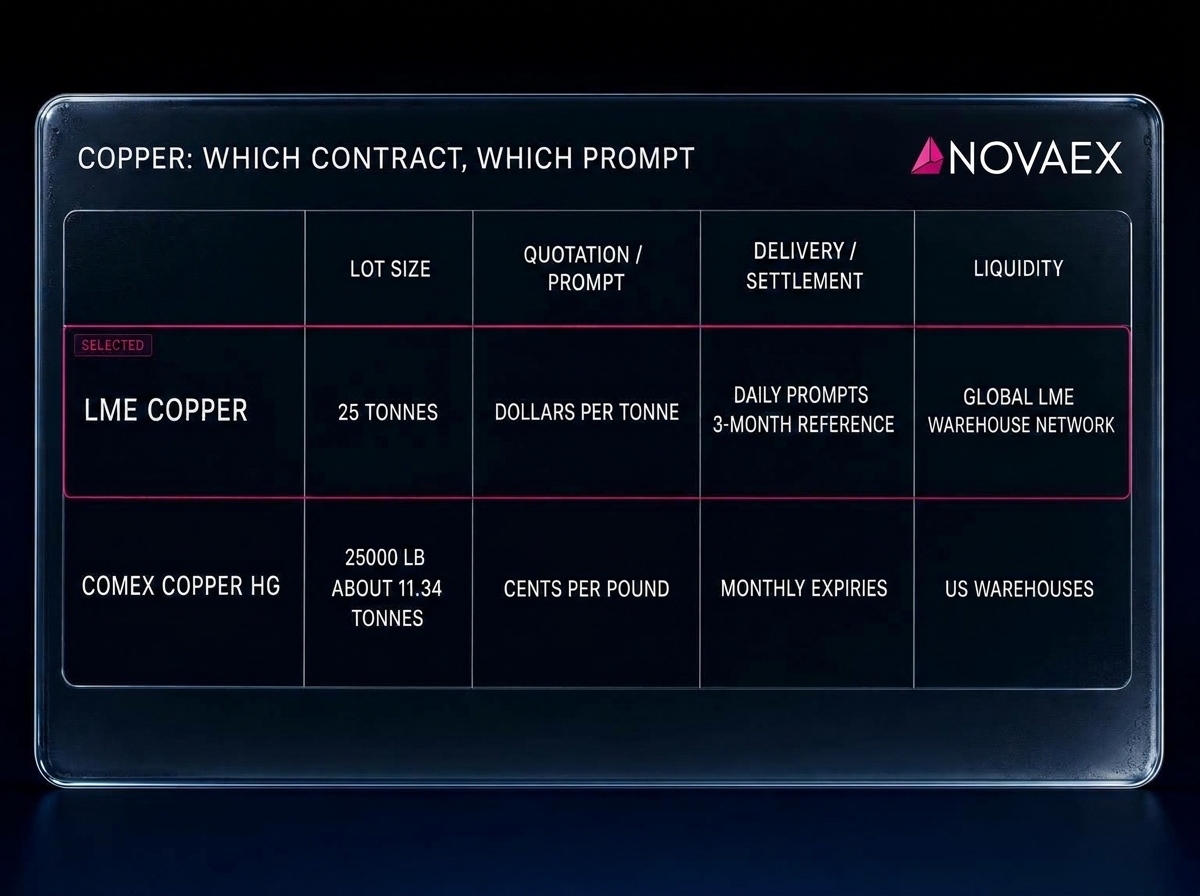
Hedge copper where the physical prices, match the prompt to the quotation period, and name what would flip the call.
If your copper prices off LME, hedge it on LME and match the prompt date to the physical quotation period. That keeps the basis you actually carry. COMEX only wins when the exposure settles inside the United States or you are deliberately holding the tariff spread as a position.
Copper priced off LME and hedged on COMEX leaves you carrying two risks: the price, and the spread between venues. This piece makes the venue call, then names what would reverse it.
How do the LME and COMEX copper contracts actually differ?
LME copper is a 25-tonne lot quoted in dollars per tonne, with daily prompt dates out along the curve and the 3-month date as the pricing reference. COMEX copper (HG) is a 25,000 lb lot quoted in cents per pound, listed for monthly expiries and delivered into US warehouses under CME rules.
That structure tells you what each contract is for. LME is built to line a hedge up against a specific physical date, since you can pick a prompt that sits beside the quotation period. COMEX concentrates liquidity into the monthly board, which suits US delivery and US pricing exposure. LME remains the benchmark most physical copper is priced against, while COMEX tracks domestic US conditions. InHedge puts the separation plainly: local logistics, taxes and rules pull the two apart for stretches at a time.
The working view here: LME and MCX live on screen, COMEX and SHFE computed into the arbitrage view. You watch the spread to time and defend the hedge. You never price physical off a computed feed.
Why does the venue choice need defending right now?
Because the gap stopped being technical in 2025. US tariff talk pulled metal toward COMEX, COMEX stocks hit records while LME and SHFE stocks drew down, and the spread blew out. ING THINK on 12 June 2026 records around 400 dollars per tonne in early June 2026, against a peak near 2,937 dollars per tonne in late July 2025 when a 50 percent tariff on all copper was briefly feared. InHedge recorded 202.36 dollars per tonne on 19 September 2025, after the July spike faded.
At 400 dollars a tonne, the venue is a P and L line of its own. Hedging LME-priced tonnage on COMEX at that spread means the spread position can cost more than the price move being hedged. That is why the head of risk now asks which contract, and expects the answer with the trail behind it.
LME copper COMEX copper (HG)
Lot 25 tonnes 25,000 lb, so about 11.34 tonnes at 2,204.62 lb per tonne
Quotation Dollars per tonne Cents per pound
Dates Daily prompts, 3-month reference Monthly expiries
Delivery Global LME warehouse network US warehouses
Suits Matching a quotation period US-settled exposure
Which contract should you hedge copper in?
Hedge where the physical prices. LME-priced cathode, rod or scrap: LME. US-delivered exposure priced off COMEX: COMEX. That is the whole call.
A trader hedging LME-priced tonnage on COMEX has swapped a price hedge for a spread position. Keep the hedge on the venue that sets the invoice price and the spread stays out of the position. Split only when the physical splits: part US-delivered, part export priced off LME means hedge each leg where it prices. Splitting one exposure across two venues to average the price creates a spread position with no physical behind it.
Which prompt date should you hold?
Hold the prompt that matches the physical quotation period, not the most liquid board date. LME lets you do this because prompts run daily.
If October metal prices over the October quotation period, hold October prompt. If the sale spans two quotation periods, split the hedge across both. Rolling a nearby date because it trades thicker leaves the quotation-period gap open, and basis moves inside that gap. The liquid date is cheaper to trade and worse to hold when it does not match the physical.
One check before the desk opens: physical quotation period, hedge prompt, broker confirmation. All three read the same month. Anything else is a spread you chose by accident.
When does COMEX win instead?
COMEX wins on three conditions. First, the sale or purchase settles to a US price. Second, delivery goes into a US warehouse or a domestic consumer contract references COMEX. Third, you are deliberately holding the tariff spread as a position, with a named exit.
Outside those three, a COMEX hedge on LME-priced metal needs its own justification line. Tariff stockpiling locked large tonnage inside the United States through 2026, per ING, which means COMEX and LME stocks no longer substitute for each other cleanly. That cuts both ways: it pays to hold COMEX when you need US metal, and it punishes holding COMEX when you do not.
Size points the same way. A COMEX lot at 25,000 lb is about 11.34 tonnes, so odd tonnage hedges cleaner in small COMEX clips, while full 25-tonne lots with a date to meet sit cleaner on LME prompts. Liquidity is execution, not coverage. Trade the liquid month to get in, then carry the prompt that matches the physical.
How do you defend the venue choice in two sentences?
Say where the price comes from and what you matched. Then say what would flip it.
Example: hedged LME October prompt against October quotation-period sales of 100 tonnes. COMEX would win only if the tonnage diverted to US delivery or we chose to hold the tariff spread outright.
Your head of risk needs those two lines plus the trail: physical tonnage, quotation period, contract, prompt, broker line. The trail attached line by line closes the discussion faster than any further explanation.
FAQ
Does the tariff spread make COMEX the better hedge right now?
No, unless your exposure is US-settled. A wide COMEX premium raises the cost of being on the wrong venue. It does not change which venue your invoice follows.
Should I let the execution venue become the hedge venue?
No. Trade where it is liquid, carry where the physical prices. Never let a liquid monthly board pull the hedge off the quotation period by default.
Where does the arbitrage argument fit?
It does not decide this call. Whether the COMEX-LME spread is tradeable is a separate question for a separate piece. This call rests on where the invoice prices and which prompt matches it.
Pick the venue before the desk opens and write down what would flip it.