Manual Reconciliation Hours: Calculate Your Trading Cost
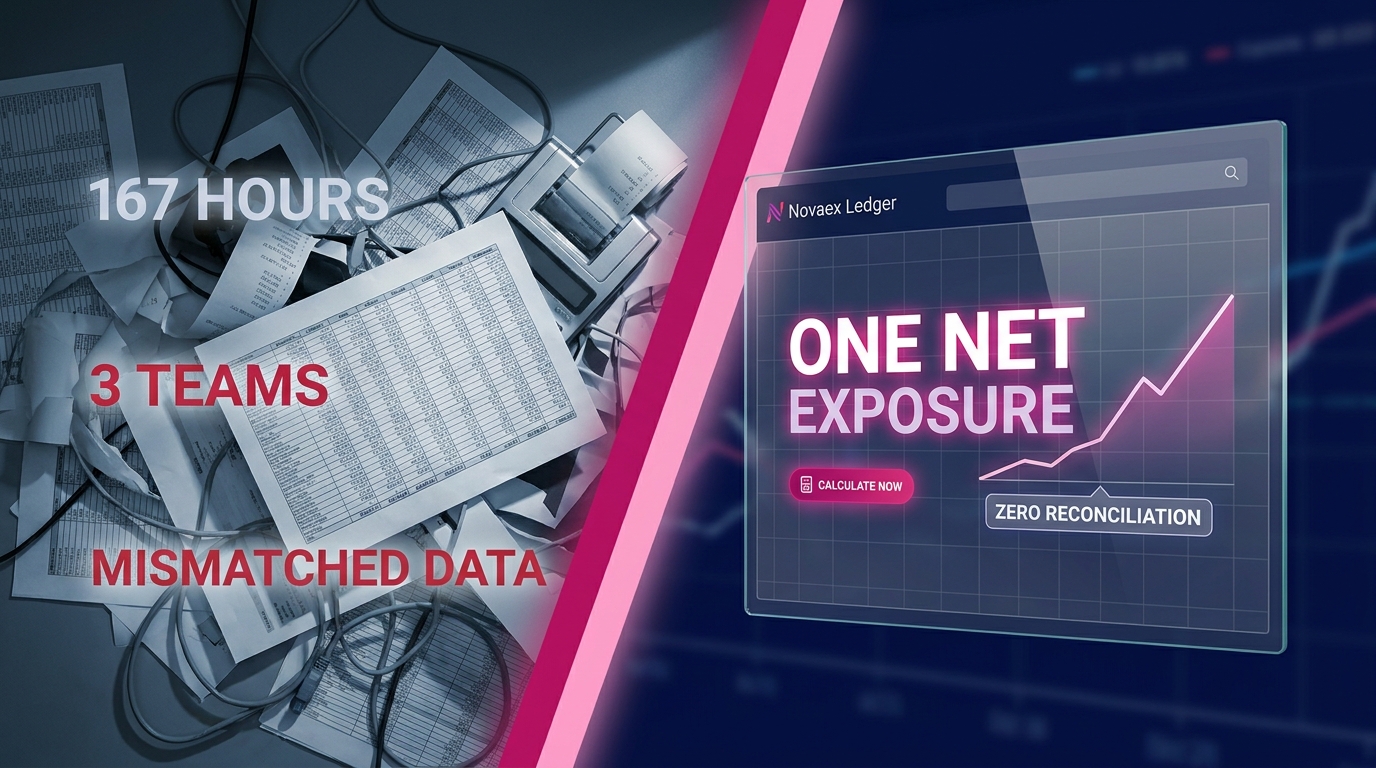
Manual reconciliation hours on a commodity trading desk are a calculable weekly liability rather than an unquantified operational overhead. Most metals desks have never formally measured them. This post provides a structured four-step framework to produce an exact hour and dollar figure for your team, then places that documented cost against the architectural alternative that eliminates it: a single book of record.
The operational impact is well documented across the industry. The specific cost figure, calculated against each desk's actual inputs, is not. What follows is the method for producing that figure.
Why Manual Reconciliation Hours Stay Off the Books
The explanation is structural.
Reconciliation work does not appear as a discrete budget line. It is distributed across roles, including traders, operations staff, and middle office analysts, in fragments of time small enough that each individual instance is absorbed as part of the job.
A trader spends eleven minutes cross-checking an LME prompt position against the internal spreadsheet before the morning call. An operations analyst spends twenty-three minutes resolving a discrepancy between the risk system and the trade capture sheet after an EFP amendment. A middle office manager spends forty minutes on Friday afternoon reconciling the weekly position summary before it goes to risk.
Individually, each instance is unremarkable. In aggregate, they constitute a measurable labor cost that is never formally booked.
According to McKinsey Global Institute McKinsey knowledge worker productivity report, knowledge workers spend nearly 20 percent of the working day searching for and gathering information. On a trading desk running disconnected systems, a substantial share of that category is reconciliation, verifying that data in one system matches data in another.
Operating without a single authoritative source creates this verification demand at every operational step. The cost is real and calculable. It has simply never been measured.
Auditing Your Manual Reconciliation Hours: A Framework
The audit requires four inputs. Each is observable from current desk operations without specialist knowledge. The output is a weekly hour figure and a weekly dollar figure, both traceable to the specific workflows of your team.
How many hours does manual reconciliation take per week?
For a three-person metals trading and operations team running spreadsheet or siloed CTRM systems, a conservative baseline is 10 to 18 hours per week. That range assumes two daily position reconciliations, one cross-system risk check, and weekly summary consolidation, standard workflows on desks that do not have a unified position ledger. Teams managing multi-venue hedges across LME, COMEX, and SHFE trend toward the upper bound.
Step 1: Daily position verification
Count the number of times per day that a trader or operations staff member confirms a position in one system or document against a position in another. Assign a conservative time estimate per instance. Industry benchmarks for this task range from 8 to 15 minutes per reconciliation event, depending on position complexity and the number of source systems involved.
Step 2: Exception resolution
Count the average number of discrepancies per week that require active investigation. In metals trading, exceptions arise from EFP adjustments, carry-roll amendments, prompt date recalculations, and cross-venue hedge structures. Each exception requiring a paper or spreadsheet trace typically consumes 20 to 45 minutes of an analyst's time.
Step 3: Consolidation events
Weekly and monthly reporting consolidation is the highest-density reconciliation event on most desks. On teams without a unified ledger, this consistently consumes two to four hours per week, concentrated in end-of-week and end-of-month reporting windows.
Step 4: Multiply by personnel and cost rate
Apply a fully loaded hourly cost, including salary, benefits, and overhead, for each person whose time contributes to reconciliation workflows. For a mid-market metals desk, a conservative blended figure is $95 to $130 per hour per person.
How do I calculate my team's reconciliation liability?
The calculation is: (Daily reconciliation minutes × working days) + (Average weekly exceptions × resolution time) + (Weekly consolidation hours) = weekly reconciliation hours. Multiply by your blended hourly cost to produce a weekly dollar figure. The result is your reconciliation liability, the documented cost of your current system's failure to maintain an authoritative position at the point of trade capture.
For a three-person desk at the conservative end of each input, the weekly reconciliation overhead typically falls between $1,100 and $2,200. Annualized, that is $57,200 to $114,400 in labor allocated to a task that produces no new information. It only confirms, imperfectly, information the underlying positions already contain.
According to research published by BlackLine BlackLine finance reconciliation survey, finance teams operating manual reconciliation processes in multi-system environments spend a significant portion of productive capacity (often exceeding 25 percent of the working month) on reconciliation-related activities. Commodity trading operations, with their daily mark requirements and multi-venue position structures, consistently perform at the high end of that range.
The Compounding Cost of Metals Trading Reconciliation
Not all manual reconciliation carries equal complexity. Base metals trading generates reconciliation demand at multiple layers that are structurally absent in simpler commodity or single-exchange environments.
Why is metals trading reconciliation more complex than other commodities?
Metals trading produces reconciliation pressure from at least four concurrent sources: LME prompt date positions that change economic character daily, COMEX futures that require margin reconciliation against exchange records, SHFE positions that introduce currency conversion as an additional reconciliation variable, and EFP or EFS structures that blend exchange and OTC components into single economic positions requiring simultaneous reconciliation across two different reporting frameworks. A desk running a standard hedge program across LME and COMEX is managing, at minimum, four separate data environments: the exchange position records from each venue, the internal trade capture system, and the risk model that aggregates them into net exposure. Each environment can diverge from the others every time a trade is amended, a carry rolls, or a prompt date calculation updates.
Reconciliation demand is the arithmetical consequence of using disconnected systems to represent a single economic reality.
According to Gartner Gartner data quality research, poor data quality, the downstream product of unreconciled systems, costs organizations an average of $12.9 million annually when all operational impacts are accounted for. For a trading operation, that cost arrives as delayed decision-making at the exact moments when market speed demands confirmed accuracy rather than an ongoing verification process.
The latency between a market event and a confirmed, accurate position is a defined operational exposure. It is the interval during which the desk cannot verify its own risk profile with precision. Every reconciliation cycle represents a window during which position certainty is incomplete.
What a Single Book of Record Eliminates
The term appears frequently in CTRM vendor materials. Its operational meaning is specific, and most systems described as offering it do not actually provide it.
What is a single book of record in commodity trading?
A single book of record is a unified ledger architecture in which every trade, position, and risk metric originates from one source of data. There are no parallel systems to reconcile because there is no parallel data: the position reflected in the risk model and the position in the trade capture system are the same object, derived from the same underlying record at the moment of trade entry. Critically, this differs from synchronization: synchronized systems reduce the reconciliation window through automation while the underlying condition remains. True single book of record architecture eliminates the divergence itself.
Most CTRM platforms described as "integrated" are, in practice, synchronized. Synchronization runs on a schedule. The discrepancy window still exists between sync cycles. The window shrinks but remains.
When a trade is booked into Novaex Ledger Novaex Ledger architecture overview, it writes a single atomic record. That record is simultaneously the trade capture event, the position update, the risk attribution input, and the P&L contribution. There is no secondary process reading from that record and attempting to replicate it in another system. The LME prompt position, the COMEX futures position, and the MCX exposure function as different views of the same ledger object, updated in real time at the point of capture.
The reconciliation workflow does not exist because the condition that creates reconciliation, data living in more than one place, has been architecturally eliminated.
Manual Reconciliation Hours vs. Architectural Finality: A Comparison
The comparison is quantitative. Apply the audit framework above to two desks with identical position complexity.
Desk A: Spreadsheet and disconnected CTRM system
- Daily position verification: 3 events × 12 minutes = 36 minutes/day × 5 days = 3 hours/week
- Exception resolution: 3 exceptions/week × 35 minutes = 1.75 hours/week
- Weekly consolidation: 3 hours/week
- Total weekly manual reconciliation hours: 7.75 hours
- Blended cost at $110/hour × 2 personnel: $1,705/week | $88,660/year
Desk B: Novaex Ledger single book of record
- Daily position verification: eliminated. Position is confirmed at trade capture.
- Exception resolution: eliminated. No divergence between systems to investigate.
- Weekly consolidation: automated. Derived from the same ledger record.
- Total weekly manual reconciliation hours: 0 hours
- Reconciliation labor cost: $0/week | $0/year
The annual differential in this example is $88,660. That figure comes directly from the audit framework applied to inputs your own desk can supply in under twenty minutes.
How much does spreadsheet reconciliation cost a trading operation?
Using the framework above, a three-person metals desk running spreadsheet or disconnected systems carries a direct reconciliation labor cost of $55,000 to $120,000 per year, before accounting for the opportunity cost of decisions delayed by unconfirmed positions, exceptions that surface risk exposure hours after it was taken, or the regulatory exposure created when position records disagree at reporting time. The spreadsheet cost includes both the hours consumed and the latency between a market event and the moment your desk can act on a confirmed position.
According to a PWC Global Commodity Trading Survey PWC commodity trading report, reducing manual intervention points in position management and reconciliation is consistently ranked among the top operational priorities for commodity trading organizations. The desks that have eliminated reconciliation as a workflow category have done so through architecture rather than process improvement or additional headcount.
How Novaex Ledger's Architecture Works in Practice
Novaex Ledger was built on a specific architectural premise: the correct moment to reconcile a trade is at the instant of capture.
This is the operational translation of depth-first methodology Novaex depth-first methodology. Before Novaex covers a new instrument or exchange, the full position lifecycle for existing instruments (from trade capture through delivery, settlement, or expiry) is handled in one place. The architecture is complete before expansion occurs. As a consequence, LME, MCX, COMEX, and SHFE positions function as different views of the same ledger object. They always agree because they were never separate.
The practical effect on manual reconciliation hours is total.
A metals trader using Novaex Ledger does not spend eleven minutes verifying a prompt position at the start of the session. That position was confirmed at trade capture, and it remains confirmed through every subsequent carry roll, margin call, or EFP amendment. An operations analyst does not spend twenty-three minutes tracing a discrepancy through parallel systems. The amendment updated a single record, and every derived view (risk exposure, P&L attribution, open position) updated with it at the same moment.
The screenshot below Novaex Ledger position screen shows the live position view for a multi-venue LME and COMEX hedge program. Every line reflects the current state of the underlying ledger record. There is no reconciliation cycle pending. There is no prior state that requires verification. The position shown is the position held.
That is the consequence of a specific architectural decision to write a single record from the point of capture.
According to ComTech Advisory's annual CTRM market benchmarking research ComTech Advisory CTRM benchmark, organizations that have transitioned to unified position management architectures report consistent reductions in reconciliation-related operational overhead, with time previously allocated to verification workflows redirected to analysis, reporting, and execution support. The recovery represents the elimination of an entire workflow category.
Closing the Reconciliation Account
The weekly reconciliation overhead on a metals trading desk is the auditable output of four observable inputs: daily verification events, exception frequency, consolidation time, and personnel cost rate. The framework above converts those inputs into a number your finance function can book.
That number represents the documented annual cost of maintaining a system architecture that requires your team to continuously verify that data in one place matches data in another. It is the price of not having a single book of record.
Three immediate next steps:
- Run the audit now. Block twenty minutes this week and apply Steps 1 through 4 to your own desk using conservative estimates. The output is instructive regardless of where it falls in the range.
- Map your divergence points. Identify the three most frequent sources of reconciliation exceptions on your desk. These are the precise locations where your current architecture fails to maintain a single source of truth, and the locations where single book of record architecture would eliminate the workflow entirely.
- Request an architecture review. Novaex offers a structured session in which we walk through your current position workflow, apply the reconciliation audit to your specific setup, and demonstrate exactly where Novaex Ledger eliminates the hours you have just counted. The session is calibrated to your instruments, your venues, and your current system environment instead of a generic demonstration. Request Novaex architecture review