MCX Aluminum and Copper: Why LME Inputs Cause Hedge Lag
MCX aluminum and copper contracts function as independent pricing environments during Indian market hours—they aren't just LME proxies. When traders use LME benchmarks as primary inputs for MCX hedges, the input sequence introduces systematic hedge lag. This is a structural issue caused by misidentifying the signal source, not a process failure you can fix with faster execution.
To understand this problem, you have to recognize what MCX actually is during Indian market hours: a distinct pricing environment with its own term structure, settlement mechanics, and demand signals that LME data cannot replicate.
What Hedge Lag Means in an MCX Signal Environment
Hedge lag is the gap between when a price signal becomes tradable and when the corresponding hedge position reflects it.
Most trading teams diagnose this as an execution problem: slow systems, manual workflows, or approval bottlenecks. But that diagnosis misses the mark when the signal itself is the root cause.
When you hedge an MCX copper or aluminum position using LME prices as the primary reference, your signal input is already behind the market. MCX accounts for roughly 95% of India's commodity futures trading volume MCX trading volume and market share data. That massive volume generates its own price discovery—and it happens on MCX, not the LME.
This distinction matters. MCX and LME don't trade the same instrument, in the same time zone, or under the same structural conditions. Treating them as interchangeable creates a timing mismatch right at the point of input selection, long before execution.
Hedge Lag as a Structural Problem
Hedge lag in MCX aluminum positions is a structural consequence of input sequencing. When LME prices serve as the primary signal for an MCX hedge, the signal has to be translated (from LME cash and 3M USD terms to MCX FUTCOM INR-denominated contract terms) before you can make any positioning decision. That translation introduces latency that no execution system can eliminate, because the delay happens before the system even receives the input. If your trading team has optimized its workflows but still sees persistent lag, you're dealing with a structural problem, not an operational one.
Why MCX Aluminum and Copper Trade Independently During Indian Hours
MCX metals contracts trade from 9:00 AM to 11:30 PM IST. LME Ring sessions run from approximately 11:40 AM to 5:00 PM London time, which translates to roughly 4:10 PM to 10:30 PM IST.
As a result, MCX aluminum and copper contracts trade for about seven hours each day with no active LME price formation running in parallel.
During this window—India's morning and early afternoon session—MCX price discovery is entirely domestic. It reflects Indian demand signals, INR/USD spot dynamics, local warehouse inventory conditions, and domestic consumption expectations. According to Reserve Bank of India data, INR/USD intraday volatility regularly exceeds 0.3% Reserve Bank of India INR/USD intraday exchange rate monitoring data. At current MCX copper prices near ₹800,000 per metric ton, that currency movement alone can shift contract values by ₹2,400 or more per MT before London even opens.
A trader using an LME-derived input during this window isn't just working with stale data—they're working with data that is structurally inapplicable to current MCX market conditions. That's a categorically different problem.
MCX Aluminum Price Behavior During Indian Market Hours
MCX aluminum prices don't mechanically follow the LME during Indian market hours, especially during the non-overlapping session. While commodity market research documents long-run cointegration between the two markets, intraday price behavior on MCX is driven by independent demand signals, currency dynamics, and domestic term structure conditions. Published research on price transmission between LME and MCX shows significant short-run deviations during this non-overlapping trading window published research on LME-to-MCX price transmission and short-run deviations. For hedging decisions, these short-run deviations are exactly what matters most. They define your entry and exit moments.
The FUTCOM AUG/SEP/OCT Spread as a Primary MCX Signal
The MCX FUTCOM contract structure proves this independence.
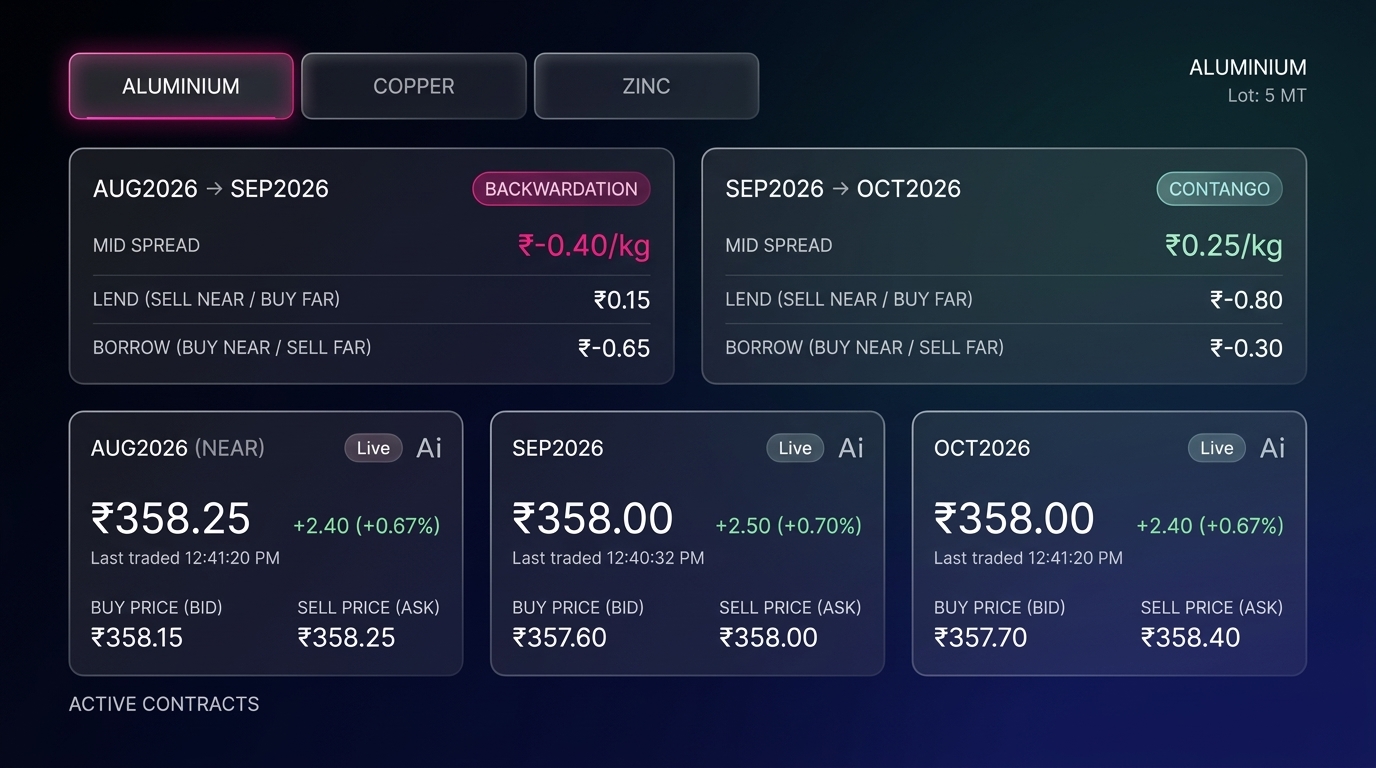
The AUG/SEP/OCT spread, visible in any active MCX dashboard showing near-term FUTCOM contracts, encodes the market's current view on Indian aluminum or copper demand across three sequential delivery months. This term structure isn't derived from LME forward curves. It's built from MCX-specific open interest, domestic roll behavior, and Indian market participant positioning.
When the AUG/SEP/OCT spread is in backwardation (near-month contracts priced above deferred months), MCX is signaling tighter near-term domestic supply or elevated immediate demand. When the spread is in contango, the opposite condition is priced in. These signals may or may not align with the LME's current forward curve, and you cannot assume they will.
FUTCOM aluminum and copper contracts settle against domestic MCX closing prices, not LME-derived benchmarks MCX FUTCOM aluminum and copper contract specifications. Because of this settlement design, a hedge structured against LME terms carries native basis risk. This isn't a market anomaly; it's a structural feature of how MCX FUTCOM contracts work.
Structural Differences Between MCX FUTCOM and LME Forward Contracts
MCX FUTCOM contracts are exchange-traded, INR-denominated futures settled against Indian domestic prices. LME forward contracts are OTC-tradable instruments denominated in USD and settled against the LME Official Price. These structural differences—currency denomination, settlement benchmark, lot size, delivery location, and counterparty mechanics—mean that price signals from each instrument describe completely different market conditions. Relying on LME forwards to time your MCX FUTCOM hedge entries or exits creates a structural mismatch. The AUG/SEP/OCT spread in MCX FUTCOM provides a direct read on domestic Indian term structure that simply has no equivalent LME input.
MCX Backwardation and Contango as Discrete Analytical Conditions
Backwardation and contango in MCX contracts describe domestic Indian market conditions, not the global supply and demand balances reflected by the LME.
In LME aluminum, backwardation signals global warrant drawdowns or tightness in LME-warehoused material. In MCX aluminum, backwardation in the AUG/SEP/OCT spread reflects India-specific conditions: pre-monsoon procurement timing, domestic smelter output cycles, or import duty changes affecting landed costs.
These aren't the same conditions expressed in different currencies. They are completely different conditions that require different analytical frameworks.
Seasonal demand analysis of India's aluminum consumption shows distinct procurement peaks tied to Q4 infrastructure and construction activity India's aluminum consumption patterns and procurement cycle peaks. A FUTCOM spread moving into backwardation in August carries specific, forward-looking information about the Indian market. A trader operating from an LME-first framework won't capture this information until it's already been priced into MCX contracts.
Divergence Between MCX and LME Copper Contango
Similarly, MCX copper contango reflects Indian market conditions—domestic inventory levels, import pipeline depth, INR financing costs, and local demand outlook. LME contango reflects global supply availability and warehouse dynamics. The two can and do diverge. An LME contango environment doesn't guarantee MCX copper will follow suit. Domestic demand acceleration or import duty shifts can push the MCX curve into backwardation completely independent of global conditions. This divergence is exactly why using LME readings as a proxy for MCX term structure introduces systematic hedge lag: the signal is describing a different market entirely.
How Input Sequencing Creates Structural Hedge Lag in MCX Positions
The mechanics of input sequencing are measurable when mapped out.
In a workflow that uses the LME as the primary input for an MCX aluminum or copper hedge, the decision sequence usually follows five steps. First, the LME price is observed. Second, currency conversion from USD to INR is applied. Third, an MCX basis estimate is applied. Fourth, the resulting figure is compared to the MCX contract price. Fifth, the hedge decision is made.
Every step after step one adds translation latency. Step three—estimating MCX basis—is the primary failure point because MCX basis isn't stable. It varies with domestic market microstructure. During non-LME hours, this basis can shift materially before you even receive an LME input.
Commodity basis research on emerging market exchanges shows that basis volatility in India's metals markets can represent 2% to 5% of the contract value during high-volatility sessions commodity basis volatility research. At ₹800,000 per MT for MCX copper, that's ₹16,000 to ₹40,000 per MT in unhedged basis exposure generated solely by your input sequencing choice—before any directional market move even happens.
Operationally, this pain point hits hardest at two specific moments in physical position workflows:
At hedge initiation: When a physical purchase or sale is concluded under domestic market conditions, the hedge entry decision must be made in MCX terms. A trader relying on an LME-derived reference enters a hedge against a price that might not reflect current MCX term structure. The hedge may be directionally correct but structurally misaligned with the actual contract being held.
At roll or close: The AUG/SEP/OCT spread dictates roll timing economics. A backwardated MCX curve means rolling from AUG to SEP carries a cost that may not appear on the LME. A trader monitoring LME roll economics won't anticipate this cost until they observe it directly, at which point the roll decision is already constrained by the market.
Research on commodity hedging effectiveness highlights basis risk as the primary driver of hedge inefficiency for physically delivered contracts commodity hedging effectiveness research. In MCX aluminum and copper, that basis risk is baked into the LME-first methodology. The exposure isn't created by market conditions; it's created by the input selection decision.
Building Infrastructure That Reads MCX Signals Correctly
Fixing this requires structural, not procedural, changes.
A platform designed to treat MCX as a derivative of the LME will rely on currency conversion modules, basis adjustment tables, and correlation-dependent assumptions. It will perform fine when MCX and LME are closely aligned, but it will systematically underperform when they diverge. As the data shows, divergence isn't rare—it's a predictable daily occurrence during the seven-hour non-overlapping session.
A platform designed to treat MCX as a primary signal environment is built differently. It maintains MCX FUTCOM term structure data independently. It surfaces the AUG/SEP/OCT spread directly as a live forward curve signal, rather than a calculated output. It tracks MCX-specific open interest and routes hedge decisions through MCX price logic first, entirely skipping the LME translation layer.
SEBI data shows that MCX metals contracts carry significant daily open interest, representing active domestic price formation SEBI commodity derivatives market open interest and volume data. An open interest base of that scale reflects a market signaling on its own, not just echoing the LME. Infrastructure that treats it as an echo will consistently stay one step behind.
To address the root cause, trading infrastructure needs four specific capabilities. First, establish MCX FUTCOM term structure as a primary feed, not a derived output. The AUG/SEP/OCT spread must be visible as an independent live forward curve. Second, treat MCX backwardation and contango as independent variables in hedge entry and exit models, requiring no LME confirmation. Third, map hedge lag explicitly by input source. Track whether each open MCX position was entered against an MCX primary signal or an LME-derived estimate, as they carry different basis risk profiles. Fourth, separate Indian market hours analytics from London hours analytics. The non-overlapping session requires a framework built specifically for MCX microstructure.
Proper commodity intelligence recognizes MCX aluminum and copper as instruments with their own contract mechanics, term structure drivers, and signal environments. Infrastructure built on that understanding doesn't address hedge lag by executing faster—it addresses it by reading the right signal in the first place.
Conclusion: The Signal Comes First
MCX aluminum and copper contracts generate independent price signals during Indian market hours. LME benchmarks cannot substitute for them without introducing structural hedge lag at the point of input selection.
The AUG/SEP/OCT FUTCOM spread is not a downstream reflection of LME forward curves. It is a primary term structure signal describing domestic Indian market conditions. You need infrastructure designed to read it directly, not translate it from a different market.
Hedge lag isn't a symptom of execution speed; it's a symptom of input selection. When the first input in a hedge workflow is structurally misaligned with the market being hedged, every subsequent step inherits that misalignment, no matter how efficiently those steps are executed.
Front-office metals traders should take three immediate steps. First, audit your current MCX hedge workflow to identify exactly where LME-derived inputs enter the decision sequence. Second, compare MCX AUG/SEP/OCT spread observations against LME forward curve readings over the past 30 trading days to measure historical divergences. Third, evaluate whether your current platform surfaces MCX FUTCOM term structure as a primary signal or a translated LME output, and calculate what that distinction has cost you in basis slippage.
The difference between a platform that knows MCX and one that approximates it is visible in hedge results, not in feature comparisons. Novaex MCX base metals platform