MCX Zinc Margin Calls: The Three-Stage Cash Flow Sequence
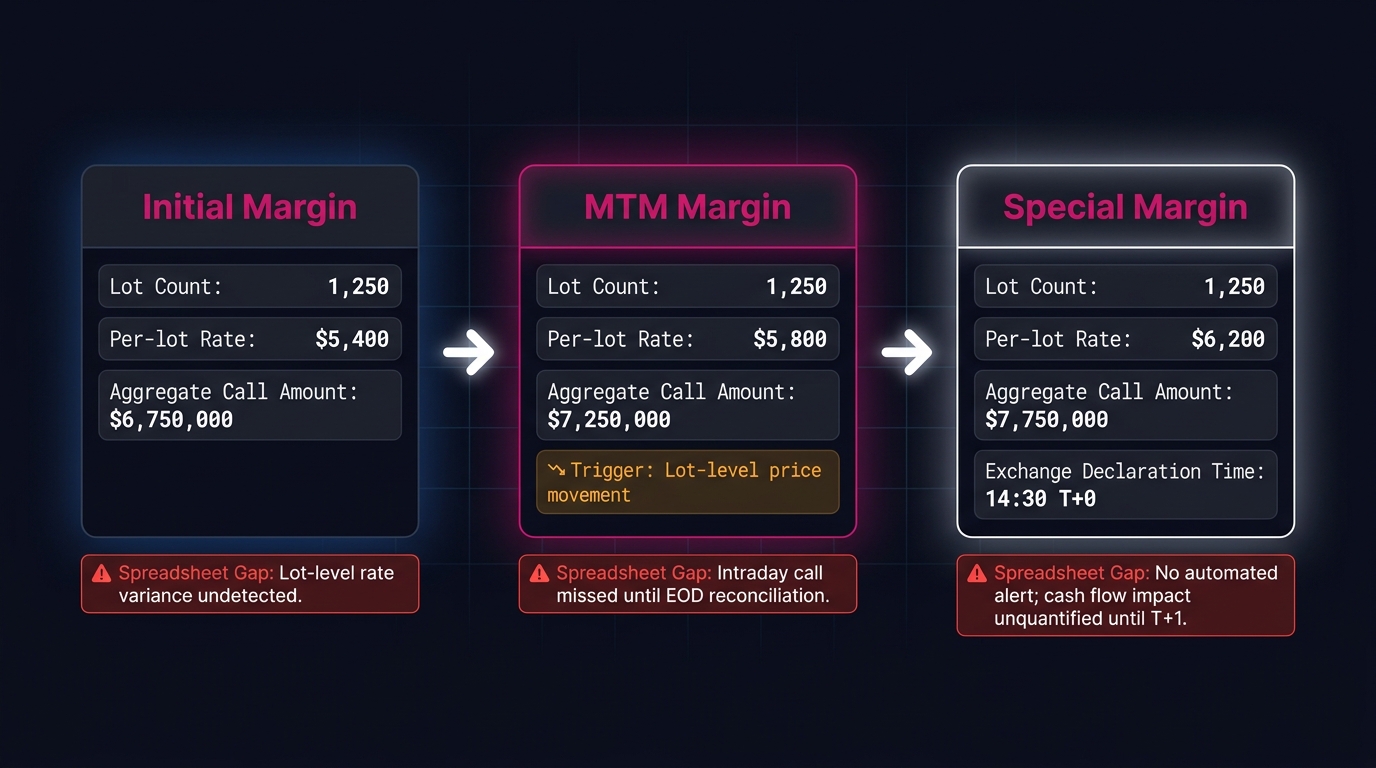
MCX zinc futures generate three distinct margin events: initial margin, MTM margin, and special margin. Each has its own trigger mechanic, calculation logic, and collection timeline. Each stage produces a specific cash flow discrepancy when lot-level tracking is absent. This is not a risk management problem. It is an architectural one. The exchange calculates margin at the lot level; spreadsheet-based monitoring does not. That gap is the consistent origin point of unplanned funding events.
This article documents the trigger mechanics of all three stages and explains, mechanically, why spreadsheet-based monitoring produces inaccurate outputs at each one. It also covers what lot-level tracking in Novaex eliminates.
How MCX Zinc Margin Events Are Structured
MCX zinc futures trade in lots of 5 metric tonnes, with prices quoted in INR per kilogram MCX zinc contract specifications. A single lot at ₹240/kg carries a contract value of ₹12,00,000. The exchange manages counterparty risk through a three-tier margin framework, rather than a single margin requirement that scales linearly.
Each tier is a separate mechanism:
- Initial margin: deposited at or before trade execution
- MTM (Mark-to-Market) margin: settled the morning after each daily settlement cycle
- Special margin: imposed by MCX exchange management during volatility or position concentration events
What triggers an MCX zinc margin call?
Each of the three MCX zinc margin events is triggered by a different mechanism. Initial margin is triggered at trade execution. MTM margin is triggered by adverse price movement between the previous settlement price and today's settlement price, assessed lot by lot at the end of each trading session. Special margin is triggered by MCX exchange management in response to abnormal price volatility or position concentration. It is not predictable from historical data alone and can be imposed intraday or at end of day.
As a result, a desk trading MCX zinc must be positioned for three categorically different margin calls simultaneously, each requiring available funds at the clearing member level before the next market open.
According to MCX's published framework, all margin shortfalls, regardless of which tier triggered them, carry the same consequence: position squareoff by the clearing broker without further notice.
Stage One: Initial Margin and the Entry-Point Miscalculation
Initial margin is the performance bond MCX requires a trader to deposit before or at trade execution. It is held against adverse price movement before the first daily settlement occurs.
MCX calculates initial margin using the SPAN (Standard Portfolio Analysis of Risk) methodology SPAN margin calculation methodology. For zinc futures, SPAN produces a per-lot margin requirement based on current contract value and the exchange's volatility parameters. Per MCX's published margin circulars, initial margin for zinc has historically ranged between 4% and 8% of contract value, adjusted dynamically as market volatility changes.
At a 5% initial margin rate on a ₹12,00,000 contract, the per-lot requirement is ₹60,000. That calculation is straightforward for a single lot entered in a single session.
Where the spreadsheet produces the first cash flow discrepancy
The first cash flow discrepancy is structural, not computational.
A spreadsheet tracking aggregate position records total lots and average entry price. When a desk builds a zinc position across multiple trade entries on different days (each at different prevailing prices and different SPAN margin rates), the spreadsheet calculates initial margin as: total lots × average contract value × a single margin rate.
MCX does not calculate initial margin this way. Each lot is margined individually at its execution-price contract value and the SPAN rate applicable at the moment of that specific execution. When the SPAN rate changes between the first and third lot entry, which routinely happens during active sessions, each lot carries a different per-lot initial margin requirement.
The clearing member's call reflects the sum of per-lot calculations. The spreadsheet reflects an average-price aggregate. The gap between those two figures is the first cash flow discrepancy.
According to a 2023 survey by the Association of National Exchanges Members of India (ANMI), margin-related discrepancies between trader records and clearing member statements are among the most consistently reported sources of operational friction in Indian commodity derivatives markets ANMI operational friction data.
The discrepancy does not originate from the exchange. It originates from calculating at the wrong level of granularity.
Stage Two: Intraday MTM Margin and the Position-Averaging Trap
MTM margin is collected each morning before market open, based on the daily settlement price MCX establishes at approximately 11:30 PM IST. That price is calculated as the volume-weighted average of the final 30 minutes of the trading session.
Every open lot is marked to this settlement price. Lots that have moved adversely relative to the previous day's settlement generate a debit. Lots that have moved favorably generate a credit. The net of these lot-level calculations determines the morning margin call or credit.
How is MTM margin calculated on MCX zinc futures?
MTM margin on MCX zinc is the difference between the previous day's settlement price and the current day's settlement price, multiplied by the lot quantity in kilograms. With a lot size of 5,000 kg (5 MT), a ₹2/kg adverse settlement move generates a ₹10,000 MTM liability per lot. This calculation runs individually on every lot in the open position book, using the previous settlement price as the baseline, not the original trade entry price. A position built across multiple days carries a different MTM baseline for each lot, equal to the settlement price on the evening before each lot was entered.
Where the spreadsheet produces the second cash flow discrepancy
This creates a more consequential discrepancy.
Consider a 10-lot short position built across five consecutive sessions: 2 lots per day at declining prices. Day 1 at ₹245/kg, Day 2 at ₹243/kg, Day 3 at ₹241/kg, Day 4 at ₹239/kg, Day 5 at ₹237/kg. Today's settlement price is ₹240/kg.
A spreadsheet calculates aggregate MTM as: (₹241 average entry - ₹240 settlement) × 5,000 kg × 10 lots = ₹50,000 credit.
MCX does not calculate MTM against average entry price. MCX calculates MTM for each lot against the settlement price of the previous trading day, not the original execution price. The two lots entered on Day 5 at ₹237/kg carry a previous-day settlement baseline of ₹238/kg. Today's settlement of ₹240/kg places those lots ₹2/kg adverse: ₹2 × 5,000 × 2 lots = ₹10,000 debit.
The spreadsheet shows a ₹50,000 credit. The clearing account shows a net debit on those two lots. The aggregate average price masked the lot-level reality entirely.
This is the position-averaging trap. The spreadsheet compresses individual lot baselines into a single average that eliminates the variance the exchange is calculating against. According to research published by the Futures Industry Association, multi-entry positions are the most frequently cited source of MTM discrepancy between trader records and clearing member statements in derivatives markets globally FIA operational risk research.
The mechanism is consistent across markets. Averaging eliminates the lot-level information that margin calculation requires.
Stage Three: Special Margin and the Compounding Blind Spot
Special margin is MCX's mechanism for managing systemic risk during price dislocation events. Unlike initial and MTM margin, which follow predictable daily cycles, special margin is event-driven and can be imposed at any point during or after a trading session.
What is a special margin call on MCX?
A special margin call on MCX is an additional levy imposed over and above existing initial margin, applied to all open positions in the affected contract. MCX issues a circular specifying the rate and the effective date, which can require same-day fund availability. For zinc, special margins have historically been set at 2% to 5% of current contract value, triggered by intraday price swings exceeding defined thresholds or by position concentration in a single contract month. The critical distinction is that special margin applies to current contract value, not entry-price contract value, making the exposure figure a moving target until it is calculated lot by lot at current market prices.
Where the spreadsheet produces the third cash flow discrepancy
Two failure modes compound at Stage Three.
Failure Mode 1: Quantum miscalculation. A spreadsheet tracking aggregate position cannot compute special margin exposure accurately because special margin applies to current contract value per lot, and current contract value moves with every price tick. A desk holding 10 lots at a current zinc price of ₹244/kg has a current contract value of ₹12,20,000 per lot. A 3% special margin on that position requires ₹3,66,000 in additional collateral. If the spreadsheet was last updated when zinc was at ₹240/kg, it estimates ₹3,60,000. The ₹6,000 gap is not material in isolation. It becomes operationally significant when it reflects the systematic inaccuracy of static-price aggregate monitoring applied across a larger position.
Failure Mode 2: Compounding blindness. Special margin does not replace initial margin. It compounds with it. A desk monitoring aggregate margin utilization tracks its initial margin consumption as a percentage of capital deployed but has no real-time view of the additional headroom required to absorb a special margin event. When the MCX circular arrives, the trader must simultaneously calculate total compounded exposure, identify which lots to adjust, and source additional collateral. Without lot-level data, none of these calculations can be performed accurately under time pressure.
According to a review of MCX zinc margin circulars over a 24-month window, special margin events in zinc have been issued during periods of LME zinc price swings exceeding 3, 5% intraday. This pattern is consistent with global supply disruption events and speculative positioning cycles MCX zinc margin circular archive. These events are not anomalies. They are a structural feature of zinc market dynamics that any active desk will encounter on a recurring basis.
Why Spreadsheet-Based MCX Zinc Margin Monitoring Fails Structurally
The three failure modes documented above share a single root cause: spreadsheets compress lot-level data into aggregate summaries, and MCX margin calculation operates at the lot level. This is not a configuration problem. It is an architectural incompatibility.
Spreadsheets are reporting tools. They are designed to reduce a dataset into summary statistics: average entry price, total lots, aggregate contract value. That compression serves P&L snapshots and end-of-day reporting. It is structurally incompatible with margin management, which requires the underlying lot-level data at every stage of calculation.
How often does MCX collect margin payments?
MCX collects initial margin at trade execution and MTM margin on a T+1 basis each morning before market open. Special margin is collected on the timeline specified in the MCX circular, which can require same-day or next-morning fund availability. In practice, an active zinc desk must be positioned for potential margin calls every morning, with the possibility of an intraday special margin call on volatile sessions. A desk managing 20 or more lots across multiple contract months can face all three margin event types simultaneously on a single volatile day.
A spreadsheet updated at end of business the prior day cannot accurately model any of these calls. By design, it is a record of what occurred, not a real-time model of current obligations.
According to a Deloitte commodities operations benchmark study, firms using manual or spreadsheet-based margin tracking report a 35% higher incidence of margin-related operational incidents compared to firms using automated lot-level tracking systems Deloitte commodity trading operations benchmark. The pattern holds across market types and position sizes. The mechanism is consistent. The monitoring system is operating at a different level of granularity than the exchange.
Lot-Level Tracking in Novaex: The Architectural Difference
Novaex is built around lot-level position tracking as a core architectural principle Novaex platform architecture. This matters operationally because margin management is a pre-event function. The data must be available before the call arrives, not assembled in response to it.
Why do zinc futures margin calls produce unplanned funding events?
Zinc futures margin calls produce unplanned funding events because monitoring data is aggregated while exchange calculation data is granular. MCX calculates every margin event at the lot level, using current contract values and daily settlement prices applied individually to each open lot. A trader monitoring aggregate position data is working from a structurally less accurate dataset than the one MCX uses to calculate their obligations. The discrepancy is not an exception; it is the predictable output of a data-architecture mismatch.
Novaex closes this gap by maintaining the same lot-level granularity as MCX's own calculation engine.
What changes at each stage with lot-level tracking:
- Stage One: Initial Margin: Novaex records every lot individually with execution price, timestamp, and the SPAN margin rate applicable at that specific execution. When the clearing member's initial margin request arrives, the Novaex figure matches it because both are derived from identical per-lot inputs.
- Stage Two: MTM Margin: Novaex calculates MTM continuously against the current settlement price for each open lot using the correct baseline: the settlement price on the evening before each lot's entry. A desk holding 15 lots entered across 8 trading sessions can see exactly which lots are generating MTM exposure at any settlement price, and the aggregate figure is the sum of accurate lot-level calculations, not an approximation derived from average price.
- Stage Three: Special Margin: When MCX publishes a special margin circular, Novaex applies the new rate to current contract values at the lot level and generates an immediate total exposure figure. The trader knows the exact additional collateral required (broken down by lot) before the clearing member issues the call.
Building a Margin-Resilient MCX Zinc Trading Operation
The taxonomy of MCX zinc margin events is not complex. Three stages, three trigger mechanics, three collection timelines. The complexity enters when monitoring operates at a different granularity than the calculation engine it is tracking.
A margin-resilient zinc trading operation requires three operational standards:
- Per-lot entry tracking with execution-price and SPAN-rate capture: Every zinc lot must be recorded with its specific execution price and the margin rate applicable at that moment. Aggregate position data is insufficient for Stage One accuracy and eliminates Stage Two precision entirely.
- Real-time MTM calculation using correct lot-level settlement baselines: The monitoring system must recalculate MTM for each open lot as the settlement price updates. It must use the previous evening's settlement as the baseline for each lot, not the original trade entry price. End-of-day batch processing does not satisfy this requirement.
- Special margin scenario modeling against current contract values: The system must be capable of applying a hypothetical special margin rate to current contract values on all open lots immediately. The calculation is not complex, but it requires the lot-level data structure that makes it executable.
Ask yourself: does your monitoring system calculate margin using the same inputs and granularity as MCX's own margin engine? If the system aggregates before it calculates, the three cash flow discrepancies documented here are not risk scenarios. They are scheduled events.
Conclusion
MCX zinc margin calls follow a defined sequence with exact mechanics at each stage. Initial margin is calculated per lot at the execution-price contract value and the SPAN rate applicable at execution. MTM margin is settled daily, marked to the settlement price per lot using the previous settlement as the baseline. Special margin is imposed at current contract values per lot and compounds with existing initial margin.
At each stage, spreadsheet-based monitoring produces a specific and mechanically traceable cash flow discrepancy. This stems not from user error, but from the structural incompatibility between aggregate monitoring and lot-level exchange calculation. The correction is not procedural; it is architectural.
Three immediate operational standards for MCX zinc trading desks:
- Audit your margin tracking granularity: Determine whether your current system records margin at the lot level or the aggregate level. If it uses average entry price for MTM calculation, Stage Two variance is already occurring on every multi-entry position.
- Map your special margin response time: Document how long it takes your desk to calculate total compounded exposure when a special margin circular arrives. If the answer is measured in hours rather than seconds, the architecture requires change before the next volatility event.
- Benchmark lot-level systems against MCX calculation logic: The evaluation criterion is not feature breadth. It is whether the system uses the same inputs and granularity as MCX's margin engine. Any system that cannot meet that benchmark will continue producing the discrepancies this article documents.