Metals month-end checklist: where do we stand going into 2027?
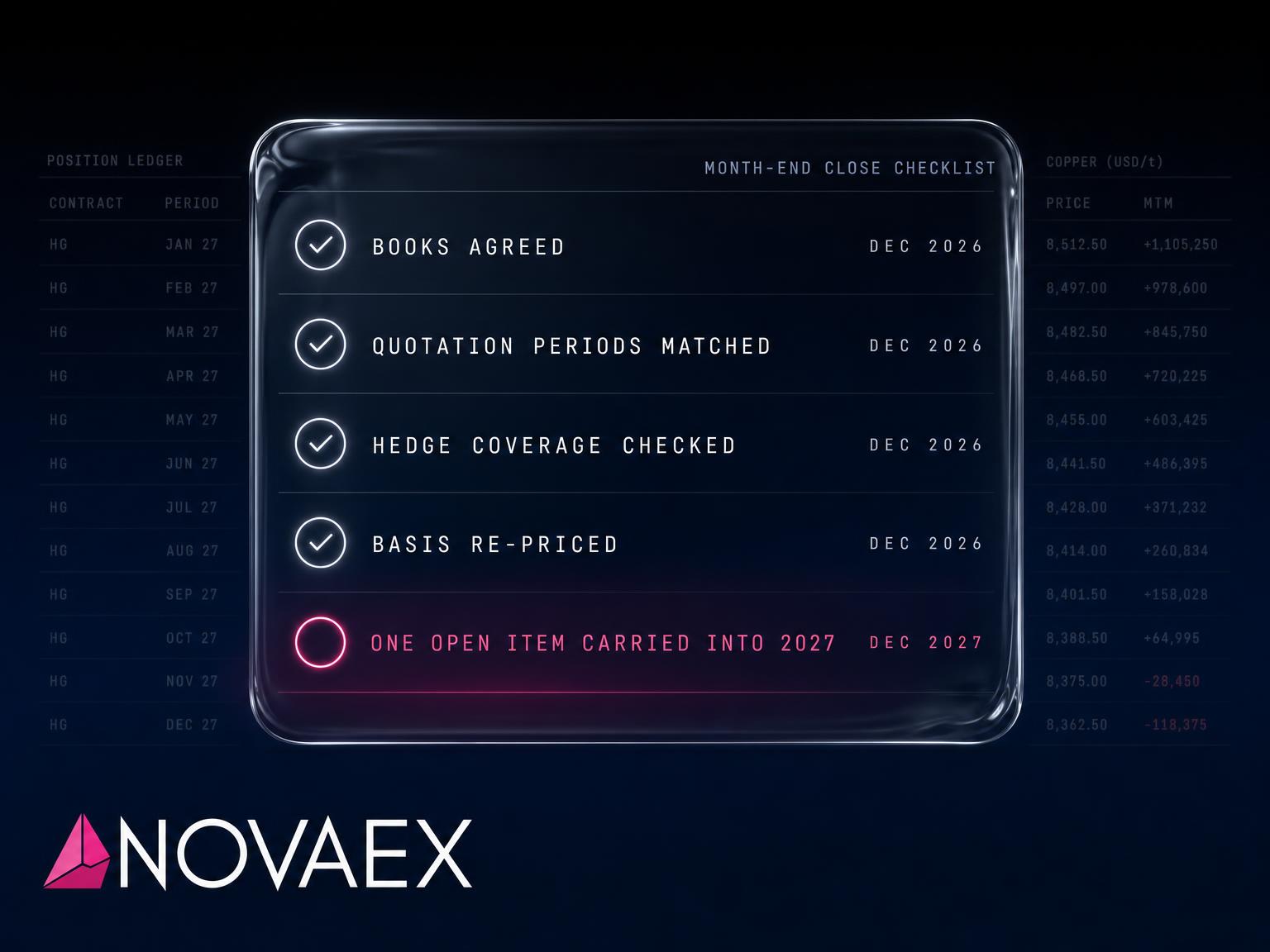
Five checks on one cut-off date: three books matched, quotation periods, hedge coverage per metal, premiums, and the one line you carry into 2027.
A metals month-end close is five checks run against one cut-off date: match the physical, hedge and broker lines; confirm quotation periods against hedge dates; recompute hedge coverage per metal against policy; re-price the premiums set earlier in the quarter; and write down the one line that will not square.
Do that and the position you carry into 2027 is one you can prove. On 1 October the check was four lines against the book in force: exposure by metal and month, premiums priced against premiums covered, hedge ratio against actuals, and hedge dates against confirmations. This is the same four, closed, with a fifth for whatever is left.
Which date and which price do all three books get marked to?
Pick one cut-off date and one price source before you touch a line. Physical, hedge and broker books marked at different times disagree before anyone has made a mistake, and the gap then reads as a break.
October shows it. LME copper closed at $14,253.50 a tonne on 1 October, and the official cash offer was $14,510 on 7 October. Different date, different series, different number.
One LME copper lot is 25 tonnes, so every $100 a tonne between two marks is $2,500 a lot. On a 40-lot, 1,000-tonne line that is $100,000. An illustration, not a figure from your book.
What still sits open between the physical, hedge and broker books?
An open line is one that a book holds and another does not match. Put the three side by side: physical shipments and receipts, futures and options on your own record, and broker statements as received. Flag every line where quantity, metal, prompt date, counterparty or trade reference differs.
Convert before you compare. Futures sit in lots and physical sits in tonnes, so 40 LME copper lots are 1,000 tonnes. Options go in at delta-equivalent tonnes, not notional. A hedge booked in lots and read as tonnes shows up as a break that is not one. Our note on position reconciliation across physical, futures and options sets out the matching field by field.
Do the quotation periods still match the hedge dates?
Only where the purchase quotation period, the sale quotation period and the hedge prompt line up lot by lot. Where they do not, basis stays open in the gap, and basis is the part nobody hedged.
List every open lot with its purchase QP, sale QP and hedge prompt. Where any of the three differ, write the exposure in tonnes and the spread that prices it. In late September the LME copper prompt spread widened to a monthly high as Chinese smelters scheduled Q4 maintenance, which means buyers paying up for nearby metal. Check whether it still holds at your cut-off. Tight nearby metal is the wrong month to find a mismatch.
Is hedge coverage still inside policy, per metal?
Hedge coverage is hedged tonnage divided by priced exposure, per metal, set against the limit in your policy. Compute it on the book at the cut-off, not the book you planned on 1 October.
Aluminium, copper, lead, nickel, tin and zinc each get a line: hedged tonnes, priced tonnes, the ratio, the policy limit, and the tonnes above or below it. State the gap in tonnes as well as per cent, because a five-point gap on a small book and on a large one are different tonnes. A shipment that slipped or a call-off that came in light changes the denominator. The hedge did not move.
Which premiums are still the ones you set early in the quarter?
A premium carried forward without a date is an assumption. Record the premium or discount on each open lot and the date it was set. Re-price anything older than the quarter's first weeks, or write the reason next to it.
US-linked lines show it most. At end-July COMEX traded about $420 a tonne over LME, roughly eight times its 20-year average. By 2 October, at about $14,480, it was only marginally above LME. The refined-copper tariff decision due 28 September passed with no announcement.
The same brief sets out one scenario: a phased tariff of 15% from January 2027, rising toward 30%, would re-widen forward premiums. It is a scenario, not a decision. Any 2027 line priced on the July gap, or on no gap at all, needs its assumption written down.
What is the one line you carry into 2027?
Every close leaves a line that does not square by month-end. Write it as one sentence: metal, tonnes, counterparty or broker, what has to happen next, and who does it by when. Attach the trail, so whoever picks it up in January can check the working rather than trust the note.
Ledger keeps that trail line by line behind each figure, over the CTRM, ERP and broker systems you already run. The rest of the book goes into the new month reconciled.
Which line is still open on your sheet, and what does it cost to leave it there into January? Write it down today and it stays a correction.