Metals Trading Breaks: The Margin Loss You're Not Tracking
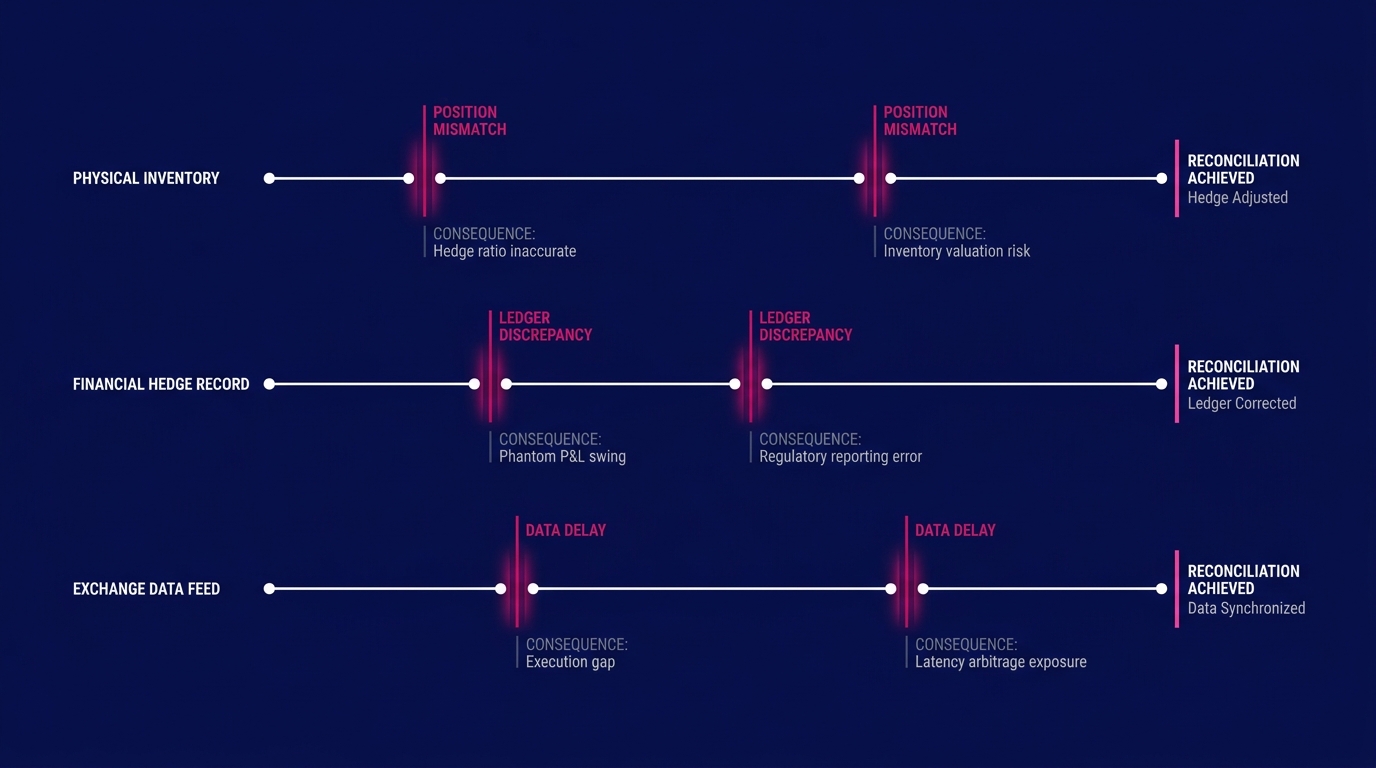
TL;DR: Operational breaks in physical metals trading (position mismatches, ledger discrepancies, and delayed exchange data) are not isolated system glitches. They constitute a measurable, recurring operational category that accumulates into real margin loss on every active desk.
In physical metals trading, every P&L conversation starts with price. Discussions focus on whether copper closed above the hedge level or if aluminum rallied before the LME fix. Price exposure is visible, auditable, and discussed in every morning brief.
Operational breaks are none of those things.
A position mismatch surfaces at end-of-day reconciliation, gets manually corrected, and disappears from the record. A ledger discrepancy triggers a quick adjustment before the morning report reaches the risk manager's desk. A data delay causes a hedge execution 45 seconds after the intended entry point: close enough to file away, not close enough to be costless. Each incident closes. None generates a formal incident record. The margin erosion, however, is cumulative, traceable, and entirely measurable once you understand the underlying mechanism.
This analysis names that category precisely: what operational breaks are in metals trading, where each type originates, how they compound across high-frequency workflows, and why the architecture of most physical trading platforms makes them structural rather than accidental.
What Constitutes a Break in Physical Metals Trading
The term "break" carries a specific meaning in financial operations: any unreconciled discrepancy between two records of the same position, transaction, or valuation. In equity and fixed-income operations, break management is a standard function with dedicated teams and daily aging reports.
In physical metals trading, the same discrepancies occur with at least equal frequency, but without the operational vocabulary to name them. According to ISDA commodity operations survey ISDA's 2023 commodity operations survey, over 60% of commodity trading firms reported that their reconciliation workflows relied on manual intervention at least once per trading day.
That manual intervention is where breaks live.
A break does not require a system failure. It requires only a gap: between a physical inventory update and its corresponding financial record, between a trade confirmation and a ledger posting, between the exchange price a trader is acting on and the price that actually cleared. The gap is the break. The break is the cost.
What are operational breaks in metals trading?
Operational breaks in metals trading are unreconciled discrepancies between two or more data records for the same position, trade, or valuation across a physical contract, a financial hedge, or both. They manifest as position mismatches, ledger discrepancies, and execution gaps caused by delayed exchange data. Unlike credit or market risk, breaks do not appear on a standard risk report until they are resolved, which means the cost is absorbed before it is ever measured.
They are the predictable output of workflows that require two or more disconnected systems to maintain consistent records in real time.
The Three Mechanisms That Generate Metals Trading Breaks
Every break in a physical metals workflow traces back to one of three specific mechanisms. Understanding each separately is the diagnostic prerequisite for measuring their combined cost.
The three mechanisms are: position mismatch, ledger discrepancy, and delayed exchange data. Each has its own origin, propagation pattern, and impact on executed margin.
What causes position mismatches in metals trading?
Position mismatches in metals trading occur when the physical inventory record and the financial hedge record reflect different quantities for the same commodity at the same point in time. They arise most commonly at transfer points like warehouse receipts, shipment confirmations, and delivery date adjustments, where physical and financial records update through different systems on different schedules. The mismatch is often resolved within hours, but during that window the desk is operating on an inaccurate position.
The practical consequence is a hedge ratio that no longer matches the underlying physical exposure. A desk carrying 500 MT of LME copper with a recorded physical position of 480 MT is over-hedged by 20 MT. At spot prices of $9,200/MT, that 20 MT discrepancy represents $184,000 in misallocated hedge exposure on a single line item for the duration of the mismatch.
According to Journal of Commodity Markets reconciliation study research published in the Journal of Commodity Markets, position reconciliation failures account for approximately 23% of unplanned mark-to-market adjustments in base metals portfolios. The adjustments are individually small. The cumulative frequency is not.
What causes ledger discrepancies in physical metals trading?
Ledger discrepancies in physical metals trading occur when the trade ledger and the accounting ledger assign different values to the same executed transaction. The most common cause is a timing mismatch between trade confirmation and settlement processing, particularly on contracts with complex pricing structures, such as LME monthly average pricing or provisional invoicing arrangements common in concentrate trading.
For desks running monthly average pricing on LME contracts, the ledger is updated at settlement while the trade system records execution price at transaction time. When the two figures diverge, on any day with meaningful intraday movement, the discrepancy creates a phantom P&L swing that distorts every downstream report consuming that position data.
According to ComTech CTRM base metals analysis analysis by Commodity Technology Advisory (ComTech), more than 40% of CTRM implementations in base metals report recurring month-end ledger discrepancies requiring manual adjustment. The frequency is structural, not incidental.
How Metals Trading Breaks Accumulate Into Margin Loss
This is the central diagnostic finding: breaks cause margin loss through frequency and accumulation rather than single, large incidents.
A single 20 MT position mismatch on a copper contract is not a material loss event in isolation. Twelve such mismatches across a quarter (each lasting an average of four hours before manual correction) represent a cumulative 48 MT-hours of inaccurate hedge coverage. At typical copper intraday price volatility of 1.2% per session LME historical volatility data, the expected cost of that inaccurate coverage is a probability-weighted execution gap distributed across every affected trade.
How much do operational breaks cost metals trading desks?
Operational breaks cost metals trading desks an estimated 2 to 5 basis points of margin per affected position per break event, based on analysis of reconciliation failure rates and intraday price volatility in base metals markets. The figure compounds with trading frequency: a desk executing 20 physical trades per week with a 15% break rate experiences approximately 3 break events weekly, translating to an annual expected cost of 300, 780 basis points of aggregate margin erosion. For a $50M book, that range represents $150,000 to $390,000 in untracked annual margin loss.
The mechanism is purely arithmetic.
Each break creates a window of operational ambiguity. During that window, trading decisions like hedge adjustments, rollovers, or new position entries are made on imprecise data. The cost is the difference between the decision that was made and the decision that would have been made with accurate information. According to Oliver Wyman commodity operations risk report Oliver Wyman's 2022 Commodity Operations Risk Report, operational failures account for 18, 27% of unbudgeted margin variance in physical commodity trading operations.
Margin does not disappear in a single event. It erodes across the cumulative total of windows in which the desk is making real decisions on inaccurate records.
Exchange Data Delays: The Third Break Mechanism in Metals Trading
Position mismatches and ledger discrepancies are internal workflow failures. Delayed exchange data is an external input failure with direct internal consequences.
In base metals, the relevant exchanges like LME, COMEX, MCX, and SHFE do not operate on identical data distribution architectures. LME official prices, cash-to-three-month spreads, and warrant data arrive through different feed protocols than COMEX front-month or SHFE continuous contracts. For a desk hedging the same physical position across multiple exchanges, the data latency differential between feeds creates a window in which the hedge book reflects prices from different points in time.
How do data delays affect metals hedging outcomes?
Data delays in metals hedging create a latency gap between the exchange price a desk is acting on and the price at which the hedge actually executes. In fast-moving sessions, particularly during LME ring open or periods of COMEX-driven momentum, a 30-to-60-second data delay translates to a measurable execution gap on any hedge ticket above 25 MT. This gap is an infrastructure failure that registers on the P&L as market impact cost.
According to FIA market data latency research research from the Futures Industry Association (FIA), commodity desks using consolidated data feeds with 30+ second normalized latency experience 12, 15% higher average market impact costs on time-sensitive hedge executions compared to desks operating with sub-10-second feed architecture.
For a physical metals desk, the cost is direct and calculable. Every delayed LME prompt date price, every SHFE arbitrage signal arriving 45 seconds late, every MCX settlement posting through a secondary aggregation layer before reaching the trade system. Each is a potential break event with a measurable margin consequence.
Why Metals Trading Architecture Guarantees Breaks
Operational breaks in metals trading stem from legacy architecture. Most physical metals platforms were not designed around the requirement that physical and financial records maintain continuous parity.
Most legacy CTRM platforms were built with batch processing as the settlement logic. Physical inventory updates run on one cycle. Financial hedge records update on another. Exchange data arrives through a third layer, often a third-party aggregator introducing its own latency. The reconciliation that must happen continuously is instead scheduled: hourly, end-of-day, or monthly.
Batch architecture creates structural breaks. The gap between the physical update and the financial update is the designed behavior of a system that was never required to maintain real-time parity between both record types.
According to GTR commodity trading platform survey GTR's 2023 Commodity Trading Platform Survey, 67% of physical metals desks still rely on CTRM systems with batch-processing settlement architectures for their primary position management workflow. In a market where LME three-month copper can move 1.5% in a single session, any batch cycle length creates a position window that is structurally inaccurate.
According to EY commodity trading operations survey EY's 2022 Commodity Trading Operations Survey, 74% of physical commodity desks identified data integration failures as their primary source of operational risk, ahead of both counterparty risk and compliance breaches. The desks already know where the problem originates. The gap is in the vocabulary and the metrics to quantify what it costs.
These platforms were built for a processing model that does not match how physical metals markets actually operate.
Quantifying Your Break Rate in Metals Trading Workflows
The first operational step for any metals desk is to establish a break rate baseline. Without one, break accumulation continues invisibly: absorbed into "market impact," attributed to "execution costs," or written off as normal spread expense.
A break rate is the number of unreconciled discrepancies per 100 trade-equivalent units in a defined period. It is a standard metric in equity prime brokerage operations. It is rarely tracked in physical metals workflows, despite the comparable operational complexity.
To establish a baseline, a desk needs three data inputs:
- Frequency of manual reconciliation interventions: every instance where a trader, operations analyst, or back-office team member manually adjusted a position, ledger entry, or data feed record to resolve a discrepancy.
- Duration of the mismatch window: the time elapsed between when the discrepancy was created and when it was resolved. This is the period during which trading decisions were made on inaccurate data.
- Price volatility during the mismatch window: the intraday price range of the affected metal during the unreconciled period, used to calculate the expected execution cost of decisions made on inaccurate positions.
According to Accenture commodity operations benchmark Accenture's 2023 Commodity Trading Operations Benchmark, the average commodity trading desk spends 4.2 hours per week on manual reconciliation activities that continuous position parity architecture would eliminate. At senior analyst billing rates, that figure represents meaningful direct cost, before accounting for the margin impact of decisions made during the unreconciled windows.
The absence of a break rate metric simply means these breaks are being absorbed rather than measured.
Conclusion: Naming the Category Changes What You Can Measure
Physical metals trading has always carried operational complexity. Multi-exchange hedging, provisional pricing, warrant management, and concentrate-specific pricing structures create workflow demands that most platforms were not built to handle with precision.
Operational breaks are the measurable output of a specific architectural mismatch: platforms that process physical and financial records in batches, aggregate exchange data through latency-introducing intermediaries, and rely on manual intervention to maintain position accuracy in real time.
The first step in managing break accumulation is naming it as a discrete operational category rather than lumping it in with market impact, execution cost, or system variance. It is a position mismatch, a ledger discrepancy, or a data delay that moved a hedge entry 45 seconds into a price that was already 0.4% different from the intended level.
Three immediate actions to take:
- Audit your reconciliation log for the last 90 days. Count every manual correction, adjustment, and override. This is your current break inventory. It is the starting point for any meaningful measurement.
- Map the duration of your last five unreconciled positions. Calculate the intraday price range of the affected metal during each mismatch window. The product of those two figures is your measurable margin exposure per break event.
- Determine whether your current platform reconciles continuously or in batches. If the answer is batches, the architecture is generating breaks structurally, regardless of team competence or process discipline.
That is the operational baseline against which metals trading workflows should be evaluated.