Metals Trading Governance: Three Structural Failures and Their Measurable Costs
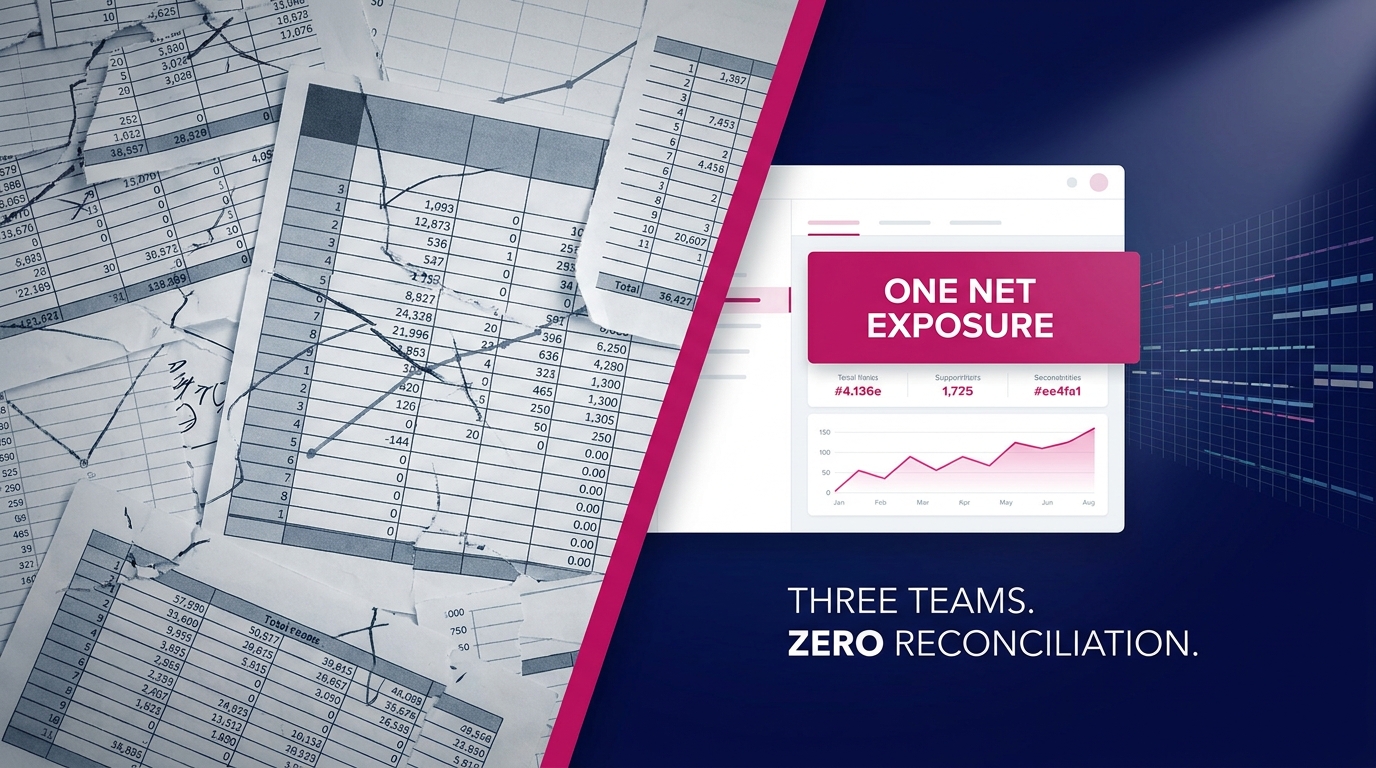
Multi-system metals workflows produce three identifiable metals trading governance failures: unreconciled positions, delayed SHFE and MCX pricing, and fragmented exposure across books. Each failure is measurable, structurally present in most legacy-platform environments, and traceable to specific architectural decisions. This diagnostic names each condition precisely so you can locate it in your own workflow today.
Why Multi-System Metals Trading Workflows Create Governance Risk
The phrase "multi-system workflow" sounds operationally neutral. In practice, it describes a condition where position data lives in one system, exchange pricing feeds live in another, and risk aggregation happens in a spreadsheet updated manually before the morning call.
According to the Commodity Technology Advisory's annual CTRM market review ComTech CTRM research, the average commodity trading desk runs between four and seven disconnected data sources for a single asset class. In base metals (where LME, SHFE, MCX, and COMEX may all carry relevant price signals simultaneously), that fragmentation becomes a governance liability rather than a manageable workflow complexity.
Governance failure in trading operations is not a theoretical risk. It is a measurable condition: a delta between what your system reports and what is actually true about your exposure at any given moment. The three failures documented below are not edge cases. They are structural properties of multi-system architectures.
The Unique Complexity of Base Metals Governance
Each exchange operates on different lot sizes, settlement conventions, margin structures, and trading hours LME contract specifications. A copper position that appears clean in one system may carry an unreported basis risk against SHFE's continuous contract pricing.
A zinc hedge booked against the LME three-month forward may be partially offset by an MCX position that has not reconciled since the previous settlement cycle. These are not hypothetical scenarios. They are the operational baseline for any desk running base metals across multiple systems without a unified architecture.
Governance Failure #1: Unreconciled Positions in Metals Trading
Unreconciled positions are the most common and most consequential metals trading governance failure in active operations. An unreconciled position exists when the quantity, direction, or valuation of a trade differs between the front-office system, the risk system, and the back-office ledger, without a documented, timestamped explanation for the discrepancy.
According to a 2023 operational risk survey published by the International Swaps and Derivatives Association ISDA operational risk survey, 41% of commodity trading operations report daily position breaks between front- and back-office systems. In base metals, where physical inventory, exchange-traded hedges, and OTC swaps must reconcile across the same underlying commodity, the frequency of breaks exceeds the cross-commodity average.
The failure is identifiable by three observable conditions:
- Intraday position breaks: The front-office blotter and the risk system display different net quantities for the same metal and maturity at the same moment in time
- T+1 reconciliation queues: Breaks carry overnight without automated resolution, requiring manual operations intervention before the next session opens
- Shadow books: Unofficial spreadsheets maintained by traders to track positions the primary system does not capture accurately
The Measurable Risk of Unreconciled Positions
This failure creates measurable risk through two distinct mechanisms: valuation error and hedging miscalibration. A position break of 25 lots in LME copper, approximately 625 metric tons, carries a mark-to-market exposure of roughly $1.5M at current prices LME copper pricing data, invisible to the risk system until the break is formally resolved.
Hedging miscalibration occurs when a trader executes a hedge against position data that does not reflect actual exposure. The hedge ratio is calculated against a number that is factually incorrect. The result is a net position that is either over-hedged or under-hedged, and neither condition becomes visible until reconciliation forces the correction, often after the market has already moved.
The compounding effect is significant: each unresolved break increases the probability that subsequent hedging decisions are miscalibrated against it. Research on trading operations workflows trading operations research indicates that desks identifying position breaks in real time resolve them three times faster than desks that catch them at end-of-day, reducing the window of exposure accordingly.
Governance Failure #2: Delayed SHFE and MCX Pricing
The second metals trading governance failure is delayed exchange pricing from SHFE (Shanghai Futures Exchange) and MCX (Multi Commodity Exchange of India). Delayed pricing is not a data quality problem. In most multi-system environments, it is a structural property of the architecture, not a correctable configuration issue.
SHFE operates on Shanghai time (UTC+8), creating an active overlap window with European metals trading during the LME morning ring. According to the World Bank Commodity Markets Outlook World Bank commodity data, Chinese copper demand represents approximately 54% of global consumption. SHFE price action is therefore directly relevant to any copper book, regardless of the primary hedging exchange.
When SHFE pricing travels through a multi-system chain (data vendor API to normalization layer to pricing database to risk system to trader interface), each link adds latency. In live market conditions, a 15-minute pricing delay on SHFE copper front-month is not an operational inconvenience. It is a governance failure with a calculable cost attached to every decision executed during that window.
The Structural Cause of SHFE Pricing Lag
The normalization layer in multi-system platforms is built for breadth rather than depth. A platform covering 40 or 50 commodities cannot allocate the engineering investment required to maintain genuinely real-time SHFE normalization across all continuous, front-month, and calendar spread contracts simultaneously.
The result is an invisible architectural prioritization: LME pricing refreshes in real time because it is treated as the primary reference. SHFE pricing refreshes on a polling schedule (every 5, 10, or 15 minutes) because the platform was designed around a generalist framework extended to accommodate base metals, not built for base metals from first principles. A trader executing against that feed is operating on pricing that is factually incorrect at the moment of the decision.
MCX compounds this problem during Indian market hours. According to MCX exchange data MCX market statistics, average daily turnover in MCX base metals contracts (copper, zinc, and lead) has exceeded ₹12,000 crore (approximately $1.4B USD) in recent periods. A 10-minute pricing delay on MCX copper during a directional session can represent a 0.3, 0.5% price move, translating directly to material valuation error on any open position referencing MCX as a hedge benchmark.
Governance Failure #3: Fragmented Exposure Across Books
The third metals trading governance failure is fragmented exposure: the condition where a trader's true net position in a specific metal cannot be observed in a single consolidated view because that exposure is distributed across multiple books, systems, or legal entities without a real-time aggregation layer connecting them.
Fragmented exposure is structurally distinct from unreconciled positions. Unreconciled positions involve data discrepancies within a single book or system. Fragmented exposure involves accurate data distributed across systems that were never designed to produce a unified net position in real time.
According to a 2022 Accenture analysis of commodity trading operations Accenture CTRM research, 67% of mid-market commodity trading firms report that traders lack real-time visibility into their firm-wide net exposure during active market hours. The majority achieve exposure aggregation only through end-of-day batch consolidation processes, hours after the decisions that required that visibility were already made.
The observable conditions of fragmented exposure include:
- Cross-book netting gaps: A long position in Book A and a short position in Book B in the same metal and maturity cannot be netted in real time, so the gross position drives margin and hedging calculations instead of the true net
- Entity-level aggregation delays: Physical positions booked in a subsidiary or logistics system do not appear in the trading system's net exposure until an end-of-day consolidation batch runs
- Tenor gaps: Near-dated LME positions and forward calendar spreads are visible in separate system views with no integrated exposure curve connecting them
The Impact on Hedging Decisions
Fragmented exposure requires traders to execute hedging decisions against incomplete information. A trader managing LME copper sees their exchange-side position but not the physical inventory hedge already recorded in the logistics system. They add an exchange hedge. At end-of-day consolidation, the firm discovers it is over-hedged by 500 lots.
This scenario does not require unusual market conditions to materialize. It is the default operational behavior of a multi-system workflow where system integration was retrofitted rather than architected from the outset. The cost is immediate and direct: for a 500-lot copper over-hedge, the margin requirement alone exceeds $1.2M LME margin requirements, with additional transaction costs to unwind the excess position once the consolidation report surfaces the error.
The Depth-First Architecture: A New Metals Trading Standard
Novaex was built from a single documented premise: no available platform had been engineered from first principles around base metals requirements. The design mandate emerged from four years of live base metals trading experience, specifically from repeated and measurable encounters with the three conditions documented here: unreconciled positions, delayed SHFE and MCX pricing, and fragmented exposure across books, occurring in the same structural sequence across every available platform.
The architectural response was not to build another multi-commodity platform with broader market coverage. It was to build a depth-first architecture: a system designed to achieve complete capability for each base metal across LME, MCX, COMEX, and SHFE before extending to additional commodities. Depth before breadth is not a positioning statement. It is the specific design decision that determines whether governance failures are structural properties of the system or addressable engineering conditions.
Depth-first architecture produces three structural properties that multi-system workflows cannot replicate without rebuilding from the foundation:
- Single position record: One position truth updated in real time across all workflow layers: front office, risk, and back office. No front-to-back breaks by design, because there is no system handoff at which discrepancy can originate.
- Native exchange integration: SHFE and MCX pricing treated as first-class data sources with the same normalization investment as LME. Real-time pricing for every covered exchange is the baseline requirement, not a premium configuration option.
- Firm-wide exposure aggregation: Physical inventory positions, exchange-traded hedges, and OTC swaps aggregated in a single exposure view by metal, maturity, and legal entity, available intraday, not as an end-of-day batch output.
Defining the Depth-First Approach
This approach means building complete, authoritative capability for a single commodity (including every exchange, contract type, pricing reference, and workflow layer) before extending that architecture to the next commodity. The multi-commodity CTRM platforms currently in the market were designed on the opposite principle: broad commodity coverage achieved by extending a generalist framework to accommodate individual asset classes.
Breadth-first platforms cover many commodities at shallow depth. They extend a generalist commodity framework to accommodate base metals support, rather than building base metals architecture from first principles with genuine exchange-level precision. The three governance failures documented in this article are not defects in those platforms. They are structural outputs of the breadth-first design decision. These are conditions that persist because the architecture was not built to eliminate them.
Auditing Your Metals Trading Workflow: A Three-Step Diagnostic
The following audit uses observable, live conditions to identify which governance failure exists in your current metals workflow. Self-reported estimates are excluded by design. The evidence must come from your systems as they operate during market hours.
Step 1: Position Reconciliation Check
During active market hours, open your front-office blotter and your risk system simultaneously. Compare net positions for your three most actively traded metals contracts at the same timestamp. If the quantities differ by even one lot, you have confirmed an active unreconciled position.
Document the frequency. If your answer is "I do not know how often this happens," that response is itself the audit finding; it indicates your current workflow does not surface breaks in real time. According to trading operations research [LINK: trading operations research], desks with real-time break detection resolve discrepancies three times faster than those relying on end-of-day reconciliation reports.
Step 2: Pricing Latency Measurement
During the SHFE morning session overlap, approximately 09:00, 11:30 Shanghai time (01:00, 03:30 UTC), record the SHFE copper front-month price displayed in your trading system at five-minute intervals. Compare each reading against the official SHFE real-time data feed [LINK: SHFE market data] at the same timestamp.
Calculate the average lag in minutes. If it exceeds two minutes consistently, your platform is operating on a polling architecture rather than a real-time connection. Repeat the measurement during MCX active hours (10:00, 23:30 IST) for copper and zinc. Record the numbers. They are the evidence.
Step 3: Firm-Wide Exposure Request
At 11:00 AM on any active trading day, request your firm-wide net copper exposure: the single number representing your organization's total long or short position across all books, entities, and instruments. Note precisely: (a) how long it takes to produce the number, (b) whether it includes physical inventory hedges, and (c) whether it includes positions held in subsidiary or logistics systems.
If producing that number requires a phone call to operations, an email to another system administrator, or waiting for an end-of-day consolidation process, you have confirmed fragmented exposure as an active governance failure. The answer to that request during market hours should require no more than a screen view.
From Diagnosis to Decision: What the Evidence Requires
The three metals trading governance failures documented here (unreconciled positions, delayed SHFE and MCX pricing, and fragmented exposure across books) are not conditions limited to large trading operations or unusually complex book structures. They are structural properties of multi-system architectures, present in direct proportion to the number of disconnected systems involved in a single metals workflow.
The diagnostic value of this framework is that it produces observable, timestamped evidence: a position break visible on a live screen, a pricing lag measured in minutes against a reference feed, an exposure aggregation that required a phone call to produce at 11:00 AM. That evidence is not abstract. It is specific to your desk, your systems, and your operating conditions on the day you run the audit.
Three immediate next steps:
- Run the three-step audit today during live market hours using your actual systems. Timestamp each finding. The evidence will be specific enough to identify the failure and the workflow stage at which it originates.
- Map your system count: For each metal you actively trade, list every system that holds position data, pricing data, or exposure data. If the list for any single metal exceeds two systems, you have identified the architectural source of fragmentation.
- Request a Novaex platform demonstration Novaex demo request structured around the specific failure you confirmed in the audit. Bring your findings: the break frequency, the pricing lag measurement, and the exposure aggregation time. The demonstration should address your documented condition, not a generic feature walkthrough.
The question is whether the operational cost of those failures (expressed in margin requirements, hedging miscalibration, and the latency between a market move and an accurate position read) represents an acceptable condition or a measurable operational risk that the current architecture is structurally incapable of resolving.
Novaex was designed for desks that have answered that question.