Metals Trading Platform Pilot: The Novaex Graduation Path
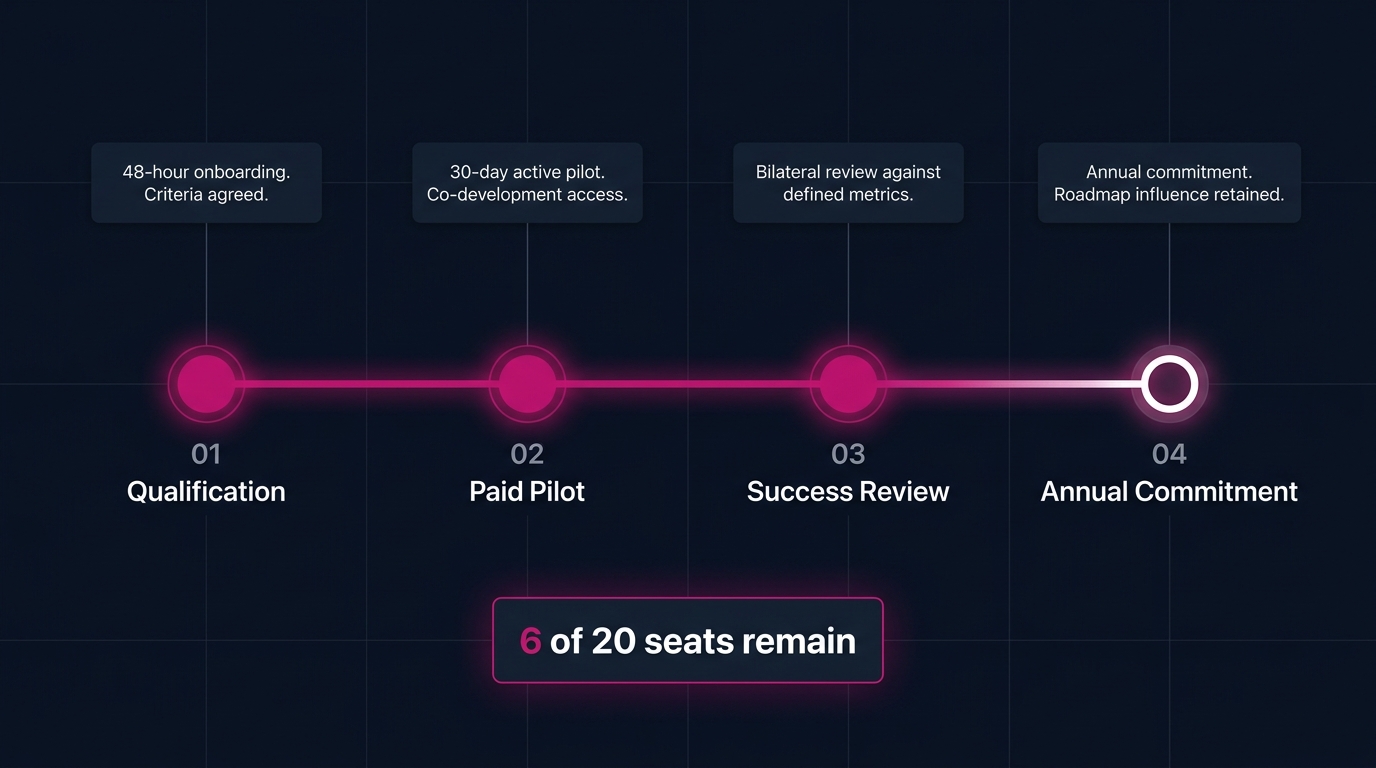
The Novaex Depth-First Pilot Sprint is a structured 90-day engagement for base metals trading desks. Twenty cohort seats exist. Several are already allocated. The pathway below maps every stage (qualification, pilot sprint, criteria review, and annual commitment) with concrete deliverables at each step so you know exactly what you are committing to before you apply.
If your desk manages active positions across LME, COMEX, MCX, or SHFE and your current metals trading platform requires manual reconciliation between exchange data and your risk reports, this pilot is designed for that specific workflow failure.
Why Base Metals Desks Are Leaving Legacy CTRM Platforms
Base metals trading desks operate across four major exchanges simultaneously, each with unique prompt date structures, settlement currencies, and margin mechanics. No other commodity asset class demands that level of multi-venue coordination from a single operations center.
According to a 2023 Commodity Technology Advisory (ComTech) survey, only 31% of commodity trading firms rated their existing CTRM platform as meeting current operational needs. CTRM platform industry satisfaction research The remaining 69% reported consistent gaps in real-time position aggregation, exchange integration, or both.
The operational consequence is measurable. According to research published by the International Energy Risk Association, trading operations teams spend an average of 2.1 hours per day on manual reconciliation tasks. trading operations efficiency research That time is extracted from execution decisions and hedging analysis, precisely when market conditions demand full attention.
What Should Metals Traders Look for in a Position Management Platform?
A metals-specific position management platform must aggregate live exchange data from LME, COMEX, MCX, and SHFE into a single normalized view, reconcile physical cargo positions against financial hedges without manual intervention, and deliver real-time delta and basis risk calculations across all active tenor dates.
Generic multi-commodity platforms cannot meet these requirements because they are built for breadth rather than depth. The LME's prompt date structure, SHFE's yuan-denominated settlement, and MCX's INR-basis contracts each require unique normalization logic, which a generalist platform treats as an edge case rather than core infrastructure.
The operational test is direct: can your platform show you net copper delta exposure across all four venues, in your reporting currency, updated in real time, without a spreadsheet in the middle? If the answer includes any qualifier, the platform is not built for base metals operations.
According to the London Metal Exchange, average daily trading volume across base metals contracts exceeded $47 billion in 2023. LME annual market statistics A platform architecture that cannot handle exchange-native data normalization at that throughput is not a metals platform. It is a general CTRM with a metals configuration option.
Who Qualifies for the Depth-First Metals Trading Platform Pilot
The Depth-First Pilot Sprint is a production-grade engagement with defined deliverables, a structured review process, and a direct graduation pathway to annual commitment.
Qualification criteria are specific by design. Novaex accepts organizations that meet all of the following:
- Active base metals trading operations (physical, financial, or both) with documented positions across at least two of LME, COMEX, MCX, or SHFE
- Identifiable reconciliation friction: current workflow requires manual steps between exchange data and risk reporting at least once per trading session
- Operational authority: the designated pilot contact must have authority to evaluate and recommend platform adoption, not technical evaluation rights alone
- Implementation availability: a dedicated internal point of contact available for structured check-ins at weeks 2, 6, and 10 of the sprint
How Do Trading Teams Evaluate CTRM Platforms During a Pilot?
Effective CTRM platform evaluation requires testing against real production data, not synthetic scenarios. Trading teams should evaluate position aggregation accuracy against their current system of record, execution latency under live market conditions, and reconciliation time reduction against a documented pre-pilot baseline.
The critical structural requirement is that evaluation criteria must be agreed before the pilot begins, rather than determined during or after. A pilot without pre-defined success metrics is an extended demonstration rather than an evidence-based evaluation.
At Novaex, success criteria are documented and signed by both parties at the conclusion of Stage 1. According to Gartner research on enterprise software adoption, organizations that define measurable pilot success criteria before deployment are 2.3 times more likely to reach a confident deployment decision within their planned evaluation period. Gartner enterprise software evaluation research
Stage 1: Qualification Entry Criteria and Deliverables
What happens: A single structured call (45 to 60 minutes) between the applying organization's trading or operations lead and Novaex's implementation team. This is a technical and operational fit assessment, not a sales presentation.
Deliverable from Novaex: A written qualification decision within 48 hours of the call, with specific notes on the fit assessment and any pre-pilot configuration requirements for your exchange connectivity and position data structure.
Deliverable from the applying organization: A representative sample of your current position reporting output (a sanitized export, a screen share, or a structured workflow description) sufficient for Novaex to confirm integration architecture before the pilot begins.
Duration: Three to five business days from application submission to written qualification decision.
Organizations that qualify proceed directly to Stage 2 with a confirmed pilot start date. Organizations that do not qualify receive a written explanation of what would need to change before they could participate in a future cohort.
This structure is intentional. Placing unqualified organizations into a 90-day production engagement wastes the cohort seat and the applying organization's time. Qualification rigor is what makes the graduation rate a meaningful operational signal rather than a sales statistic.
Stage 2: The 90-Day Metals Platform Pilot Deliverables and Structure
The pilot sprint is a production-grade engagement. Novaex connects to your live or near-live data environment (exchange feeds, existing position records, or both) while the platform operates against real operational conditions for 90 days.
According to a 2022 Aberdeen Group study on enterprise software evaluation, organizations that pilot software against production data report 3.7 times higher confidence in deployment decisions compared to sandbox-only evaluations. Aberdeen Group software pilot research This is why the Novaex sprint requires production-environment access as a qualification condition, not an optional upgrade.
The sprint is structured in three phases:
Phase A: Integration and Baseline (Weeks 1, 3)
- Exchange connectivity confirmed and validated against your existing data
- Position baseline established: Novaex aggregate view reconciled against your current system of record
- Success criteria document finalized and signed by both parties
Phase B: Operational Testing (Weeks 4, 9)
- Daily position aggregation against live exchange data across all active venues
- Hedging workflow support: delta exposure tracking, basis risk monitoring, tenor management
- Three structured check-ins with the Novaex implementation team
- Performance log maintained for the Stage 3 criteria review
Phase C: Evidence Compilation (Weeks 10, 12)
- Full reconciliation accuracy report against the Phase A baseline
- Execution and latency benchmarks versus stated success criteria
- Workflow time reduction measurement (target: minimum 40% reduction in manual reconciliation time)
- Criteria review documentation prepared and shared with the applying organization before the Stage 3 session
What Is Included in a Metals Trading Platform Pilot Program?
The Novaex pilot includes live exchange integration for all active venues in your current operation, real-time position aggregation and P&L attribution, hedging workflow tools covering delta, gamma, and basis exposure, and dedicated implementation support throughout the full 90-day sprint.
Pilot participants receive complete data portability at the end of the sprint regardless of graduation outcome. Every position record, performance log, and reconciliation report generated during the pilot belongs to the participating organization. There is no data lock-in risk associated with evaluation.
How Long Does a CTRM Software Pilot Evaluation Take?
A rigorous CTRM evaluation requires a minimum of 60 to 90 days to capture representative market conditions, including at least one period of elevated volatility and one delivery cycle relevant to the organization's physical position structure.
Evaluations shorter than 60 days tend to capture only stable market conditions, which understates both the platform's advantage under stress and the legacy system's failure points. The Novaex sprint is set at 90 days to ensure the evaluation window is genuinely representative of live trading operations.
The LME copper market alone recorded six separate intraday moves exceeding 3% during Q1 2024. LME copper volatility data A pilot that does not run long enough to encounter those conditions has not evaluated the platform at the operational moments that define its actual value.
Stage 3: Criteria Review and What Determines Graduation
The criteria review is conducted at the end of week 12, after Phase C evidence compilation is complete. It is a structured evidence review against the success criteria both parties agreed and signed at the conclusion of Stage 1.
What Criteria Determine Graduation From Pilot to Full Deployment?
Graduation from the Novaex pilot to annual commitment requires meeting three measurable thresholds: a minimum 40% reduction in manual reconciliation time versus the pre-pilot baseline, position aggregation accuracy at or above 99.5% against exchange-reported data, and a written workflow improvement assessment verified by the designated internal point of contact.
Organizations that meet all three criteria are offered annual commitment terms at the exact pricing agreed at qualification, with no renegotiation and no scope adjustment.
The criteria review session includes four documented components:
- Reconciliation time comparison: pre-pilot baseline versus week 10, 12 average, measured in minutes per session, documented by the internal pilot contact
- Position accuracy audit: Novaex aggregate view versus exchange-reported positions across 20 representative trading sessions sampled from Phase B
- Workflow documentation: before-and-after workflow maps showing the manual steps eliminated or automated during the sprint
- Internal recommendation: a written statement from the pilot contact confirming whether the platform met, exceeded, or failed the operational requirements defined at qualification
Stage 4: Annual Commitment and Graduation Benefits
Organizations that graduate receive annual commitment terms covering full production deployment, continued exchange integration for all active venues, and access to new base metals modules released under the Depth-First methodology.
Annual commitment pricing is fixed at the rate agreed during qualification. The reconciliation time reduction documented during the pilot covers the annual commitment cost within the first quarter of deployment for desks operating at representative trading volumes. A desk eliminating 2.1 hours of daily manual reconciliation recovers approximately 500 staff-hours annually. At any professional trading salary, that figure exceeds a mid-market CTRM annual commitment cost by a material margin.
According to research from the Commodity Markets Council, trading desks that fully integrate position management and risk analytics into a single platform reduce their effective cost of risk by an average of 12 to 15 basis points per transaction compared to desks operating with fragmented data environments. Commodity Markets Council risk analytics research At meaningful trading volumes, that represents a major operational improvement and a structural advantage that compounds across every hedging decision the desk makes.
Annual commitment clients also receive priority access to new commodity modules as Novaex expands under the Depth-First methodology. Aluminum and zinc modules are in active development following the copper depth build. Annual commitment clients receive early integration access before new modules are offered to subsequent pilot cohorts, creating a sequencing advantage that grows in value as the platform's coverage expands.
The Application Window Is Closing: [X] Seats Remain
The current cohort has 20 seats. As of publication, [X] seats have been allocated to organizations that have completed the qualification stage. The remaining seats will be allocated in the order applications are received and qualified.
The application window closes when the remaining seats are filled. There is no waitlist for this cohort and no extended deadline. Organizations that do not submit before full allocation will be considered for the next cohort, which does not have a confirmed open date.
To apply, submit your pilot application at [Novaex Pilot Application URL].
The application takes approximately 10 minutes and requests:
- Organization name and primary exchange venues currently active
- Brief description of your current position management workflow
- Name and role of the designated pilot contact
- Preferred timing window for the qualification call
After you submit, the process is:
- Application review within 24 business hours
- Qualification call scheduled within three business days of receipt
- Written qualification decision within 48 hours of the call
- Pilot start date confirmed and integration architecture planning begins
To initiate the qualification process:
- Confirm your qualification: review the Stage 1 entry criteria above and verify your desk meets the operational and authority requirements Novaex qualification criteria detail page
- Submit your application: [Novaex Pilot Application URL] or contact [Pilot Program Contact Name] at [contact@novaex.com]
- Schedule your qualification call: the 45-minute structured assessment delivers a written fit decision within 48 hours