Metals Trading Platforms Have a Documented Gap Problem
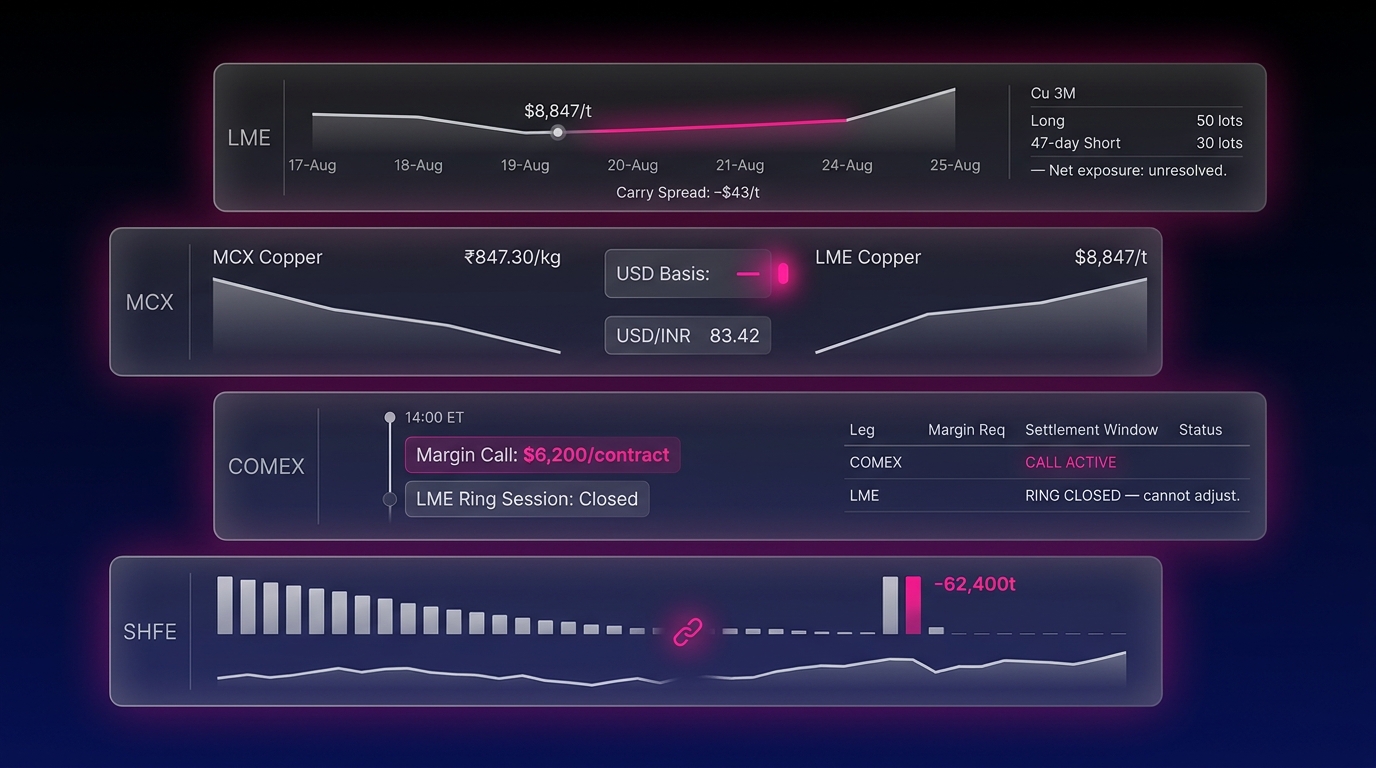
Multi-commodity platforms treat metals coverage as a checkbox: one market listed among many. The result is a specific, documented set of analytical failures: an inability to reconcile MCX backwardation structure against LME forward curves within the same position window, COMEX margin exposure that miscalculates during concurrent LME ring sessions, and SHFE warrant data delivered without the context needed to identify arbitrage windows. These are not configuration gaps. They are architectural ones.
Front-office desks running multi-exchange base metals exposure encounter these failures systematically. The diagnostic question is not whether they exist (the evidence is consistent) but whether each failure has been identified as a platform architecture problem or absorbed as a workflow workaround.
This article documents the specific analytical gaps that emerge when a generalist CTRM platform adds metals as a feature, and establishes why those gaps are structural, not addressable through better onboarding or additional modules.
The Checkbox Problem in Metals Trading Platform Design
The CTRM software market overview global CTRM/ETRM software market was valued at approximately $1.2 billion in 2023, according to analysis by Commodities Technology Advisory (ComTech). The majority of that market consists of platforms designed around horizontal coverage: adding commodities as modules rather than building exchange-specific depth first.
This architecture produces a predictable outcome: each new commodity receives the same generic treatment. Prices feed in. Positions net. Risk metrics calculate. The platform can accurately claim "metals coverage" because it satisfies every item on a capability matrix.
What the capability matrix does not measure is whether the metals-specific price behavior, exchange microstructure, and settlement mechanics are modeled correctly.
The Structural Complexity of Metals Trading
Multi-commodity platforms struggle with metals because base metals have exchange-specific structural features (LME's prompt date system, SHFE's warehouse warrant mechanics, MCX's INR-denominated contracts with domestic price policy sensitivity) that do not map onto generic commodity pricing modules. A platform built for energy and agriculture requires fundamental architectural changes to model metals accurately, not just a new data feed.
The LME runs prompt dates for every business day up to three months forward, weekly to six months, and monthly to ten years. No other major exchange operates this way. A platform that models forward curves as monthly or quarterly strips (adequate for crude oil or corn) produces structurally incorrect LME exposure calculations from the moment a prompt-date position is entered.
According to the London Metal Exchange, over $15.7 trillion in notional value was traded across its base metals complex in 2023. Treating that market as a variant of a standard commodity forward is not a minor analytical gap. It is a systematic misrepresentation of exposure.
LME Forward Curve Mechanics: Where Metals Trading Platforms Break First
The LME's prompt date system is the first place a generalist platform reveals its structural limitations, and the failure mode is specific.
When a trader holds copper across prompt dates (say, long 50 lots on the 3-month date and short 30 lots on a date 47 days forward), a platform using simplified curve modeling collapses these into a net position approximation rather than tracking discrete prompt-date exposure.
The operational consequence: carries and contango structures become invisible at the position level.
LME Prompt Dates vs. Standard Futures Contracts
LME prompt dates differ from standard futures contracts in that they represent specific daily delivery dates rather than monthly contract expirations. Every business day carries its own bid/ask spread, lending rate, and liquidity profile. This means a position described as "3-month copper" on the LME is a single discrete date, not a rolling monthly contract the way COMEX copper futures work.
According to LME market data, the spread between nearby and 3-month copper can move by $40, $80 per tonne within a single session during tightness events. A platform that flattens prompt-date granularity into monthly buckets will not capture this intraday exposure shift, and a risk manager reading the position summary will see a misleadingly flat profile.
This matters in documented practice. During the LME nickel market disruption of March 2022, intraday prompt-date spread movements exceeded $1,000 per tonne within hours. Platforms that aggregated positions by month rather than by prompt date reflected traders as flat who were, in fact, significantly exposed to the near-date squeeze.
That outcome was not produced by inadequate data. It was the predictable result of an architecture that cannot model what prompt-date granularity requires.
LME prompt date trading mechanics
MCX Backwardation and LME Forward Curves: A Simultaneous Position Problem
The following scenario illustrates the second major architectural gap.
A copper trading desk runs simultaneous exposure: long MCX copper futures (INR-denominated, Mumbai delivery) and short LME copper (USD-denominated, LME warehouses). The position is structured as a cross-exchange spread, capturing the MCX premium over LME that periodically opens due to Indian import duties, INR/USD movements, and domestic demand seasonality.
Accurate management of this position requires the following in a single position window:
- MCX futures price in INR, converted at live FX
- LME 3-month price with prompt-date granularity
- The implied basis in USD per tonne
- The backwardation or contango structure on each leg independently
- Aggregate USD P&L across both legs in real time
Managing Simultaneous MCX and LME Copper Positions
Most multi-commodity platforms can display both MCX and LME prices simultaneously, but displaying prices and modeling cross-exchange position economics are not the same capability. Accurate cross-exchange position management requires FX-adjusted basis tracking, exchange-specific term structure modeling, and the ability to compute aggregate risk in a single base currency without collapsing the individual legs. This is precisely where generalist platforms consistently fail.
According to MCX exchange data, copper futures average daily turnover on MCX has exceeded ₹4,200 crore in recent trading periods, a significant domestic market that Indian and international desks actively trade against LME benchmarks.
When a generalist metals trading platform models MCX copper as "copper price in INR," it strips out the structural information embedded in the MCX forward curve. MCX copper has entered periodic backwardation driven by domestic supply tightness with no correlation to LME forward structure.
A desk managing the cross-exchange spread cannot identify the backwardation/contango divergence between the two markets if the platform treats each as an isolated price feed rather than a component of a unified position model.
The gap is not data availability. Both prices are accessible. The gap is the analytical layer that transforms two separate prices into a coherent cross-exchange position with correctly modeled exposure on each leg.
COMEX Margin and SHFE Warrant Data: Two More Named Failures
The LME and MCX failures are the most commonly encountered, but they are not isolated. COMEX and SHFE each introduce a distinct class of analytical gap that generalist platforms handle incorrectly for the same underlying reason: each exchange was modeled as a data feed, not as a structural trading environment.
COMEX Margin Calculation During LME Ring Sessions
COMEX copper futures and LME copper are deeply linked: price discovery on one influences the other, and arbitrage desks actively trade the differential. But they operate on entirely different margin frameworks, settlement conventions, and trading hours.
COMEX copper settles daily via CME's standard margin framework. LME copper settles on prompt dates via the LME's own clearing structure. A desk running long COMEX / short LME as an arb position is exposed to asymmetric margin calls: a COMEX margin call can trigger during hours when LME positions cannot be adjusted because the ring is closed.
According to CME Group, initial margin requirements for COMEX copper futures have ranged from $3,000 to $9,000 per contract depending on market volatility, a range that can shift by 50% or more within a single week during high-volatility periods.
A generalist platform that calculates aggregate margin exposure across COMEX and LME without modeling the timing asymmetry of margin calls will reflect a desk as adequately capitalized when, in practice, one leg can trigger forced liquidation before the offsetting leg can be adjusted. That is a risk model architecture problem, not a display issue.
SHFE Copper Warrant Data and Exchange-Specific Interpretation
SHFE copper futures are backed by physical warehouse warrants stored in SHFE-registered warehouses across China. Warrant availability, inventory drawdowns, and registered brand discounts create a specific class of price behavior (physical delivery premiums and discounts) that directly affects the SHFE/LME price spread. A platform that treats warrant inventory as a standalone data field with no connection to the futures price model removes its entire analytical value.
According to SHFE data, copper warrant inventories have moved by 40,000, 80,000 tonnes within a single month during peak import seasons, shifts that reprice the SHFE/LME arbitrage from viable to uneconomic within days. A platform that cannot model warrant inventory against futures price structure is not providing metals coverage. It is providing a copper price with the most analytically significant contextual variable removed.
SHFE copper warrant mechanics and price impact
How These Gaps Compound Across Multi-Exchange Exposure
Each analytical gap documented above is significant individually. The more consequential problem emerges when a desk holds simultaneous exposure across LME, MCX, COMEX, and SHFE, which is not an edge case. It is standard operating practice for any mid-to-large base metals desk with global commercial exposure.
When four exchange-specific gaps operate simultaneously, the effect is not additive. It is multiplicative.
The aggregate risk management problem is precise: a metals trading platform that collapses LME prompt dates into monthly buckets, treats MCX as an isolated INR price feed, cannot model COMEX/LME margin timing asymmetry, and delivers SHFE warrant data without price context will produce a risk summary that is systematically incorrect on every leg of a multi-exchange position.
The Real Costs of Analytical Gaps
The real costs manifest in three areas: missed arbitrage windows due to delayed or incomplete cross-exchange spread visibility, incorrect hedge effectiveness calculations that create undisclosed basis risk, and margin management failures that force reactive liquidation rather than planned position adjustment. Each carries direct P&L consequences that compound across every trading session.
According to a 2022 Accenture study on commodity trading operations, firms that rely on manual data reconciliation between trading systems and market data sources lose an estimated 3, 7% of potential trading efficiency, a figure that compounds quickly across a desk with active multi-exchange metals exposure.
The manual workarounds desks construct to compensate (spreadsheet overlays, separate MCX pricing tools, standalone SHFE warrant trackers) are not evidence of operational discipline. They are evidence that the platform has not delivered the integrated analytical layer the workflow requires. The presence of a workaround marks the precise location of an architectural gap.
The Architecture Explains the Outcome
Multi-commodity platforms are not poorly engineered. They are correctly engineered for their stated design objective: broad commodity coverage across many markets with sufficient depth for the most common use cases in each.
The issue is definitional: base metals trading across LME, MCX, COMEX, and SHFE simultaneously is not a common use case for a generalist platform. It is the core use case for a metals specialist, and it requires an architecture designed around that workflow from the ground up.
Building metals coverage into a multi-commodity platform as a module means inheriting the platform's existing pricing model, curve structure assumptions, and position management framework, then fitting metals within it. LME prompt dates do not fit monthly curve buckets. MCX cross-exchange basis modeling does not fit isolated price feed architectures. SHFE warrant data does not fit a standard inventory field.
According to ComTech Advisory's 2023 CTRM market report, over 60% of commodity trading firms using multi-commodity platforms report maintaining parallel spreadsheet-based processes for at least one major commodity category. For metals desks trading across multiple exchanges simultaneously, that figure is almost certainly higher, given the exchange-specific complexity documented above.
The analytical gaps in this article are not bugs to be patched or configurations to be adjusted. They are the predictable output of a platform architecture that treats metals as one commodity category among many rather than as a distinct analytical domain with exchange-specific structural requirements.
CTRM platform architecture for metals trading
What Accurate Multi-Exchange Metals Analytics Requires: A Desk-Level Specification
For any desk running multi-exchange metals exposure on a generalist CTRM platform, the following questions define the analytical standard against which current platform capability should be evaluated: precisely, not optimistically.
On LME exposure:
- Does the platform track positions by discrete prompt date, or does it aggregate to monthly buckets?
- Is prompt-date carry exposure visible in real time within the position window, not in a separate analytics module accessed after the fact?
On MCX cross-exchange positions:
- Does the platform model MCX/LME basis as a live, FX-adjusted spread with independent term structure visibility on each leg?
- When MCX enters backwardation while LME remains in contango, does the position view reflect this divergence explicitly, or a single net price?
On COMEX/LME margin management:
- Does the risk model account for the timing asymmetry of COMEX daily margin calls against LME prompt-date settlement?
- Can a margin stress scenario be modeled on the COMEX leg independently from the LME leg within the same workflow?
On SHFE warrant data:
- Does SHFE warrant inventory connect analytically to futures price context, or does it arrive as a separate data field requiring manual interpretation against a second screen?
Where any of these questions cannot be answered affirmatively, the analytical gaps documented in this article are active in the current workflow. The manual processes absorbing those gaps carry a measurable cost in time, precision, and P&L, with the greatest exposure occurring precisely when markets move fastest.
What a platform architecture designed specifically around these requirements looks like (exchange by exchange, from LME prompt date modeling to SHFE warrant integration) is the subject of the next article in this series.
metals-first platform design requirements
Next in this series: What metals-first platform architecture actually requires: exchange by exchange.