Metals Trading Position Divergence Is a Governance Failure
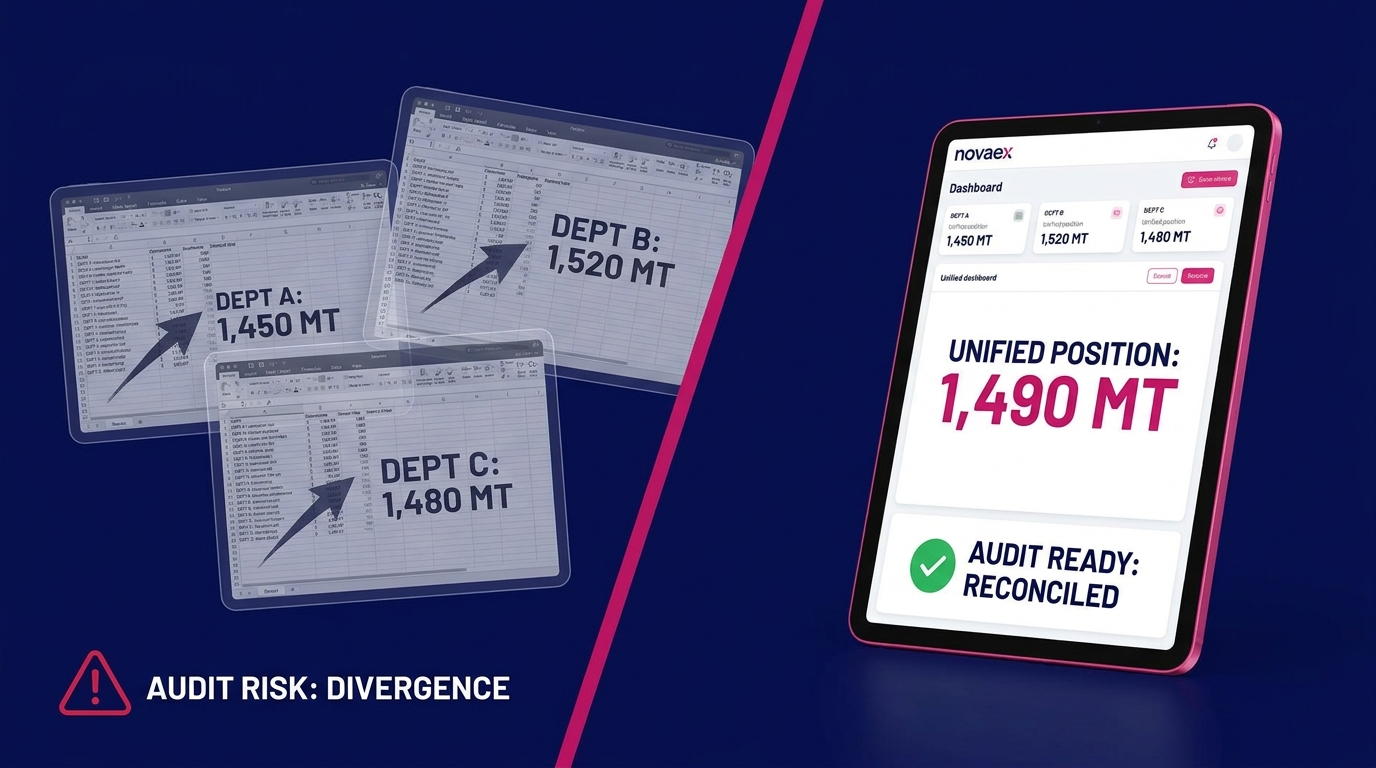
When front office, back office, and risk management each report a different position from the same portfolio, this represents a fundamental governance failure. Metals trading position divergence occurs when three departments process the same trade data through three separate systems, each applying different timing, netting logic, or valuation conventions. The divergence is structurally generated.
This distinction carries regulatory weight. According to the Basel Committee on Banking Supervision, position reconciliation failures rank among the top five recurring findings in commodity trading desk audits. In nearly every documented case, the root cause is departmental data architecture.
This analysis classifies the specific governance risks produced by departmental position divergence, identifies the audit finding categories those risks generate, and uses the FX Positions module as structural evidence that divergence is architecturally produced and therefore requires an architectural response.
The Three-Position Problem in Metals Trading
In most metals trading operations, position is not a single number. It is three numbers produced simultaneously from the same underlying portfolio.
The front office reports economic position: the net exposure the desk holds after accounting for all executed trades, hedges, and anticipated deliveries. The back office reports confirmed position: the net figure derived from settled and confirmed transactions only. Risk management reports modeled position: a risk-adjusted figure that may include hedge effectiveness classifications, scenario overlays, or haircuts applied under IFRS 9 or ASC 815.
Each figure is internally consistent. None of them agree.
The Causes of Position Divergence in Metals Trading Operations
Position divergence in metals trading results from three separate systems processing the same underlying trade data at different confirmation stages, applying different netting conventions, and updating at different intervals. Each system is technically correct within its own logic. The divergence is a product of architectural design.
While the systems produce technically correct outputs based on their inputs, they were never designed to produce the same unified output.
A front-office execution platform captures trades at entry, before broker confirmation, before back-office booking, and before risk adjustment. According to a 2023 survey by Accenture, 72% of commodity trading organizations report that front-office and back-office position figures differ by at least 3% on any given trading day. That gap, which most desks treat as routine, represents the documented baseline of an active governance problem.
The three-position problem compounds specifically in metals trading because of the layered complexity of LME prompt structures, COMEX calendar spreads, MCX contract specifications, and SHFE margin conventions. Each exchange applies distinct delivery, lot sizing, and settlement logic. Each departmental system interprets that logic through its own data model. Metals trading amplifies this structural divergence to the point of regulatory exposure.
Why Position Divergence Qualifies as a Governance Failure
A data inconsistency becomes a governance failure the moment an organization cannot respond to a direct regulatory inquiry with a single, authoritative number.
In metals trading, that moment arrives on a scheduled basis. LME position reporting thresholds, CFTC large trader reporting requirements, SEBI position limit filings on MCX; each requires the organization to submit a specific position figure at a specific point in time. When three departments hold three different figures, the organization must select one. That selection is itself an undocumented governance event.
Departmental Position Divergence as an Audit Trigger
Departmental position divergence triggers audit findings by creating documented inconsistencies between what the organization reports to regulators and what its internal systems record. Auditors compare exchange submissions against back-office ledgers, risk system outputs, and front-office records simultaneously. When those records disagree, auditors immediately classify the finding.
According to the International Swaps and Derivatives Association (ISDA), position reporting discrepancies are the second most common source of material weakness findings in commodity trading desk audits, behind only valuation methodology disputes. That ranking is significant: valuation disputes arise from judgment; two defensible methodologies producing different outputs. Position reporting discrepancies arise from structure. One portfolio, recorded by the same organization, producing different figures for different audiences.
The governance failure classification is precise. The organization recorded the data but failed to designate which version carries regulatory authority. An audit cannot accept an explanation for that failure. It classifies it.
The Structural Origin: How One Portfolio Produces Three Numbers
The technical mechanism has material governance implications. A single metals portfolio (500 LME copper lots hedged with 200 COMEX futures and a physical delivery position against a term contract) generates different position figures depending on which system reads it and when.
The front-office system reads the portfolio at trade entry. It sees 500 lots long, 200 lots short, and a physical delivery offset. It calculates net economic exposure: 300 lots long copper.
The back-office system reads only confirmed and settled records. If 40 LME lots are pending broker confirmation at end-of-day, the back-office position registers 460 lots long, not 500. The net figure becomes 260 lots long, a 13.3% variance from the front-office number, produced entirely by a confirmation lag.
Position Reconciliation and Compliance Significance
Position reconciliation is the process of comparing position figures across systems to identify and resolve discrepancies before those discrepancies enter regulatory reports, management decisions, or risk calculations. It matters for compliance because unreconciled positions create the documented evidence that auditors classify as control failures, specifically evidence that the organization's internal systems did not agree with its regulatory submissions.
Risk management then reads the same portfolio through a third lens. The risk system applies hedge effectiveness tests under IFRS 9, reclassifying a portion of the COMEX hedge as speculative if effectiveness falls below the 80% threshold. The hedged position shrinks. The net figure changes again. Three reads of the same portfolio, three different numbers, all produced before the trading day closes.
According to a study published by the Energy Risk Management Institute, commodity trading firms spend an average of 14.7 staff-hours per week on manual position reconciliation. That labor exists entirely because three systems produce three figures from the same portfolio. This represents a recurring cost generated by an architectural decision to permit departmental systems to operate on separate data sources.
Specific Audit Findings Produced by Departmental Divergence
The governance risk of metals trading position divergence produces specific, classifiable audit findings. Organizations that have received escalated audit outcomes will recognize these categories.
Finding Category 1: Position Reporting Inconsistency.
The organization submitted a position figure to a regulatory body that differs from the figure recorded in the back-office system of record. The discrepancy exceeds materiality thresholds. The auditor cannot determine which figure is authoritative because no documented policy designates one.
Finding Category 2: Inadequate Segregation of Position Authority.
No documented policy establishes which department's position figure carries regulatory reporting authority. The absence of a designated position of record means the organization exercises discretion in regulatory submissions without a documented basis for that discretion, a condition auditors classify as a control gap.
Finding Category 3: Ineffective Reconciliation Controls.
The organization performs manual reconciliation between front-office, back-office, and risk system position figures after regulatory cut-off times, meaning submitted figures cannot be verified against reconciled data. Alternatively, reconciliation tolerances permit variances that exceed the precision requirements of exchange position reporting.
Regulatory Consequences of Position Reporting Failures
Position reporting failures in commodity trading can result in exchange-mandated position limit reviews, CFTC or FCA enforcement actions for large trader reporting inaccuracies, and internal audit escalations to board-level risk committees. According to the London Metal Exchange's 2023 member guidance, inaccurate prompt-date position reporting is among the top three compliance triggers for LME membership reviews, a directly operational consequence.
Finding Category 4: Control Environment Deficiency.
The three-system architecture creates a structural control gap. No system owns the position of record. Auditors classify the absence of a designated authoritative source as a control environment deficiency, a material weakness designation that triggers heightened supervisory oversight and mandates remediation documentation across multiple audit cycles.
Finding Category 5: Risk Calculation Integrity Failure.
When risk management calculates VaR, delta exposure, or stress test results using a position figure that differs from the confirmed back-office position, the risk calculation output is technically unreliable. This finding category is particularly consequential because it cascades: every downstream risk decisions (hedging instructions, limit utilization assessments, margin calls) rested on a number that cannot be validated against the organization's system of record.
According to PricewaterhouseCoopers' 2022 Commodity Trading Risk Management Survey, 61% of commodity trading organizations that received escalated audit findings in the prior two years cited position reporting infrastructure as a contributing factor. These five finding categories are the documented outputs of the three-position architecture that most metals trading operations have normalized.
The FX Positions Module: Architectural Evidence of the Root Problem
The FX Positions module within Novaex serves as structural evidence here because its architecture demonstrates precisely how the three-position problem is generated and why it requires a structural response rather than a procedural one.
In conventional multi-asset CTRM platforms, currency positions follow the same fragmented logic as commodity positions. The front office captures FX exposure at trade booking. The back office captures confirmed FX settlements through a separate process. Treasury maintains a third FX position view for hedging and cash management purposes. Three systems, three figures. This is an identical structural failure mode in a different asset class, stemming from the same underlying cause.
Eliminating Position Discrepancies Across Departments
Eliminating position discrepancies across departments requires a single authoritative data source from which all departmental views are derived rather than synchronized to. Synchronization implies periodic alignment between separate systems. Derivation means every departmental view is computed from the same underlying record, with differences in representation made explicit and documented rather than produced as an unintended architectural byproduct.
The Novaex FX Positions module maintains a single position ledger from which front-office, back-office, and risk views are all derived. The confirmed position is not a separate system's output; it is a filtered view of the same ledger, with the confirmation-status filter documented as part of the position governance policy. The risk-adjusted position applies a documented methodology to the same underlying data, rather than to a downstream export that may reflect a different state of the portfolio.
This architecture eliminates the structural condition that produces divergence. An auditor reviewing the organization's position records finds one ledger, one source of truth, and three documented views, each with a traceable derivation methodology that can be reproduced, tested, and defended.
According to Gartner's 2023 Market Guide for CTRM/ETRM platforms, **organizations that consolidate position management onto a single authoritative data source reduce position reconciliation workload by 68% on average and demonstrate materially improved outcomes in operational risk audits. That reduction follows from eliminating the structural cause of divergence at the point where it is architecturally produced.
LME position reporting compliance requirements
What Genuine Position Governance Requires in Metals Trading
Position governance in metals trading is fundamentally an architectural question. A policy can designate the back-office position as authoritative for regulatory reporting. That designation is operationally meaningless if the back-office position is calculated from different data than the front-office position at a different point in time.
Genuine metals trading position governance requires three structural conditions, none of which can be satisfied by policy language alone.
Condition 1: A Single Position Ledger.
All departments must compute their position views from the same underlying record. The front-office view, the back-office view, and the risk view must be derivations of one ledger, rather than outputs of three systems attempting reconciliation after the fact. The ledger is the governance artifact. The views are the operational interface.
Condition 2: Documented Derivation Logic.
The methodology that transforms the single ledger into each departmental view must be documented, auditable, and consistent across reporting periods. If the back-office view includes only confirmed and settled records, that filter must be documented in the position governance policy. If risk management applies hedge effectiveness thresholds under IFRS 9, those thresholds must be part of the documented derivation, rather than embedded in closed system configurations.
Condition 3: A Designated Position of Record.
The organization must designate one position figure as the authoritative source for regulatory reporting before the reporting period begins, rather than retroactively. That designation must be traceable to the single ledger and consistent with the documented derivation logic for the designated view.
Without these three structural conditions, the organization is not managing metals trading position divergence. It is tolerating it and absorbing the audit findings that the structure reliably produces.
In base metals specifically, the complexity compounds in ways that make structural weakness acutely visible. LME three-month positions interact with prompt-date structures that carry different delivery obligations on different calendar dates. COMEX monthly contracts have distinct margining and settlement logic. MCX near-month expirations introduce physical delivery requirements that affect position netting differently than financial settlement. A system that aggregates position across these exchange structures without exchange-specific logic will misrepresent the portfolio regardless of synchronization precision between departments.
According to the CME Group's 2023 Commodity Trading Compliance Framework, organizations managing cross-exchange metals positions face a 2.3x higher probability of position reporting discrepancies compared to single-exchange operations, precisely because cross-exchange netting logic varies by system implementation rather than standardized methodology. That multiplier is structural. It does not diminish with more rigorous manual reconciliation.
cross-exchange metals position netting methodology
IFRS 9 hedge effectiveness documentation requirements
The Governance Case, Concluded
Metals trading position divergence is a governance failure from the moment the architecture permits three systems to produce three figures from the same portfolio. That architecture guarantees the conditions that produce every finding category documented above.
The FX Positions module provides structural evidence that the problem is architectural and that the structural response (a single position ledger with documented derivation logic for each departmental view) eliminates the divergence at its source. It ensures the architecture never permits them to diverge in the first place.
For metals trading organizations evaluating their current exposure, three immediate actions are specific and executable:
- Audit your position architecture. Identify every system that produces a position figure from your portfolio. Determine whether those systems share a single underlying data source or operate on separate inputs with periodic synchronization. The answer to that question defines whether a governance problem exists.
- Map your audit history to the five finding categories. Review your last two completed audit cycles for position reporting inconsistency, inadequate position authority segregation, ineffective reconciliation controls, control environment deficiency, and risk calculation integrity failure. If any of those categories appear, the structural condition that produced them remains present.
- Evaluate your position-of-record policy. Confirm whether your organization has a documented policy designating which position figure carries regulatory reporting authority and whether that designation was made before the reporting period or selected retroactively. The answer defines whether you have a governance policy or a governance gap.
metals trading CTRM platform evaluation criteria