Nickel basis risk: what it actually costs on an export book
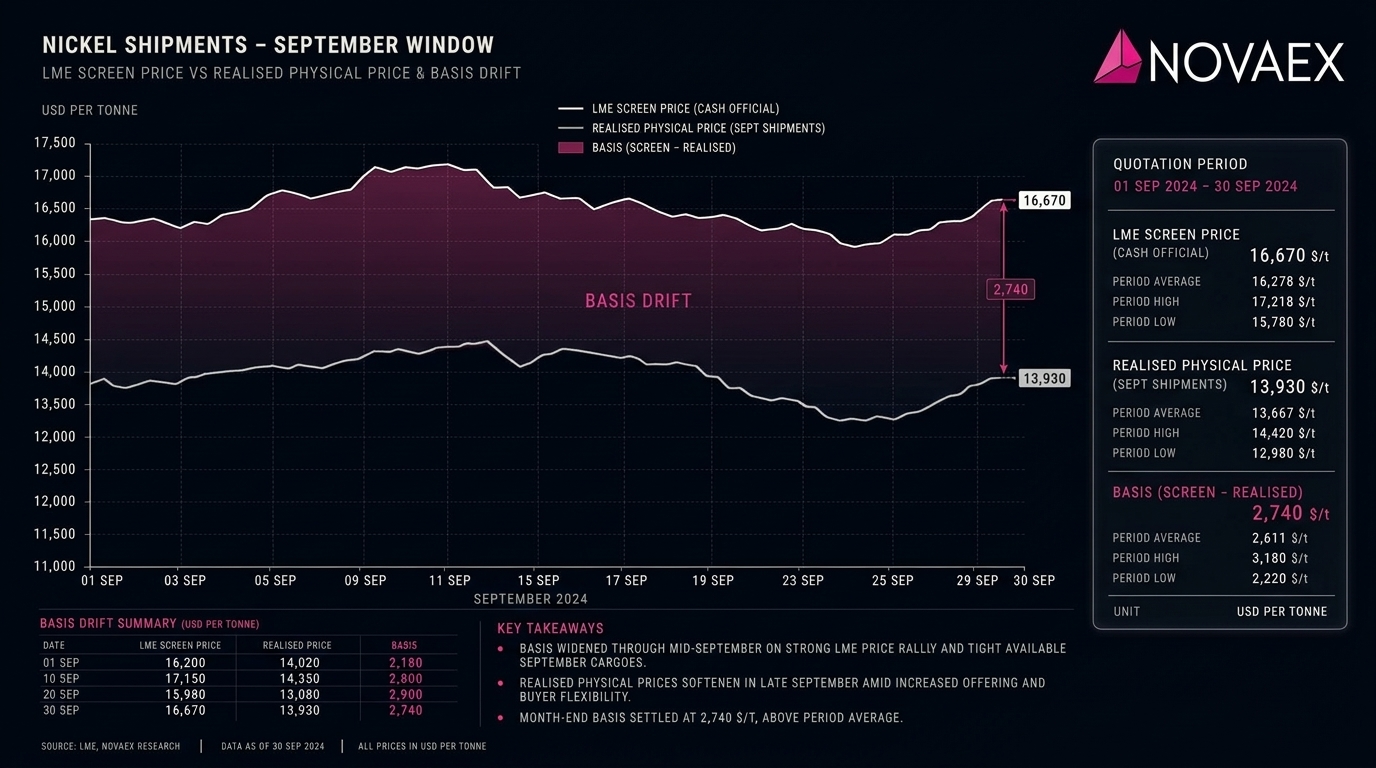
Screen price is not realised price. A three-shipment method for pricing nickel basis in dollars per tonne, and the hedge fix it points to.
Nickel basis risk is the dollars-per-tonne gap between the LME screen price you hedge against and the physical price you actually realise after premiums, grade, location and quotation-period timing. On an export book, measure it per shipment as screen average minus realised price, then total it across three shipments. That total is what your hedge left exposed.
How is nickel basis different from a price move?
Nickel basis is the difference between the LME reference price and your realised physical price for the same tonnage. The screen can stay flat while your basis widens, because premiums, grade differentials, port location and quotation-period timing move on their own terms.
The LME describes this structure directly: physical contracts reference LME prices for the underlying metal, which leaves premiums and discounts for location, form and refining stage outside the hedge. That unhedged portion is where nickel basis lives.
For an export book, that means two ledgers matter. The screen ledger shows what the hedge covered. The physical ledger shows what the buyer paid after premium and adjustments. Basis is the space between them, in dollars per tonne.
How do you measure realised basis on a shipment?
Take one shipment and hold screen and physical side by side over the same quotation period. Record the LME average for the quotation period, record the realised physical price net of premium and adjustments, then subtract.
Realised basis per tonne equals LME quotation-period average minus realised physical price. Multiply by shipped tonnage for the shipment cost. Repeat for three shipments and add the three costs.
The lots below are illustrative, labelled so they read as method rather than market data:
Early Sept lot, M+1 QP — 142 t · LME QP average $16,214/t · Realised physical $15,937/t · Basis -$277/t · Shipment cost $39,334
· Mid Sept lot, M+1 QP — 138 t · LME QP average $15,842/t · Realised physical $15,517/t · Basis -$325/t · Shipment cost $44,850
· Late Sept lot, M+2 QP — 145 t · LME QP average $16,038/t · Realised physical $15,786/t · Basis -$252/t · Shipment cost $36,540
Across those three illustrative lots: 425 tonnes shipped, 120,724 dollars of basis between screen and realised. At 142 tonnes, 277 dollars per tonne gives 39,334 dollars; at 138 tonnes, 325 dollars gives 44,850 dollars; at 145 tonnes, 252 dollars gives 36,540 dollars. The arithmetic stays attached to each lot so audit can follow it line by line.
Run the same three lines on your last three export lots. Pull the quotation-period average from broker confirmations, pull realised from invoices net of premium and adjustments, and keep both dates in the sheet. If the two periods do not match, note the mismatch rather than forcing the average to fit.
Why does nickel basis move harder than copper or aluminium?
Nickel trades thinner liquidity and wider swings than the larger base metals, which leaves less room for a mistimed quotation period or a mis-set premium.
The record here is public. In March 2022 LME nickel rose from 27,080 dollars to 101,365 dollars per tonne in three trading days before the LME suspended trading, an event covered in Fastmarkets summaries of the suspension and in reporting on the independent review. Trading resumed under disruption, and liquidity took time to rebuild.
That history still shapes the contract. The LME now operates daily price limits and price bands, with a Multiple Day Framework in place since June 2024 for contracts held at limit across sessions. Oversupply pressure added a second leg: LME warehouse stocks built through 2024 and 2025, reaching 254,364 tonnes by late November 2025 according to Investing News coverage of year-end stocks, with Trading Economics noting 271,000 tonnes in early September on soft downstream demand and Indonesian ore flow.
Thin liquidity plus volatile physical premiums means the screen hedge covers less of your realised outcome than the same hedge would in copper. Measure accordingly.
What hedge adjustment does your basis imply?
A measured basis points to a specific fix. A persistent negative basis across three lots usually traces to one of three causes: quotation periods that sit a month apart from physical pricing, a premium assumed flat that actually floats, or tonnage hedged to screen weight rather than assayed nickel content.
Match the hedge quotation period to the physical quotation period first. Where the physical premium floats, separate it from the screen hedge and track it as its own exposure rather than burying it in the futures result. Where grade varies, hedge to payable nickel tonnes and leave the uncovered remainder visible. The companion piece on copper quotation-period mismatch carries the worked version of the same method.
LME and MCX pricing sits live on screen in our own view; COMEX and SHFE values are computed into the arbitrage view rather than displayed live. The call stays the same shape regardless of venue: which contract, which prompt, and how much tonnage it actually covers.
Pull your last three nickel shipments and price screen against realised in dollars per tonne.
Measure three shipments this week and re-set the quotation period before the next fixture lands.