Position limits and reporting: what UK and EU regimes ask of a metals book
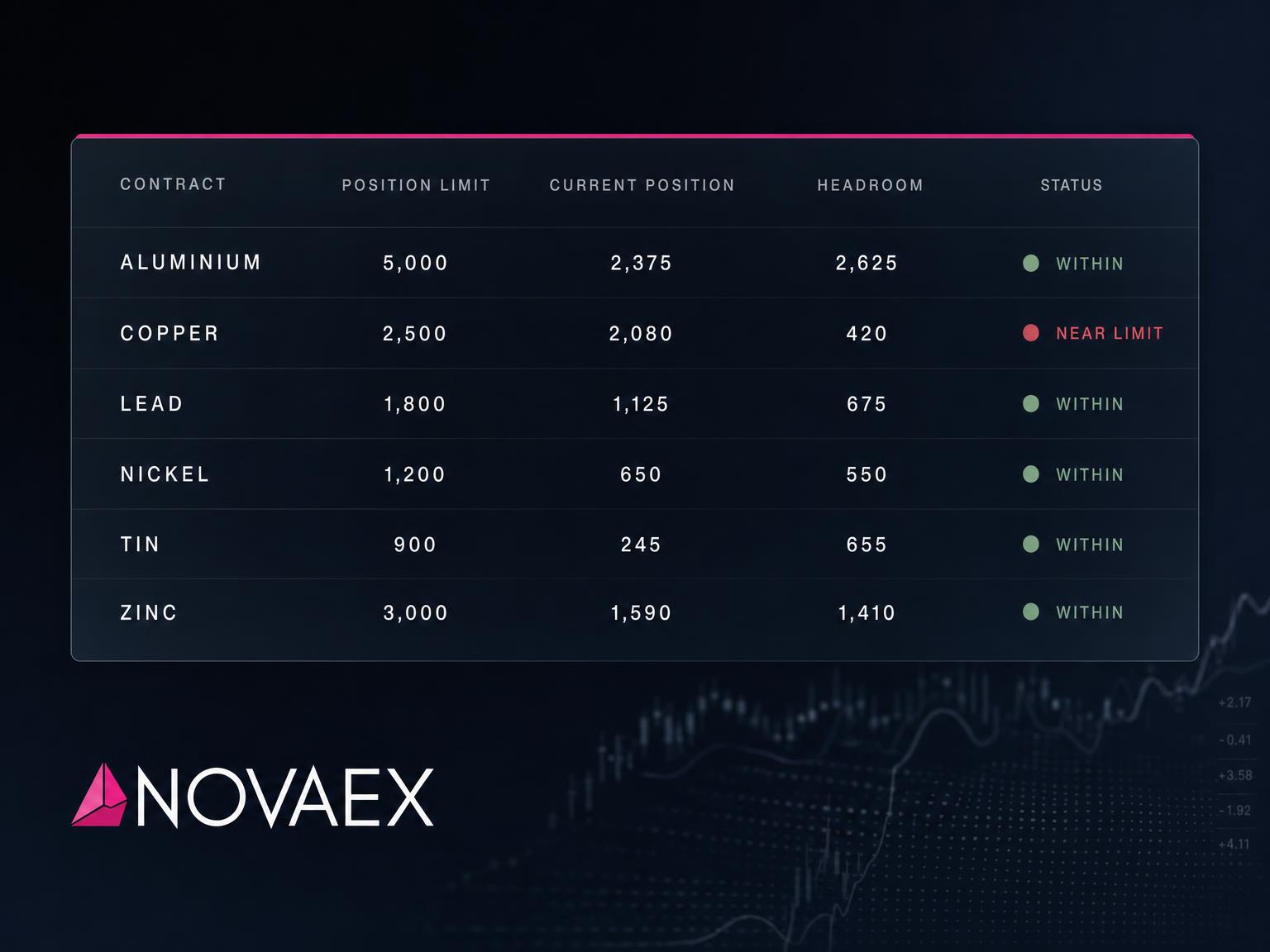
UK limits move to the LME on 6 July 2026; EU limits stay with authorities under Article 57. What each regime counts, reports, and asks you to prove.
A UK or EU metals book has to answer three questions on demand. What is the net position by contract. How far is it from the limit. What commercial exposure does each exempt tonne cover.
In the UK, the revised regime in the FCA policy statement on commodity derivatives reform applies in full from 6 July 2026, with the LME setting and administering limits for six LME metals contracts and their related contracts. In the EU, MiFID II Article 57 still puts limit-setting on competent authorities for agricultural and critical or significant contracts. Both regimes count economically equivalent OTC contracts alongside on-venue positions, both keep a hedging exemption for commercial risk, and both let the venue ask for the working behind the number.
This is not legal advice. It is the operational read: what has to be reported, how often, and what file you would open if asked today.
What counts as a limit in the UK now?
The UK position is that only critical contracts carry hard limits, and the venue sets them. The Mayer Brown FAQs on the final position limits framework set out the shape: 14 critical contracts, six of them LME metals. Aluminium, copper, lead, nickel, tin and zinc. All rules apply from 6 July 2026, with existing exemptions running to 5 July 2026.
The LME update on implementing PS25/1 confirms the handover. From 6 July 2026 the LME takes over setting and administering position limits from the FCA.
Limits apply to a net position in the critical contract plus all related contracts, including economically equivalent OTC contracts. Related has a fixed meaning here. Options on the critical contract. Minis and spreads where one leg is the critical contract. Options, minis and spreads on those related contracts. Venues must also consider adding contracts that could influence pricing or settlement of a critical contract, or that could be used to go around the limit with comparable exposure. Netting is not automatic where netting would hide the risk to orderly pricing and settlement.
Alongside each limit sits an accountability threshold. The threshold is not a limit. It is the point where the venue can ask what the position is for and what sits behind it, and in some cases ask for a reduction. The UK requires thresholds for spot months, where expiry risk is highest, with venue discretion for other months. Limits cannot be breached. Thresholds trigger a conversation that can end in a direction to reduce.
What counts as a limit in the EU?
The EU position still starts with the ESMA text of Article 57 on position limits. Member States must ensure competent authorities set and apply limits on the net position a person can hold at all times in agricultural commodity derivatives and in critical or significant commodity derivatives traded on venues, plus economically equivalent OTC contracts. A contract counts as critical or significant where end holders' open interest averages at least 300,000 lots over a year.
Competent authorities set the numbers from ESMA's calculation methodology, notify ESMA, and ESMA publishes an opinion on whether each limit fits the methodology and the Article 57 aims. Prevent market abuse. Support orderly pricing and settlement, including convergence between delivery-month prices and spot. Limits must be transparent and non-discriminatory, and they must state how they apply to different users of the contract.
Venue controls sit in the same article. A venue that trades commodity derivatives must run position management controls, including monitoring open interest, obtaining information on size, purpose, beneficial ownership and related exposures, requiring a reduction, and in a temporary case requiring liquidity back into the market to steady a large or dominant position.
The UK and EU now diverge on who sets the number. The venue sets it in London. The authority sets it in the EU. The question both ask the book is the same.
What has to be reported, and how often?
Three layers matter for a metals book.
First, the LME daily position report. Members file a daily Commodity Position Report covering on-exchange and OTC positions, by 08:30 on the next business day. That is the file the LME uses to see an accountability threshold being approached in time to ask.
Second, the MiFID II venue reports under Article 58. Venues publish a weekly public report with aggregate positions by category of holder, in the Commitment of Traders style, and send daily and weekly position breakdowns to the national competent authority. The ICE Futures Europe MiFID II reporting page describes the weekly Commitment of Traders report published after Wednesday under Article 58, and ESMA's trading page sets the weekly aggregate publication duty in the same terms.
Third, the venue's standing information power. Both regimes let the venue ask for the detail behind a position. Size and purpose. Beneficial or underlying owner. Concert arrangements. Related assets or liabilities in the underlying. Positions in the same underlying held on other venues or OTC, reached through members and participants. The UK framing gives venues discretion over what OTC data they collect from members and clients, with metals already carrying periodic OTC reporting.
A house that files the daily report and keeps the weekly public number in view still needs the third layer on file. The ad hoc request is the one that tests whether the book joins up.
What does an exemption actually ask you to prove?
Both regimes keep the commercial hedge out of the limit, but neither grants it on assertion.
In the UK, the hedging exemption stays for non-financial firms, with venues required to test whether the position could be unwound in an orderly way, including size against open interest and current liquidity. Venues must refuse where it could not. Two further exemptions sit beside it. A passthrough for financial institutions carrying risk mitigation for a hedging non-financial firm. A liquidity-provider exemption where the firm meets venue obligations to provide liquidity. Venues must also consider an exemption ceiling, sized to the firm's current and expected activity over the year ahead, its credit standing, risk management and experience.
In the EU, Article 57 keeps the same shape. Positions held by or for a non-financial entity that are objectively measurable as reducing risks directly linked to commercial activity sit outside limits, alongside qualifying passthrough positions inside predominantly commercial groups and qualifying liquidity-provision positions.
The operational point is identical in both. Exempt does not mean unmonitored. A large exempt position that cannot be unwound in stress still draws attention.
What would you have to produce on demand?
If the venue or authority asks this week, the request lands in the same four places.
Net position by contract, spot month split from other months, on-venue and OTC aggregated in the way each regime's netting rules allow. Headroom to limit and distance to each accountability threshold, by contract. Hedge linkage: which physical tonnage or commercial exposure each derivative position reduces, with quotation period and maturity visible. Ownership and control: who holds the position, on whose behalf, and what related positions sit in the same underlying elsewhere.
Most desks can answer the first two from broker statements. The third is where the request usually stalls, because physical tonnage lives in the CTRM or ERP, hedges live with the broker, and the link between them is reconciled at month-end. That is the artefact this article points at. One table by contract with headroom and breach columns, and the trail behind every line.
The check to run before the desk opens
Pull one LME metal for last Friday. Rebuild the net position across venue and OTC, split spot from other months, mark headroom to limit and to threshold, and attach the hedge linkage line by line.
If that file is not to hand, that is the gap to close before the venue asks for it.