Real-Time Basis Analysis: Audit Your Four-Exchange Stack
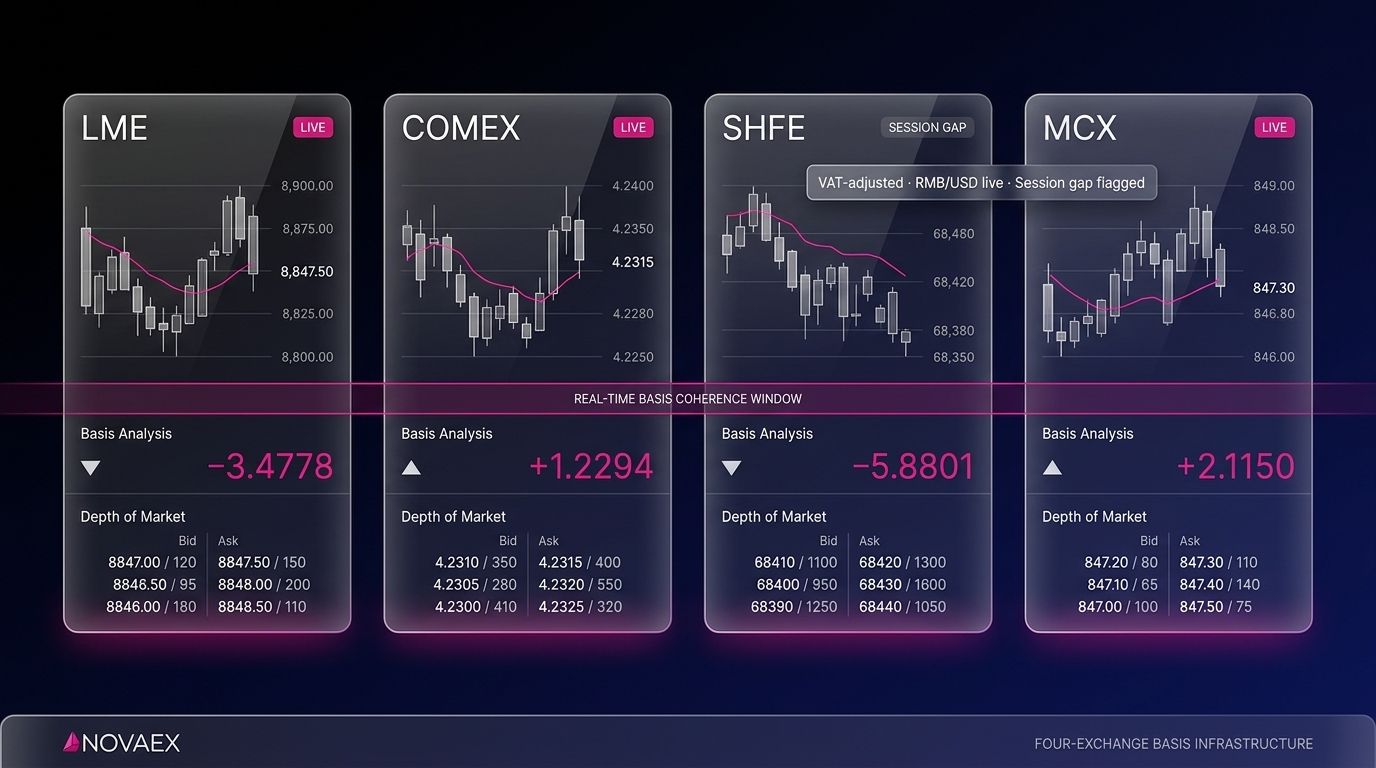
Real-time basis analysis across LME, COMEX, SHFE, and MCX simultaneously requires four independent data streams, contract-specific spread logic, and session-aware latency handling at each venue. Most mid-market data stacks deliver one or two exchanges at adequate fidelity. This diagnostic framework identifies precisely where your coverage falls short: exchange by exchange, instrument by instrument.
Basis analysis demands a specific intersection of depth, speed, and cross-venue coherence that general-purpose data infrastructure was not architected to deliver, even when current tools provide adequate data. When copper moves on SHFE at 02:00 London time, your platform must have a price that is contract-granular, latency-stamped, and instantaneously comparable to its LME three-month equivalent.
According to the London Metal Exchange, the LME processes over $14.6 trillion in notional annual turnover, making it the largest base metals exchange in the world by traded value. That scale creates a reference price environment every metals trader depends on. However, depending on a price and analyzing basis against it in real time are two entirely different operational requirements.
This post gives you a four-exchange evaluation rubric. Each exchange is assessed on what real-time basis analysis actually demands at that venue. Work through each section against your current data stack. The gaps will be precisely locatable.
Actual Requirements For Real-Time Basis Analysis
Before auditing by exchange, the functional baseline needs to be clear. Real-time basis analysis goes beyond price streaming. It requires the continuous, simultaneous calculation of the spread between a physical or forward position and the relevant exchange-traded contract, adjusted for location, quality, and time premium differentials at the moment of decision.
That definition carries four operational requirements:
- Contract-level price resolution: Specifically, the exact prompt date or futures month driving the hedge rather than just a spot price.
- Sub-second feed latency: Basis relationships can shift significantly in under 500 milliseconds during active sessions.
- Cross-venue timestamp coherence: Spreads calculated between two exchanges are only analytically valid if the underlying prices share a comparable observation window.
- Carry and premium disaggregation: Basis requires stripping contango, location premia, and quality adjustments to isolate the true spread signal, rather than simply subtracting one price from another.
Most platforms satisfy requirement one. Very few satisfy all four simultaneously across more than two exchanges.
Distinguishing Price Data From Basis Infrastructure
Price data delivers a number, while basis infrastructure delivers a relationship. The distinction matters because a hedge decision driven by a price alone (without the disaggregated carry and premium components) is structurally incomplete.
A trader acting on a LME/COMEX copper spread without contract-granular prompt alignment is merely approximating basis. Approximation requires a different risk posture than true analysis. In active markets, the gap between them is a P&L event.
The LME Diagnostic: Where Real-Time Basis Analysis Starts
The LME is architecturally unlike any other exchange. Its prompt date system (daily dates out to three months, weekly to six months, monthly to 63 months) means that basis analysis at LME functions continuously across a moving date curve rather than acting as a spread calculation between two fixed contracts.
For real-time basis analysis, you must verify whether your data stack resolves individual LME prompt dates in real time, or if it aggregates to a cash or three-month reference price.
Most CTRM integrations resolve to the three-month contract. That is analytically adequate for position tracking. It is insufficient for basis trading, where the spread between a physical prompt and the three-month benchmark (the TOM/NEXT carry component) is itself a tradeable signal.
According to LME published statistics, daily volume across all traded metals averages approximately 1.5 million lots, with a significant proportion executed on dates other than the headline three-month contract. A data stack that collapses LME into a single forward price is missing the instrument-level resolution that basis analysis requires.
Resolving LME Prompt Dates In Real Time
If your platform shows a single "LME Copper" price rather than date-specific bid/ask pairs across the forward curve, you have a reference price instead of real-time basis analysis at LME. Those serve different analytical purposes.
The test is specific: pull your LME copper data and verify whether you can see the spread between the cash price and the 15-day forward in real time. If you cannot, your LME basis coverage fails at the instrument level before any cross-venue calculation begins.
Carry disaggregation is the second failure point. The LME contango or backwardation structure directly affects hedge cost. A platform that does not separate the carry component from the outright price cannot determine whether a basis widening reflects a true spread move or a shift in the funding curve. Those two signals require different responses.
The COMEX Diagnostic: Real-Time Basis Analysis Under U.S. Session Pressure
COMEX copper and aluminum futures operate on a fixed monthly expiry calendar, which is structurally simpler than LME. However, simplicity in contract structure still requires complex basis analysis. The key metric at COMEX involves session depth and volume concentration.
COMEX copper futures average approximately 120,000 contracts per day in daily volume, according to CME Group market data. That volume is highly concentrated: roughly 70% of daily activity occurs in the first three hours of the U.S. session. For basis analysis, this means the LME/COMEX spread during the New York open is a qualitatively different signal than the same spread calculated at 14:00 London time.
Your data stack must preserve session-aware context when calculating basis across LME and COMEX simultaneously, rather than treating both prices as equivalent observations regardless of when they were generated.
Maintaining Basis Coherence During The Simultaneous LME/COMEX Open Window
There is a 45-minute overlap between LME Ring trading activity and COMEX open interest buildup where both exchanges are generating high-fidelity price signals. This window is when LME/COMEX basis is most actionable, and most demanding on data infrastructure.
A platform that buffers COMEX prices or introduces feed latency during this window will show a basis figure that is numerically present but analytically stale. According to CME Group market microstructure research CME Group research on market microstructure, latency differentials as small as 200 milliseconds during high-volume windows materially affect spread calculation accuracy.
The instrument-level failure mode at COMEX is front-month rollover basis. At COMEX, the transition from one front-month contract to the next creates a roll spread that, if not handled at the contract level, causes basis figures to jump artificially. That is a data artifact. It remains indistinguishable from a market signal without proper roll management.
The SHFE Diagnostic: Where Standard Data Infrastructure Reaches Its Structural Ceiling
The Shanghai Futures Exchange is where the majority of mid-market data stacks reveal their structural limitations. SHFE copper futures are among the most actively traded base metals contracts in the world (SHFE reported annual copper futures volume exceeding 50 million lots in recent reporting periods). The exchange operates across a different timezone, denominated in RMB, and with position reporting requirements tied to Chinese regulatory frameworks.
For a metals trader in London or New York running a cross-venue basis strategy, the platform must verify whether those SHFE prices are:
- FX-adjusted in real time: RMB/USD conversion at the exact moment of the spread calculation rather than a lagged daily rate
- VAT-adjusted for physical delivery basis: SHFE delivery contracts include embedded VAT, which affects the true economic basis against LME
- Session-gap handled explicitly: SHFE trades in two sessions (09:00, 15:00 and 21:00, 01:00 Shanghai time), creating a non-continuous price series that must be flagged as such
Session-Gap Handling For Accurate SHFE Basis Analysis
SHFE's non-continuous trading sessions mean that a basis calculation run during the gap between sessions is, by definition, using a stale SHFE price against a live LME or COMEX price. A platform that does not flag this condition is presenting a stale basis figure as actionable data.
The VAT adjustment is the most frequently overlooked failure point at SHFE. According to base metals physical market structure analysis documented physical market practice, SHFE copper delivery contracts carry an embedded 13% VAT component. A basis spread calculated between LME and SHFE copper without stripping this adjustment overstates the true spread by a structurally fixed margin. This produces a signal that resembles geographic arbitrage but is actually a data artifact.
If your platform does not expose VAT-adjusted SHFE prices as a distinct field, your LME/SHFE basis coverage is incomplete at the instrument level. The spread is calculable; it is simply inaccurate.
The MCX Diagnostic: The Most Consistently Underaddressed Coverage Gap in Mid-Market Data Stacks
MCX (the Multi Commodity Exchange of India) handles approximately 85% of India's commodity derivatives turnover, according to MCX annual reports. For base metals traders with physical exposure in South Asia or trading against Indian demand signals, MCX copper and aluminum basis is a major risk factor.
Yet MCX is the exchange most commonly absent from mid-market data stacks, or it appears as a delayed, end-of-day data feed rather than a real-time stream. You must verify whether your platform carries MCX as a real-time basis instrument or merely as a reference price updated post-session.
The instrument-level requirements for MCX basis analysis are distinct from the other three venues:
- INR/USD FX conversion in real time: Analogous to the SHFE RMB requirement, but with India-specific forward curve dynamics that deviate from global USD rates
- Lot size normalization: MCX copper is quoted per lot at 1 MT, while LME standard is 25 MT; a spread calculation that lacks this normalization produces a meaningless basis figure
- Session closure awareness: MCX closes at 23:30 IST (18:00 UTC), which overlaps with active COMEX trading; a data stack that ignores this closure produces a phantom LME/MCX basis signal during the overlap window
MCX Basis Analysis Differences From LME And COMEX Coverage
MCX basis functions primarily as a physical demand signal rather than an arbitrage vehicle in the same sense as LME/COMEX or LME/SHFE spreads. Traders use MCX basis to gauge the strength of Indian physical buying relative to global benchmark pricing, serving as a directional input rather than a direct spread trade.
That analytical use case requires the same infrastructure standard as the other venues (real-time, contract-level, FX-adjusted) while serving a different decision. A platform that treats MCX as an optional data module implicitly decides which demand signals matter. That decision carries a substantial cost when Indian physical buying moves ahead of other indicators.
According to MCX annual market statistics MCX published data, average daily turnover in base metals on the exchange exceeds ₹15,000 crore on active sessions. This liquidity environment generates price signals well ahead of any end-of-day summary.
Where Simultaneous Four-Exchange Real-Time Basis Analysis Fails Under Concurrent Load
Running each exchange through its discrete diagnostic isolates individual failure points. But simultaneous four-exchange basis analysis carries a second-order failure mode that the exchange-by-exchange audit does not capture: infrastructure coherence under concurrent load.
A data stack can handle LME adequately. It can handle COMEX adequately. It may handle SHFE with some manual FX adjustment. The failure point is the moment all four are required simultaneously (in real time, with cross-venue calculations running at sub-second latency) during an active trading session when at least two venue clocks are live.
According to commodity trading platform benchmarking research industry benchmarking data on multi-exchange commodity platforms, latency degradation of 15, 40% is commonly observed when three or more live feed integrations are active simultaneously. That degradation is invisible in static product documentation. It surfaces when SHFE is moving at 02:00 London and the LME prompt date feed begins buffering.
Simultaneous Exchange Coverage Requires More Than Additive Data Feeds
Four independent data feeds running simultaneously is an additive architecture. Simultaneous basis analysis is a relational architecture. The difference is that a relational system must maintain timestamp coherence, FX cross-rate integrity, and contract normalization across all four venues at the exact moment of calculation within a unified observation window, avoiding sequential processing or brief lags.
Most mid-market platforms were built as additive systems. Exchange feeds were integrated independently, often from different data vendors, into a CTRM designed for position management rather than real-time cross-venue analytics.
The failure point often hides in plain sight, appearing as a basis figure that is 30 seconds stale, a spread calculation silently using the prior SHFE session close, or an MCX lot-size normalization error that raises no flag. These specific instrument-level failure modes will evade a routine platform audit unless you know precisely which instruments to test.
Running the Audit: Your Four-Exchange Evaluation Rubric
Work through these four questions against your current data stack. Each maps to a discrete failure mode identified above.
LME: Can you display the real-time spread between any two specific LME prompt dates with carry disaggregated from the outright price, rather than relying solely on the three-month contract?
COMEX: During the New York open, does your LME/COMEX basis calculation maintain sub-second coherence, and does it handle front-month contract rollover without generating artificial basis jumps?
SHFE: Are your SHFE prices VAT-adjusted, FX-converted at a real-time rate, and does your platform explicitly flag stale prices during SHFE session gaps between the morning and evening trading windows?
MCX: Does MCX appear as a real-time basis venue with INR/USD conversion and lot-size normalization applied, or does it show up as a daily reference price appended to a COMEX-primary data model?
If any question surfaces a gap, you have located a specific instrument-level deficiency in your current basis analysis capability. The framework provides immediate value by securing an accurate answer to each question, regardless of any pending platform decisions.
Depth-First Metals Coverage In Practice
Depth-first coverage means each of these four exchanges is fully instrumented at the exact level this diagnostic describes before the platform extends to any additional commodity. It enforces the architectural principle that LME prompt date resolution, SHFE VAT adjustment, COMEX roll handling, and MCX lot normalization act as fundamental prerequisites.
Novaex platform architecture and methodology Novaex was built from this principle: four exchanges, one base metal at a time, until the basis analysis infrastructure meets the standard this audit describes. The result is a platform where each of these four rubric questions has a specific, demonstrable answer.
What to Do With the Gaps You Have Found
A basis analysis gap represents a real-time trading decision made on incomplete information, rather than an abstract data quality finding. This includes spread trades sized without knowing whether the VAT component is stripped, hedges placed without prompt date resolution, and positions managed against a 30-second-stale MCX price that no alert flagged.
Three immediate steps from this audit:
- Test your live platform against the four rubric questions during active trading hours to avoid the artificial conditions of a demo environment. Data behavior under concurrent exchange load differs significantly from behavior in a controlled demonstration.
- Document the specific instruments where coverage falls short rather than summarizing the exchanges generally. Vague statements like "SHFE coverage is limited" fail to provide direction. Specific findings like "SHFE prices are not VAT-adjusted and session gaps are not flagged" define exactly what the next infrastructure requirement looks like.
- Evaluate any replacement infrastructure against these same four questions instead of feature lists or the number of exchange logos on a marketing page. A platform that names all four exchanges but fails the instrument-level standard identified here merely relabels the problem instead of resolving it.
Novaex structured platform demonstration Request a platform demonstration built directly around these four rubric questions, run against live data instead of a prepared environment, to see each diagnostic answered in real time.