Real-Time LME Ring Session Data Ends Two-Hour Hedge Lag
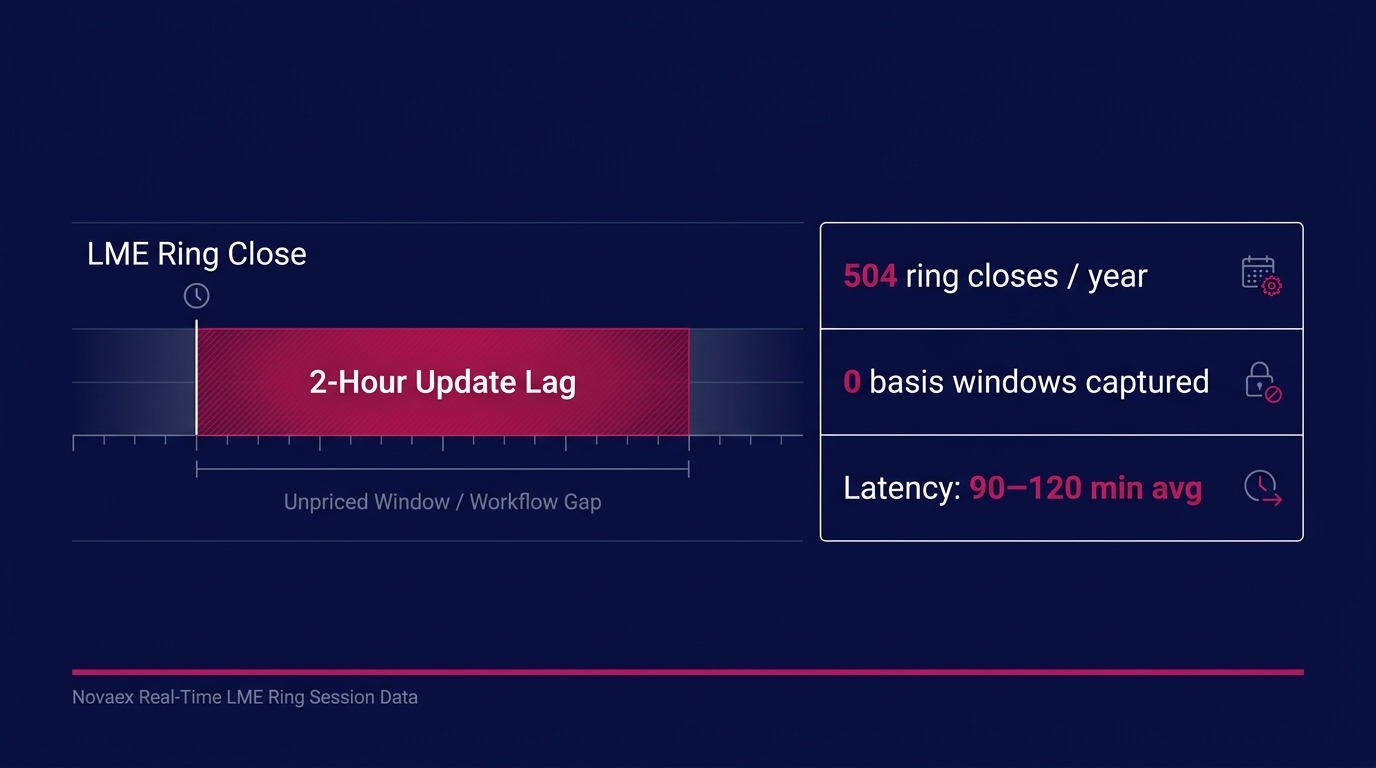
Real-time LME ring session data eliminates the two-hour post-session manual update cycle that delays hedge execution into the next trading window. The LME ring produces official prices that set the basis for your hedges. Each minute of update latency represents a period during which your position is unpriced, your risk is unquantified, and your execution window is narrowing.
Most metals trading operations treat the post-session lag as a workflow constant. The ring closes, back-office processes run, the system is updated, and the decision is made, sometimes 30 minutes later, often two hours. The LME's session architecture, however, does not pause while that reconciliation is underway.
This analysis identifies the two-hour delay as a documented cost, quantifies its downstream consequences in missed basis windows, next-session carry exposure, and documentation gaps. It explains how real-time LME ring session data functions as a structural correction, not a product feature.
The Two-Hour Post-Session Delay Is a Documented Workflow Tax
The post-session manual update cycle is one of the most widely tolerated inefficiencies in metals trading infrastructure. Front-office teams at mid-market metals firms routinely spend 90 minutes to two hours reconciling LME settlement data after each ring session before positions can be accurately repriced. This figure represents both a time cost and a risk interval.
According to the LME's published ring schedule, official pricing is established during specific ring sessions throughout the trading day, not at end of day. A platform built on end-of-day data ingestion is structurally behind every time a ring closes, regardless of how efficiently the back-office team operates.
The delay is not simply administrative latency. It is an unpriced interval: a period during which physical and financial positions cannot be accurately netted because the reference price is not yet reflected in the system. In a market where LME copper can move $50 to $150 per tonne intraday, according to LME historical volatility data, that interval carries real and calculable cost.
What causes the two-hour delay after LME ring sessions?
The delay originates from a three-stage data pipeline: extraction from the exchange feed, transformation into the platform's position schema, and validation before the data surfaces to traders. Each stage introduces latency. In manual workflows, a single data discrepancy can pause the entire pipeline while a back-office team resolves it. This often happens during peak trading hours when resolution speed matters most.
The result is a documented gap between when the ring prices and when the system reflects that price. For a desk running active basis positions, that gap is not a processing inconvenience. It is a risk interval with a measurable opening and a compounding cost.
The LME Ring Architecture and Why Timing Is Non-Negotiable
The LME has operated its ring-based price discovery mechanism for over 145 years. LME ring history and structure The ring is not ceremonial. It is the mechanism through which official prompt-date prices are established for copper, aluminium, zinc, nickel, lead, tin, and cobalt, and those prices are used as reference benchmarks for contracts, warrants, and physical settlement globally.
According to the London Metal Exchange, the ring schedule runs two full rounds of official sessions each trading day, with kerb trading following the second ring. Official prices are not a single daily event. They are a sequence of tightly timed closes that occur throughout the trading day.
How long does the LME ring session last?
Each individual ring session lasts five minutes per metal. The full morning ring cycle runs from approximately 11:40 AM to 1:20 PM London time, with a second afternoon ring from approximately 3:10 PM to 5:00 PM. Including kerb trading, the LME's price discovery activity spans a four-to-five-hour window each trading day.
This architecture means a platform that cannot surface ring session data in real time requires traders to work with the last known price rather than the current official price, creating compounding basis error across every position on the book.
With approximately 252 trading days per year and two official ring cycles per day, the LME produces 504 official ring closes annually. Each one is a discrete decision point. Each one a platform misses due to update latency is a forfeited window, not a delayed one.
Quantifying the Annual Cost: How Many Hedging Windows Does Your Workflow Forfeit?
Every metals trading operation should run this calculation. The resulting figure is operationally significant, which may explain why it is rarely formalized in infrastructure reviews.
A basis window is the period immediately following a ring close during which the spread between your physical price and the LME official is most accurately quantifiable and most executable. According to commodity risk management practitioners, basis windows on active metals positions typically remain favorable for 60 to 90 minutes after ring settlement, before intraday carry movement erodes the spread. basis risk in metals hedging
A two-hour manual update cycle eliminates that window entirely. The calculation is direct:
- 504 ring closes per year (252 trading days × 2 official ring cycles)
- Two-hour delay per close under manual update workflows
- Basis windows lasting 60, 90 minutes post-close
- Result: 504 missed basis windows annually. That means every available window.
How does post-session lag affect basis risk?
Post-session lag creates an unpriced interval during which physical and financial positions cannot be accurately netted because the official reference price is not yet in the system. According to ISDA documentation on commodity hedge accounting, accurate basis documentation at hedge inception requires contemporaneous price observation. A two-hour lag creates a documentation gap that can directly affect hedge effectiveness designations under IFRS 9 and ASC 815.
Beyond accounting implications, the unpriced interval creates execution risk. If a counterparty calls during that window, the desk is pricing off memory or approximation, not the official ring close. On a 1,000-tonne copper position, the difference between an approximation and the official close can represent a material basis error before a single additional market movement is factored in.
Where the Liability Compounds: Manual Workflows Under Load
Manual update workflows do not fail at a uniform rate. They fail under load, specifically during periods of high volatility, when ring sessions produce large price movements that require immediate review and reconciliation.
According to operational research on commodity trading desks, front-office teams report that data reconciliation time increases by 40 to 60 percent on high-volatility days. The workflow tax is not fixed. It is inversely correlated with ideal execution conditions: the days when the delay costs the most are precisely the days when the delay grows longest.
Consider a desk running copper hedges against physical inventory. A ring closes with a significant basis move. The correct action (executing a basis trade or adjusting a hedge ratio) requires knowing the official close. If the platform needs 90 minutes to reflect it, and the next ring closes in 90 minutes, the ability to respond to that price move is forfeited entirely. The unhedged interval carries into the next session at a cost that is structural, not incidental.
What is next-session carry risk in metals hedging?
Next-session carry risk arises when a hedging decision deferred by data latency must be executed at the open of the following ring cycle, against a price that has already incorporated overnight movement or inter-session carry. In contango markets, every session of delay costs the spread between prompt and forward prices. In backwardated markets, the cost structure inverts, but the decision timing remains compromised regardless of market structure.
According to LME published data on historical 3-month to cash spreads for copper, the average daily carry movement in recent years has ranged from $0.50 to $8.00 per tonne depending on prevailing market structure. For a 1,000-tonne position, a single session of deferred execution can represent $500 to $8,000 in carry cost, even before accounting for any directional price movement. Multiplied across an active hedging calendar, the annual carry cost of systematic delay becomes a quantifiable line item. LME carry structure and prompt dates
Real-Time LME Ring Session Data Is a Structural Correction
Framing real-time data as a "feature" (something added to a platform to expand its capability) mischaracterizes the problem and its solution. Real-time LME ring session data is not an enhancement to an existing workflow. It is the correction of a structural timing liability that the delayed workflow creates.
The distinction matters operationally. A feature can be adopted or deferred based on preference and budget. A structural correction addresses a documented flaw in the current architecture. The two-hour manual update cycle is that flaw. Real-time ring session data removes it by eliminating the latency-dependent step, not by accelerating it.
When a system reflects ring session closes as they occur, the workflow changes at the architecture level:
- Positions are priced continuously, not in batches after session close
- Basis calculations are available at the moment of decision, not 90, 120 minutes later
- Hedge execution windows are captured, not forfeited to reconciliation time
- Documentation is contemporaneous, not reconstructed post-delay with timestamp gaps
- Volatility events trigger immediate review, not queued processing during peak load
What is the difference between ring session data and end-of-day data?
Ring session data captures official prices at the close of each individual ring. These prices drive contract settlement, warrant pricing, and basis calculations for active hedges. End-of-day data captures a single consolidated close. For a desk running intraday basis hedges or managing prompt-date positions across multiple metals, end-of-day data is structurally insufficient: it provides one observation where ring session data provides up to 504 per year, each one actionable.
The distinction is not data volume. It is decision timing. End-of-day workflows assume all relevant decisions can wait until market close. Ring session workflows reflect the actual structure of LME pricing: a sequence of discrete closes, each one representing a moment of maximum basis observability and minimum execution uncertainty. Only one of those assumptions aligns with LME market architecture.
How Novaex Delivers Real-Time LME Ring Session Data
Novaex was designed around a specific operational premise: that accurate, timely hedging decisions in base metals require a platform built from the metal's pricing architecture outward, not a generic commodity system adapted to include LME data. Novaex depth-first methodology The platform's real-time LME ring session data capability is not an API layer added to a general-purpose commodity system. It is the architectural foundation of a metals-first design.
The approach is depth-first: master the LME ring structure, the prompt date calendar, the official and unofficial price relationships, and the carry mechanics across copper, aluminium, zinc, nickel, lead, tin, and cobalt before addressing any other exchange or commodity. That discipline produces a system where ring session data flows directly into position calculations without a manual reconciliation step between close and decision.
For a front-office metals trader, the operational outcome is direct: when Ring 2 closes at 5:00 PM London time, positions are priced, basis is calculated, and the hedging decision window is open, not queued for processing by a back-office team.
According to Novaex analysis, firms that transition from post-session manual update workflows to real-time ring data integration reduce post-session decision latency from 90, 120 minutes to under 60 seconds. That figure represents the elimination of the delay as a workflow variable, not an incremental improvement to it.
The platform integrates real-time ring session data with:
- Position management across physical and financial legs, updated at each ring close
- Basis analytics calculated against the current official ring price, not the last available approximation
- Risk reporting that reflects current exposure, not exposure aged by reconciliation lag
- Hedge ratio calculations that update with each session close rather than accumulating error across a two-hour interval
From Workflow Tax to Workflow Infrastructure
The two-hour post-session delay is not a technology limitation requiring tolerance while better options mature. It is an infrastructure decision that can be reversed. The downstream consequences of reversing it are calculable before a single contract is signed.
For a desk running active base metals hedges, the transition from delayed to real-time ring session data produces three measurable changes:
- Basis execution precision improves because decisions are made against the official close, not an approximation aged 90 minutes into the post-session interval
- Annual hedging windows captured increases from near-zero under delayed workflows toward the full 504 available ring closes per year
- Documentation integrity improves because price observations are contemporaneous with decision timestamps, supporting hedge effectiveness testing under IFRS 9 and ASC 815 without reconstruction gaps
According to commodity risk practitioners, the first-year operational benefit of eliminating post-session data lag is typically realized within the first quarter, as basis execution timing improves and next-session carry costs from deferred decisions are reduced. [LINK: CTRM platform ROI metals trading]
Conclusion
The two-hour post-session manual update cycle is a documented timing liability that compounds across 504 annual ring closes, erodes basis precision on every active position, and creates an unpriced interval that carries real cost in both stable and volatile markets. It is not an unavoidable feature of metals trading operations. It is a consequence of infrastructure built for end-of-day workflows in a market that prices in real time.
Real-time LME ring session data removes that liability structurally, not by accelerating the manual workflow, but by replacing the latency-dependent step with continuous position pricing that reflects each ring close as it occurs.
Three steps to assess your current exposure:
- Calculate your annual forfeit: Multiply your average post-session update time in hours by 504 ring closes per year. If that number exceeds one hour, you are forfeiting measurable basis windows on a documented, recurring schedule.
- Audit your documentation gap: Review the timestamp difference between ring close and your last confirmed hedge decision on five recent trading days. That gap is your timing liability, expressed in minutes and dollars.
- Evaluate your infrastructure architecture: Determine whether your platform is built on end-of-day data ingestion or real-time ring session data. If the former, the correction is a platform decision, not a configuration or workflow one.